
Here’s one of the first secrets unlocked for a mystery novel: There are mandatory
characters you need to set your mystery in motion.
The Mandatory Mystery Crew
You can’t have a mystery without a crime, and you can’t have a crime without the core
cast. These characters form the required foundation of your story:
- Victim: Without a victim, there is no crime. They may or may not be dead when
- the story begins.
- Sleuth: The character who investigates the crime: your professional or amateur
- detective.
- Multiple Suspects: You need more than one character who could have done it. At least a few of these need to have the opportunity to commit the crime. Otherwise, the mystery is solved too quickly.
- Motive: Each suspect must have a reason why they are a suspect.
- Culprit (Antagonist): The character
Once you have your mandatory characters, you can fill out the rest of your cast with supporting players, such as a sidekick, a mentor, multiple victims or antagonists, experts, or characters who provide local color.
The Protagonist Rule: Why One is the Magic Number
One of the most fundamental principles we stress is this: A story can only have one protagonist.
This isn’t just an arbitrary rule; it’s about engaging the reader. The protagonist is the central character whose journey the reader follows and whose goal drives the entire plot. Readers need a single entity to connect with and root for. If they don’t know who to cheer for, they’re likely to lose interest.To help writers focus their energy, we identified three types of protagonists:
- Single Protagonist: The most straightforward, where one main character drives the plot toward a clear goal.
- Combined Protagonist: Two main characters who share the exact same story goal and stakes. If an event helps one, it helps the other; if it hurts one, it hurts the other. They must have distinct personalities to create necessary friction.
- Group Protagonist: Three or more characters who work together to achieve the central story goal (like a heist team or a community). While individual characters may experience events differently, the group as a whole is either moving closer to or farther away from the main goal.
Defining this pivotal character is the first step in crafting an effective skeleton blurb for your mystery. For those of you not familiar with a skeleton blurb, it is a simple sentence that captures the heart of your story. Using only the protagonist, the story goal, and the story stakes, you can create a sentence that you can use as a touchstone for every scene in your story. I’ll write more about this in the near future.
I’m sure you already have ideas for your protagonist.
Want to dive deeper into story structure, learn how to weave in powerful subplots, and plant the perfect clues and red herrings?
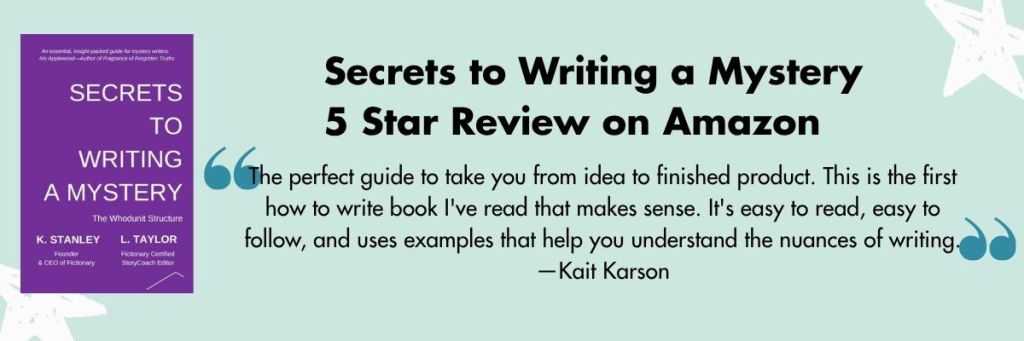
Secrets to Writing a Mystery provides a full framework to support your creativity and set you up to write a commercially successful mystery novel. If you can’t wait for the next blog post, our book is available now to help you solve your own mystery and write your book.

Until next time, Lisa.

From the moment the children’s librarian walked a young bookworm upstairs to the Adult Department and introduced her to the mystery section…Lisa Taylor has been hooked on the genre.
For years, Lisa was an educator and librarian, honing her skills in helping readers and writers develop with curiosity and creativity. Now as an editor and writing coach, Lisa works with a small publishing house as well as being a Fictionary Certified StoryCoach Editor and Certified Instructor.
Secrets to Writing a Mystery is Lisa’s first published book. Along with editing and coaching, she is currently writing an amateur cozy mystery series set in Northern Ontario.
Want to Learn to Self-Edit?
Join the Fictionary School for Writers and Editors

Discover more from Kristina Stanley
Subscribe to get the latest posts sent to your email.

