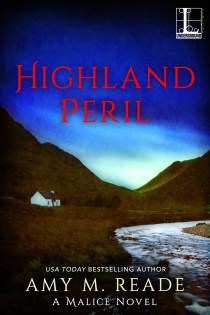
 Today, we are celebrating tomorrow’s release of Highland Peril by author Amy Reade. Congratulations, Amy!
Amy hosts a fabulous blog called Reade and Write. Today she’s talking to us about one of my favorite subjects: SETTING.
Setting the Scene
by Amy Reade
Whether I’m on a panel or at a book signing or visiting a book club, one of the questions I’m frequently asked is whether I consider setting to be a character in my books. I get the question so often that I’ve started putting it in the back of each book as one of the discussion topics.
Here’s my short answer (and yes, I’m answering a question with another question): would the book be the same if it were set someplace else? If no, then I would consider the setting a character. If yes, then setting is probably not one of the characters, however important it may be.
Novels with a strong setting tend to be my favorite books. The main reasons I read are to learn and to be entertained. When a book has a strong atmosphere and sense of place combined with a strong plot, not only do I lose myself in the story, but I also get the opportunity to learn about a new place (or learn more about a place I already know). This is even true for places that don’t actually exist, such as a fantasy world or a fictional town. Two examples that immediately spring to mind are Hogwarts (from J.K. Rowling’s Harry Potter series), and Loch Dubh (from M.C. Beaton’s Hamish Macbeth series).
So how can a setting be a character? Let’s break down some of the qualities of well-drawn characters. Such characters generally have at least three components: personality, emotion or lack thereof, and the ability to change or move the plot along.
In some books, setting has those same three characteristics. Personality, emotion, and ability to move the plot forward can be indefinable when applied to a place rather than a person, but they are easily understood through examples.
Just as with a human character, a setting’s “personality” is its essence. Personality includes a place’s heritage, its culture, its climate; in other words, its specialness. Take, for example, a book set in New Orleans. New Orleans is a place of music, of storied cuisine, and of sultry heat. In any book I’ve ever read that takes place in New Orleans, at least one of those three components are essential to the plot. Such a book could never be set in Chicago without losing its essence.
And how about emotion? In much the same way a human character expresses emotion, a setting can be cheerful, spooky, stormy, listless, or almost any other adjective you can think of. This notion can be applied equally to any setting: towns and cities, houses, islands, boats, schools, hospitals, mountain tops, etc. You get the point.
When I think of a setting’s emotion, often what comes to mind is weather. Weather can play a huge role in a story—think of how wintry weather and blizzard conditions can affect the outcome of a particular plot. That same plot isn’t going to work as well if it’s set in a place where there are no blizzards; in other words, the frigid, blizzard-prone setting is essential to the story.
And when it comes to moving the plot forward, setting has the ability to do that as well as any character. In my first novel, Secrets of Hallstead House, the main character, Macy, can’t swim. The setting of the story is the Thousand Islands region of northern New York, on an island. When a person who can’t swim is put on an island, you can imagine the dread that can develop. And that story couldn’t have taken place, say, on a busy barrier island along the eastern seaboard—it had to take place on a small, isolated island in a region where the weather can be harsh and unpredictable. Just like a human character. There are several instances in Secrets of Hallstead House in which the direction of the plot is determined by the very nature of the island setting.
Now for my favorite part of this post. I’ve made a short list of some of my favorite books which feature setting as one of the characters. Though you may not be familiar with all of them, you are no doubt familiar with most of the titles. I am confident you’ll agree that setting is one of the main characters in each of these books. Remember, ask yourself this question: could this story have taken place anywhere else without losing its very essence?
To Kill a Mockingbird by Harper Lee and Gone with the Wind by Margaret Mitchell: the setting is an absolutely essential part of each of these books, both of which take place in the American south. I would go so far as to say these books wouldn’t even exist if it weren’t for the American south.
Rebecca by Daphne du Maurier: the setting of this book, the Cornish coast of England, is reflected in every action the characters take. Just like the characters, the cliffs and moors, the mansion, and the grounds in Rebecca are stormy, moody, and dark. The book would be fundamentally different if it took place anywhere else.
Heidi by Johanna Spyri: everyone knows the story of the little girl who went up the mountain to live with her gruff grandfather. The mountain is as important to the book as the main characters: Heidi loves the mountain just as she loves her grandfather and her friend Peter; the mountain provides a stark and necessary contrast to the bleak city where she lives temporarily. The story just wouldn’t be the same if Heidi lived in an area that was simply rural without being mountainous.
From the Mixed-Up Files of Mrs. Basil E. Frankweiler by E.L. Konigsburg: if you’re not familiar with this book, the majority of the action takes place in the Metropolitan Museum of Art in New York City. The main characters, a brother and sister, run away from home and live in the museum for a time, trying to solve a mystery they find there. Whenever I think of this book, it’s the museum that comes to mind, not the human characters, not the mansion in the suburbs where they find someone who helps them in their quest, not the streets of New York City. It’s the museum—a setting-character if ever there was one.
Black Amber by Phyllis A. Whitney: this book, probably my favorite of Whitney’s works, is set in Turkey. The plot and setting are inextricably linked—you can’t have one without the other. The story wouldn’t be the same if it were set in, say, Michigan (not that there’s anything wrong with Michigan).
Finally, to my new book, Highland Peril, which comes out tomorrow. As in all my novels, the setting in Highland Peril is one of the book’s most important elements. The main characters live in a little village called Cauld Loch, and though I had to send them to London and Edinburgh for short stints, they always return home to the Highlands. The beauty, the majesty, and the rugged landscape are as important to the story as any character. If you get a chance to read the book, I hope you’ll agree.
Please share your thoughts about books with setting-characters. What are your favorites? Which ones stick in your mind?
Kristina, thank you so much for having me here today. I love the Mystery Monday posts because they make me think, and I hope I’ve done that for your readers.
Who Is Amy Reade?
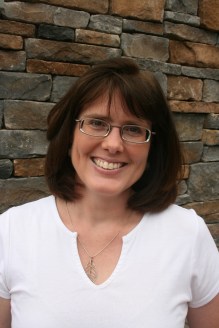 Amy M. Reade is a cook, chauffeur, household CEO, doctor, laundress, maid, psychiatrist, warden, seer, teacher, and pet whisperer. In other words, a wife, mother, and recovering attorney. But she also writes (how could she not write with that last name?) and is the author of The Malice Series (The House on Candlewick Lane, Highland Peril, and Murder in Thistlecross) and three standalone books, Secrets of Hallstead House, The Ghosts of Peppernell Manor, and House of the Hanging Jade. She lives in southern New Jersey, but loves to travel. Her favorite places to visit are Scotland and Hawaii and when she can’t travel she loves to read books set in far-flung locations.
Where Can You Find Amy?
Website: www.amymreade.com
Blog: www.amreade.wordpress.com
Facebook: www.facebook.com/amreadeauthor
Facebook: www.facebook.com/groups/AmyMReadesGothicFictionFans
Twitter: www.twitter.com/readeandwrite
Pinterest: www.pinterest.com/amreade
Instagram: www.instagram.com/amymreade
Amazon Author Page: https://www.amazon.com/Amy-M.-Reade/e/B00LX6ASF2/ref=ntt_dp_epwbk_0
Goodreads Page: https://www.goodreads.com/author/show/8189243.Amy_M_Reade
And Finally, Where Can You Buy Highland Peril?
Amazon: http://amzn.to/2uaP5dq
Barnes & Noble: http://bit.ly/2uzgzcD
Kobo: http://bit.ly/2v9ooHB
Google Play: http://bit.ly/2vKh6Hh
iTunes: http://apple.co/2ePwnTf
Independent Bookstore: http://www.indiebound.org/book/978151610018
Thanks for reading…



 Will Macmillan Jones lives in Wales, a lovely green, verdant land with a rich cultural heritage. He does his best to support this heritage by drinking the local beer and shouting loud encouragement whenever International Rugby is on the TV. A just turned sixty lover of blues, rock and jazz he has now fulfilled a lifetime ambition by filling an entire wall of his home office with (full) bookcases. When not writing, he is usually lost with the help of a satnav on top of a large hill in the middle of nowhere, looking for dragons. He hasn’t found one yet, but insists that it is only a matter of time.
 Donna Galanti is an Author, Speaker, and Book Marketing Consultant!


 Thank you,






 Lyn Horner resides in Fort Worth, Texas, with her husband and several very spoiled cats. Trained in the visual arts, Lyn worked as a fashion illustrator and art instructor before she took up writing. She loves crafting passionate, action packed love stories, both historical and contemporary. Her Texas Devlins series blends Old West settings, steamy romance and a glimmer of the mysterious. This series has won multiple awards and nominations.
![Pageflex Persona [document: PRS0000038_00074]](https://kristinastanley.com/wp-content/uploads/2017/09/lynhorner_profilingnathan_800px.jpg?w=204&h=306) Nathan Maguire just wants to make a living inking tattoos in steamy Tampa, Florida, but a serial killer is murdering young women near his shop. Latino gangbangers are giving him trouble. On top of all that, he’s a covert Guardian of Danu sworn to protect one of seven ancient scrolls containing apocalyptic prophesies.
Nathan Maguire just wants to make a living inking tattoos in steamy Tampa, Florida, but a serial killer is murdering young women near his shop. Latino gangbangers are giving him trouble. On top of all that, he’s a covert Guardian of Danu sworn to protect one of seven ancient scrolls containing apocalyptic prophesies.