Before You Submit: Who or That

Do you have a draft of your novel or short story and are thinking of submitting to an agent, publisher or writing contest? My series called Before You Submit might help. This series contains hints and tips I’ve received from professionals in the publishing industry. Each week I’ll share a new tip.

This week I’ll write about the use of who.

I’m loving going through my old notes from an editor. I mean, if can’t laugh at myself and the silly mistakes I made in the early days of writing, what’s the point. Writing should be fun, at least some of the time, maybe even most of the time. Even the hard work of editing can be fun.

Now, to the topic of Who or That, and what I needed to know. Here’s the sentence I wrote:

“I’ll need a list of everyone that had the combination to the safe.”

Yikes. Did you catch the error? The sentence should read:

“I’ll need a list of everyone who had the combination to the safe.”

Funny enough, who is used when referring to people. Every little correction makes the novel a better read. Thank you to the editor who pointed this out to me.

I hope this helps improve your writing.

See Before You Submit:Likeable Characters for the first blog in this series and an introduction the benefits of submitting even if you get a rejection letter.

Thanks for reading…

Farley’s Friday: The Case of The Disappearing Ball

Farley here,

Do you know where my ball went?

Kristina lobbed it over my head and across the field. What I don’t understand is why she threw the ball when I was still on leash. I don’t think she was paying attention. She tossed it. I ran. She fell when I jerked the leash.

I looked back for a second, just to check she was okay, and then kept running. I had my eye on the bright orange ball as it flew through the air. I was concentrating hard. And then . . . in an instant it disappeared.

No matter how hard I searched, I couldn’t find it.

Lost Ball

Can someone mail me another ball? By the way, Kristina wasn’t hurt during the production of this blog.

Woof Woof.

Before You Submit: The Use of ‘That’

Do you have a draft of your novel or short story and are thinking of submitting to an agent, publisher or writing contest? My series called Before You Submit might help. This series contains hints and tips I’ve received from professionals in the publishing industry. Each week I’ll share a new tip.

This week I’ll write about the use of that.

My editor thought ‘that’ should only be used if it was needed to keep the meaning of the sentence clear. Here’s an example of where it’s not needed.

Kendra smelled the odour of sweat coming from the ski boots that were resting askew on the floor.

The easy fix my editor recommended was to remove ‘that were’ from the sentence. The new sentence becomes:

Kendra smelled the odour of sweat coming from the ski boots resting askew on the floor.

I think the editor was reminding me to cut back on words. There are many places on the internet to get find the detailed rules, but I thought a quick example would give you something to check for in your writing.

I hope this helps improve your writing.

See Before You Submit:Likeable Characters for the first blog in this series and an introduction the benefits of submitting even if you get a rejection letter.


Thanks for reading . . .


Farley’s Friday: Loneliness

Farley here,

Boo Hoo. I’m lonely this week. Finn left me. You remember him? He’s the Icelandic Sheepdog who lived with us for two weeks. He went back to Calgary, where ever that is. I thought he’d moved in with us for good. Sometimes my peeps don’t explain things very well. Kristina still thinks I understand full sentences. Finn did bark that he missed the city, so I guess he needed his own life back with his peeps.

Now I have to play with the ball my myself.  I carry it around and give Kristina my most pathetic look. She won’t wrestle with me for the ball, she won’t chase me across the snow, and she won’t bite the ball and try to pry it out of my mouth.

Lonely

Someone send me another dog.

Woof Woof.

Before You Submit: Dialogue, Narrative and Repetition

Do you have a draft of your novel or short story and are thinking of submitting to an agent, publisher or writing contest? My series called Before You Submit might help. This series contains hints and tips I’ve received from professionals in the publishing industry. Each week I’ll share a new tip.

This week I’ll write about Dialogue, Narrative and Repetition.

Combining dialogue and narrative is where style, or dare I say art, comes into your writing. 

We all know you don’t want to bore the reader with repetition, but sometimes it’s easy to do without even noticing. I tend to repeat something in narrative that I’ve already said in dialogue.

Here’s what the editor didn’t like in one of my manuscripts:

“You have a choice to make,” Sarah said. “You can walk away right now, or  I’ll call the cops and see what they have to say about the drugs.” Sarah stood her ground.

The editor recommended removing ‘Sarah stood her ground.’ Her thought was that it was obvious Sarah was standing her ground. The dialogue indicated this, and there was no need to hit the reader over the head with it.

Her overall point, if you repeat things, make sure you have a reason to. You might repeat for style or for emphasis, but don’t repeat for filler.

To figure out if you have a similar problem, you can analyze your writing, checking for areas of repetition, or you can ask someone else to read your work and check for you. A reader other than myself can often see things I can’t, so I like asking for help on this one.

I hope this helps improve your writing.

See Before You Submit:Likeable Characters for the first blog in this series and an introduction the benefits of submitting even if you get a rejection letter.

Thanks for reading . . .


Farley’s Friday: Dogs and Coyotes

Farley here,

The song of coyotes reaches my ears for this first time this winter. Their barking, howling, and yipping echoes around me. A pack is crossing the range on the other side the golf course. They’re barreling through the trees, probably chasing something.

Finn picks up on the noise, and with alert ears and nose,  checks for their scent. He’s a city dog and can’t tell the pack is far away. I don’t react much. Call me Mr. Cool.

Coyote check

Finn makes a move, as if to cross the golf course and chase the forest beasts, but Kristina tells him to stay.

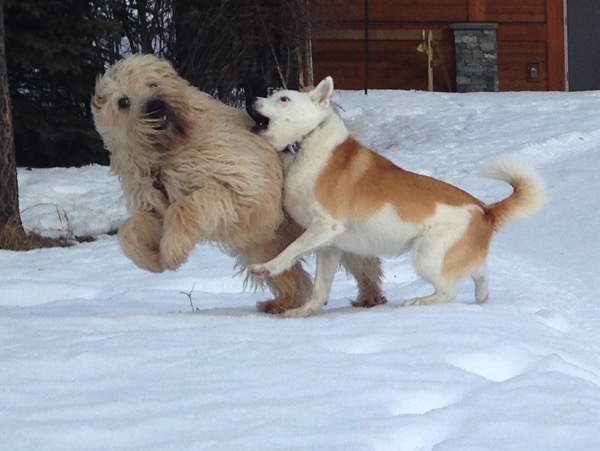
He can’t take the excitement and attacks me instead.

Crazy dogs

Finn’s a goof, but I’m starting to get attached to him. Soon his humans will come and take him away. Bummer. I want him to stay and live with us.

Woof Woof

Before You Submit: Run-on Sentences

Do you have a draft of your novel or short story and are thinking of submitting to an agent, publisher or writing contest? My series called Before You Submit might help. This series contains hints and tips I’ve received from professionals in the publishing industry. Each week I’ll share a new tip.

This week I’ll write about Run-on Sentences.

Was I embarrassed when an editor corrected a line a narrative by commenting that it was a run-on sentence, and I didn’t know what a run-on sentence was? You bet. I had to look it up.

Basically a run-on sentence occurs when two or more independent clauses are connected without the correct punctuation or coordinating conjunction.

Here is an example of what not to do.

After the avalanche, Darren changed, he’s been getting into fights at the bar.

As you can see, I liked commas at the time. 🙂

The corrected version is:

After the avalanche, Darren changed. He’s been getting into fights at the bar.

The second comma changed to a period. The second sentence starts with a capital letter.

Everyone has to start somewhere, and I was lucky to have an editor who took the time to correct my writing during my early days of crafting a novel.

I hope this helps improve your writing.

See Before You Submit:Likeable Characters for the first blog in this series and an introduction the benefits of submitting even if you get a rejection letter.

Thanks for reading . . .

Farley’s Friday: Snowball fights

Farley here,

My FFL Finn has been here since Wednesday. He’s an Icelandic Sheepdog and knows all kinds of games. Dogs in Iceland must really like games.  I just found out what a snowball fight is.

Kristina throws a ball at my face. I look at her as if she’s crazy. I have no idea what she wants me to do.

Farley Curios

Kristina throws a snowball at Finn’s face. He catches it.

Finn Farley Snowball

Can you see the snowball in his mouth? I’m getting the idea of what’s expected of me.

Kristina throws a snowball in between us and look what happens!

Dogs

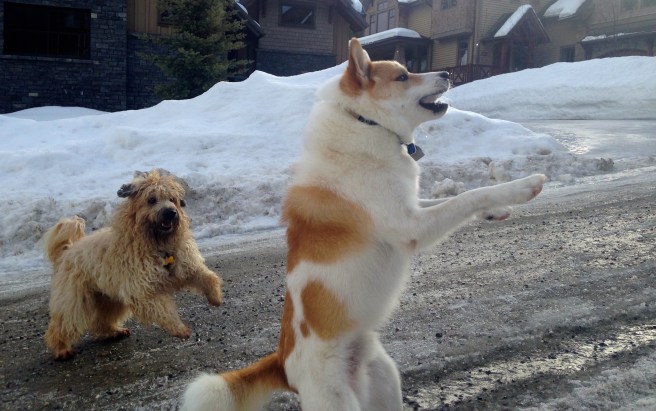
Finn is poised and ready. He’s concentrating on the snowball. I fly into the air. I just don’t know why.

Can you guess who caught it?

Woof Woof


Lesson Seventeen from a Manuscript Red Line: Who are we talking to?

Before You Submit: Do you have a draft of your novel or short story and are thinking of submitting to an agent, publisher or writing contest? My series called Before You Submit might help. This series contains hints and tips I’ve received from professionals in the publishing industry. Each week I’ll share a new tip. This week, I’m reblogging a post from Jennifer Eaton. She’s talking about how to start a scene and let the reader know who has the point of view. Her explanation is so clear, I thought I’d share it with you. Thanks Jennifer 🙂

Jennifer M Eaton's avatarJennifer M Eaton


For an intro into where these tips are coming from, please see my post: A Full Manuscript Rejection, or a Gold Mine?  You can also click “Rant Worthy Topics” in my right navigation bar.  Choose “Gold Mine Manuscript” to see all the lessons to date.

We’ve been on Point of View for a little while now.  No need to break a trend.  This particular publisher harped on it a lot, so here I am passing their wisdom on to you.  The next POV comment they made was to make sure it is immediately obvious when you start a chapter whose POV you are in.

I was a little surprised by this.  One of the things that I admired in the Gold Mine Manuscript, was the beautiful imagery.  The author is so much better at building the “view” of the scene for a reader than I am.  The problem…

View original post 175 more words