5 Ways to Hook Your Reader In Every Scene

Many writing books talk about the importance of the first line, first paragraph and first page of a novel.

If you don’t grab the reader early in your novel, you might lose them for good. Taking that thought and applying it to each scene means evaluating the entry hook for each scene.

There’s a lot of pressure on a writer to produce an extraordinary first line for a novel.

But as with most things, practice will make you better. So start practicing now with the first line of every scene in your novel. By the time you’ve evaluated every scene looking for the entry hook, and maybe rewriting the scene opening for a few, you’ll be ready to go back and rework the first line of your novel.


What Is A Scene Entry Hook?

How many times have you read a book, were a little tired, and not sure if you wanted to start the next scene or chapter? You might read the first few lines of the next scene and then decide to keep reading.

Whatever you read at the beginning of the scene that kept you reading was the scene entry hook.


5 Ways To Hook Your Reader

When creating an entry hook, consider:

  1. Starting in media res
  2. Foreshadowing trouble
  3. Using a strong line of dialogue
  4. Raising a question
  5. Not wasting words on extraneous description.

Alternate Your Technique

Alternate your technique so the reader doesn’t get bored. If you don’t know what the hook is or why the reader would keep reading the scene, think about rewriting the scene opening.

Sometimes you might find you’ve started the scene too early. Look at cuttingthe beginning of the scene until something exciting happens.

If there is description you need, move it to later in the scene if you can. You might just need a little reorganizing of the scene to make the opening sizzle.


How Fictionary Can Help You

Fictionary is a new interactive web app for self-editing fiction that helps writers turn a first draft into a story readers love.

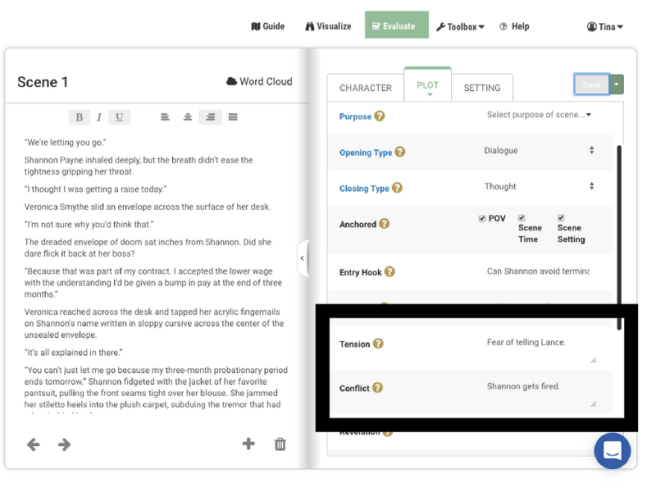
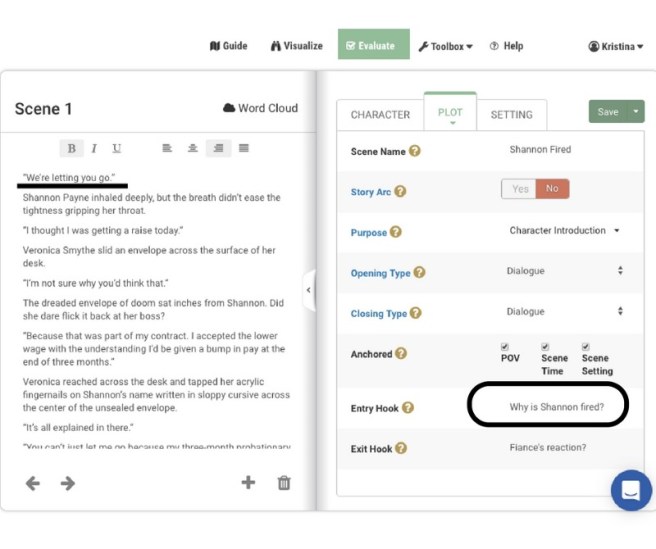
Below is the opening scene from Look The Other Way (by Kristina Stanley).

The “Entry Hook” key element makes me evaluate each scene and think about whether I’ve used a good entry hook. If I haven’t, then I need to rewrite the opening.

The entry hook is the first line of dialogue. “We’re letting you go.” leaves the reading wondering who is being fired and why.

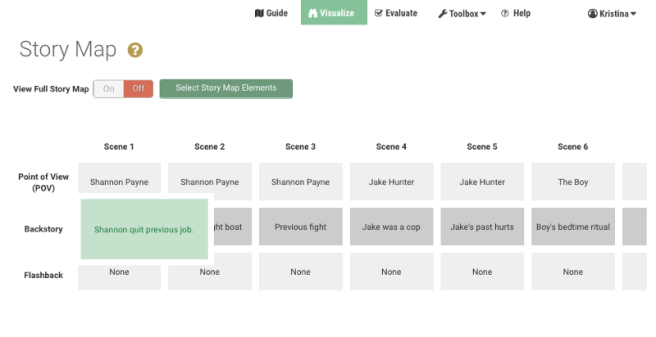
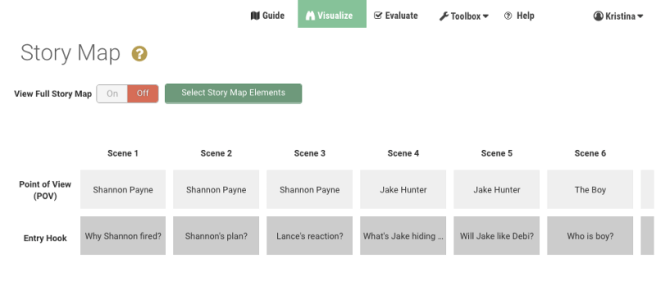
In Fictionary, you can use the Story Map so evaluate key elements of fiction throughout your story.

Here, I’ve chosen just the point of view character and the entry hook to be shown in the Story Map. This way I can evaluate how I’m drawing a reader into each scene.

Your challenge is to ask yourself if every scene in your novel is has an entry hook.


Post written by Kristina Stanley, author of Look The Other Way (Imajin Books, Aug 2017).

Kristina Stanley is the best-selling author of the Stone Mountain Mystery Series and Look The Other Way.

Crime Writers of Canada nominated DESCENT (Imajin Books, July 2015) for the Unhanged Arthur award. The Crime Writers’ Association nominated BLAZE (Imajin Books, Oct 2015) for the Debut Dagger. Imajin Books published her third novel in the series, AVALANCHE, in June 2016.

Luzifer-Verlag published Abwaerts (Descent) in Germany in the fall of 2017.

Her short stories have been published in the Ellery Queen Mystery Magazine and The Voices From the Valleys anthology. She is the author of THE AUTHOR’S GUIDE TO SELLING BOOKS TO NON-BOOKSTORES.

Her short story, WHEN A FRIENDSHIP FAILS, won the 2014 Audrey Jessup with Capital Crime Writers.

Kristina is the CEO of Fictionary, and all of her books were edited using Fictionary.


Why not check out Fictionary’s free 14-day trial and turn your draft into a story readers love?

Mystery Mondays: Haris Orkin on Finding Ideas

Today we welcome Haris Orkin. His novel You Only Live Once, was published by Imajin Books on March 21st. So it’s hot off the press, as they say. In addition to being an author, Haris is and playwright.

Over to Haris…

James Bond is Barking Mad

by Haris Orkin

Aspiring writers often ask me where I get my ideas. I don’t always have an answer for them on the spot. I’ll be glib or I’ll deflect, but in fact, it’s a very good question. Even though “You Only Live Once” is my first novel, I’ve been making a living as a writer for thirty years.

I’ve written radio and TV commercials for some of the largest companies in the world. I’m a produced playwright and screenwriter and for the last ten years I’ve been writing and designing video games. So I’m always generating ideas. Always. Sometimes I hesitate to delve too deeply into my process. I worry that if I pull it apart I may not be able to put it back together. I like the fact that my process seems mysterious and I trust that ideas will come to me, but the truth is the way I work is not all that complicated or mystical.

I’m a watcher, a reader and a listener. I’m endlessly curious and love eavesdropping on people’s conversations. (Okay, that sounded a little creepy.) I’m always reading newspapers and magazines and watching documentaries. I love movies and TV shows and my taste is incredibly eclectic.

It’s all grist for the mill. Those influences then collide with whatever internal conflict going on at the moment. (And I always have some internal conflict going on.) Writing is a way for me to work out those conflicts: a way to have a conversation with myself and the world.

Here’s an example.

When I found out I was going to be a father 28 years ago, I was happy and excited and terrified. My wife and I knew we were going to have a son and the prospect of impending fatherhood raised all kinds of questions and fears. What kind of example would I be? What would I teach my son? What kind of man was I? What kind of man would I like him to become?

It brought to mind my own childhood and the relationship I had with my own father. (And the relationship he had with his father.) With all those concerns and thoughts swirling around in my head, I started writing things down. It was a way to process my thoughts and feelings. Those thoughts and feelings eventually became a play that was performed in New York and at the La Jolla Playhouse in Southern California.

The play was called “Dada” and there was a scene in it that eventually became the spark that inspired “You Only Live Once.” The main character in the play, David, is an insecure father to be. He remembers a meeting he had with his guidance counselor when he was a junior in high school and it’s dramatized in the play.

The guidance counselor asks David what he wants to do when he graduates and he says doesn’t know. She pushes him, telling him, “Your grades are good. You’re clearly college material. You’ve always done well in math. Have you considered accounting?”

“My dad’s an accountant.”

“You want to follow in your father’s footsteps?”

“Definitely not.”

“Have you thought about actuarial science of the insurance industry?” Dave shakes his head, a painful look on his face. The counselor continues, “Well, there must be something that seems interesting to you. Isn’t there anyone you’ve read about or have heard of who has a career that seems the slightest bit intriguing?”

“Well, there’s one I guess, but it’s kind of dumb.”

“Why don’t you let me be the judge of that. You’re bright, you’re personable and if you apply yourself you probably could do most anything you want.”

“I want to do what James Bond does.”

“What?”

“James Bond. He gets to travel all over the world and drive really cools cars and he never has to sit in some dumb office and shuffle papers.”

“Very funny David,” she says as she sternly shuffles some papers. “But this is a serious question. What do you want to do with the rest of your life?”

Later in the play, grown up David has an imaginary conversation with James Bond and Bond confronts him on his choices, saying, “You settled. You gave up. You wanted to be me. How do you know you couldn’t have?”

“You’re not even real.”

“When you were fifteen I was more real to you than your own father. I embodied all your dreams. All your desires. You wanted to be suave and masterful and seductive and dangerous. You wanted men to fear you and women to fall all over you. Is that no longer true? Or do you know longer know what you want anymore.”

David stands up to him and says. “You kill people. You force people to have sex with you.”

“I have a license to kill and because I do I will brook no insolence from anyone. I take what I want and I do what I want and no one tells me how to live or what I can or cannot do.”

“But no one cares about you. And you don’t care about anyone else. What kind of life is that?”

“A life free of sticky and unnecessary encumbrances. To love is to allow someone inside so deeply the can cause you…unmentionable pain.” Bond’s eyes fill with tears. “Why give someone that power?”

David puts his arm around Bond and comforts him and, in that moment, finally puts the fantasy of James Bond to rest.

“You Only Live Once” examines the mythos of a Bond-like character in today’s world. It seemed to me that you’d have to be barking mad to actually do what James Bond does. And that brought to mind one of my favorite novels ever. Don Quixote. I could see the connections and from those connections “You Only Live Once” was born.


“You Only Live Once” Synopsis

James Flynn is an expert shot, a black belt in karate, fluent in four languages and irresistible to women. He’s also a heavily medicated patient in a Los Angeles psychiatric hospital. Flynn believes his locked ward is the headquarters of Her Majesty’s Secret Service and that he is a secret agent with a license to kill.

When the hospital is acquired by a new HMO, Flynn is convinced that the Secret Service has been infiltrated by the enemy. He escapes to save the day, and in the process, kidnaps a young Hispanic orderly named Sancho.

This crazy day trip turns into a very real adventure when Flynn is mistaken for an actual secret agent. Paranoid delusions have suddenly become reality, and now it’s up to a mental patient and a terrified orderly to bring down an insecure, evil genius bent on world domination.

http://getbook.at/YouOnlyLiveOnce

 You Only Live One
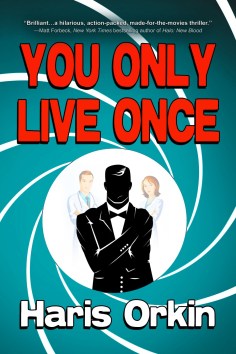
You Only Live Once Front Cover Official resized for websiteJames Flynn is an expert shot, a black belt in karate, fluent in four languages and irresistible to women. He’s also a long-term mental patient in a Los Angeles psychiatric hospital. Flynn believes his locked ward is the headquarters of Her Majesty’s Secret Service and that he is a secret agent with a license to kill.

When the hospital is acquired by a new HMO, Flynn is convinced that the Secret Service has been infiltrated by the enemy. He escapes to save the day, and in the process, Flynn kidnaps a young Hispanic orderly named Sancho.

This crazy day trip turns into a very real adventure when Flynn is mistaken for an actual secret agent. Paranoid delusions have suddenly become reality, and now it’s up to a mental patient and a terrified orderly to bring down an insecure, evil genius bent on world domination.

Reviews for “You Only Live Once”

“A brilliant homage to everyone’s favorite super-spy, and a hilarious, action-packed, made-for-the-movies thriller about a man suavely dancing along both sides of the thin line between heroism and madness.” —Matt Forbeck, New York Times bestselling author of Halo: New Blood

“Pacey and unrepentant fun, Haris Orkin’s You Only Live Once takes the James Bond mythos, gives it a swift kick in the backside and steals its wallet.” —James Swallow, New York Times bestselling author of Nomad 

“Fill shaker with ice. Add equal parts Ian Fleming and Quentin Tarantino. Shake (do not stir). Garnish with Douglas Adams, and you get You Only Live Once, a delicious martini as dry as the dusty California desert.” —Dan Jolley, USA Today bestselling author of the Gray Widow Trilogy

“If you’re looking—and who isn’t?—for a sexy, slapstick, razzle-dazzle, rock’em-sock’em re-imagining of Don Quixote as James Bond emerging from deep cover in a mental hospital to save the world, Haris Orkin’s hilarious yet touching You Only Live Once is the book for you.” —Charles Harper Webb, award-winning author of Brain Candy

WHO IS Haris Orkin?
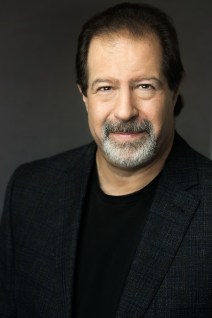
Haris_1-25-18_120 FinalHaris Orkin is a playwright, screenwriter, game writer, and novelist. His play, Dada was produced at The American Stage and the La Jolla Playhouse. Sex, Impotence, and International Terrorism was chosen as a critic’s choice by the L.A. Weekly and sold as a film script to MGM/UA. Save the Dog was produced as a Disney Sunday Night movie. His original screenplay, A Saintly Switch, was directed by Peter Bogdanovich and starred David Alan Grier and Viveca Fox. He is a WGA Award and BAFTA Award nominated game writer and narrative designer known for Command and Conquer: Red Alert 3, Call of Juarez: Gunslinger, Tom Clancy’s The Division, Mafia 3, and Dying Light, which to date has sold over 7.5 million copies.

Haris has contributed chapters to two books put out by the International Game Developers Association; Writing for Video Game Genres and Professional Techniques for Video Game Writing.

www.harisorkin.com

https://twitter.com/HarisOrkin

Find Haris on Social Media

Website: https://www.harisorkin.com/you-only-live-once

Facebook: https://www.facebook.com/AuthorHarisOrkin/

Goodreads: https://www.goodreads.com/author/show/17753529.Haris_Orkin

Amazon Author Page:  https://www.amazon.com/Haris-Orkin/e/B07B2L75HH/ref=dp_byline_cont_ebooks_1
Learn How To Self-Edit #AuthorToolboxBlogHop: Two Questions To Ask When Writing a Sequel

Nano Blog and Social Media Hop2Thank you, Raimey Gallant for organizing the #AuthorToolboxBlogHop.

This is a monthly blog hop on the theme of resources/learning for authors: posts related to the craft of writing, editing, querying, marketing, publishing, blogging tips for authors, reviews of author-related products, anything that an author would find helpful.

To continue hopping through other great blogs in the monthly #AuthorToolboxBlogHop or to join, just hop on over to Ramey Gallant!


Two Questions To Ask When Writing a Sequel

Action scenes and sequels drove me crazy until I figured out a way to deal with them.

Image Source Pixabay

My simple view of action and sequel:

POV Goal: Girl wants to put beloved fish in new tank.

Action: Girl trips, her hand flops, and the glass tips. The fish falls out. Girl scrambles on floor, gets fish, and puts in tank.

Sequel: Girl mad at herself for dropping fish but proud she saved it.


The Scene: Action or Sequel?

The common terms to define an event in a novel are “scene” and “sequel”, but I find this confusing as “scene” is too generic for me. I use “action” or “sequel” when I’m evaluating my scenes.

An action scene is where something happens. This is written mostly via movement and dialogue. Usually, description and character internalizations during the action scene are kept to a minimum. The point of view character’s goal often drives the action.

A sequel is where a character reacts to the events that happened in the action scene. This can be an emotional reaction, a decision made, or just thoughts. If you do this right, your reader will feel connected to your character.


To Write a Sequel:

At the end of each action scene, ask yourself:

  1. How did the action affect the POV character?
  2. How did the action affect the protagonist if it’s not the same character as the POV character for the scene?

The answers will help you create a sequel that works with the action.

The answers may also help you resolve plot holes. For example, you may find a character felt something you didn’t want them to feel till much later in the novel.

If you have a character whose flaw at the beginning of the story is fear of intimate relationships, and this is the flaw that will change by the end of the story, you don’t want to have a scene mid-novel where the character has an intensely intimate moment with another character.

You want the big change in your character to occur during the climax scene.

You can hint at how the character feels or reacted, so there is growth throughout the story, but don’t solve the flaw until the climax scene.


Keep Track of How Many Scenes are Action or Sequel

Depending on the genre, you’ll want to balance action versus sequel scenes. Action scenes increase the pace of your story. Sequels can be used to slow the pace.

In a thriller, you’ll focus on action scenes. Your readers will still need some sequels to catch their breath and stay connected to the hero.

In a character-driven story, write more sequels than in a thriller so your readers form an intense emotional connection with your characters.

It’s important to know your genre and what works for that genre.


Check out Fictionary’s free 14-day trial, and turn your draft into a story readers love.

Mystery Mondays: New Release by Laurence St. John

It’s such a thrill to share a new release by Laurence St. John. Laurence and I share the same publisher (Imajin Books), and he’s just one of those authors who helps other authors promote their works.

The following is pretty exciting, so get ready…

Terror on the East Coast – Two Million Dead!

TOLEDO, OHIO, March 15, 2018 – Yesterday, more than two million people were killed, including the President of the United States.

The death toll is the worst in the history of America and the world.

This tragic day will be known forevermore as “The Day of Annihilation.”

The CIA has the sole person responsible for the killing of millions and millions of innocent people in custody.

His name is Tyler Thompson – a moral person turned evil. The question foremost on everyone’s mind is, why did he orchestrate this horrific act of terror and how did he pull it off?

This headline is fake news – or is it?

In his new release, METATRON: DAGGER OF MORTALITY, science fiction/fantasy author Laurence St. John creates an uplifting and inspiring fiction novel that “sustains constant action as 15-year-old Tyler struggles to stop the relentless animosity of a demonic figure and his accomplice! Sometimes you need to go backwards to move forward,” said Piers Anthony, New York Times bestselling fantasy Author of the Xanth series.

St. John, who hails from just south of Toledo, Ohio, quickly grabs the reader’s attention then poses the ultimate question: Can superheroes really be killed?

Who is this Black Shadow character and who does he want to get revenge from?

Tyler must execute the most grueling choice of his life – save himself, save his beloved girlfriend Kendall or save millions of helpless people and hinder Kelltie’s plan.

In this, his highly anticipated third action-adventure, St. John keeps readers turning the pages up to the last adrenaline-filled moment when Tyler’s fate is determined.

The story is set in New York, Nevada, and Massachusetts, where the action-packed adventure opens your mind’s eye, conveying the sensation that you’re watching a movie.


Metatron: Dagger of Mortality is a novel made for the silver screen ― action-packed, emotional and a gripping story that will leave you wanting more.
Metatron Book 3 Front Cover 2.8.2018Tyler believes a Superhero’s responsibility is to make the right decision then follow it through to the end. But, what if the outcome results in his death?

Fourteen-year-old Tyler Thompson has been in isolation for eight months so he could focus on completing his superhero training. Not even one day after his completion, Master Pat Tanaka urgently summoned Tyler. Pat desperately needs his help, but for what?

Kelltie is threatening Tyler’s destiny of being a superhero by framing him for what will be the largest mass killings in American history and there’s nothing he can do to stop it. She also teams up with Black Shadow, a ruthless demonic figure with his own agenda — to use the Dagger of Mortality and kill Metatron.

Tyler feeling vulnerable gets inspiration one last time from Master Tanaka’s instructor Master Dogmai. Nevertheless, with the Dagger of Mortality in hand, it’s time for Black Shadow to get his revenge. Tyler must render the most arduous choice of his life. He’ll save himself, save his beloved girlfriend Kendall or save millions of helpless people and hinder Kelltie’s plan.

Can superheroes really die? What choice does Tyler make?


Reviews:

“Metatron – Dagger of Mortality, by Laurence St. John sustains constant action as 15-year-old Tyler struggles to stop the relentless animosity of a demonic figure and his accomplice! Sometimes you need to go backwards to move forward…”

Piers Anthony – New York Times bestselling fantasy Author of the Xanth Series

“Laurence St. John turns up the heat with Metatron – Dagger of Mortality. This book continues the story of Tyler Thompson and his journey of discover as he masters his powers in preparation of a new evil threat. A can’t miss read for middle-grade readers and young adults!”

Braxton A. Cosby – Author of the award-winning Star-Crossed Saga Series

“Dagger of Mortality’ packs a wallop! St. John blends equal parts superhero and X-Files into a high energy yarn sure to inspire.”

Jason Born – Author of The Norseman Chronicles Series

“Teens and adults alike will identify with Tyler and his all too human angst as he executes superhero feats in a way only St. John’s hero can accomplish, with many twists and surprising turns of events in this young adult thriller.”

Kenna McKinnon – Author of Short Circuit: And Other Geek Stories, Blood Sister, and Den of Dark Angels


Metatron: Dagger of Mortality was published by Ogopogo Book an Imprint of Imajin Books and is available in eBook edition at Amazon, Google Play and Kobo. Order your copy today.

It is also available in trade paperback edition at Amazon, Books-A-Million, and Barnes & Noble, as well as other retailers.

View the paperback and eBook links at the bottom of this page.


DSC_9511-1aLaurence St. John is currently working on book four and five in the Metatron Series.

Laurence is also available for interviews/guest appearances.

For book sign dates please see his Facebook page.

For more information please visit:

http://www.laurencestjohn.com or http://getbook.at/DaggerofMortality

Follow Laurence on Twitter: http://twitter.com/laurencestjohn

“Friend Request” Laurence on Facebook: http://www.facebook.com/laurenceastjohn

Imajin Books: http://www.imajinbooks.com

For those of you who have dreamed of having super powers like the Avengers or Superman; or special abilities like the force or even cool moves like Neo in the Matrix, you’ll want to check out METATRON: Dagger of Mortality by author Laurence St. John – a superhero novel that sustains constant action as 15-year-old Tyler struggles to stop the relentless animosity of a demonic figure and his accomplice!

Piers Anthony – New York Times bestselling fantasy Author of the Xanth Series

Tyler believes a Superhero’s responsibility is to make the right decision then follow it through to the end. But, what if the outcome results in his death?

Laurence is a 1983 graduate of Genoa High School, a 1988 Black Belt recipient in Tae Kwon Do and a 2004 graduate of Owens State Community College.

Links:

Amazon – http://getbook.at/DaggerofMortality

3 Reasons To Relate A Character’s Goal To The Plot

Richard North Patterson has some great writing advice. I’d like to take the high-level advice and get practical with it.

Let’s link Patterson’s advice to the point of view character’s goal in every scene.
  1. Deepen characters — have a goal that relates to the story’s plot.
  2. Trim writing — cut story elements that don’t relate to the goal or the plot.
  3. Intensify scenes — have your character strive for a goal that is related to the overall plot.

1. Deepen Characters

Each scene has a point of view character. This character must have a goal for the scene. If there is no goal, then what is the character doing?

To add depth, give the character an internal and an external goal.

The reader is aware of the external goal.

A character’s internal goal is one you may or may not share with the reader. This is something the reader should be able to guess from the story. You as the writer know that the character has an internal goal.

Either goal can be expressed through dialogue, thought, action, or narrative. You need to decide how blunt you want to be when letting the reader know what the goal is. Varying your methods will make the story more interesting to the reader and add depth to your characters.


2. Trim

For each scene, think about how the POV character’s goal is related to the plot of the novel. If you don’t know the answer, perhaps the scene isn’t relevant to the story, or perhaps another character should have the POV for that scene.

Your scene may just need some updating. Can you strengthen the character’s goal? Is there a way to add a goal to the scene so it relates to the novel’s plot? Otherwise, it’s time to trim.


3. Intensify

Whatever type of story you’re writing, there will be a plot. The plot may entail solving a mystery, saving the world, coming of age, or many other things. Only you know the overall plot.

You can intensify a scene using character goals. Here’s a quick example:

The POV character’s goal is to get her car from the service station. That’s not very intense. Ho hum even. But what if we link the goal to the plot.

The plot: The protagonist has witnessed a crime. Her overall goal in the novel it to prove a crime was committed and find who committed it.

The antagonist is trying to find and kill her, but he only knows what car she drives. He doesn’t know where she lives, but he knows where she took her car. In this case, the POV goal of getting the car from the service station may put the character’s life in danger, give an advantage to the antagonist, and intensify the scene.


How Fictionary Can Help You

Fictionary is a new interactive web app for self-editing fiction that helps writers turn a first draft into a story readers love.

This is a scene from DESCENT (by Kristina Stanley— cofounder of Fictionary)

Finding a murderer is Kalin’s main goal throughout DESCENT. She also has goals within each scene where she holds the point of view.

In this scene below her external goal is to go skiing. Her internal goal is to be good at her job.

The reader is shown Kalin wants to go skiing. She doesn’t achieve this goal because a skier falls and is terribly hurt. She has to put her own wants aside and deal with the situation. This is the start of Kalin’s journey of searching for a murderer. At the time, she doesn’t know she is witness to a crime, she’s only thinking of taking care of the skier. The external goal of skiing places her on the hill at the time the skier falls.

Kalin’s internal goal is to be good at her job. In this scene, she doesn’t know yet this will involve chasing a murderer.

Both goals are linked directly to the overall plot.

The internal and external goal give Kalin depth. It shows she has an active life and enjoys adventure, but it also shows she knows when to put aside her own wishes and be serious about her job.

The first time I wrote this scene, Kalin heard about the accident over the phone. She had no goal. She just reacted by answering the phone. By putting her in an action scene and giving her both an internal and external goal, the scene is intensified.

In my final rewrite of the scene, I trimmed everything that wasn’t related Kalin’s goals or to the plot.

You can use Fictionary to check the character’s goal for each scene is related the plot.


Check out our free 14-day trial and turn your draft into a story readers love.

Mystery Mondays: Judy Penz Sheluk on Fore the Love of Golf (and Writing)

I’m very excited to have Judy on Mystery Mondays again. Before getting to her post, let me share the endorsement I wrote for her latest book: A Hole In One.

A Hole in One is a captivating page turner. Set in the world of antique dealing, dangerous secrets simmer until they lead to murder.

Penz Sheluk is an expert at writing intriguing characters. Past and present relationships drive the story. Along with a splash of romance, Penz Sheluk delivers a fast-paced story with twists that keep you guessing until the very end. You don’t have to be a golf lover to love A Hole In One.

So now go and buy her book 🙂

Fore the Love of Golf (and Writing)

by Judy Penz Sheluk

I’ve been a passionate, if less than spectacular, golfer for about 15 years now, and one of my quirkier hobbies is collecting golf quotes that are also life lessons. Here are five of my favorites:

“It takes hundreds of golf shots to gain confidence, but only one bad one to lose it.” Jack Nicklaus.

So true, and yet, ridiculous when you stop to think about it. The same thing can apply to the negative review that broke your heart, fellow authors – don’t let it spoil all the 4-and 5-star reviews you’ve managed to garner. You can’t par on every hole!

“In golf, as in life, it’s the follow through that makes the difference.” Anonymous.

Ah…would that be like making time to write every day instead of procrastinating?

“To find a man’s true character, play golf with him.” P.G. Wodehouse.

Yup. Also watch the way someone treats the wait staff at a restaurant. Just saying.

“Golf is a game of ego, but it is also a game of integrity: the important thing is you do what is right when no one is looking.” Tom Watson.

Enough said.

“Golf is the closest game to the game we call life. You get bad breaks from good shots; you get good breaks from bad shots – but you have to play the ball where it lies.” Bobby Jones.

This quote from the co-founder of The Masters is my all-time favorite, because it really is true on all counts. But how has golf made me a better writer? I’ll leave you with one last quote, this one from me:

“Golf has taught me to accept that patience is part of the process—patience and a lot of hard work. Practice may not make perfect, but it’ll go a long way to getting there.”

About A HOLE IN ONE

Judy Penz Sheluk’s latest release (March 6, 2018, Barking Rain Press).

Lo-res coverHoping to promote the Glass Dolphin antiques shop, co-owners Arabella Carpenter and Emily Garland agree to sponsor a hole in one contest at a charity golf tournament. The publicity turns out to be anything but positive, however, when Arabella’s errant tee shot lands in the woods next to a corpse.

They soon learn that the victim is closely related to Arabella’s ex-husband, who had been acting as the Course Marshal. With means, opportunity, and more than enough motive, he soon becomes the police department’s prime suspect, leaving Arabella and Emily determined to clear his name—even if they’re not entirely convinced of his innocence.

Dogged by incriminating online posts from an anonymous blogger, they track down leads from Emily’s ex-fiancé (and the woman he left Emily for), an Elvis impersonator, and a retired antiques mall vendor with a secret of her own.

All trails lead to a mysterious cult that may have something to do with the murder. Can Arabella and Emily identify the killer before the murderer comes after them?

 Who Is Judy Penz Sheluk

Opening Day
Judy is in the red hoodie (standing up)

Judy Penz Sheluk is the author of two mystery series: The Glass Dolphin Mysteries (THE HANGED MAN’S NOOSE and A HOLE IN ONE) and The Marketville Mysteries (SKELETONS IN THE ATTIC)

Judy’s short crime fiction appears is several collections. She is a member of Sisters in Crime, International Thriller Writers, the Short Mystery Fiction Society, and Crime Writers of Canada, where she currently serves on the Board of Directors as the Regional Representative for Toronto/Southern Ontario.

Find Judy on her website/blog at http://www.judypenzsheluk.com, where she interviews and showcases the works of other authors and blogs about the writing life.


The Importance of Failure

Failure will make your point of view character human. Failure will add tension to your scene. Failure drives your character and your story forward.

What is the goal?

The reader should understand early in each scene what the POV character’s goal is.

How Serious Is The Goal?

In each scene, the POV character may or may not reach the goal. As a writer, even if the character reaches the goal, you need to understand what’s at stake if he doesn’t. If there isn’t much at stake, there won’t be enough tension in the scene.

If the character’s goal is to have a cup of coffee and he doesn’t get it, will the reader care? Probably not. But what if he wants a cup of coffee, and there is poison in the coffee? Now there is a lot a stake — his life — and the tension just ratcheted up a notch.

To Fail or Succeed?

In some scenes, the POV character should reach the goal, and in others, he should not.

A character who reaches every goal will be unbelievable and won’t be struggling. There won’t be enough tension to keep the reader engaged.

A character who fails at reaching every goal could be hard to empathize with. Again, the character won’t be believable, and your reader may lose interest.

Having a balance of succeeding and failing will keep your reader guessing and engaged in your story. If your story is upbeat, have more successes. If your story is dark, more failure is in order.

The Reaction

Whether the character succeeds or fails, don’t forget to include a sequel to the action. This is the beat where the reader is shown the character’s reaction. Readers love to know how a character feels, and you can use the goals to show the feelings.

Every Scene?

There must be a POV character goal in every scene. Without a goal, think about removing the scene from the story. If there is no goal, the scene might not have a purpose, so review each scene carefully. Maybe you can add a goal to the scene if you want to keep the scene for other reasons.

Fictionary Helps With Character Goals

Fictionary is a new interactive web app for self-editing fiction that helps writers turn a first draft into a story readers love.

This is the first scene from Maxwell Huxley’s Demon (by Michael Conn — cofounder of Fictionary).

Image Source: Fictionary

Maxwell Huxley wakes up with a hand on his mouth. It’s immediately clear his goal is to survive. If he fails, he dies. Something serious is at stake. The goal sets the tone for the novel. The reader knows they are about to read a thriller. The genre is YA thriller.

You can use Fictionary to check the character’s goal for each scene is related the plot and keep track of the impact on the POV character.

Developed by writers to help fellow writers, Fictionary is the first online tool for editing the story, not just the words. Writers are guided through a scene-by-scene evaluation of their manuscript by analyzing key story elements for characters, plot, and settings.

With interactive reports and writing advice for each element, writers can visualize their story and see where and how to improve their writing. With automated progress tracking, writers save time on self-editing and can be confident that their work is ready to share.

How Fictionary Works: A writer imports a manuscript. Within seconds, Fictionary automatically creates a character list, links characters to scenes, plots word count per scene, and draws a story arc.

The writer then inputs key story elements for each scene, evaluates and edits the manuscript based on Fictionary’s reports, and then exports the updated manuscript. The reports in Fictionary are dependent on the writer’s input and is specific to each manuscript.

Why not check out our free 10-day trial? Turn your draft into a story readers love.

Two Types Of Character Goals

A character goal is what a character wants. She should want it so badly that your readers feel her need in their guts.

The Point of View (POV) goal is what the POV character of a scene wants.

Whether you write from a single POV for the entire novel or from multiple points of view, it’s important to know what the POV character is trying to achieve in each scene.


Internal and External Goals

An external goal is the goal a character shows the world.

In a fantasy novel, that might be to find a magic object. The reader and other characters in the novel are aware of the goal. The antagonist(s) will try to make the character fail.

An internal goal is a character goal that the other characters in the scene are not aware of.

For example, a character may have a goal of stealing a jewel from a desk drawer. The other characters in the scene may think the character’s goal is to sit at the desk and calculate the latest revenue figures for their business.

The reader may or may not know about the internal goal, but as a writer, you must keep track of this.

To give a scene depth, have an internal and external goal for the POV character for each scene.

Failing To Reach A Goal

Once you know the POV goal for a scene, you can start thinking about all the ways the character will fail at achieving the goal, what obstacles you put in the way, and how the character will feel about failing or achieving the goal.

This will add tension and conflict to your scenes.

Scene Goal Versus Novel Goal

Your protagonist must have an overall goal for the novel, but she will also have a goal for each scene where she is the POV character.

You may find the POV goal for a scene is the same as the character’s goal for the novel, or you may find the character has a different goal for a scene. In the second case, make sure the scene goal is related to the plot.

For example, in a murder mystery, the protagonist’s goal for the novel is to solve the murder. In a specific scene, her goal may be to uncover a clue, hide something from the antagonist, or something a simple as trying to get a few hours of desperately needed sleep.

Driving the story forward

By giving your POV character a goal in every scene, you’re also giving your readers something to cheer for or cheer against. This will keep your readers engaged in your story and turning the pages.


Fictionary

Fictionary helps you keep track of internal and external goals. You can list the goals right beside a scene, or you can see the goals listed together in the Story map report.

Here is an example of my work in progress, Evolution, from within Fictionary. The protagonist, Jaz Cooper has two goals in the first scene.

She’s struggling with how to spend her time. This external goal is shown to the reader early in the scene (highlighted in blue).

Her internal goal, which the reader doesn’t know about, is her struggle against suicide. As the writer, I know this is her goal, and it influences what I write.

Why not try the free 10-day trial of Fictionary and see if can help you turn your first draft into a story readers love?

Mystery Mondays: Mary Cunningham On Becoming An Author

This week on Mystery Mondays, Author Mary Cunningham shares her story on becoming an author. Mary and I are both published by Imajin Books, so as always a great big shout out to Imajin Books and Cheryl Kaye Tardif!

It All Starts With Reading

by Mary Cunningham, author, Margaritas, Mayhem & Murder

Andi Anna Jones Mystery # 1

When I was a kid, I had to cross a busy downtown street to walk the two blocks to the public library. Mom would guide me across that first street then let me walk the rest of the way to my favorite spot on earth; well, except for the high school gym on Friday basketball game night.

I guess you’d call me a tomboy. I loved sports; playing and watching. Although, I still had fun cutting out paper dolls with my friend, Cynthia, and playing with her Easy Bake Oven (I was so jealous she had one and I didn’t!)

But, back to the library. I’ll never forget the summer I discovered sports biographies. A whole set of them! Probably due to my yet-to-be-discovered OCD, I commenced reading them in order – A-Z.

I’ll never forget the thrill of learning all about Hank Aaron. I was a huge fan back then of the Milwaukee Braves outfielder. In 1957, as a 10-year-old, I would sit in front of the TV keeping stats during the Braves games. In a record-breaking year, he hit an 11th inning home run that propelled the Braves to the World Series, where he led underdog Milwaukee to an upset win over the New York Yankees in seven games. Yep, “Hammerin’ Hank” was my idol.

I tore through the biographies in record time. Patty Berg, Jim Brown, Althea Gibson, BabePancho Gonzales, Byron Nelson, Warren Spahn. Then, the unbelievable happened. I finished Babe Didrikson Zaharias. Finished. Caput. A through Z. There were no more.

I was crushed.

I muddled along reading Nancy Drew, The Hardy Boys, and then got interested in historical fiction. Then I got bored with the writing and storylines I considered beneath my reading and comprehension level.

As luck would have it, my aunt replaced the ancient librarian (Miss Georgia Stockslaver – yes, that was her real name!) who had been in her position for, oh, around 108 years. Or, at least it seemed like it. What a refreshing change! Nothing against Miss Georgia, but she single-handedly destroyed my older brother’s love of reading. It was the summer after his fourth-grade school year. He took “The Bears of Blue River” to the desk to check it out. Miss Georgia wouldn’t let him read it. “This is a Fifth Grade book. You’ll have to wait ‘til then.” Barely a month away. My brother, who had a bit of a stubborn streak, left the library and never returned, to my knowledge.

ForeverBack to my reading boredom. Between my eight grade and freshman year, the aforementioned librarian, my beloved Aunt Gertrude, began setting books aside she thought I’d enjoy reading. To Kill a Mockingbird, of course, and anything by Steinbeck. I graduated to slightly steamier novels like Forever Amber by Kathleen Winsor, and later, in high school, Lady Chatterley’s Lover. She made me swear not to tell my mother she let me check that one out. I believe I hid the book under my mattress until I finished reading and returned it, safely, to the library.

I now consider myself to be a pretty fair writer. My children’s book series, Cynthia’s Attic, has been well-received by readers of all ages. My new series, Andi Anna Jones Mysteries, has made its debut and am I ever excited! Writing these mysteries has given me a new perspective. While I love writing for middle-grade, it does keep the creative juices flowing when you change things up every now-and-then.

I wouldn’t be writing, however, if not for one important fact.

It all starts with reading!

Margaritas, Mayhem & Murder: Synopsis

Andi’s step-mother is a real piece of work! But is Ruby a murderer?

 Andi Anna Jones, so-so travel agent/amateur sleuth, puts aside her resentment of her father’s widow and books a 60th birthday cruise to Cancun for Ruby and three friends. Never does Andi imagine the cruise will lead to the murder of a has-been lounge singer—or that Ruby will be the main suspect.

Flirting with more than danger after arriving in Mexico, Andi connects with the charming local sheriff, Manual Rodriquez. After an embarrassing night involving the sheriff, too many margaritas, and a Mariachi band, a chance to check out an eyewitness to the murder leads her to Las Vegas.

In Vegas, a mysterious meeting in the Bodies Exhibition, a body preserving in the prep-room, and an evasive owner of a dance studio, give Andi clues to help Ruby. But when Andi is mercilessly drugged and locked in a storage room, she realizes dear old step-mom isn’t the only one in jeopardy. 

WHO IS Mary Cunningham?

x300 dpi MARY CUNNINGHAM org. enhance slightly no blur 4368-004Author, Mary Cunningham, grew on the northern side of the Ohio River in Corydon, Indiana. Her first memories are of her dad’s original bedtime stories that no doubt inspired her imagination and love of a well-spun “yarn”.
Childhood experiences, and a recurring dream about a mysterious attic, inspired characters, Cynthia and Augusta Lee, for her award-winning middle-grade series, Cynthia’s Attic. The setting is in her childhood home in Southern Indiana. Family stories and ancestors comprise the storylines. There are currently five books in the series: The Missing Locket, The Magic Medallion, Curse of the Bayou, The Magician’s Castle, and Legend of Lupin Woods.

Through a horrifying stint as a travel agent and more rewarding experience teaching travel and tourism, the character, Andi Anna Jones, travel agent/amateur sleuth, inspired her latest adult mystery series. She’s currently writing Book # 2 of the series, along with another middle-grade series, The Adventures of Max and Maddie, a historical time-travel, and a biography about a former Army brat/University of Connecticut women’s basketball player who started a non-profit foundation to create scholarships for children of deployed veterans.

Cunningham is a member of The Georgia Reading Association, and the Carrollton Writers Guild.

When she gives her fingers a break from the keyboard, she enjoys golf, swimming and exploring the mountains of West Georgia where she makes her home with her husband and adopted, four-legged, furry daughter, Lucy.


An Imajin Qwickies® Mystery/Crime Novella

Pageflex Persona [document: PRS0000447_00052]Andi’s step-mother is a real piece of work!

But is Ruby a murderer?

Andi Anna Jones, so-so travel agent/amateur sleuth, puts aside her resentment of her father’s widow and books a 60th birthday cruise to Cancun for Ruby and three friends. Never does Andi imagine the cruise will lead to the murder of a has-been lounge singer—or that Ruby will be the main suspect.

Flirting with more than danger after arriving in Mexico, Andi connects with the charming local sheriff, Manual Rodriquez. After an embarrassing night involving the sheriff, too many margaritas, and a Mariachi band, a chance to check out an eyewitness to the murder leads her to Las Vegas.

In Vegas, a mysterious meeting in the Bodies Exhibition, a body preserving in the prep-room, and an evasive owner of a dance studio, give Andi clues to help Ruby. But when Andi is mercilessly drugged and locked in a storage room, she realizes dear old step-mom isn’t the only one in jeopardy.


Reviews for Margaritas, Mayhem & Murder!

“If Evanovich’s Stephanie Plum were a travel agent, she’d fit right in working this case alongside Andi, a wanna-be detective readers are sure to love.” —Regan Black, USA Today bestselling author of the Escape Club Heroes and Knight Traveler novels.

Margaritas, Mayhem & Murder…WOW. Snappy dialog, quirky characters, opens with a curious bang and yanked me through the pages. A fun, fantastic read. —Jean Rabe, USA Today Bestselling author, Piper Blackwell Mysteries.

“Grab a margarita and hold on tight; you’re in for a wild ride.”

—Karen MacInerney, Agatha Award nominee and author of the Dewberry Farms Mysteries

“Charming, lively, and unpredictable, Margaritas, Mayhem & Murder excels in a vivid story mystery fans will relish.”—Diane Donovan, Senior Editor Midwest Book Review

Purchase Margaritas, Mayhem & Murder:

Amazon: https://www.amazon.com/dp/B076N6KBM3

B & N Nook: https://www.barnesandnoble.com/w/margaritas-mayhem-murder-mary-cunningham/1127355519?type=eBook

 Find Mary on Social Media:

Website Links


Farley’s Friday: Grooming With Love

Farley here,

Any of you dogs out there get a cuddle while you’re getting your haircut?

Farley haircut

When Kristina brings my grooming kit into the room, I run to her and snuggle up.  There is something about human hands taking care of me that puts me in a state of relaxation.

The warmth of Kristina’s hands, the gentleness of her touch, just brings on happiness.

She complains she never gives me an even cut when I’m sprawled around her legs, but I know she loves the cuddles as much as I do.

Besides, I’d rather have funny looking hair if it means lots of loving!

Woof Woof.