Can You Proofread to Perfection?

And should you try?

If you’re  submitting your manuscript to your agent, publisher, editor, or beta readers, absolutely. If you’re interested in the process  I use for this, click here.

But what if you’re proofreading your blog before posting?

Maybe you could give yourself a break. I think the occasional typo is okay. Usually a kind reader will point out an error, sometimes even via a private email. The beauty of the blog versus a novel: it’s easy to update after publication.

I usually thank the person who pointed out my error, update the blog immediately, and move on.

Four steps to get close to perfection:

  1. Read once before posting draft.
  2. Read a preview version. Somehow seeing the blog in the format it will be posted helps me see it differently, and I usually pick up a typo or two.
  3. Read the blog out loud or have the computer read it to me. Then I can hear the error if my eye refused to see it.
  4. If I have the time, I let some time pass and read the blog again before I hit the publish button.

Just remember, we all makes mistakes and a typo isn’t one to lose sleep over.

Do you have any tricks for quickly eliminating typos?

Thanks for reading . . .

Farley’s Friday: Wheaten Terrier Catches His Humans

Farley here.

Dogs can learn. This I know for a fact. Last week my humans escaped, and I was left with temporary humans for the week. Although I had fun, I missed my peeps.

What did I learn?

Suspicious activity: Kristina puts clothes in something she calls a suitcase.

“Are you leaving me again?” I bark.

“Don’t worry, you’re coming with us,” she says.

Should I believe her?

Next suspicious activity: Matt carries the suitcase toward the van.

Huh? Last time that happened, away they went for the week.

“Open the door, “ I bark.

Matt opens the side door, puts the suitcase inside, and goes back into the house for another bag.

Silly man. I grab the opportunity and jump into the van. I look left, I look right and I assess the situation. They can easily pull me out of here. Now, remember I’m getting smarter and learning.

I jump into the front seat. The door is closed,, so there’s no way they can get me out.

Farley in Van

“Ha, ha,” I bark. “You have to take me now.” I’m not as confident as I sound, so I wiggle and look as cute as I can.

So did I get to go on the trip? I did, I did, I did 🙂

Woof Woof.

Writing a Series

Keeping track of details in one novel can be an overwhelming task. My handy-dandy spreadsheet does the job for me.

But what happens when one novel becomes two and then two become three? And then you make a change in one . . . and it has to be updated in two and then three.

This is enough to drive a person crazy or at least keep them entertained or maybe keep them from sleeping. Who knows?

My solution. As always my spreadsheet. I have now added a new spreadsheet to my collection. I keep one spreadsheet per novel and have found an extra one for details that need to be remembered from one book to the next helps.

I can remember the big details, but what about the ones like an address, a description of a room, a character’s sibling.

Without a spreadsheet I am lost.

Any tips that might help me?

Thanks for reading . . .

Can a Ruler Help You Proofread?

I’m fascinated by how difficult it is to proofread my work. Why can’t my eye see if on the page instead of reading of – that’s not really there?

What does a ruler have to do with proofreading? Let’s call it the new tool in my toolbox.

When I think my work is ready to send to my agent, I print the final copy and read it, line by line, very slowly.

I place the ruler underneath each line as I read it. This forces my eye not to stray forward to the next line. The ruler stays in place until I’ve read every word.

Out of 80,000 words, I found five typos. They were:

–       a missing quote

–       a missing word (had)

–       a missing period at the end of a sentence

–       you’re instead of your

–       color instead of colour

I don’t think I would have found the mistakes without the ruler. This may seem like a lot of work for just 5 errors, but I believe in sending my best work out. If I don’t take is seriously, why would anyone else?

Do you have any proofreading tips you’d like to share?

Thanks for reading . . .

Crowded Marina?

Compass Cay Marina during the march break . . . Where did the boats come from?

I’ve never seen this marina so full. We were all so amazed, since we’re used to being isolated out here, that our friend climbed to the top of the mast and took this photo.

DCIM100GOPRO

Mattina is in the bottom corner, tucked between some very large boats.

Lots of fun on the docks . . .

All this happened after we were the only boats docked at Highbourne Cay Marina.

Highbourne Cay Marina

Thanks for reading.

Location, Location, Location: Details for a Manuscript

Do you create your location first or do you write a scene first?

For a novel, I decide on the location before I start writing. My first three novels take place in a fictitious ski resort in British Columbia, Canada. The fourth novel takes place in the Bahamas. I chose the location first because I wanted to write about people who live in isolated places.

Some scenes dictate a location, but for others, I might write the scene and then chose a location. I keep track of locations in a spreadsheet. This helps me avoid using one place to often. Believe it or not, in a ski resort not everything happens on the mountain.

If I have a scene written and haven’t chosen a location, I do this by looking at the mood of the scene. Is is romantic, frightening, funny, awkward?  I think about where in my created world the scene will have the greatest impact. Then I add the details.

When reviewing a manuscript, I check for the empty stage syndrome. Did I get carried away with action or dialogue and not describe the location? If I did, I work on describing the location. Sometimes at this stage I drop a clue or a red herring based on location.

Do you decide on location first or write a scene first?

Thanks for reading . . .

Kickstart Your Writing Session

Writer’s block? I don’t’ believe it.

Sometimes it’s very difficult to put words on page, and there are too many reasons for this to mention them all.

Here’s one quick trick I use when my brain is stuck.

First I remind myself that if I was at work, there is no excuse for not getting your job done. You can’t exactly say to your boss, “The numbers for the spreadsheet you wanted by three just didn’t appear, so I didn’t create the spreadsheet,” now can you?

So why make excuses for writing?

Having decided that giving myself the easy way out is not an option, what do I do?

I spend 10 minutes working on a crossword puzzle. It makes my brain think of words. They may not be words I would write with, but more often than not, a word triggers an idea, and then before I know if, I’m off and typing.

Doesn’t work every time, but when it does, it’s a good feeling.

Any tricks you want to share?

Thanks for reading . . .

Deep Sea Fishing

I’ve been writing about how to keep fit while cruising. But what if we’re done with exercise for the day?

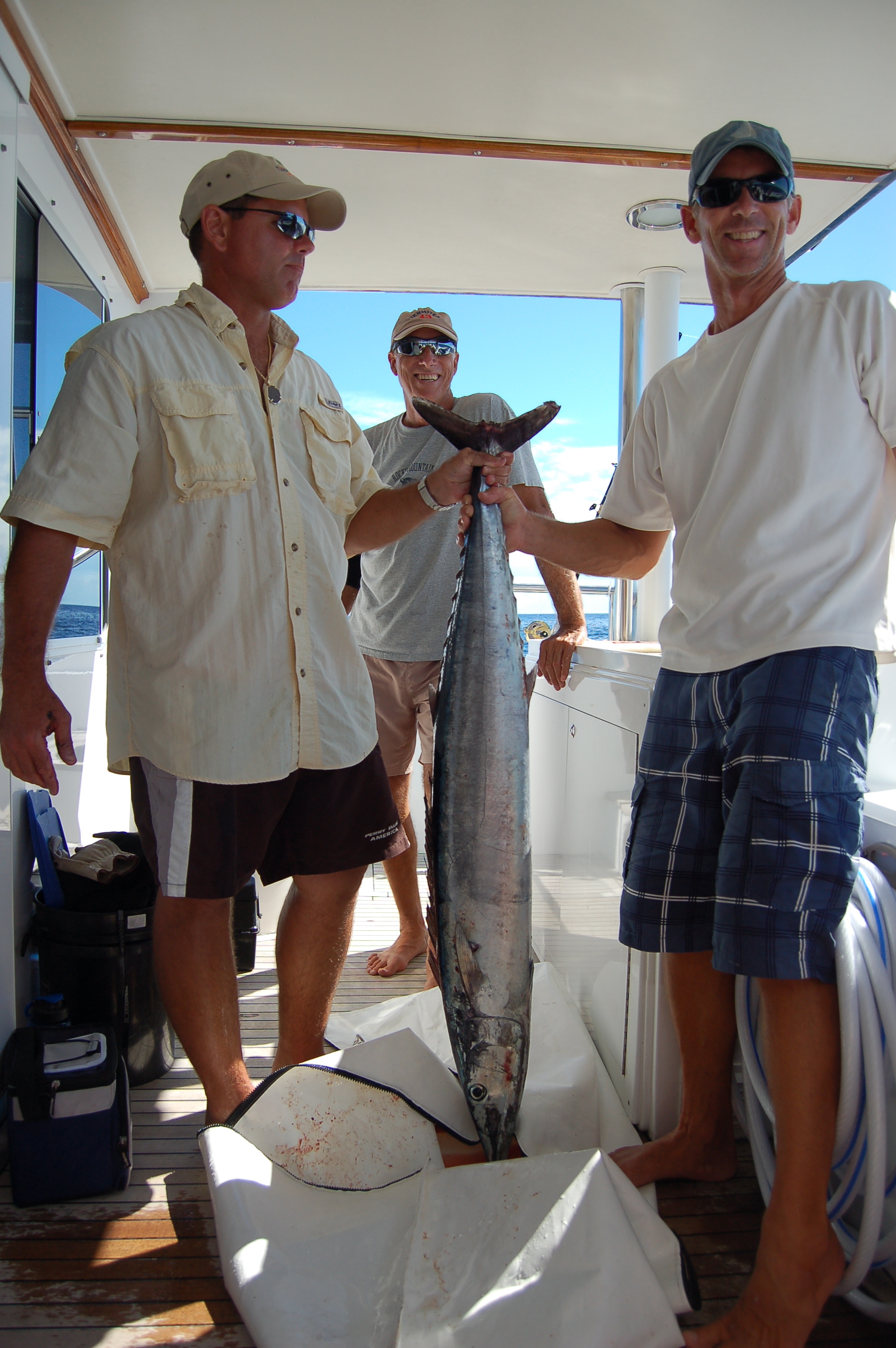
When the winds are too low to go windsurfing and it’s too hot for beach yoga or beach running, a little deep sea fishing goes a long way to keep us entertained and fed. Nothing like a sea of flat water and a little breeze to make fishing a fun experience.

Here we caught a wahoo, and you can see by the size of it, it fed our whole gang.

Matt and the Lure

When we checked into the Bahamas, we received a fishing license as part of our cruising permit, allowing us to fish in the Bahamian waters. We make sure we know what we are allowed to catch and what is in season, and only catch what we can eat.

It’s an amazing way to live off the sea.

Thanks for reading . . .

Writing Targets

I’ve read some authors write to achieve a specific word count per writing session.  This doesn’t work for me. During the time I allocate for writing, I might write, edit, proof read, research, or read. Setting a word count adds to much stress to the joy of writing. I can write to a deadline, I can write for the fun of it, I can write for creativity, but if I set a word count for a session, I obsess about the number of words and not about the quality of the writing.

While I’m doing other things with my writing time, all related to writing, an idea will often pop into my head. When that happens, I make a note of it. I’ve learned that if I don’t capture an idea, I won’t remember it later. I get right back to whatever activity I’ve been doing.

For me the writing life doesn’t mean writing all the time, but it does mean I shouldn’t get distracted from the task at hand. I believe all these things (editing, proof reading, researching, reading) make me a better writer.

Any thought?

Thanks for reading . . .