Big-Picture Editing and Word Count Per Scene – Feedback For Fiction

As a writer, you’ve probably read there are recommended lengths for a manuscript depending on the genre you write in. We’ve done some research and thought we’d share that with you.

In order of length, word count guidelines for a few of the popular genres are:

  • Novellas: 20,000 to 30,000
  • Middle Grade: 25,000 to 40,000
  • Romance: 40,000 to 100,000
  • Young Adult: 50,000 to 80,000
  • Mysteries, thrillers, and suspense: 70,000 to 100,000
  • Paranormal: 75,000 to 95,000
  • Fantasy: 90,000 to 100,000
  • Horror: 80,000 to 100,000
  • Science Fiction: 95,000 to 125,000
  • Historical: 100,000 to 120,000

Genre length may vary with different publishers, so check submission guidelines carefully. If you’re self-publishing, readers of the genres have come to expect a certain word count, and you don’t want to disappoint them, so think about the word count and make a conscious decision on the length of your novel.

But what about word count per scene?

When you’re about to begin a big-picture edit, you may wonder if counting the number of words per scene is important. We think it is, and we’ll tell you why.

Scene Emphasis

After you’re happy with the total word count for your novel, it’s time to evaluate how your word count is spread across your scenes.

By counting the words in each scene, you can see where you are putting emphasis and where you are not. Without knowing the specific word count, you don’t have a method to know if a critical scene is too short or a minor scene is too long.

Patterns

Some authors like to write scenes of the same length for the entire novel. Others vary the scene word count. The choice is yours, and you can use it to your advantage if you evaluate the per scene word count from a big-picture view.

If you follow a pattern (same word count per scene) throughout your novel and one scene is way longer than the rest of your scenes, make sure this is the climax scene. If it’s not, you probably have too many words in the scene.

How I Used Word Count To Improve My Novel

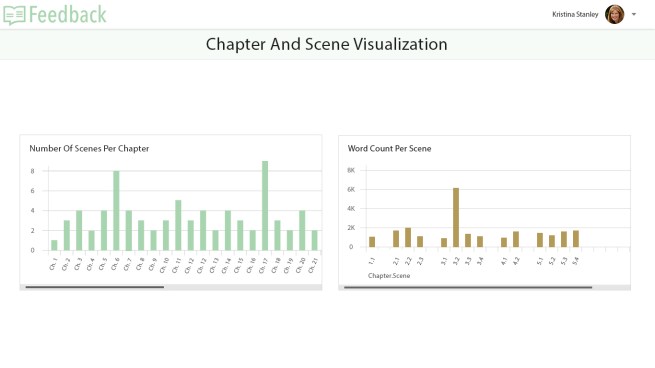
You can see in the Word Count Per Scene graph below, that scene 2 in chapter 3 is over 6000 words long. The other scenes in the novel are all under 2000 words. I discovered this during my big-picture edit of DESCENT (my first novel).

This was a scene early in the novel where my main protagonist, Kalin Thompson, moves to Stone Mountain Resort. In great detail, the scene described Kalin moving into her new apartment. After I looked at the word count, I realized I’d written the scene to give the reader a feel for resort life. Nothing much happened in the scene to move the plot forward.

I knew I needed to fix this. Instead of putting the details in one scene,  I cut the scene and sprinkled the details throughout the other scenes.

This improved the story by eliminating an info dump but still leaving in details that showed the reader what it’s like to move to a ski resort. If I hadn’t reviewed the word count of the scene in the context of the other scenes, I might have missed this.

How The Feedback App Will Help

Depending on the software you use to write your novel, counting the words in each scene can be a time-consuming exercise.

For example: In Microsoft word, you’ll highlight each scene and look at the word count displayed at the bottom of each page. In Scrivener, it’s a little easier. The word count is displayed at the bottom of each screen if you’ve broken your text into scenes as you write. In either case, you’ll have to keep track of the word count and evaluate it from a manuscript level.

The Feedback app will automatically break your novel into scenes and create a report showing you how many words are in each scene. You’ll be shown a graph, and can easily see where you need to focus on word count. Word count is one of the Key Elements Of Fiction the app uses to help you perform your own big-picture edit.

The Feedback App will also show you the breakdown of scenes per chapter. We’ll talk about this in another blog.
 

Download our free eBook, BIG-PICTURE Editing And The Key Elements Of Fiction and learn how big-picture editing is all about evaluating the major components of your story. We call these components the Key Elements Of Fiction.  Our eBook shows you how to use the key elements of fiction to evaluate your story and become your own big-picture editor.

Source: Big-Picture Editing and Word Count Per Scene – Feedback For Fiction

Free eBook: BIG-PICTURE Editing Using Feedback’s Key Elements Of Fiction

You’ve finished your first draft. Congratulations! Now what?

Whether you’re self-publishing or going the traditional route, your story needs to be as good as you can possibly make it before sharing with others.

Now is the time to evaluate your writing with a big-picture edit to ensure your story works and is compelling to your readers.

But just re-reading your novel and looking for areas of improvement without having a process can waste a lot of time. Questions that come to mind are:

  • Where to start?
  • What to change?
  • How to make it better?

DOWNLOAD Free eBook

Don’t despair. There is light at the end of the editing tunnel. Just like you learned how to write a novel, you can learn how to perform a big-picture edit. All you need is a clear process, some editing knowledge, and the right tool.

With our free eBookyou’ll learn how big-picture editing is all about evaluating the major components of your story. We call these components the Key Elements Of Fiction.  Our eBook shows you how to use the key elements of fiction to evaluate your story.

BIG-PICTURE Editing

TOP 5 Fiction Elements For A Mystery

I had to share my guest post on A NEW LOOK ON BOOKS. I hope the editing tips help!

Self-editing A Mystery (TOP 5 FICTION ELEMENTS FOR A MYSTERY)

Self-editing a mystery is one of the joys of the writing process. You get to use your imagination to lead the reader through your story. As a mystery writer, it’s important to keep track of your story, and not only in the context of what you share with your readers but also what your characters know….


Source: Day 1: Mystery; Kristina Stanley – A New Look On Books

Structural Editing. Copyediting. Proofreading. Steps To Revising Your Fiction. – Feedback For Fiction

After you’ve written your first draft, you’ll need to work your way through the revision process. In today’s publishing environment, it’s up to the author to ensure all the major steps of revision/self-editing have been completed. So what are the different steps in self-editing fiction?

We’re glad you asked. Here is our take on it. The first step is a structural edit, followed by your rewrites. Then you’ll do a copyedit and finally a proofread. These steps combined make up the revision process.

Following this order will save you time on editing. If you copyedit or proofread too early, you may have to repeat this work. Of course, you can fix obvious errors when you see them, but don’t spend time on copyediting until you’ve finished a comprehensive rewrite…

More at Source: Structural Editing. Copyediting. Proofreading. Steps To Revising Your Fiction. – Feedback For Fiction

New Year’s Resolution: Turn Your First Draft Into A Great Story – Feedback For Fiction

Happy New Year.

The holidays are over and maybe you’re thinking about your New Year’s resolution.

How about rewriting your novel by following the Feedback process? Spend more time on your passion and finish that awesome story. Being able to perform a structural edit on your own manuscript will ensure you create a great story readers will love.

In 2016 we kicked off our rewriting tips with:…

Source: New Year’s Resolution: Turn Your First Draft Into A Great Story – Feedback For Fiction

Rewriting: Getting Your Point Of View Right – Feedback For Fiction

Happy New Year!

Now that the holiday season is over, are you ready to get back to your manuscript and rewrite it into a great story? Perhaps you wrote your first draft during NaNoWriMo in November and are wondering what to do next.

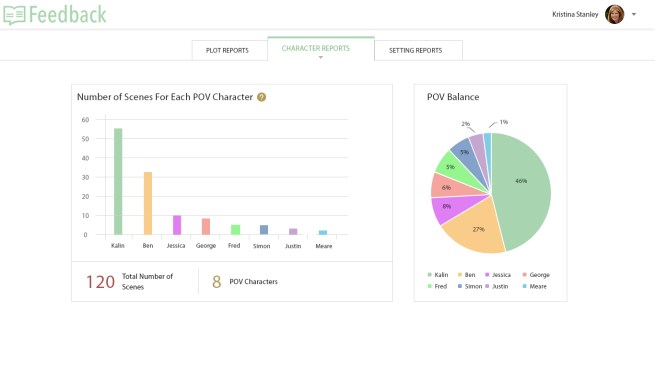
To illustrate how the Feedback app will help with your rewrite, I’m going to work through an example with Point of View (POV), one of most important elements of fiction for character. Having control over your point of view choices will enable you to rewrite a better story…

Read more: Source: Rewriting: Getting Your Point Of View Right – Feedback For Fiction

character-report-2

Feedback For Fiction | Self-Evaluating Scene Endings and Novel Structure

Self-Evaluating Scene Endings and Novel Structure

Imagine sitting on a plane next to a man reading your novel. You watch him read. He gets to the end of a scene and quickly turns the page to the next scene. He does this for hours. You watch the entire time, thrilled that he just keeps reading. He doesn’t take a moment to talk to you, to eat, or to drink. The TV shows and movies aren’t enough to draw him away from your book.

Isn’t this what we all want?

Read More and find out how to create great scene endings at: Feedback For Fiction | Self-Evaluating Scene Endings and Novel Structure

Feedback For Fiction | Self-Evaluating Scene Openings and Novel Structure

Self-Evaluating Scene Openings and Novel Structure

There are times when a person has the luxury of sitting down and reading a novel in one session. Wouldn’t that be nice if we could all do that? However, most of us read a novel in multiple sessions.

screen-shot-2016-11-23-at-10-11-46-amWhen you’re rewriting your draft, dreaming of creating a novel readers will love, it’s critical to think about how readers read.
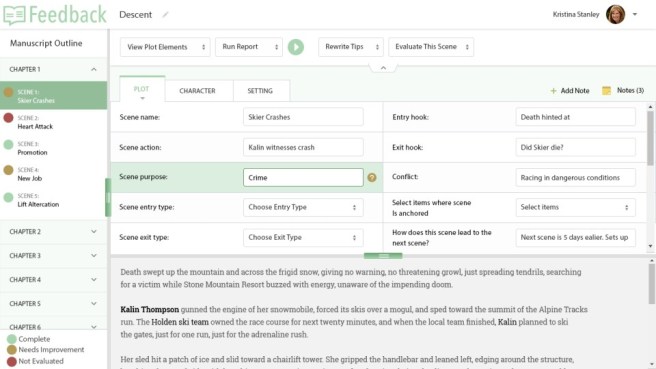
Many writing books talk about the importance of the first line, first paragraph and first page of a novel. If you don’t grab the reader then, you might lose them for good. There is a lot of pressure on a writer to produce an extraordinary first line for a novel. If your reader has put your book aside for a while and picked it up at a new scene, that scene opening has to all the things the opening of your novel does. So much pressure…but we have a process to help you.

When your readers start a new scene, they must be immediately be engaged in the scene. To ensure this happens, work through your revision as if you…

READ MORE at: Feedback For Fiction | Self-Evaluating Scene Openings and Novel Structure

Feedback For Fiction | Starting Your Rewrite With A Focus On Plot

Find out where to start your rewrite by focusing on plot first.

You’ve finished your first draft, and you’re about to embark on rewriting that draft, turning it into a novel readers will love. Now is the time to focus on story and structure. Word choice, style,…

Source: Feedback For Fiction | Starting Your Rewrite With A Focus On Plot

Feedback For Fiction | Rewriting: What’s In It For You?

In today’s world, fiction writers have access to many tools to create and publish novels. That puts writers in the luxurious position of having control over their novels and publishing what t…

Source: Fictionary| Rewriting: What’s In It For You?