Mystery Mondays: Jennifer Young on Researching Historical Fiction

I’m so pleased to have award winning novelist Jennifer Young on Mystery Mondays. She’s here to talk to us about researching historical fiction – something I’m in awe of.

Hot off the press: Cold Crash (eBook Edition) is free today on Amazon. Why not check it out and post a review for Jennifer?

Researching Tips for Historical Fiction

cold crash front cover
Cinnamon Press Debut Novel Winner

When I started writing Cold Crash, I looked online for music that came out in early spring 1952. I found ‘Tenderly’ by Rosemary Clooney, and it played on a continual loop as I wrote the first chapters of Max Falkland’s story. It even found its way into what eventually became chapter twelve.

As I researched further though, I found that while ‘Tenderly’ came out in the United States in spring 1952, Rosemary Clooney didn’t release any records until years later in the United Kingdom. Max Falkland lived in the UK, so I had a problem. Fortunately, Max is Anglo-American, so I simply added a reference to her grandmother posting the record to her from America.

I told this story at a reading I did last week, and another author and friend Helen Gordon asked if I ever fudged my historical details, pointing out that my obsession with historical accuracy sounded more like creative nonfiction than fiction. Cold Crash is undoubtedly fiction – I’ve never flown a plane and I’m certainly not an archaeologist – but the facts represented in the novel are as accurate as I can make them.

Coming from an academic background, I consider it vital to get those details right. I love reading historical fiction, and I adore the details of the past that makes the world rich and compelling. I don’t want to be distracted from the mystery or character development by wondering if one tidbit of information is correct. It’s very easy to get overwhelmed with research. Here’s some advice from my experience researching and writing about spring 1952.

Research broad brush stroke history first. I started with overviews of the 1950s – reading books ranging from Robert Opie’s 1950s Scrapbook to Jessica Mann’s The Fifties Mystique. I also read about the Korean War. Max has just come out of mourning as the novel opens, for her brother who was shot down over Korea. (I had to supplement knowledge gleaned from a childhood of watching M*A*S*H!)

While you’re writing, don’t disappear into the internet to check one obscure fact. I did this far too regularly, and you end up wasting precious writing time. You can always correct a historical fact, but if you never write, you have nothing to correct! In one case in Cold Crash, I left a mistaken detail in place. Max’s friend Emma says it’s nice to bake scones with dried fruit again, when Max has provided it. In April 1952, dried fruit was off rationing, but I decided to leave the dialogue in, as Emma doesn’t have the money to splurge on dried fruit.

If you have an area that particularly interests you, save that for last. It sounds counterintuitive – it might have been the reason you chose your historical period. However, a real danger exists that you will research that one area forever, and never write. I deliberately chose to do this with fashion. After I had a complete first draft of the novel, I went to the British Library and poured over fashion magazines for 1952. I loved looking at Harper’s Bazaar and Vogue issues, the very ones that Max would have read, seeing the ads she would have seen. It felt almost like shopping – I needed a ball gown for this scene, a dinner dress for this one.

This worked well for other areas too. Train travel is not my passion, but I knew I needed details of both the look of the LMS trains from London to Oban. An Illustrated History of LMS Coaches gave me pictures of the upholstery on the LMS train line, as well as the sleeping compartments. The microfiche version of Bradshaw’s Guide allowed me to find out the timetable of trains going between London and Oban – and that the reverse train didn’t run on weekends at all. I reorganised the timings of the novel to allow Max to travel on a Friday. Would anyone have checked? Probably not, but that detail mattered to me.

My final piece of advice is to enjoy the research – and also take it seriously!


Who is Jennifer Young?

Jennifer Young University of Hertfordshire. Photography by Pete Stevens ©Jennifer Young was born in a small textile town in North Carolina, USA and moved to the UK in 2001. She has since completed a PhD, become the daughter-in-law of a Catholic priest and gained British citizenship. Her degrees are from the University of North Carolina Chapel Hill, Cardiff University and the University of Southampton. She is a Senior Lecturer in Creative Writing and an Associate Dean of the School of Humanities at the University of Hertfordshire. Jennifer lives in North London with her husband and daughter.

Her novel Cold Crash won the Cinnamon Press Debut Novel Prize.

www.maxfalkland.com

@maxfalkland

https://www.facebook.com/ArchaeologyandEspionage/

Buy Cold Crash

Cold Crash

For archaeologist Maxine ‘Max’ Falkland, life in early-50s London is difficult enough as cold crash front covershe tries to move on from the death of her brother, an RAF pilot shot down over Korea. But, when she meets John Knox things get more complicated — before they get outright dangerous.

Flying her light plane to Scotland, Max overhears whispered arguments in Russian coming from the next-door room and sees lights across the moors that appear to answer flashes from the sea. Add the mysterious malfunction of her plane and she has a lot to confide when she encounters the enigmatic Richard Ash, a local landowner and recluse. But when Knox unexpectedly reappears and a dive goes disastrously wrong, Max must act fast as she finds herself in the middle of a Soviet military plot.

Cold Crash is the first of four novels that follows Max through archaeology and espionage from 1952 to 1953.

Thanks for reading…

Mystery Mondays: Heather Weidner on The Writing Life

Today on Mystery Mondays, we welcome author Heather Weidner to share her advice on becoming a writer and what she learned along the way. I connected with Heather because of the Pens, Paws, and Claws Website and Blog. If you like writing, and you like cats or dogs, this is the blog for you!

Over to Heather…

Key Things about the Writing Life

by Heather Weidner.

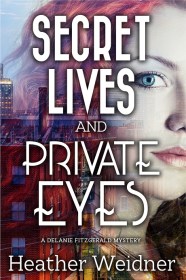
secret lives private eyes cover - webWhen I dreamed of being a writer, I had visions of working at my desk (at a house that overlooked the beach), doing TV interviews, and cashing royalty checks. I never realized how many marketing and other tasks are needed to sell books.
My debut novel launched in 2016, and the second in the Delanie Fitzgerald Mystery series is slated for mid-November 2017. For the first book, I planned a launch celebration and did interviews, author spotlights, and guest blog posts for 35 sites. I did a Facebook hop, a Goodreads give-away, radio interviews, and podcast interviews. I do about 50 book signings and presentations each year. And I am also a full-time IT manager, so writing and marketing get shuffled in with all the other demands of everyday life.

Here are some key things I’ve learned over the years about what it really means to be a writer.

  1. Publishing is a business. The goal is to sell books.
  2. Make sure that you’re writing your next book.
  3. Always be professional. Be on time and strive to meet all deadlines.
  4. Keep one master calendar for all your events and deadlines. Mine helps me stay organized with all the other parts of my life.
  5. Writing is a lot of work. The first few “sloppy” drafts need a lot of work.
  6. Build relationships through your social media platform. They make a difference.
  7. Set a blogging and social media schedule that works for you. These sites need care and feeding, but they shouldn’t be a 24×7 job.
  8. Everyone has an opinion. Comments and reviews can sting, but learn what you can from them and then move on.
  9. Try to write something every day.
  • Keep a notebook or electronic notes of names and story ideas. You never know when you’ll encounter something that’ll work in your next book or story.
  • Look at your social media posts. Make sure that they’re not all “buy my book.” Make sure that you share others’ celebrations on your social media sites.
  • It’s key for writers to network, market, and build their platforms. Just make sure you leave enough time for writing.
  • Collect email addresses at your events for your newsletter’s mailing list. Get a clipboard and make sure you take it with you to all events.
  • Writing is often lonely. Find a group of kindred souls. Look for other authors or groups who will assist and support you. (I am so fortunate to have my Sisters in Crime – Central Virginia, Sisters in Crime National, Guppies, and James River Writer friends.)
  • Find beta readers or a critique group to help you revise and edit your work.
  • Remind yourself that you do not have to do everything. There are lots of opportunities, but you can burn out if you’re constantly on the go. Take care of yourself.
  • Learn from your mistakes. Make note of how you’d do it differently next time.
  • I try a lot of events and marketing ideas. If it doesn’t work for me, I see what I can learn from it and move on.
  • Order bookmarks and postcards. Make sure you always have them with you.
  • Take pictures at your events or on your adventures to share on your website or social media platforms.
  • Review your website from time to time to ensure your content and photos are current.
  • Review your social media biographies or descriptions to ensure that they are current.
  • Make sure to back up your computer files. It’s devastating when you lose your work.
  • Keep your author headshot current. (People will comment if your picture is ten years old and no longer looks like you.)
  • Most of my correspondence is done via email. I keep lots of folders to ensure I can find the email when I need it. I also add new contacts to my address book immediately, so I don’t lose them.
  • Keep all your receipts and be diligent about tracking your mileage. You’ll be glad when it’s tax time.
  • When you schedule an event, ask about where you’ll be seated and what will be provided (especially if it is an outdoor event).
  • Keep a box of books in the trunk of your car. I’ve encountered times when the bookseller couldn’t get books in time for an event. Also, at several events, the bookseller sold out, so it was nice that I had some extras to provide on consignment.
  • Don’t give up. The writing life is a challenge, and it’s difficult sometimes, but it is worth it. I get excited every time that box of books arrives.
  • Take time to celebrate your wins and successes.

Who Is Heather Weidner?

Heather WeidnerHeather Weidner’s short stories appear in the Virginia is for Mysteries series and 50 Shades of Cabernet. She is a member of Sisters in Crime – Central Virginia, Guppies, Lethal Ladies Write, and James River Writers. The Tulip Shirt Murders is the second novel in her Delanie Fitzgerald series. Secret Lives and Private Eyes debuted in 2016.
Originally from Virginia Beach, Heather has been a mystery fan since Scooby Doo and Nancy Drew. She lives in Central Virginia with her husband and a pair of Jack Russell terriers.

Heather earned her BA in English from Virginia Wesleyan College and her MA in American literature from the University of Richmond. Through the years, she has been a technical writer, editor, college professor, software tester, and IT manager. She blogs regularly with the Lethal Ladies and Pens, Paws, and Claws.

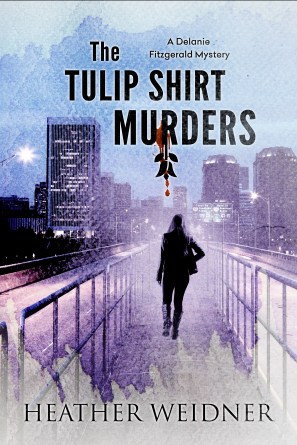
The Tulip Shirt Murders

TheTulipShirtMurdersFinalPrivate investigator Delanie Fitzgerald, and her computer hacker partner, Duncan Reynolds, are back for more sleuthing in The Tulip Shirt Murders. When a local music producer hires the duo to find out who is bootlegging his artists’ CDs, Delanie uncovers more than just copyright thieves. And if chasing bootleggers isn’t bad enough, local strip club owner and resident sleaze, Chaz Smith, pops back into Delanie’s life with more requests. The police have their man in a gruesome murder, but the loud-mouthed strip club owner thinks there is more to the open and shut case. Delanie and Duncan link a series of killings with no common threads. And they must put the rest of the missing pieces together before someone else is murdered.


The Tulip Shirt Murders is a fast-paced mystery that appeals to readers who like a strong female sleuth with a knack for getting herself in and out of humorous situations such as larping and trading elbow jabs with roller derby queens.


Contact Information

Website and Blog: http://www.heatherweidner.com

Twitter: https://twitter.com/HeatherWeidner1

Facebook: https://www.facebook.com/HeatherWeidnerAuthor

Instagram: https://www.instagram.com/heather_mystery_writer/

Goodreads: https://www.goodreads.com/author/show/8121854.Heather_Weidner

Amazon Authors: http://www.amazon.com/-/e/B00HOYR0MQ

Pinterest: https://www.pinterest.com/HeatherBWeidner/

LinkedIn: https://www.linkedin.com/in/heather-weidner-0064b233?trk=hp-identity-name


Mystery Mondays: Madeline McEwen with Guidance, Advice, and Jokes

This week on Mystery Mondays, it’s my pleasure to host author Madeline McEwen. I “met” Madeline when she joined the Imajin Books team this year.

Her novelette, Tied Up With Strings, will be published by Imajin Qwickies on the 11th December 2017. So keep an eye out for it!

Over to Madeline…

 Guidance, Advice, and Jokes

By Madeline McEwen

Thanks for the invitation, Kristina. I gave some thought about what to offer your readers: guidance, advice, jokes?

 Guidance first–how about that infernal problem—procrastination. Have no fear, I have several solutions whether you suffer from writer’s block or information overload. Both prevent productivity. If you find your time frittered away on social media and frivolous distractions then I am here to help.

Don’t get me wrong, social media is a Godsend to the isolated hermits of this world—the sparks keeping us connected, grounded, and alert to change. However, just like other addictions, moderation if our watchword. Instead, get your Internet fix—your reward–after completing specific, measurable goals. Make yourself a numbered and prioritized list, such as: one hour of writing / editing or 500 words / three loads of laundry / replace the air filter / de-mat the dog.

If you find you’re still dithering, use a paper template to make a 3-D cube, throw the di, and then do it.

Advice: buff your humor muscles as frequently as possible.

Joke: I love “knock knock” jokes, but Debra Purdy Kong got there first.


Knock 1


Knock 2


Here are a couple of mine:-

knock3

Who Is Madeline McEwen:

Madeline photoMadeline McEwen is an ex-pat from the UK, bi-focaled and technically challenged. She and her Significant Other manage their four offspring, one major and three minors, two autistic, two neurotypical, plus a time-share with Alzheimer’s. In her free time, she walks with two dogs and chases two cats with her nose in a book and her fingers on the keyboard.
Her novelette, Tied Up With Strings, will be published by Imajin Qwickies on the 11th December 2017, the first in the new series–The Serebral Seniors–celebrating the witty sparks of a ripening generation.

You can find me here:-

http://www.madelinemcewen.com

http://www.amazon.com/-/e/B00Q41VUFI

https://www.pinterest.com/macmaddy/pins/

https://twitter.com/#!/MadMcEwen

http://www.facebook.com/madeline.mcewenasker

https://www.goodreads.com/author/show/9886841.Madeline_McEwen

http://whittereronautism.com/


Mystery Mondays: Debra Purdy Kong on Traditional to Self-Publishing

This week on Mystery Mondays we welcome Debra Purdy Kong. I first came across Debra’s writing when I read Opposite of Dark. I loved the book and reached out to Debra on LinkedIn and was very excited to hear back from her. She’s an author who is generous with her time and her advice, which you’ll get some of below.

As you can imagine, I’m happy to host Debra on Mystery Mondays again.

Debra is here to tell you what it’s like to transition from traditional publishing to self-publishing.

I’ve just preordered my copy of Knock Knock and only have to wait 2 days for it to arrive on my kindle!

Over to Debra…

Maintaining Continuity in Changing Times

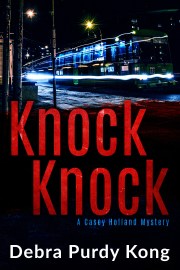
Knock Knock, front coverThey say that the only constant in life is change. This is especially true for writers. Over the years, I’ve lost count of all the magazines and publishers I’ve worked with, but who no longer exist. When the publisher for my Casey Holland series let me and several other mystery authors go in 2015, I took it in stride and decided to continue self-publishing my series.

It took time to obtain all of my rights back, but I did, and then reissued the first four books in ebook format. I’m now delighted to announce that the 5th installment in my Casey Holland mystery series, Knock Knock, will be released on Wednesday, November 8th!

The decision to keep the series going raised new issues. I no longer had access to the jacket designer and editors who’d worked on the previous four books. I needed to find professionals who would help me maintain the editing style already adopted. But even then, there were questions.

For instance, I was never partial to my editor’s decision to use American spelling in a series set in Canada with Canadian characters. But changing this in mid-series didn’t seem right either, so I sent the editor I hired a detailed list of editing needs.

I also sent the new jacket designer images of the earlier novels. She did a beautiful job of capturing the essence of the series while providing a fresh look that I’m thrilled with.

Change isn’t always easy and sometimes continuity can be a challenge, but when you’re writing a series readers appreciate it, which makes everything worth the effort.


Who Is Debra Purdy Kong

Debra Purdy Kong, 2016Debra Purdy Kong’s volunteer experiences, criminology diploma, and various jobs, inspired her to write mysteries set in BC’s Lower Mainland. Her employment as a campus security patrol and communications officer provide the background for Casey Holland and Evan Dunstan mysteries.
Debra has published short stories in a variety of genres as well as personal essays, and articles for publications such as Chicken Soup for the Bride’s Soul, B.C. Parent Magazine, and The Vancouver Sun. She assists as a facilitator for the Creative Writing Program through Port Moody Recreation, and has presented workshops and talks for organizations that include Mensa and Beta Sigma Phi. She is a long-time member of Crime Writers of Canada.


Look for her blog at https://debrapurdykong.wordpress.com/ More information about Debra and her books is at www.debrapurdykong.com You can also find her on Twitter: https://twitter.com/DebraPurdyKong & Facebook: www.facebook.com/debra.purdykong


Where to find out more:

Amazon: myBook.to/KnockKnock

Kobo: http://tinyurl.com/y6wejnls

Apple: http://tinyurl.com/y96xscpv


Mystery Mondays: An Inside Look at Anthologies by Medames of Mayhem

When M.H Callway approached me about hosting Medames of Mayhems on Mystery Mondays, I was thrilled! As a Canadian, showcasing a collection of Canadian mystery authors makes me proud of the writers in our little country.

The newly released Anthology is a must read for mystery lovers. You’ll get exposed to a variety of styles and stories, so why not check it out.

Now over to the Medames…

13 CLAWS BY THE MESDAMES OF MAYHEM

What is 13 Claws?

claws2

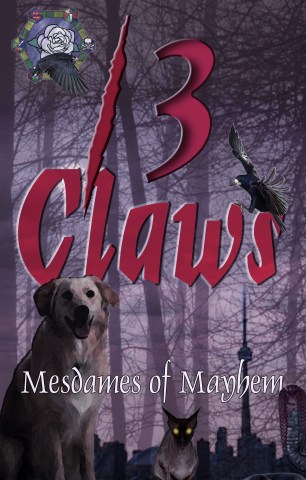
13 Claws is the third anthology by the Mesdames of Mayhem. It’s a collection of 17 crime fiction stories by 15 authors, three of whom are newcomers to the genre.

We are all animal lovers so it’s natural we’d pen tales centred on our non-human friends. Caro Soles rescues dachshunds from puppy mills and Melodie Campbell’s “Frankenpoodle” works as a therapy dog. All of us own – or have owned – a cat or a dog and like Jane Burfield, several of each at the same time. Cheryl Freedman though favours much more exotic pets: ferrets!

Few cozies in our book though. Perhaps it’s the influence of our troubled times, but our writing has taken a decidedly darker turn.

Who are the Mesdames of Mayhem?

We are 15 established Canadian crime fiction authors. Most of us have won or been nominated for major awards like the Arthur Ellis, Edgar, Derringer, Debut Dagger, Bony Pete and Ippy.

Back in 2013, I had the idea that my two literary critique groups should join forces on social media. Donna Carrick designed our website, set up our Facebook and Twitter accounts – and the Mesdames of Mayhem were born.

Our goal is to promote Canadian crime fiction. Many readers here at home don’t realize that their favorite crime writers may be Canadian. And of course, many American readers never hear about Canadian titles.

We work to promote women crime writers and many of us are longstanding members of Sisters in Crime. It might surprise readers that Sisters in Crime has Brother members, men who promote equity for women authors. I’m happy to say that the Mesdames have a Monsieur of Mayhem, Ed Piwowarczyk.

All of us are published short story writers and most of us are novelists. Several of us are also proficient in other forms of fiction: Lisa De Nikolits and Sylvia Warsh are literary authors; Melodie Campbell and Caro Soles have written books in fantasy and speculative fiction; and Rosemary Aubert is a respected poet. Catherine Dunphy is a biographer and she and Madonna Skaff write for young adults.

For details, do check out our website.

Why create three anthologies?

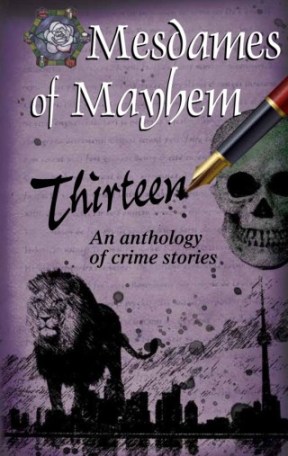
13 Claws is our third anthology. When we first got together, we thought that an mesdames-thirteen-coveranthology would be a great way readers could get to know the work of many different writers. We do write from comedy to noir. Even better, our readers could go on to read more books and stories by the writers they enjoyed.
To our delight, Thirteen, did really well and the stories by Donna Carrick and Sylvia Warsh were nominated for the Arthur Ellis Short Story award. That encouraged us to issue our second anthology, 13 O’clock with crime stories focused on time. And later, our third collection, 13 Claws.

Why “Thirteen” in the titles?

When we put together our first anthology, 13 of us contributed stories. So I thought: why not simply call our collection Thirteen?

And 13 has proved to be our lucky number! Promoting our anthologies has led to numerous public readings, warm partnerships with our public libraries and community theatres, participation in literary festivals like Word on The Street, radio interviews, you name it – more publicity than we ever anticipated or imagined.

13 Claws features three newcomers? How did that happen?

We love to teach. Several of us teach or have taught creative writing: Catherine Astolfo, Rosemary Aubert, Mel Campbell, Cathy Dunphy, Lynne Murphy, Rosemary McCracken, Caro Soles and Sylvia Warsh.

For 13 Claws, we ran a contest for writers who had never published a crime fiction story. Our winner, Mary Patterson, has a delightful story about a cat detective though she’s actually a dog lover. Our finalist, Roz Place wrote a chilling suspense tale about a disappearance revealed by a cat. And in our other runner-up, Marilyn Kay’s police procedural, a stray cat is at the heart of dark crime.

What do reviewers say about 13 Claws?

Our previous anthologies have been warmly reviewed but we were especially delighted to be singled out by Jack Batten, the crime fiction reviewer at the Toronto Star, who had this to say about 13 Claws:

In one especially clever story by Catherine Dunphy, we get a plot built around boxes of animal crackers.

But just because the contributors to the collection write out of an affection for animals doesn’t mean readers need similar feelings to appreciate the stories. There’s enough suspense and intellectual fascination built into the plots of the majority of stories to satisfy even the most ferociously cynophobic reader. Catherine Astolfo’s story involving a pig offers an intriguing way of giving Paul Bernardo himself a case of the chills. And M. H. Callway’s tale mixes snakes and the real estate business in a way that will make readers run a mile from both.

Maureen Jennings, creator of the famous Murdoch series, writes:

A great mix of shuddery dark and tongue-in-cheek funny. What devious minds all these nice women have.

And Vanessa Westermann, reviewer for Sleuth of Baker Street newsletters, writes:

I can only recommend it. There’s something here for everyone. The stories, ranging from cozy mysteries to thrillers, feature cats, dogs, dragons and snakes – some of which are quite mischievous. As stated on the Mesdames’ website, the writers all share one mission: to thrill readers with their passion for Crime Fiction.

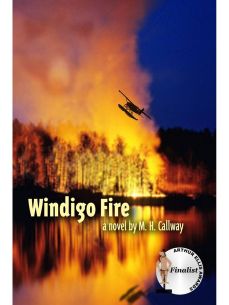
WHO IS M. H. CALLWAY?

windigo

M.H. Callway is the pen name of Madeleine Harris-Callway, the founding member of the Mesdames of Mayhem. Her debut thriller, Windigo Fire, was short-listed for the Arthur Ellis Best First Novel award.

Her award-winning short crime fiction stories and novellas have been published in several anthologies and mystery magazines and are available in the book, Glow Grass and Other Tales.


Where to Find Out More

www.mesdamesofmayhem.com

Amazon link to 13 Claws:

Amazon link to Thirteen:

Amazon link to 13 O’clock:


Mystery Mondays: Luke Murphy On Writing A Sequel

Today, we have the pleasure of welcoming author Luke Murphy to Mystery Mondays. Luke’s new book. WILD CARD, was released last week by Imajin Books.  He’s here to talk about writing a series – something he has a lot of personal experience with.

I met Luke via Imajin Books, loved the first two books in the series: DEAD MAN’S HAND and KISS & TELL and am looking forward reading WILD CARD.

Over to Luke…

Writing A Sequel

By Luke Murphy

So I’ve written my first sequel, which was a new experience for me. WILD CARD is the second part to my debut novel, DEAD MAN’S HAND. I have no plans, no idea how many books I’ll write with these characters. I’ll just write, and see where the characters take me. Who knows?

PROS: There are definitely some benefits to writing a sequel.

Characters

For one, the main cast of characters are already formed. Readers are familiar with the main characters in the series, and there is no need for a lot of backstory to get readers caught up, or a lot of explicit detail to show character traits and physical appearances.

Setting

Since I already researched the setting of my first novel, I can save that time for novel #2, because I am already familiar with the city (Las Vegas) that I’ve chosen for the setting of my adventures.

Readers/Fans

Since I have book #1 under my belt, I’ve already formed a small fan base and readership who are earnestly awaiting my next novel. I won’t have to worry about reaching those readers, as they are returning customers, and will already be searching out my books.

CONS:

Expectations

Because DEAD MAN’S HAND garnered so much attention and success, now there is a level of expectation that comes with my next book. With so much praise and five-star reviews, readers have a high expectation of what they are looking for with a new Calvin Watters’ book.

Time

I don’t have to tell you that it’s a lot faster to read a book than it is to write it. Readers are expecting another book as soon as they finish reading the previous one. It took me five years to write the sequel to DEAD MAN’S HAND (sandwiching another book in between), and once readers have finished WILD CARD, they will be expecting another Calvin Watters adventure. I might not have time to breathe.

Ideas

There are only so many ideas/conflicts to write about, so coming up with new, fresh ideas for my characters with each new novel, can possess a bit of a challenge for a writer.

With all that said, I really enjoyed writing WILD CARD, the sequel to DEAD MAN’S HAND, and I look forward to possibly writing more Calvin Watters’ adventures in the future.

WILD CARD

Pageflex Persona [document: PRS0000040_00071]This time, it’s not a job.

After proving his innocence as a murder suspect, taking down an assassin, and being an instrumental part in solving a high profile murder, Calvin Watters believes he can finally move on—until Ace Sanders’ prison escape catapults him into action.

This time, it’s personal!

Something has always bothered Detective Dale Dayton about the arrest of Ace Sanders. Call it police intuition, but his inner ‘cop alarm’ keeps twitching. When Dale reopens the case, he’s introduced to new evidence that leads him into a political nightmare.

Who will play the Wild Card to survive?

While Calvin tracks Sanders across continents and into unknown, unfriendly surroundings, Dale remains in Vegas to uncover the truth behind police corruption, prison escapes, and hired assassins. But Calvin and Dale must be vigilant, because there’s a deadly, new player in town.

Who Is Luke Murphy?

1425368_517024845062353_568710561_oLuke Murphy is the International bestselling author of Dead Man’s Hand (Imajin Books, 2012) and Kiss & Tell (Imajin Books, 2015).

Murphy played six years of professional hockey before retiring in 2006. His sports column, “Overtime” (Pontiac Equity), was nominated for the 2007 Best Sports Page in Quebec, and won the award in 2009. He has also worked as a radio journalist (CHIPFM 101.7).

Murphy lives in Shawville, QC with his wife, three daughters and pug. He is a teacher who holds a Bachelor of Science degree in Marketing, and a Bachelor of Education (Magna Cum Laude).

Wild Card, a sequel to Dead Man’s Hand, is Murphy’s third novel.

For more information on Luke and his books, visit: http://www.authorlukemurphy.com, ‘like’ his Facebook page www.facebook.com/AuthorLukeMurphy and follow him on Twitter www.twitter.com/AuthorLMurphy

Review Blurbs

“All the danger, treachery, and action a thriller reader could wish for. Luke Murphy has the touch.”

—Steve Berry, New York Times bestselling author of The Lost Order

“Hold on for a wild ride that doesn’t end until the last page.”

—Jordan Dane, bestselling author of the Sweet Justice series

“Murder, sex, hackers…an elaborate criminal chess game: Luke Murphy delivers.”

—Bryan Gruley, author of the Starvation Lake trilogy

Mystery Mondays: Dave Butler on MYSTERY WRITERS PAYING IT FORWARD

DaveButler_profilepicThis week on Mystery Mondays, I’m pleased to host author, Dave Butler. Dave lives a couple of hours from my home in British Columbia, Canada.

I’ve hosted authors from all over the world, and this is the closest one has been in distance. Kinda cool, I think.

And congratulations are in order. Full Curl was short listed for the 2015 Crime Writers of Canada Unhanged Arthur Ellis award for best unpublished crime fiction. Now Full Curl is published by Dundurn Press!

So over to Dave…

MYSTERY WRITERS PAYING IT FORWARD

By Dave Butler

Paying it forward: “beneficiary of a good deed repaying it to others instead of to the original benefactor.”

 Coming to mystery writing from the world of business, I was ready for the worst. In the list of literary genres, mystery/thriller is second only to romance/erotica in sales (there’s a cross-over opportunity there, but I digress…), so I knew that the potential for fame and fortune was very high (😉). I expected that writers would jostle with each other in dog-consumes-dog, winner-take-all battles, that trade secrets would be held close to protective chests, that there’d be fisticuffs for the right to be noticed by a tiny pool of hungry agents and publishers, and that despairing writers would pounce on every opportunity to trip up competitors and then step over (or on) their cold corpses to get ahead.

And with many of us living lonely solitary lives, with long hours and little in the way of validation or gratification, I assumed that the potential was also high that I’d be interacting with people who were one rejection slip away from being basement-dwelling serial killers.

However, I was wrong. It has been a pleasant surprise to discover that it’s not like that at all (with the possible exception of the serial killer potential … that I’m still not sure about…). Instead, I’ve found writers, particularly in the mystery/thriller world, to be incredibly gracious, open and friendly, and welcoming to newcomers.

In my own situation, I was lucky to have Full Curl, my first novel, shortlisted for the Unhanged Arthur Award in 2015. I had no idea what to expect when I attended the Crime Writers of Canada’s Arthur Ellis awards banquet in Toronto. While I didn’t win (way to go, Elle Wild!), I was immediately overwhelmed by how welcome I felt.

As an example, I shared dinner that evening with Ian Hamilton (author of the successful Ava Lee series). He was patient with my rookie questions, and kind in sharing experience and advice. In a Toronto bar later that evening, over a glass or two of Forty Creek whisky, he asked me the pivotal question that then played a role in a multi-book deal for me. “Why don’t you write a series?” he asked.

That same pattern has been repeated many times. I see it when I share a coffee with other mystery writers, when I read communications from the Crime Writers of Canada, and when I attend workshops and conferences. It’s almost as though “paying it forward” has become what we do in our genre.

One could argue that holding everything close to our chests might mean that we can grab more of the pie for ourselves. But I’ve realized that growing the genre, both in readers and writers, is good for all.

It’s clear that deciding to “pay it forward,” or not, is very much an individual decision. Perhaps it’s a moral and ethical responsibility, but it depends on your own perspective and your own experience. And it doesn’t mean spending so much time helping others that you miss deadlines, or lose the muse. But by sharing information on the writing life, on the business of writing, we all move ahead.

For me, there’s no doubt that I’ll “pay it forward” to recognize the kindness and generosity of those who have helped me. But at the same time, if I meet a writer who invites me in to see his/her pile of rejection letters, I refuse to go in their basement!

Who is Dave Butler?

OLYMPUS DIGITAL CAMERADave Butler is a mystery/thriller writer from Cranbrook, BC who is the author of the Jenny Willson mystery series (Dundurn Press). Full Curl, the first in the series, in on store shelves now.
He’s a forester and biologist living in Cranbrook, British Columbia, in the shadow of the Rocky Mountains. His writing and photography have appeared in numerous Canadian publications. He’s a Queen Elizabeth II Diamond Jubilee Medal winner, and a Fellow of the Royal Canadian Geographical Society. When he’s not writing, Dave is professionally involved in sustainable tourism at local, national and international levels and he travels extensively. www.davebutlerwriting.com

Mystery Mondays: Will Macmillan Jones on What Makes a Mystery Successful

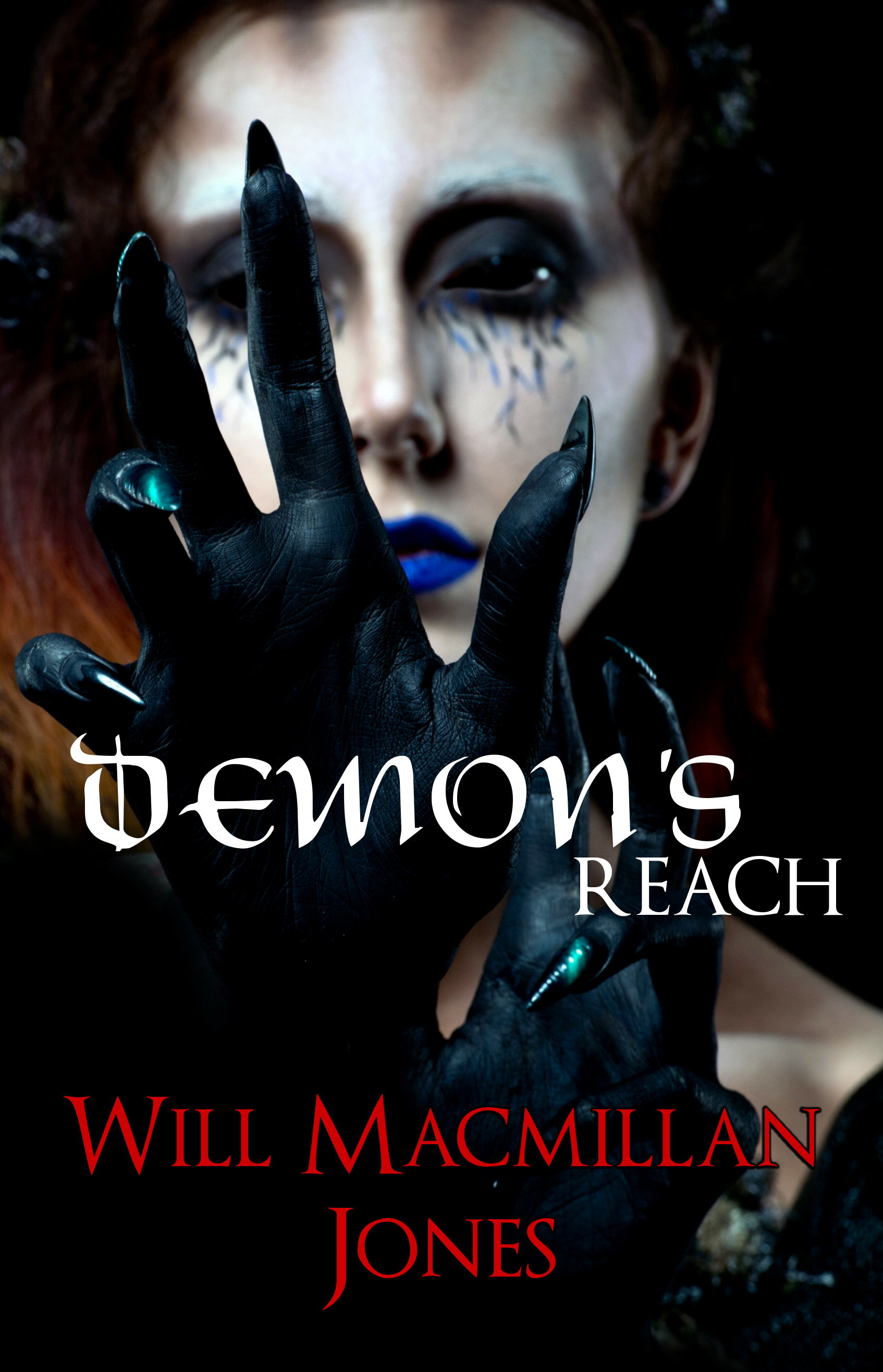
Demon_s_Reach_Front_CoverWelcome to this week’s edition  of Mystery Mondays. This week, author Will Macmillan Jones is here. You can probably tell by the cover, Demon’s Reach – 5th in the series – falls under the horror category.

Demon’s Reach will be released Oct, 20 2017 but you can pre-order now. Congratulation, Will!

The first in the series is The Showing.

Will is shares his journey in writing and along the way gives us his take on a successful mystery.


What makes a Mystery Successful

By Will Macmillan Jones

 Come on admit it: we all love a mystery. There’s the challenge of trying to outguess the author by picking up clues too early*; the sneaky pleasure of realising that you were right all along where other readers would have failed to identify the killer so soon – more commonly achieved on the second or third reading of a book, in my personal experience; the satisfaction in a decent denoument; and (hopefully) appreciation of the author’s skill in hiding the real villain of the piece until almost the last minute through careful misdirection.

It is the reason Agatha Christie was so successful. Many of her books have, with some justification, been accused of being formulaic: but all the factors for a satisfying reading experience are there in every book. Be it Poirot, or Miss Marple – the reader knows that the main character will uncover the truth, whether or not the perpetrator is ever brought to justice. In fact, the latter point is usually the least important (with the honourable exception of Christie’s book Nemesis, which is all about Justice, with a capital J), and the intellectual chase is the main point of the book.

This is where mysteries are a step removed from most crime novels, where the murderer is sometimes revealed early, to allow the reader to focus on the efforts of the Detective to uncover the truth. Wire in The Blood, a highly successful crime novel by Val McDiarmid (another successful novel transferred to TV by the way) is a great example, while Colin Dexter’s Inspector Morse novels are more akin to a Christie style with the perpetrator hidden for as long as possible.

Next up are the new generation of ‘Cosy Mysteries’. I’ve read more than a few of these, and while the crimes involved are frequently less grisly than Christie’s favoured felonies, for me they feel like the direct descendant of the tradition of Miss Marple, where an innocent (for a given value of innocent!) and certainly non professional character with no real police connections both uncovers and then solves the crime, all in a quite genteel way.

 A successful mystery novel may, but does not need, to hide the malefactor. This is just as well for me, when we move a little outside the comfortable zone I have considered so far, then we can move over to some of the darker stories around. Stephen King is normally considered just as a writer of horror, but that really isn’t strictly true. The supernatural forms a significant theme in a number of his books – Needful Things is a great example, and of course his breakthrough book Carrie, but several are mystery stories in their own right – although the characters involved may not be human, or even alive. Bag of Bones is the example I’d chose here.

Then of course we meet Dennis Wheatley, an author both revered and reviled in equal measure, mostly by people who have never read his work. For the record, he always describes the Black Magic he portrays as fundamentally wrong, and something to be avoided at all costs – and Evil never triumphs in his work, which always seems to me to be fundamentally highly moralistic. But besides the mystery of the abuse thrown his way, there are the mysteries portrayed in his books.

When I decided that I needed a change from writing humour, another niche genre to horror and carrying its own rules and challenges (not the least of which is finding readers!), I knew that I wanted to write in the paranormal genre. Not Romance, of course, anything but that! I loathe sparkly vampires and not-very-hairy werewolves** who have other designs on attractive men or women than ripping their throats out. Besides, as my ex would tell you at great length if you were to ask her, I am one of the most unromantic people to ever walk the earth. My last publisher once invited me to a Romance Writers Convention, probably after reading my work Bass Instinct, which was written just after my ex and I had parted, an event that might have somewhat coloured my views on Romance. I digress. Sorry.

Anyway, I had grown up reading some Dennis Wheatley novels that I had quietly removed from my Grandfather’s library without my parents’ knowledge, and worked out that while the settings of the novels were reliably Gothic and Magical and very dark, the story in each novel was fundamentally a mystery. A murder or an abduction perhaps? Illictly gaining money is always a motivating factor, is it not? Both in life (according to the lesser quality of newspapers) as well as mystery novels. These were in Wheatley’s books, I was delighted to discover when I started rereading them. As, inevitably, was the desire for Power. In fact, all the myriad of vices known to the human race could become the subject of a novel, viewed through the right prism. Just, of course, as they are in conventional mystery or detective stories. The paranormal just adds an extra dimension and offers an opportunity for the writer to deceive the reader in fresh and unexpected ways.

That was the great pleasure that, as a writer, I found in sailing blithely into the Paranormal Mystery genre. The joy for the reader is, in any mystery, accepting the challenge laid down by the author; and trying to discover the hidden secret of the novel from the clues laid out before the reader in the text. The joy for the writer lies in setting out these clues, and then using misdirection and red herrings to conceal the truth of the mystery for as long as possible. Hopefully to the final chapter. Adding the Paranormal into the mix gives the writer many, many more opportunities to have fun!

And of course, to offer the reader a few frights, chills and scary delights along the way. If I make you go to sleep with the lights on for a night or two, well that’s my bonus payment for the labour involved in writing the book, isn’t it?

*I have a friend, a well known author with an Amazon released film or two to her credit, who writes the first draft of a novel, and then rewites it to change the identity of the killer in an effort to prevent readers catching on.

** Ooops. Just alienated a huge potential audience, there, I suspect. But I’m a bit of a traditionalist and like my monsters to be more evil than your local Bank Manager or Traffic Enforcement Officer.


Who is Will Macmillan Jones?

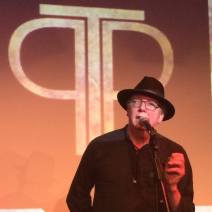
fwrness 2Will Macmillan Jones lives in Wales, a lovely green, verdant land with a rich cultural heritage. He does his best to support this heritage by drinking the local beer and shouting loud encouragement whenever International Rugby is on the TV. A just turned sixty lover of blues, rock and jazz he has now fulfilled a lifetime ambition by filling an entire wall of his home office with (full) bookcases. When not writing, he is usually lost with the help of a satnav on top of a large hill in the middle of nowhere, looking for dragons. He hasn’t found one yet, but insists that it is only a matter of time.
When not performing as an oral storyteller and poet, he writes Dark Fantasy, fantasy he fantasises is funny, and books for children. Some of his pieces have won awards but he doesn’t like to talk about that as it draws attention to the fact that other pieces haven’t.

http://www.willmacmillanjones.com

Will Macmillan Jones is responsible for the ‘Mister Jones Mysteries’ collection of books, released through Red Kite Publishing. The latest, Demon’s Reach, will be released on 20 October 2017. They are available in both paperback and all ebook formats.

Mystery Mondays: Lyn Horner on Formatting & Publishing on Amazon

Today on Mystery Mondays we have Lyn Horner here to give us an in-depth lesson on how to format and publish your book on Amazon. This is a great resource if you’re about to embark on a self-publishing journey.  Thanks Lyn!

Over to Lyn…

Formatting & Publishing Your Book on Amazon

by Lyn Horner

Many thanks to Kristina for having me on her awesome site. I’m a self-published author with 15 books on Amazon. Some authors hire a service to format and upload their books to Kindle Direct Publishing (KDP), Amazon’s self-publishing platform, but I do it myself. Today I’ll share what I’ve learned about the process.

**First, make sure your book meets Amazon’s content and quality guidelines.

 Then prepare your manuscript:

  1. Back-up your book file onto an external drive or one of the cloud backup sites (or both.) Copies can be a life saver if anything goes wrong during formatting.
  2. Combine your chapters. If you normally save chapters separately, you need to combine them into one document. Insert a page break at the end of each chapter to prevent them from running together in the uploaded book.
  3. Remove page numbers. Kindle books are reflowable (viewable in different font sizes). Page numbers would cause problems. Also remove any headers with the book title, your name, etc.
  4. Your font style must change sizes easily on a variety of devices. Times New Roman 12 pt. works well. Enlarge font for chapter headings.
  5. Remove paragraph indent tabs to avoid uneven indents in your ebook. To remove, type one tab at the top of your document, select and copy it. Open Find in the Edit menu. Paste the tab you copied into the Find box. (Word won’t let you type in the tab.) Open Replace in the Edit menu but leave the box empty; click Replace All. This will remove all tabs from your document.

To replace indents, select one whole chapter at a time, except the chapter title. Go to Indents and Spacing in your Paragraph drop-down. Set your first line indent at 0.5″ (default width) or smaller if preferred. Click okay. WORD will indent each paragraph for you. This does not cause problems with the Kindle conversion.

  1. Do not double space, no double line spacing and no double spaces after each sentence.
  2. Do not underline to indicate italics. Just italicize the word. Be sure to italicize foreign word. They will be underlined in red by the Word spell checker, but those lines will not show in your uploaded file.
  3. Indicate scene breaks within a chapter by centering three or four asterisks, pound signs or other symbol on a line between scenes. For point of view changes in a chapter, I simply insert a blank line. I want readers to know which character’s POV they’re in.
  4. Front and Back matter: Create a title page at the start of your book. See published books for style ideas. Add a copyright page after the title page. Again, see examples in published books. Next, add a dedication page and/or preface if you wish.

End your book by thanking your reader for purchasing it and include live links to your Amazon author page, website, social sites, etc. Then add a brief author bio and review snippets if you have them. Place a page break at the end of each page in your front and back matter.

  1. Amazon wants a table of contents (TOC) even in fiction ebooks, allowing readers to navigate easily. Some authors don’t include one, but I do. Each chapter title in the TOC must link to that chapter in your book. I also include links to my front and back matter pages. Find instructions for creating a TOC in your Word program.
  2. Create an HTML copy. You can upload your book as a doc or docx file, or in html format. To do that, first save your formatted book as a Word document first, in case you need it later. Then hit “Save As” and choose “Web Page, Filtered” as the file type. This converts it to an HTML file.


Another option is to have your book converted to mobi, the Kindle format, by a professional service, but it’s not necessary in most cases.

Okay, your book is ready to upload. Now what?

–Use your Amazon account to sign in to KDP or create a new one.

–Make sure your browser is updated.

–Go to your KDP Bookshelf. In the “Create a New Title” section, click +Kindle eBook and

enter your information for each section:

Kindle eBook Details: Enter title, description, keywords, categories, etc.

Kindel eBook Content: Upload manuscript and create your cover. (That’s a whole different post.) Preview your eBook to make sure everything looks good.

Kindle eBook Pricing: Select the territories where you hold distribution rights. (In most cases you should select Worldwide.) Select a royalty plan and set your list price.

  1. Click Publish Your eBook. Wait ’til your book is live on Amazon, then celebrate!

WHO IS LYN HORNER?

Lyn in cat shirt cropped.2Lyn Horner resides in Fort Worth, Texas, with her husband and several very spoiled cats. Trained in the visual arts, Lyn worked as a fashion illustrator and art instructor before she took up writing. She loves crafting passionate, action packed love stories, both historical and contemporary. Her Texas Devlins series blends Old West settings, steamy romance and a glimmer of the mysterious. This series has won multiple awards and nominations.


Lyn is now writing book 7 in her Romancing the Guardians series. These books combine her trademark psychic phenomena with chilling apocalyptic prophesies and sizzling romance. All feature suspense and adventure in settings ranging from Ireland to Texas, the Navajo Nation and other exotic sites.

Profiling Nathan

Pageflex Persona [document: PRS0000038_00074]Nathan Maguire just wants to make a living inking tattoos in steamy Tampa, Florida, but a serial killer is murdering young women near his shop. Latino gangbangers are giving him trouble. On top of all that, he’s a covert Guardian of Danu sworn to protect one of seven ancient scrolls containing apocalyptic prophesies.
When sexy FBI profiler Talia Werner delivers a message from one of the other Guardians, Nate instantly distrusts her. No one outside the top-secret group is supposed to know they exist, but despite his suspicions, a fiery attraction ensnares the pair. Then, to save Talia’s pretty neck, Nate must help catch the murderer. His psychic gift may come in handy.


Five Star Review from mystery author Craig A. Hart

Lyn Horner doesn’t waste any time getting into the meat of the story with this book. One thing that bothers me about a lot of writers is that they take forever to get to the actual story–not an issue here!

I also enjoyed the characters. Nathan Maguire, a psychic tattoo artist, and Talia Werner, a sexy FBI profiler are both larger than life and help move the story along.

The story itself is a good mix of romance and murder mystery, so there’s something for everyone! Horner also does a good job of creating some great Florida atmosphere, although early on in the book, I got hungry for a Cuban sandwich and had to stop reading to eat something!

A great read!

Profiling Nathan buy links:

US Amazon     UK Amazon     CA: Amazon     AU Amazon

Amazon Author Page: http://amzn.to/Y3aotC

Lyn’s Romance Gazette: (http://eepurl.com/bMYkeX

Lyn Horner’s Corner: (http://lynhorner.com)

Twitter   Facebook   Goodreads   Google Plus

Mystery Mondays: Amy Reade on Setting

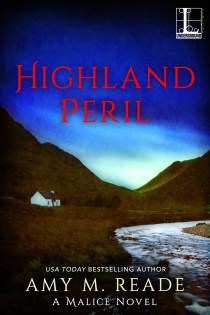
HighlandPerilToday, we are celebrating tomorrow’s release of Highland Peril by author Amy Reade.   Congratulations, Amy!
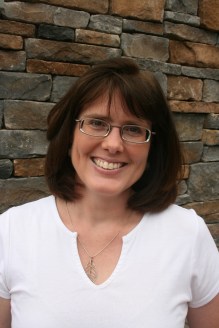
Amy hosts a fabulous blog called Reade and Write. Today she’s talking to us about one of my favorite subjects: SETTING.

Setting the Scene

by Amy Reade

Whether I’m on a panel or at a book signing or visiting a book club, one of the questions I’m frequently asked is whether I consider setting to be a character in my books. I get the question so often that I’ve started putting it in the back of each book as one of the discussion topics.

Here’s my short answer (and yes, I’m answering a question with another question): would the book be the same if it were set someplace else? If no, then I would consider the setting a character. If yes, then setting is probably not one of the characters, however important it may be.

Novels with a strong setting tend to be my favorite books. The main reasons I read are to learn and to be entertained. When a book has a strong atmosphere and sense of place combined with a strong plot, not only do I lose myself in the story, but I also get the opportunity to learn about a new place (or learn more about a place I already know). This is even true for places that don’t actually exist, such as a fantasy world or a fictional town. Two examples that immediately spring to mind are Hogwarts (from J.K. Rowling’s Harry Potter series), and Loch Dubh (from M.C. Beaton’s Hamish Macbeth series).

So how can a setting be a character? Let’s break down some of the qualities of well-drawn characters. Such characters generally have at least three components: personality, emotion or lack thereof, and the ability to change or move the plot along.

In some books, setting has those same three characteristics. Personality, emotion, and ability to move the plot forward can be indefinable when applied to a place rather than a person, but they are easily understood through examples.

Just as with a human character, a setting’s “personality” is its essence. Personality includes a place’s heritage, its culture, its climate; in other words, its specialness. Take, for example, a book set in New Orleans. New Orleans is a place of music, of storied cuisine, and of sultry heat. In any book I’ve ever read that takes place in New Orleans, at least one of those three components are essential to the plot. Such a book could never be set in Chicago without losing its essence.

And how about emotion? In much the same way a human character expresses emotion, a setting can be cheerful, spooky, stormy, listless, or almost any other adjective you can think of. This notion can be applied equally to any setting: towns and cities, houses, islands, boats, schools, hospitals, mountain tops, etc. You get the point.

When I think of a setting’s emotion, often what comes to mind is weather. Weather can play a huge role in a story—think of how wintry weather and blizzard conditions can affect the outcome of a particular plot. That same plot isn’t going to work as well if it’s set in a place where there are no blizzards; in other words, the frigid, blizzard-prone setting is essential to the story.

And when it comes to moving the plot forward, setting has the ability to do that as well as any character. In my first novel, Secrets of Hallstead House, the main character, Macy, can’t swim. The setting of the story is the Thousand Islands region of northern New York, on an island. When a person who can’t swim is put on an island, you can imagine the dread that can develop. And that story couldn’t have taken place, say, on a busy barrier island along the eastern seaboard—it had to take place on a small, isolated island in a region where the weather can be harsh and unpredictable. Just like a human character. There are several instances in Secrets of Hallstead House in which the direction of the plot is determined by the very nature of the island setting.

Now for my favorite part of this post. I’ve made a short list of some of my favorite books which feature setting as one of the characters. Though you may not be familiar with all of them, you are no doubt familiar with most of the titles. I am confident you’ll agree that setting is one of the main characters in each of these books. Remember, ask yourself this question: could this story have taken place anywhere else without losing its very essence?

To Kill a Mockingbird by Harper Lee and Gone with the Wind by Margaret Mitchell: the setting is an absolutely essential part of each of these books, both of which take place in the American south. I would go so far as to say these books wouldn’t even exist if it weren’t for the American south.

Rebecca by Daphne du Maurier: the setting of this book, the Cornish coast of England, is reflected in every action the characters take. Just like the characters, the cliffs and moors, the mansion, and the grounds in Rebecca are stormy, moody, and dark. The book would be fundamentally different if it took place anywhere else.

Heidi by Johanna Spyri: everyone knows the story of the little girl who went up the mountain to live with her gruff grandfather. The mountain is as important to the book as the main characters: Heidi loves the mountain just as she loves her grandfather and her friend Peter; the mountain provides a stark and necessary contrast to the bleak city where she lives temporarily. The story just wouldn’t be the same if Heidi lived in an area that was simply rural without being mountainous.

From the Mixed-Up Files of Mrs. Basil E. Frankweiler by E.L. Konigsburg: if you’re not familiar with this book, the majority of the action takes place in the Metropolitan Museum of Art in New York City. The main characters, a brother and sister, run away from home and live in the museum for a time, trying to solve a mystery they find there. Whenever I think of this book, it’s the museum that comes to mind, not the human characters, not the mansion in the suburbs where they find someone who helps them in their quest, not the streets of New York City. It’s the museum—a setting-character if ever there was one.

Black Amber by Phyllis A. Whitney: this book, probably my favorite of Whitney’s works, is set in Turkey. The plot and setting are inextricably linked—you can’t have one without the other. The story wouldn’t be the same if it were set in, say, Michigan (not that there’s anything wrong with Michigan).

Finally, to my new book, Highland Peril, which comes out tomorrow. As in all my novels, the setting in Highland Peril is one of the book’s most important elements. The main characters live in a little village called Cauld Loch, and though I had to send them to London and Edinburgh for short stints, they always return home to the Highlands. The beauty, the majesty, and the rugged landscape are as important to the story as any character. If you get a chance to read the book, I hope you’ll agree.

Please share your thoughts about books with setting-characters. What are your favorites? Which ones stick in your mind?

Kristina, thank you so much for having me here today. I love the Mystery Monday posts because they make me think, and I hope I’ve done that for your readers.

Who Is Amy Reade?

Amy M. ReadeAmy M. Reade is a cook, chauffeur, household CEO, doctor, laundress, maid, psychiatrist, warden, seer, teacher, and pet whisperer. In other words, a wife, mother, and recovering attorney. But she also writes (how could she not write with that last name?) and is the author of The Malice Series (The House on Candlewick Lane, Highland Peril, and Murder in Thistlecross) and three standalone books, Secrets of Hallstead House, The Ghosts of Peppernell Manor, and House of the Hanging Jade. She lives in southern New Jersey, but loves to travel. Her favorite places to visit are Scotland and Hawaii and when she can’t travel she loves to read books set in far-flung locations.

Where Can You Find Amy?

Website: www.amymreade.com

Blog: www.amreade.wordpress.com

Facebook: www.facebook.com/amreadeauthor

Facebook: www.facebook.com/groups/AmyMReadesGothicFictionFans

Twitter: www.twitter.com/readeandwrite

Pinterest: www.pinterest.com/amreade

Instagram: www.instagram.com/amymreade

Amazon Author Page: https://www.amazon.com/Amy-M.-Reade/e/B00LX6ASF2/ref=ntt_dp_epwbk_0

Goodreads Page: https://www.goodreads.com/author/show/8189243.Amy_M_Reade

And Finally, Where Can You Buy Highland Peril?

Amazon: http://amzn.to/2uaP5dq

Barnes & Noble: http://bit.ly/2uzgzcD

Kobo: http://bit.ly/2v9ooHB

Google Play: http://bit.ly/2vKh6Hh

iTunes: http://apple.co/2ePwnTf

Independent Bookstore: http://www.indiebound.org/book/978151610018

Thanks for reading…