How to Write a Description For the Back Cover of Your Novel

Writing a Book Description?

Here are some ideas that might help. I’ve shared my book description (blurb) for DESCENT, the first novel in The Stone Mountain Mystery series, below and outlined how we arrived at the final description.

Step One: Decide what you want to tell the reader. You want to give away enough to intrigue the reader but not so much that you take away from the suspense. I was tempted to put too much information in the description and pulled back a bit.

The goal of DESCENT’s description is to give the potential reader the idea that:

  • Kalin Thompson is the protagonist
  • The story takes place in a remote mountain resort
  • The crime is a murder
  • The victim is a talented ski racer
  • Ongoing conflict between Kalin’s boyfriend and her boss will be a struggle for Kalin

Once you know what you want to say,  write, rewrite and rewrite again.

Step TwoDecide who your audience is. For me, I want an international audience. How does that affect the description? I’d used RCMP in the description? You’ll see below that RCMP is now cops. RCMP is a very Canadian acronym. My bad for assuming it was a world-wide term 🙂

Step Three: Get feedback from anyone you trust. Then write, rewrite and rewrite again.

Final Product: The idea behind the two paragraph description below is if we need a short version, we can use the first paragraph only. The first paragraph is designed to end with a hook just in case that’s all we use. I hadn’t thought of that in my first try at a description.

The back of the book description for DESCENT is:

When Kalin Thompson is promoted to Director of Security at Stone Mountain Resort, she soon becomes entangled in the high-profile murder investigation of an up-and-coming Olympic skier. There are more suspects with motives than there are gates on a super-G course, and danger mounts with every turn.

Kalin’s boss orders her to investigate the murder. Her boyfriend wants her to stay safe and let the cops do their job. Torn between loyalty to friends and professional duty, Kalin must look within her isolated community to unearth the killer’s identity.

Now as with other changes, I have to wade across the internet and change everywhere I’ve put a blurb out for DESCENT.

If you haven’t read my blog before, I’ve signed on with Imajin Books and intend to blog about my publishing adventure. I’ll share what I learn and hope it helps someone out there get their novel published.

Thanks for reading…


Before You Submit: Paragraph Breaks and Dialogue

Do you have a draft of your novel or short story and are thinking of submitting to an agent, publisher or writing contest? My series called Before You Submit might help. This series contains hints and tips I’ve received from professionals in the publishing industry. Each week I’ll share a new tip.

This week I’ll write about Paragraph Breaks and Dialogue.

I was reading through an editor’s notes on an early draft of my novel and had to laugh at my mistake.

The editor’s advice:

Start a new paragraph for each speaker.

This is simple advice and something I don’t think about now. It comes naturally, but when I started writing, it was one more skill I needed to learn. The skill of paragraphs breaks.

I hope this helps improve your writing.

See Before You Submit:Likeable Characters for the first blog in this series and an introduction the benefits of submitting even if you get a rejection letter.

Thanks for reading . . .

The Writing Process Blog Hop

Calgarian Garry Ryan, author of the Detective Lane mystery series and the Blackbirds Trilogy, asked me to be part of the blog hop. Of course I said yes to Garry. You may have heard of the Crime Writers of Canada. When Garry was the president, I was lucky enough to have him as my mentor as part of the CWC mentorship program. Garry worked by my on my Manuscript, Burnt, which has since been nominated for the Debut Dagger by the Crime Writers Association in the UK. How could I not be excited to follow Garry in the blog hop?

This is your chance to get a looking inside a writer’s  mind, or in this case many minds if you follow the blog hop.

I have tagged two author friends to take part in the blog hop. The bio’s are listed below. Please check out their blogs too 🙂

Now to the reason for the blog hop:

What Am I Working On?

I read somewhere that life as a writer means having homework for the rest of your life. There is aways something to work on, whether it is writing, researching, social networking, learning, editing or proofreading. Then there is the query letter, blurb or synopsis to be written. Now add in my blog. All are part of being a writer and all can be very engaging tasks.

On the writing scene, I currently drafting the fourth novel in the Stone Mountain mystery series. The series takes place in a fictitious ski resort located in the depth of the Purcell Mountain Range in British Columbia, Canada.  The protagonist, Kalin Thompson, is the director of security and human resources at the resort in continually finds herself torn between running investigations and her friends who live in the small community. She can’t look for suspects without looking at one of her friends.

For editing, I am working on Look the Other Way. The novel takes place in the Bahamas and is a spin off from the Stone Mountain mystery series.

How Does My Work Differ From Others in It’s Genre?

Drugs and the drug industry gets a lot of focus in the BC press. i try to stay away from the topic. There are many great books by BC novelists that delve into this area. I’ve chosen other crimes, typically the type committed by an every day individual who has been pushed beyond their limits. I try to make wilderness living and wildlife interaction a character within my books.

Why Do I Write What I Do?

One night, while I was living in Germany, I tried to go to bed early. A company driver was to pick me up at 4 a.m. to take me to the airport. I was nervous about a presentation I was to make in London, England and wanted a good night sleep. Here’s where a small decision I made changed my future path. I picked up a novel, Moonlight Becomes You, by Marry Higgins Clark. It starts out with a woman trapped in a coffin. Now how could I put that down before finding out how she got out of the coffin. I read through the night until my car arrived. Exhausted, but excited, I knew I wanted to write something that would keep a person from going to sleep, even when they knew they needed to be their best for the coming day.

I write about the Purcell Mountain range because it’s a magical place. I write about human resources and security at a ski resort because I have experience in the field. My job at a ski resort was the best job of my life and writing about the industry is a way for me to keep it with me.

How Does My Writing Process Work?

Variety. That’s the key for me. Morning’s are usually better for me if I want to get more words on the page. By the end of the day, I’m better at researching or working on my online platform. I like to write without interruption, as I’m sure most of us do, but I’m pretty good a tuning out the world around me if I can’t find a quiet place. Mostly I write on a computer, but sometimes a pen a paper get my creativity moving.

To create a first draft, I decide on a crime and start writing. I develop my characters as I go. By the end of the first draft, I usually know who committed the crime, but that might change in a later draft. Once the draft is done, I create a spreadsheet and start a detailed analysis of each scene. This is where I look for the empty stage, errors in timing, too much or too little of something and so on. Once I’ve written several, okay many, drafts, I send the manuscript to my favourite readers. At this stage I ask for them for notes on when they think they know who committed the crime, if they skim any sections, if something is unclear, and if they feel connected to the characters. i don’t ask for proofreading at this stage. That comes later before I’m about to submit to my agent.

As soon as I submit to my agent, I start on my next novel. The writing business is slow, and this is a good time to focus on new work and not agonize about the words I’ve sent out.


Fellow author friends are:

Charlotte Morganti will post on July 28th:

Charlotte Morganti has been a burger flipper, beer slinger, lawyer, and seasonal chef de tourtière. And, always, a stringer-together-of-words. Her first novel, The Snow Job, was a finalist for Crime Writers of Canada’s Unhanged Arthur award in 2014 for the best unpublished crime novel. You can find out more about Charlotte’s fiction at www.charlottemorganti.com.

Brenda Chapman will post on August 11th.

Brenda Chapman began her writing career with the Jennifer Bannon mysteries for young adults. More recently, she writes the Stonechild and Rouleau police procedural series – Cold Mourning was released from Dundurn in 2014 and Butterfly Kills will be on the shelves in early 2015. Brenda also writes the Anna Sweet mystery novellas for Grass Roots Press, with My Sister’s Keeper shortlisted for a 2014 Arthur Ellis Award. Brenda is a former teacher and currently works as a senior communciations advisor in Ottawa.
Brenda’s blog link:  http://brendachapman.blogspot.ca/

Thanks for reading . . .


Farley’s Friday: A Wheaten Can Listen Well (Audrey Jessup Crime Writing Award)

Farley here,

I’ve had a weird week.

Kristina talked for days on end and it took me a while to figure out what she was doing. First I thought she was talking to me, and I felt pretty flattered to get so much attention.

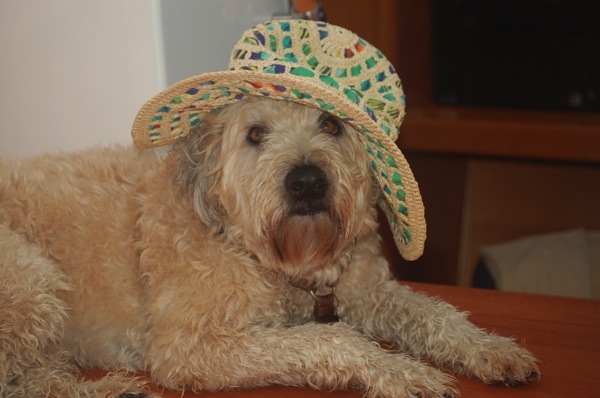
Then I realized she was focussed on something else entirely. And look what she made me wear.

Farley in Hat

“Take this hat off my head,” I bark.

“You’re my audience,” Kristina says.

“Audience for what?” I bark.

“I have to read aloud at the Audrey Jessup awards, and I need to practice.”

“Yeah, but why do have to wear a hat?”

“Because I’m pretending you’re sitting in a bar listing to me read my story.”

Okay, I get it. She’s nervous and wants to practice. She keeps mumbling something about the 10,000 hour theory and the more you do something to better you get at it.

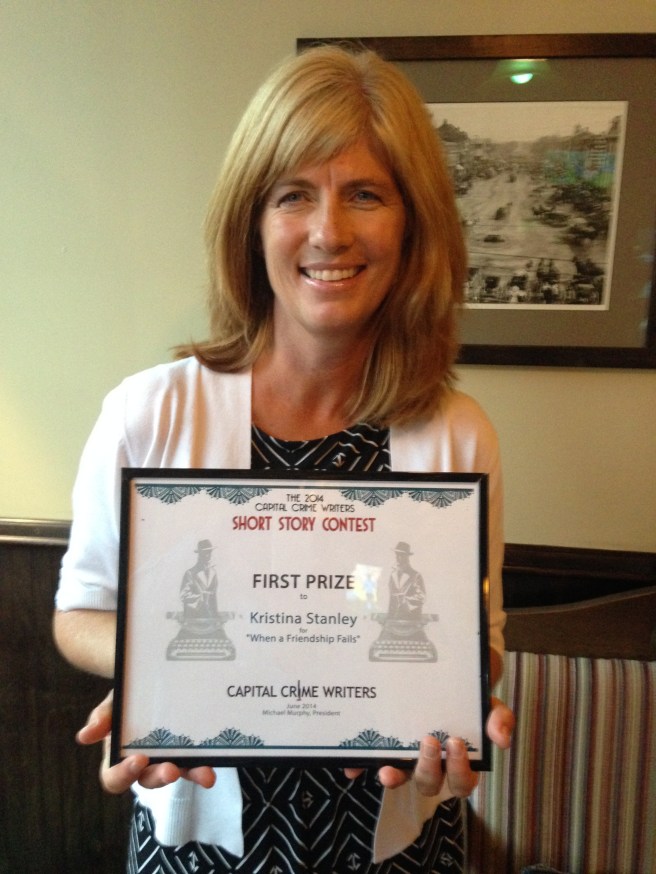
So the night of the awards, she comes home all happy and dances around the living room. She won 🙂

Kristina Stanley Audrey Jessup

Now I just wag my tail. I’ll let her read to me anytime if it helps.

Woof Woof.

Capital Crime Writers


Scapple and Writing

If you haven’t used Scapple, it’s a neat tool for organizing thoughts when editing or writing a novel.

I made bubble diagrams of each suspect in my novel, Avalanche.

Things I found that helped:

  • Connections between characters that could strengthen the readers belief that one of the characters was guilty.
  • Inconsistencies with clues.
  • Ideas for more clues.
  • At what point in the plot did the protagonist learn important details. Then I made sure I didn’t reference the information earlier.
  • Were the clues evenly balanced amongst the suspects?
The software is free flowing in the sense that you can draw what you like. Bubble diagrams, flow of information etc. It has a free 30 day trial so if you’re interested, you have nothing to lose.

It’s a fun and easy tool to work with, and I think has tightened my plot. See Literature and Latte for a better product description.

Here’s a shout out to Kirsten for pointing out Scapple to me. She always blogs about something interesting and useful.

Do you have any tools to help you write?

Thanks for reading . . .

Farley’s Friday: My Human Is Doing The Happy Dance

Farley here.

My human is singing “Debut Dagger Shortlist” and doing the happy dance. Sometimes Kristina looks really silly, but she’s so happy I won’t mention that to her.

I give her my confused look to ask her what’s going on. Seriously, she’s freaking me out.

Farley looking interested

She makes we wait until I settle down. Then she says, “My novel BURNT has been shortlisted for the Debut Dagger Award.”

“Huh,” I bark.

“It’s from the Crime Writers’ Association in the UK for unpublished authors.”

I decide I better do the happy dance too.

Farley Happy Dance

Then I bring her a present. Who doesn’t like an already chewed stick?

Farley With Stick


Well apparently Kristina. She won’t chew it, but she’s still dancing.


Woof Woof


See Mystery Fanfare: CWA Nominations

Crime Writers Of Canada: Arthur Awards

I’m giddy with happiness and need to share.

Writing  and trying to publish a novel is a long, seriously long, journey, with very few accolades along the way.

With trepidation, I entered DESCENT in the Unhanged Arthur competition. This competition is for Canadian writers and is given for excellence in mystery, suspense and crime writing to unpublished authors.

I submitted my entry last fall. In January came the first exciting news. Descent made the long list. A wild sense of relief filled me. Descent had made it that far, and I felt pretty good. Now, all I had to do was wait until April 24th for the short list announcement.

That’s sounds easy, right?

Wrong. I didn’t sleep for the four nights leading up to the announcement. On the night of the 24th, I went to bed not knowing if Descent made the list or not. I woke up more times than I want to admit, but forced myself not to turn on my computer and check. If Descent wasn’t on the list, I knew I was in for a completely sleepless night.

On the morning of the 25th, I took my first sip of coffee, opened my laptop and collected my email.

The first message I read was from a facebook friend. The text read : Congrats on making the short list.

I looked up at my husband and smiled.

“I told you, you would make it,” he said with a big grin on his face.

Next I read the email from CWC (Crime Writers of Canada) with the official notice that Descent was short listed.

I asked my husband to read the email, just to make sure I wasn’t reading only what I wanted to see.

“Yup, he said. You made it.”

Friday turned out to go by in a blur. I couldn’t quite believe I was on the list.

Saturday morning, I woke up with the first feeling of happiness about the award.

I’m still in the middle of my journey, but once in a while it’s good to stop and enjoy small successes.

Thanks for reading . . .

Here are the places I found the announcement:

CBC Books

Crime Writers Of Canada

Blog Mystery Fanfare

Blog Criminal Element

Blog Shots Crime and Thriller Ezine 

Blog Mystery Mavin Canada

Blog Black Mask

Blog The Rap Sheet

Blog Mystery Scene

As If Subordinating Conjunctions Can Be Confusing

Did you know if you want to spend a lifetime learning something, punctuation and grammar can give you the opportunity.

This week while proofreading my  novel, I noticed I wasn’t using ‘as if’ consistently. Sometimes I put a comma before the words and sometimes I didn’t.

I noticed this while I was reading on my Kindle. Last week I blogged about How To Avoid Errors In E-books, and here is one more instance where the new addition to my process helped me. As if!

I looked up ‘as if’ and found out it’s a subordinating conjunction. I knew this but had forgotten. Now I know the rules for comma use with ‘if’, another subordinating conjunction, so all I had to do was apply the rule to sentence containing ‘as if.’

The rule, you ask?

A subordinating conjunction joins two clauses of unequal importance. If the clause containing the subordination conjunction comes before the main clause then follow the clause with a comma. If it doesn’t, don’t.

  • As if he could stop the bleeding with his eyes, he stared at the knife impaling his calf. (subordinating conjunction before main clause)
  • He stared at the knife impaling his calf as if he could stop the bleeding with his eyes. (subordinating conjunction after main clause)

Attention to detail is a must when writing a novel, but how can you do that if you don’t know the rules? This brings me back to the lifetime of studying idea.

Keep on the look out for areas in your writing where you’re not consistent and you might find areas where you don’t know the rules. Grammar: How to Learn What You Don’t Know gives another idea on learning grammar.

How do you figure out what you don’t know?

Thanks for reading . . .

How To Avoid Errors In E-Books

Have you ever noticed typos in an e-book?

Maybe it’s not a big deal, but I’ve been reading reviews on Amazon lately and have found reviews where readers enjoyed the story but won’t buy another book by the author because of typos, grammatical errors, or bad formatting. That can’t be good.

If you’ve published electronically, you don’t want this to happen to you. But how do you avoid it?

After you’ve proofread, and proofread and proofread again, then had your novel proofread by someone other than yourself, there is another task you can perform to ensure high quality work.

I use Scrivener to write and recently found the feature that exports a manuscript into e-book formatting. I tried this and then sent my novel to my Kindle. I used to just send a word document to my Kindle and read my novel that way, but how could I know if the formatting was off?

Now with this feature, my novel is formatted as a reader would see it on their electronic device. Scrivener will export to epub (.epub), Kindle ebook (.mobi) or iBooks Author Chapters (.docx). I’m sure there are other writing programs that have the same function.

It’s interesting reading my novel for the first time in this format. I caught several errors in formatting; such as, no space after one scene and before the next. This might seem like an inconsequential error, but what if I’d confused a reader by not indicating when one scene ended and a new scene started?

As an added bonus, reading on the kindle makes my novel seem real.

Do you have ways to check your novel for formatting errors or typos?

See Proofreading/Copyediting  if you’re interested in my in-depth process.

Thanks for reading . . .

Tips For Ordering Scenes In A Novel

Have you ever had trouble deciding the best order to put your scenes in?

Once you have a first draft written do you try different combinations to see what works best?

If you’ve been reading my blog, you might have guessed I’ve added a new row to my spreadsheet. I call it Scene Dependency.

First, I was just using it to list what scenes had to come before the scene I was reviewing. Then I discovered something even better.

Was it possible to link the end of one scene to the beginning of the next?

You bet. There are different ways to achieve this. For example:

  • Have one character end a scene. Have the next scene start with another character thinking of the previous character.
  • Put an object important to the story at the end of one scene and beginning of the next.
  • Use the same location at the end of one scene and the beginning of the next.
  • End a scene at night, start the next scene the following morning.
  • Reference the same weather in both scenes.
  • Reference the same sight. Maybe the moon setting or an avalanche at the end of one scene and the beginning of the next.
  • Use emotions to link the scenes.

In the end, have it all listed in your spreadsheet. You might be surprised how it changes the order of your scenes and gives you a fluid motion throughout your novel. The reader will feel more connected to your story if one scene links to the next even if the scenes are about different events.

Can you add to this list? Do you have any tips to ordering scenes? I’d love to hear them.

Thanks for reading . . .