Farley’s Friday: A Wheaten and his boat

Farley here.

Ah, it’s fun to be in Canada again. Even thought I sold my boat . . . yeah I know, my humans sold Mattina . . .  I still spend time boating.

And my Canadian boat goes fast. No more 8 knots over ground stuff. My hair is flying, and did I mention Kristina is letting me grow it long, and I can barely keep my eyes open.

IMG_0585

But wait, we rip by a field full of cows. The smells are incredible. I just don’t understand why my humans don’t stop and smell the cows!

Also, they should stop making me go tubing and swimming in the middle of the lake. Not my thing 🙂

Woof Woof

The Writing Process Blog Hop

Calgarian Garry Ryan, author of the Detective Lane mystery series and the Blackbirds Trilogy, asked me to be part of the blog hop. Of course I said yes to Garry. You may have heard of the Crime Writers of Canada. When Garry was the president, I was lucky enough to have him as my mentor as part of the CWC mentorship program. Garry worked by my on my Manuscript, Burnt, which has since been nominated for the Debut Dagger by the Crime Writers Association in the UK. How could I not be excited to follow Garry in the blog hop?

This is your chance to get a looking inside a writer’s  mind, or in this case many minds if you follow the blog hop.

I have tagged two author friends to take part in the blog hop. The bio’s are listed below. Please check out their blogs too 🙂

Now to the reason for the blog hop:

What Am I Working On?

I read somewhere that life as a writer means having homework for the rest of your life. There is aways something to work on, whether it is writing, researching, social networking, learning, editing or proofreading. Then there is the query letter, blurb or synopsis to be written. Now add in my blog. All are part of being a writer and all can be very engaging tasks.

On the writing scene, I currently drafting the fourth novel in the Stone Mountain mystery series. The series takes place in a fictitious ski resort located in the depth of the Purcell Mountain Range in British Columbia, Canada.  The protagonist, Kalin Thompson, is the director of security and human resources at the resort in continually finds herself torn between running investigations and her friends who live in the small community. She can’t look for suspects without looking at one of her friends.

For editing, I am working on Look the Other Way. The novel takes place in the Bahamas and is a spin off from the Stone Mountain mystery series.

How Does My Work Differ From Others in It’s Genre?

Drugs and the drug industry gets a lot of focus in the BC press. i try to stay away from the topic. There are many great books by BC novelists that delve into this area. I’ve chosen other crimes, typically the type committed by an every day individual who has been pushed beyond their limits. I try to make wilderness living and wildlife interaction a character within my books.

Why Do I Write What I Do?

One night, while I was living in Germany, I tried to go to bed early. A company driver was to pick me up at 4 a.m. to take me to the airport. I was nervous about a presentation I was to make in London, England and wanted a good night sleep. Here’s where a small decision I made changed my future path. I picked up a novel, Moonlight Becomes You, by Marry Higgins Clark. It starts out with a woman trapped in a coffin. Now how could I put that down before finding out how she got out of the coffin. I read through the night until my car arrived. Exhausted, but excited, I knew I wanted to write something that would keep a person from going to sleep, even when they knew they needed to be their best for the coming day.

I write about the Purcell Mountain range because it’s a magical place. I write about human resources and security at a ski resort because I have experience in the field. My job at a ski resort was the best job of my life and writing about the industry is a way for me to keep it with me.

How Does My Writing Process Work?

Variety. That’s the key for me. Morning’s are usually better for me if I want to get more words on the page. By the end of the day, I’m better at researching or working on my online platform. I like to write without interruption, as I’m sure most of us do, but I’m pretty good a tuning out the world around me if I can’t find a quiet place. Mostly I write on a computer, but sometimes a pen a paper get my creativity moving.

To create a first draft, I decide on a crime and start writing. I develop my characters as I go. By the end of the first draft, I usually know who committed the crime, but that might change in a later draft. Once the draft is done, I create a spreadsheet and start a detailed analysis of each scene. This is where I look for the empty stage, errors in timing, too much or too little of something and so on. Once I’ve written several, okay many, drafts, I send the manuscript to my favourite readers. At this stage I ask for them for notes on when they think they know who committed the crime, if they skim any sections, if something is unclear, and if they feel connected to the characters. i don’t ask for proofreading at this stage. That comes later before I’m about to submit to my agent.

As soon as I submit to my agent, I start on my next novel. The writing business is slow, and this is a good time to focus on new work and not agonize about the words I’ve sent out.


Fellow author friends are:

Charlotte Morganti will post on July 28th:

Charlotte Morganti has been a burger flipper, beer slinger, lawyer, and seasonal chef de tourtière. And, always, a stringer-together-of-words. Her first novel, The Snow Job, was a finalist for Crime Writers of Canada’s Unhanged Arthur award in 2014 for the best unpublished crime novel. You can find out more about Charlotte’s fiction at www.charlottemorganti.com.

Brenda Chapman will post on August 11th.

Brenda Chapman began her writing career with the Jennifer Bannon mysteries for young adults. More recently, she writes the Stonechild and Rouleau police procedural series – Cold Mourning was released from Dundurn in 2014 and Butterfly Kills will be on the shelves in early 2015. Brenda also writes the Anna Sweet mystery novellas for Grass Roots Press, with My Sister’s Keeper shortlisted for a 2014 Arthur Ellis Award. Brenda is a former teacher and currently works as a senior communciations advisor in Ottawa.
Brenda’s blog link:  http://brendachapman.blogspot.ca/

Thanks for reading . . .


Farley’s Friday: Windsurfing? Paddle Boarding for a Wheaten Terrier?

Farley here,

All I can say is, “Woof woof,” about my week.

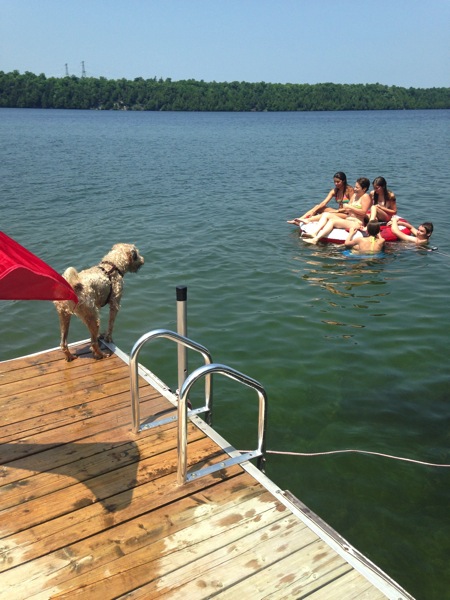
Kids, water toys. Life is just exciting! I’m telling my short human, Julia, to hang on as Kristina tries to paddle away from her. I end up in the water more often  than the kids, and no one cares. They’re all too busy laughing at me.

Farley on Board

Cottage life is the greatest, but I’m getting a little tired of being wet all the time. I used to be a boat dog, but I never spent this much time in the water.

Woof Woof.

RePost of Capital Crime Writers Audrey Jessup Announcement.

Thank you to Capital Crime Writers for hosting the Audrey Jessup short story contest.  Also thanks to the judges who took the time to read all of the entries and thanks for the lovely evening out.

The photo is me looking surprised and happy 🙂

This is the blog they posted on Monday.

Congratulations to our Audrey Jessop Short Story Prize winner!


Kristina Stanley Audrey Jessup


Kristina Stanley walked away with the 2014 Audrey Jessop Short Story prize for her submission, “When a Friendship Fails”.

The awards dinner at The Heart & Crown in the Byward Market capped off a Capital Crime Writers’ mayhem-filled year.

A huge thanks to our judges and all participants. And it’s never too early to start working on your submission for next year.

Here’s the complete list of prize winners and honourable mentions:

FIRST PRIZE:   ‘When a Friendship Fails’ by Kristina Stanley

SECOND PRIZE:  ’The Moment It Fell’ by Wynn Quon

THIRD PRIZE:  ’The Ride Home’ by Linda Standing

HONOURABLE MENTION:  ’Act the Part’ by Jennifer Jorgensen

HONOURABLE MENTION:  ’Scapegoat’ by Nicholas Ashton

Farley’s Friday: A Boatless Wheaten Terrier

Farley here,

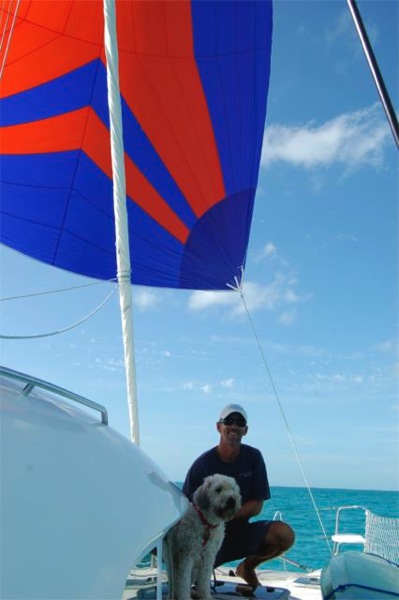
I was born in the fall of 2008. In July of 2009, I moved on Mattina. She’s a catamaran and is great for dogs. The only life I remember is on my sailboat. I’m a cruising dog. I love running free on the beach. I get to chase crabs.

Farley on Deck

I think I’m a key part of our pack, but how come I don’t get a say in key decisions! Mathew and Kristina just laid a whopper on me.

They sold Mattina. How could they without asking me? You heard me right. They sold my sailboat.

“Why?” I bark at Kristina.

“Don’t us that tone with me,” she says.

I sit in my most handsome way, roll my eyes up at her, and lay my head on her lap. “But why?” I whine while my tail swishes back and forth on the floor. “I’m sad.”

“Don’t you remember living in the mountains?” she asks.

“Sort of,” I say in my low growl. I’m very suspicious of this.

“Don’t you remember Joe?”

My ears perk up and I peak around at the scene on her laptop. There he is. I remember him. I tilt my head to Kristina.

081207230949 879

She smiles. “I see you do. There are lots of dogs and lots of off leash time. You’ll be fine.”

And I will be.

Woof Woof.


Spelling: Canadian Vs. American

I’m confused.

I’m a Canadian and spell Canadian. I’ve spent many hours proofreading my novels to make sure my spelling is consistently Canadian.

I read novels written by Americans and am used to reading American spelling. This can make writing in one or the other difficult. as both ways of spelling look correct. I have my spell checker set to Canadian spelling, but sometimes there is an option and so the spell checker won’t highlight if I’ve slipped into American spelling when both versions may be acceptable.

What I’m saying is I’ve worked hard to keep my spelling consistently Canadian.

Then – and I feel like I should play music here – I attended the Bloody Words Conference in Toronto and a Canadian editor said, “It drives me crazy when the first thing I have to do is change all the Canadian spelling to American. Taking out the ‘u’ gets annoying.”

I didn’t get a chance to talk with her about the comment, but it’s been bothering me ever since.

Do any other Canadian writers out there prefer one way of spelling to another?

Is there a standard in the Canadian publishing industry?

Have I done this the wrong way?

If you’re opinionated on the subject, I’d love to hear about it.

Thanks for reading . . .
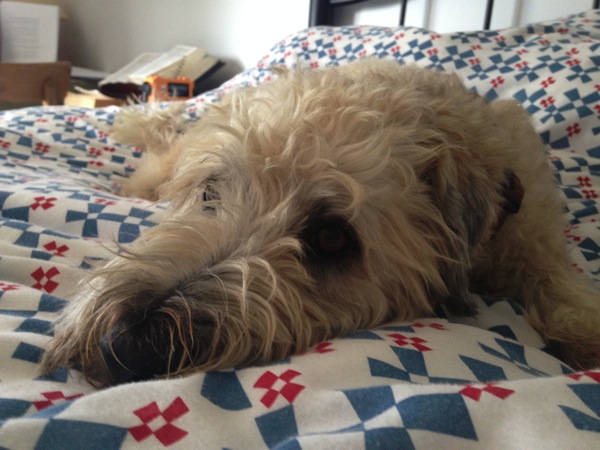
Farley’s Friday: A Wheaten Gets In Bed

Farley here,

Ever heard of stealth mode? I need to learn how to be stealthily. So to all you dogs out there who want to do something naughty, here’s what I happens if you’re not stealthy.

I’m visiting my human’s parents. They love dogs, and especially me. But there are some rules Kristina insists on when we are visiting others. She says she wants me to be welcome everywhere, so I have to behave. Like she behaves all the time! Ha!

I wanted in the home office so I could curl up under the desk. It’s my favourite place in the house. I run upstairs and find the door shut.

“Open the door,” I say in my sweetest wine. Nothing. All is quiet. I try a gentle scratch on the door. Still no response.

This is when I bust loose. I need to express my dissatisfaction with the situation. I just can’t help myself, and I get all excited. When I’m excited, I’m noisy. I run around in circles and then I jump on the bed.

Busted. I hear Kristina’s footsteps. They’re getting closer.

Farley on Bed

Instantly, I lay still and pretend I haven’t been messing up the covers. I give Kristina my best “I’m sorry” look, but she makes me get down anyway. What she doesn’t know is that when she’s not here, I get to sleep on the bed whenever I want.

Woof Woof

15 Tips For A Successful Author Reading

Writing means learning, and learning all the time, for the rest of your life.

In the modern world of publishing, whether you choose the traditional route or self publishing, much is expected from an author. Writing a great novel is only the beginning of the journey if you want your work to have a public audience.

Last week, I experienced some intense learning about reading aloud. And by this I mean what it takes to read your novel or short story in front of an audience. If you’ve been reading this blog, you know I won the Audrey Jessup award for short story crime writing from the Capital Crime Writers. Part of being nominated meant reading aloud before the winner announcement was made.

The reading was on June 11th. During the week before the event, I attended the Bloody Words conference in Toronto. A bit of luck, as it turned out, because I heard seven authors read. Then on Monday June 9th in Ottawa, I attended a reading by three Scandinavian authors. That’s 10 readings I could learn from.

Here’s my advice about delivering a great reading:

The advice is slit into  4 sections.

Practice before the event:

  • Don’t leave practicing to the last-minute. Practice every day even for short periods of time. If you can, read to an audience.
  • Practice pausing for commas, periods, paragraph breaks, and starting new scenes.
  • Practice until you can take your eyes away from the words and make eye contact with the audience. This will engage them in your reading. Reading to a mirror will allow you to see if you’re looking up.

Technical preparation:

  • Don’t staple the pages. Stapled pages are noisy when turned and are awkward to hold in place.
  • Number your free pages in case you drop them.
  • Ask how many minutes you have to read. Then prepare for a few minutes less, the exact amount of time and a few minutes more. If other readers don’t show up, you  might be given more time. If the proceedings are running long, you might be given less time, Be ready so you can end with a cliff hanger or a dramatic spot that will leave people wanting more.
  • If you’re reading from printed pages, print in font large enough to read. Remember the lighting could be dark or there could be glare from other lights. If the font in your printed books is small, you can always print the pages you want to read and place your book in front of you while you’re reading.
  • Ask what the setup will be. Is there a podium where you can set your pages? Will you be holding a mic? Will you be standing or sitting?

At the event, before you read:

  • If you’re not first, watch the other readers for what works and doesn’t work. Standing with the mic too close to the sound system can cause feedback, having the mic too far or too close to you mic can make understanding your words difficult.
  • Have your material ready. Don’t start looking for the section you want to read after you’re at the podium. This distracts the audience.

During your reading:

  • Once you are on stage, thank the hosts of the event. This will make your look professional and give you time to let your voice and your nerves settle before you start reading your story.
  • Breathe. This sounds obvious, but breathing will make your speech clear. During the reading, I was so nervous at first, I couldn’t bring air into my lungs. At the end of the first page, when I had to flip to the next page, I moved the mic away from my mouth and took a deep breath. This helped me calm down.
  • Don’t explain your work in the middle of reading. Let your words speak for themselves.
  • Only brief the audience about the story if you’re not starting at the beginning.
  • Speak slowly.

Remember: the audience came to hear you and they want you to succeed, so smile and have fun.

If you have any tips on reading aloud, please share 🙂 I’m always looking for ways to improve.

Thanks for reading . . .

Bloody Words Conference

Danse Macabre: The Historical Dance of Death was the theme of the Bloody Words conference held in Toronto over the June 6th weekend.

The action packed conference started on Friday night and ended Sunday afternoon.

My favourite part: Meeting other authors. What a treat it was to meet with people who have been my “internet friends” for the last several years. I was pleased to see so many of the Crime Writers of Canada authors in attendance.

Learning in the sessions is a given, but learning in the hallway is fun too. Everyone spent time networking  – translate: experienced authors sharing trade secrets with the newbies. There was an opportunity to meet with agents and publishers.

Many thanks to the gang who ran the conference. The hard work put into the conference showed in the professional delivery. On a sad note, rumour has it this is the last Bloody Words conference. The year was my first and I’m glad I got to the event.

Thanks for reading  . . .