Before You Submit: Job Titles

Do you have a draft of your novel or short story and are thinking of submitting to an agent, publisher or writing contest? My series called Before You Submit might help. This series contains hints and tips I’ve received from professionals in the publishing industry. Each week I’ll share a new tip.

This week I’ll write about Capitalizing Job Titles.

Until a professional edited my work, I hadn’t thought about job titles and whether I should capitalize them or not.

An editor corrected a sentence by changing the first letter of a job title to lower case. Hmm? I used my handy Chicago Manual of Style to check the rule. It’s hard to know what to check if you don’t even know you should check something. This is where an editor comes in.

The rules for capitalizing job titles (and this is me summarizing so check a grammar manual for details):

If the job title is part of the name, then use a capital.

President Stanley likes grammar rules.

I decided I should be the president in this example 🙂

If ‘the’ is written before the job title or the job title follows the person’s name, then don’t use a capital.

Ms. Stanley, the president, likes grammar rules.

It’s not a hard rule. Job titles are sometimes capitalized for style or emphasis within an organization, and so we get used the look even though it’s incorrect. All I needed was an editor to point out my error, and I’ll never make it again. I can dream, can’t I?

I hope this helps improve your writing.

See Before You Submit:Likeable Characters for the first blog in this series and an introduction the benefits of submitting even if you get a rejection letter.

Thanks for reading . .


Before You Submit: Sentence Length

Do you have a draft of your novel or short story and are thinking of submitting to an agent, publisher or writing contest? My series called Before You Submit might help. This series contains hints and tips I’ve received from professionals in the publishing industry. Each week I’ll share a new tip.

This week I’ll write about Sentence Length.

My editor wrote: Simple declarative sentences are powerful but tend to lose power if repeated too often.  If all your sentences are the same length, the writing can come across as dull, and I’m going to guess none of us want to create a dull novel.

There are software programs that provide a graph of your sentence lengths. Autocrit and ProWritingAid are two of them. I haven’t reviewed either product fully, so this is not a product plug. If you don’t want to use another software program, you can take a section of your text, hit return after each sentence and “see” the sentence lengths on the page. This will give you an idea if you vary your sentence lengths.

If the text is shaped like a rectangle, your sentence lengths are too similar.

If all your sentences are short, try joining two sentences with a conjunction making a longer sentence. You can leave in or take our the subject if the subject is the same in both original sentences. This is a subjective choice. Just make sure you get the comma right.

If all your sentences are long, try breaking a sentence into two or even three sentences.

I hope this helps improve your writing.

See Before You Submit:Likeable Characters for the first blog in this series and an introduction the benefits of submitting even if you get a rejection letter.

Thanks for reading . . .

Before You Submit: Dialogue Tags

Do you have a draft of your novel or short story and are thinking of submitting to an agent, publisher or writing contest? My series called Before You Submit might help. This series contains hints and tips I’ve received from professionals in the publishing industry. Each week I’ll share a new tip.

This week I’ll write about dialogue tags.

Are you using too many dialogue tags? Does he said/she said sound repetitive? Here’s a tip on how to reduce the number of tags you are using.

Try using a character’s action to indicate who’s speaking. The following sentence uses a dialogue tag: Kendra said.

“You dropped this,” Kendra said. She held a crumpled piece of paper in her outstretched hand.

The editor recommended I rewrite the sentence as follows:

Kendra held a crumpled piece of paper in her outstretched hand. “You dropped this.” 

By  moving the character action to the beginning of the sentence, it’s clear Kendra is speaking. There is no need for the dialogue tag. When you remove a dialogue tag, you must update the punctuation. Don’t forget to change the comma to a period inside the dialogue quotes.

I hope this helps improve your writing.

See Before You Submit:Likeable Characters for the first blog in this series and an introduction the benefits of submitting even if you get a rejection letter.

Thanks for reading . . .

Before You Submit: Hyphenated Adjectives

Do you have a draft of your novel or short story and are thinking of submitting to an agent, publisher or writing contest? My series called Before You Submit might help. This series contains hints and tips I’ve received from professionals in the publishing industry. Each week I’ll share a new tip.

This week I’ll write about Hyphenated Adjectives.

If you’ve been reading Before You Submit, you’ll know I love getting feedback from an editor. Some of the tips I’m presenting are from the  early days of my writing career, and I’m almost embarrassed to admit I made these mistakes. I say almost, because we all have to learn, and not all of us remember everything we learned in grade school.

The editor corrected the following sentence:

Young people living in a dorm type facility . . .

to:

Young people living in a dorm-type facility . . .

Instead of trying to describe the nuances around hyphenated adjectives, I’m going to refer you to Grammar Girl for an explanation. If you don’t know about Grammar Girl, it’s an excellent site to look up grammar rules. The hyphen is a tiny mark on the page, but one that will show an acquiring editor you are serious about your trade if you get it right, or you have homework to do if you get it wrong. The lack of a hyphen when you need one could throw your novel back into the slush pile, especially if it’s on the first page.

I hope this helps improve your writing.

See Before You Submit:Likeable Characters for the first blog in this series and an introduction the benefits of submitting even if you get a rejection letter.

Thanks for reading . . .
Before You Submit: Point of View Goal

Do you have a draft of your novel or short story and are thinking of submitting to an agent, publisher or writing contest? My series called Before You Submit might help. The series contains hints and tips I’ve learned from professionals in the publishing industry that I’d like to share.

See Before You Submit:Likeable Characters for the first blog in this series and an introduction the benefits of submitting even if you get a rejection letter.

This week I’ll give you questions to ask yourself for each scene in your novel when you are thinking about your Point of View (POV) character. The POV may be the same throughout the novel, change per scene, or change within a scene. However you structure your novel, the following questions can help ensure you POV character is active and interesting.

  1. What is the goal of the scene POV?
  2. What hinders the goal?
  3. How is the goal important to the overall story?
  4. How does the goal move the story forward?
  5. What happens if the POV character doesn’t succeed?
By answering the questions you might surprise yourself and come up with new ideas for your plot. You may find areas where you can deepen the character, intensify the action, or dare I say it, cut a scene.
 
Thanks for reading . . .

Before You Submit: Scene Opening and Closing

Do you have a draft of your novel or short story and are thinking of submitting to an agent, publisher or writing contest? My series called Before You Submit might help. The series contains hints and tips I’ve learned from professionals in the publishing industry that I’d like to share.

See Before You Submit:Likeable Characters for the first blog in this series and an introduction the benefits of submitting even if you get a rejection letter.

This week I’ll write about how to start and end scenes throughout a novel without being monotonous.

Sometimes it’s easy to get into a habit and open or close scenes in the same manner.

A dramatic line of dialogue is a great way to hook the reader and keep them reading. But what if you do this every scene? The dramatic tension will decrease. The same goes for other ways to start a scene.

Here are your options for opening and closing a scene.

  1. Dialogue
  2. Narrative
  3. Action
  4. Thought

When you are reviewing your manuscript prior to submitting, make a list of how you enter and exit scenes. I do this in excel so I can graph how many scenes start or finish in each way. The result gives me an idea of whether I’ve used one technique to often or not.

Entering and exiting scenes in a balanced and thought out approach will make your writing more interesting and keep the dramatic tension flowing.

If you have any tips on entering and exiting scenes, please share.

Thanks for reading . . .

Before You Submit: Likeable Characters

Do you have a draft of your novel or short story and are thinking of submitting to an agent, publisher or writing contest?

This is a scary prospect, right? Ignore the night demon who tells you to hide your work in a drawer and prepare your story for submission. Besides signing an agent, getting your work published, or winning a contest, there are other benefits to submitting.

Submitting your work is a great way to get feedback from a professional in the industry. We all know this is hard to get, but if you’re lucky, valuable pieces of advice will end up in your inbox.

There are contests, the Debut Dagger hosted by The Crime Writers’ Association is one of them, that will provide feedback on your entry if you are short listed. There are also agents, who when queried, will give you feedback. You might even get comments back from a publisher or editor.

I thought I’d share a bit of what I’ve learned this last year from people in the industry.

The week I’ll talk about liking the main protagonist.

Many writing books declare the reader must like your main character. This doesn’t mean everything about your character should be likeable. No one likes a perfect person. On the flip side, even if your character is nasty, is there at least one characteristic your reader can relate to, like or admire? If not, you might create something.

In a novel, giving your reader someone to cheer for and follow for 300 or so pages might make the difference between the reader dropping your book on the coffee table after chapter one to staying awake late into the night reading until the climax satisfies their need to know what happened to the character.

When I started writing, I struggled with how to make a character likeable. Thinking about what made me like people in real life was difficult to translate into the pages of a novel. How was I to get a reader to like my character?

The Crime Writers’ Association honoured me by shortlisting my novel, Burnt. The comment I received from one Debut Dagger judge on the topic of likeable characters was:

“The thread with the dog is a clever way of engaging interest and building suspense right from the start, while telling the reader something appealing about Kalin.”

Kalin is the main protagonist in Burnt.  In the opening scene, on the run and separated from her dog in a forest fire, Kalin fights for her life. The suspense part: Will she be able to save herself and her dog?  The likeable part: Her concern for her dog.

What I learned from this comment: The actions of your characters can show the reader a likeable trait. There is no need to describe the trait by telling the reader Kalin cares about animals.

I hope this helps you review your draft and get it ready for submission. In the coming months, I’ll post a series on what I’ve learned from the mysterious publishing industry.

Thanks for reading . . .

Click here for a look at my proofreading and copyediting series.

The Golden Leaves of British Columbia

Spending a large part of my youth in Ontario, I’m used the reds, oranges and yellows of fall. The forest of British Columbia have a different look and feel to them. Just as beautiful, but not the same.

BC Yelloe

The mountains are an inspiration to me when I think about writing. As I stopped and took in the scenery, I thought of the importance of getting details correct when writing a novel. Before living in BC, I might have assumed all forests transformed into a multitude of colours in the fall. There is nothing like seeing your imagined setting in real life.

Now, I’m not saying you have to visit every place you write about, although, if you’re lucky, maybe you get to, because with today’s technology, you can see the places without ever going there. Google Earth is a wonderful way to explore a setting, getting familiar with an area before putting words to a page.

Online videos, photos and travel blogs are also a good source to travel from the comfort of your back porch.

Every day the forest of the Purcell  Mountains inspire me to be a better writer. And now that I’m used to seeing only yellow leaves, I find them just as beautiful as the multicoloured trees of the east.

Thanks for reading. . .

Put Your Novel In A Drawer

I’m walking my dog Farley home and the forest is whispering little reminders to me, making me think, giving me story ideas.

To my left, we come across a doe and two fawns. We’ve been in the mountains long enough that Farley behaves  – for a moment. I decide I’ll be safe if I walk on the far side of the road away from the deer. The mama deer, she decides I might rethink that plan. Her two fawn hide behind her, and she turns and faces me.

She struts her fronts paws, telling me to back off. And I do. I’m not sure if she’s about to charge.

Dusk is upon us, and I’d like to reach home before dark. I can take a path down to the river, back behind the houses and up on the other side, but I’m a little nervous about bears. I can climb up a step hill to a neighbouring house and cut through their property, or I can pass the mama deer. I opt for choice number two.

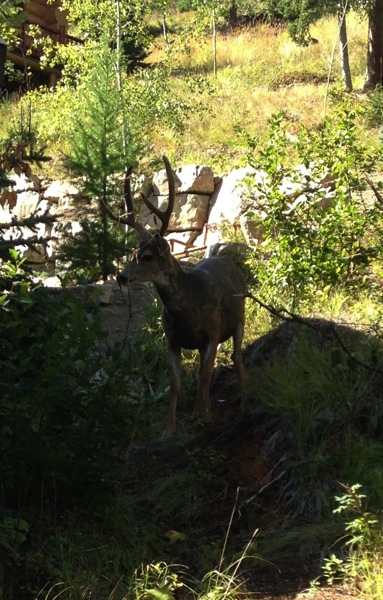
I grab ahold of long grass, four feet long and full of thistles, and pull my myself toward the crest of the hill. Farley quickly jumps in front of me and pulls me forward. I’m halfway up when we startle a buck. He’d been sitting in the grass, and I’d been too focussed on the doe and her fawns to notice him. He bolts, and I catch a glimpse of his antlers as he runs by.

Buck

Change of plan. I head toward the next house, feeling like a trespasser, and walk around the front, only to come face to face with another, bigger, buck. I hold in a scream, Farley barks wildly and Mr. Buck stares at us. Doesn’t move an inch.

So, I step back, cross through my neighbours outdoor eating area, wishing I’d actually met my neighbours, and head away from the buck. And who’s behind the next house. Buck number one.

This is crazy, I think. Did the deer decide to have a party near my house? Mama doe, her fawns and both bucks are frozen like statues, staring at me. I choose the only option left and keep walking forward. They stay, I go. All works out well.

I arrive home a little exhilarated, realizing sometimes I just have to face my fears. Even when it comes to writing.

Early on in my writing career, someone told me the best thing to do after finishing a draft of a novel, is to put it in a drawer and don’t look at it for at least two weeks. How hard is that? Well, I followed that advice and haven’t looked at my novel for 6 months.

Now that I’m my new brave self, I go to my desk drawer and pull out my novel. I didn’t understand the advice at first, but now I get the act provides distance from the story. I’m so glad I put the novel away.

After hours of hard work, I find plot holes, repeated words (even if they’re a chapter apart, they can jar the reader), scenes that are not needed and of course, the dreaded typos. Now my novel is a better read, and I’m glad I put it out of sight. I’m also glad the deer are out of sight, and hopefully sleeping somewhere and dreaming finding haunting grounds farther away from my house.

Even though hiding your novel out of sight might seem impossible, if you’re looking for ways to improve the writing, this might help.

Thanks for reading . . .

Literary Agents

Margaret Hart, my wonderful literary agent at HSW Literary agency is retiring. I wish to thank her, her employees, especially Natalie St. Pierre, and the agency for signing me on, for working with me and for helping me get where I am today.

I’ve written the first three novels in the Stone Mountain Mystery Series. Descent, Burnt and Avalanche.

Descent was nominated for the 2014 Crime Writers of Canada Unhanged Arthur award. Burnt was nominated for the 2014  Crime Writer’s Association’s Debut Dagger. The guidance, editorial comments and encouragement from Margaret and her team helped make this possible.

Along with Margaret retiring, the HSW Literary Agency is closing its doors. This means I’m looking for a new literary agent.

If you know of an agent looking for new authors or you are an agent looking to new authors, please send me a note from my Contact Information page.

Thank you to Margaret and her team!

Thanks for reading . . .