The Golden Leaves of British Columbia

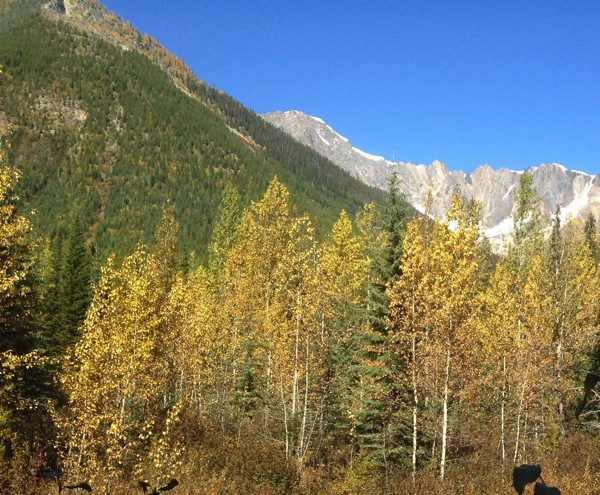
Spending a large part of my youth in Ontario, I’m used the reds, oranges and yellows of fall. The forest of British Columbia have a different look and feel to them. Just as beautiful, but not the same.

BC Yelloe

The mountains are an inspiration to me when I think about writing. As I stopped and took in the scenery, I thought of the importance of getting details correct when writing a novel. Before living in BC, I might have assumed all forests transformed into a multitude of colours in the fall. There is nothing like seeing your imagined setting in real life.

Now, I’m not saying you have to visit every place you write about, although, if you’re lucky, maybe you get to, because with today’s technology, you can see the places without ever going there. Google Earth is a wonderful way to explore a setting, getting familiar with an area before putting words to a page.

Online videos, photos and travel blogs are also a good source to travel from the comfort of your back porch.

Every day the forest of the Purcell  Mountains inspire me to be a better writer. And now that I’m used to seeing only yellow leaves, I find them just as beautiful as the multicoloured trees of the east.

Thanks for reading. . .

Put Your Novel In A Drawer

I’m walking my dog Farley home and the forest is whispering little reminders to me, making me think, giving me story ideas.

To my left, we come across a doe and two fawns. We’ve been in the mountains long enough that Farley behaves  – for a moment. I decide I’ll be safe if I walk on the far side of the road away from the deer. The mama deer, she decides I might rethink that plan. Her two fawn hide behind her, and she turns and faces me.

She struts her fronts paws, telling me to back off. And I do. I’m not sure if she’s about to charge.

Dusk is upon us, and I’d like to reach home before dark. I can take a path down to the river, back behind the houses and up on the other side, but I’m a little nervous about bears. I can climb up a step hill to a neighbouring house and cut through their property, or I can pass the mama deer. I opt for choice number two.

I grab ahold of long grass, four feet long and full of thistles, and pull my myself toward the crest of the hill. Farley quickly jumps in front of me and pulls me forward. I’m halfway up when we startle a buck. He’d been sitting in the grass, and I’d been too focussed on the doe and her fawns to notice him. He bolts, and I catch a glimpse of his antlers as he runs by.

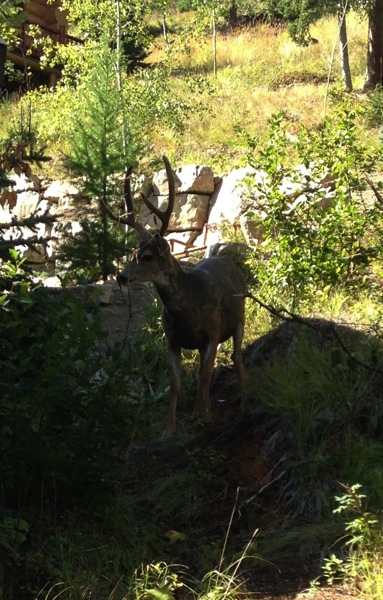
Buck

Change of plan. I head toward the next house, feeling like a trespasser, and walk around the front, only to come face to face with another, bigger, buck. I hold in a scream, Farley barks wildly and Mr. Buck stares at us. Doesn’t move an inch.

So, I step back, cross through my neighbours outdoor eating area, wishing I’d actually met my neighbours, and head away from the buck. And who’s behind the next house. Buck number one.

This is crazy, I think. Did the deer decide to have a party near my house? Mama doe, her fawns and both bucks are frozen like statues, staring at me. I choose the only option left and keep walking forward. They stay, I go. All works out well.

I arrive home a little exhilarated, realizing sometimes I just have to face my fears. Even when it comes to writing.

Early on in my writing career, someone told me the best thing to do after finishing a draft of a novel, is to put it in a drawer and don’t look at it for at least two weeks. How hard is that? Well, I followed that advice and haven’t looked at my novel for 6 months.

Now that I’m my new brave self, I go to my desk drawer and pull out my novel. I didn’t understand the advice at first, but now I get the act provides distance from the story. I’m so glad I put the novel away.

After hours of hard work, I find plot holes, repeated words (even if they’re a chapter apart, they can jar the reader), scenes that are not needed and of course, the dreaded typos. Now my novel is a better read, and I’m glad I put it out of sight. I’m also glad the deer are out of sight, and hopefully sleeping somewhere and dreaming finding haunting grounds farther away from my house.

Even though hiding your novel out of sight might seem impossible, if you’re looking for ways to improve the writing, this might help.

Thanks for reading . . .

Literary Agents

Margaret Hart, my wonderful literary agent at HSW Literary agency is retiring. I wish to thank her, her employees, especially Natalie St. Pierre, and the agency for signing me on, for working with me and for helping me get where I am today.

I’ve written the first three novels in the Stone Mountain Mystery Series. Descent, Burnt and Avalanche.

Descent was nominated for the 2014 Crime Writers of Canada Unhanged Arthur award. Burnt was nominated for the 2014  Crime Writer’s Association’s Debut Dagger. The guidance, editorial comments and encouragement from Margaret and her team helped make this possible.

Along with Margaret retiring, the HSW Literary Agency is closing its doors. This means I’m looking for a new literary agent.

If you know of an agent looking for new authors or you are an agent looking to new authors, please send me a note from my Contact Information page.

Thank you to Margaret and her team!

Thanks for reading . . .

Backing Up Your Novel

Do you back up  your novel?

Last night, I was out for dinner and a friend asked me if I kept printed copies of my novels. Since I’ve spent the last five years living on a sailboat, my answer was no.

My friend was incredulous.

Of course, I had to start thinking about it – at three in the morning – when the worry fairy comes to visit.

I back up to an external hard drive.

I email a copy to my dad for safe keeping. While we were living on the boat, I worried a lightning strike would take out all out electronics, so even it my back up was on a separate hard drive, I thought it wasn’t enough.

The question is: do I need a paper copy too?

Thanks for reading . . .

The Writing Process Blog Hop

Calgarian Garry Ryan, author of the Detective Lane mystery series and the Blackbirds Trilogy, asked me to be part of the blog hop. Of course I said yes to Garry. You may have heard of the Crime Writers of Canada. When Garry was the president, I was lucky enough to have him as my mentor as part of the CWC mentorship program. Garry worked by my on my Manuscript, Burnt, which has since been nominated for the Debut Dagger by the Crime Writers Association in the UK. How could I not be excited to follow Garry in the blog hop?

This is your chance to get a looking inside a writer’s  mind, or in this case many minds if you follow the blog hop.

I have tagged two author friends to take part in the blog hop. The bio’s are listed below. Please check out their blogs too 🙂

Now to the reason for the blog hop:

What Am I Working On?

I read somewhere that life as a writer means having homework for the rest of your life. There is aways something to work on, whether it is writing, researching, social networking, learning, editing or proofreading. Then there is the query letter, blurb or synopsis to be written. Now add in my blog. All are part of being a writer and all can be very engaging tasks.

On the writing scene, I currently drafting the fourth novel in the Stone Mountain mystery series. The series takes place in a fictitious ski resort located in the depth of the Purcell Mountain Range in British Columbia, Canada.  The protagonist, Kalin Thompson, is the director of security and human resources at the resort in continually finds herself torn between running investigations and her friends who live in the small community. She can’t look for suspects without looking at one of her friends.

For editing, I am working on Look the Other Way. The novel takes place in the Bahamas and is a spin off from the Stone Mountain mystery series.

How Does My Work Differ From Others in It’s Genre?

Drugs and the drug industry gets a lot of focus in the BC press. i try to stay away from the topic. There are many great books by BC novelists that delve into this area. I’ve chosen other crimes, typically the type committed by an every day individual who has been pushed beyond their limits. I try to make wilderness living and wildlife interaction a character within my books.

Why Do I Write What I Do?

One night, while I was living in Germany, I tried to go to bed early. A company driver was to pick me up at 4 a.m. to take me to the airport. I was nervous about a presentation I was to make in London, England and wanted a good night sleep. Here’s where a small decision I made changed my future path. I picked up a novel, Moonlight Becomes You, by Marry Higgins Clark. It starts out with a woman trapped in a coffin. Now how could I put that down before finding out how she got out of the coffin. I read through the night until my car arrived. Exhausted, but excited, I knew I wanted to write something that would keep a person from going to sleep, even when they knew they needed to be their best for the coming day.

I write about the Purcell Mountain range because it’s a magical place. I write about human resources and security at a ski resort because I have experience in the field. My job at a ski resort was the best job of my life and writing about the industry is a way for me to keep it with me.

How Does My Writing Process Work?

Variety. That’s the key for me. Morning’s are usually better for me if I want to get more words on the page. By the end of the day, I’m better at researching or working on my online platform. I like to write without interruption, as I’m sure most of us do, but I’m pretty good a tuning out the world around me if I can’t find a quiet place. Mostly I write on a computer, but sometimes a pen a paper get my creativity moving.

To create a first draft, I decide on a crime and start writing. I develop my characters as I go. By the end of the first draft, I usually know who committed the crime, but that might change in a later draft. Once the draft is done, I create a spreadsheet and start a detailed analysis of each scene. This is where I look for the empty stage, errors in timing, too much or too little of something and so on. Once I’ve written several, okay many, drafts, I send the manuscript to my favourite readers. At this stage I ask for them for notes on when they think they know who committed the crime, if they skim any sections, if something is unclear, and if they feel connected to the characters. i don’t ask for proofreading at this stage. That comes later before I’m about to submit to my agent.

As soon as I submit to my agent, I start on my next novel. The writing business is slow, and this is a good time to focus on new work and not agonize about the words I’ve sent out.


Fellow author friends are:

Charlotte Morganti will post on July 28th:

Charlotte Morganti has been a burger flipper, beer slinger, lawyer, and seasonal chef de tourtière. And, always, a stringer-together-of-words. Her first novel, The Snow Job, was a finalist for Crime Writers of Canada’s Unhanged Arthur award in 2014 for the best unpublished crime novel. You can find out more about Charlotte’s fiction at www.charlottemorganti.com.

Brenda Chapman will post on August 11th.

Brenda Chapman began her writing career with the Jennifer Bannon mysteries for young adults. More recently, she writes the Stonechild and Rouleau police procedural series – Cold Mourning was released from Dundurn in 2014 and Butterfly Kills will be on the shelves in early 2015. Brenda also writes the Anna Sweet mystery novellas for Grass Roots Press, with My Sister’s Keeper shortlisted for a 2014 Arthur Ellis Award. Brenda is a former teacher and currently works as a senior communciations advisor in Ottawa.
Brenda’s blog link:  http://brendachapman.blogspot.ca/

Thanks for reading . . .


RePost of Capital Crime Writers Audrey Jessup Announcement.

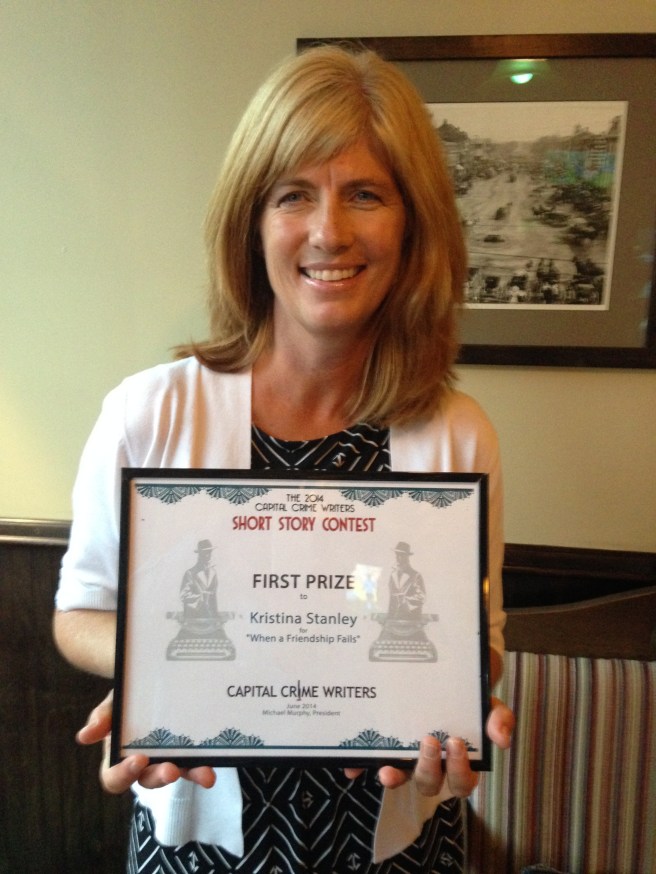
Thank you to Capital Crime Writers for hosting the Audrey Jessup short story contest.  Also thanks to the judges who took the time to read all of the entries and thanks for the lovely evening out.

The photo is me looking surprised and happy 🙂

This is the blog they posted on Monday.

Congratulations to our Audrey Jessop Short Story Prize winner!


Kristina Stanley Audrey Jessup


Kristina Stanley walked away with the 2014 Audrey Jessop Short Story prize for her submission, “When a Friendship Fails”.

The awards dinner at The Heart & Crown in the Byward Market capped off a Capital Crime Writers’ mayhem-filled year.

A huge thanks to our judges and all participants. And it’s never too early to start working on your submission for next year.

Here’s the complete list of prize winners and honourable mentions:

FIRST PRIZE:   ‘When a Friendship Fails’ by Kristina Stanley

SECOND PRIZE:  ’The Moment It Fell’ by Wynn Quon

THIRD PRIZE:  ’The Ride Home’ by Linda Standing

HONOURABLE MENTION:  ’Act the Part’ by Jennifer Jorgensen

HONOURABLE MENTION:  ’Scapegoat’ by Nicholas Ashton

How to Make the Most of a Writer’s Conference

Thinking of attending a writer’s conference?

You can learn a lot, make contacts and have fun, but how do you make the most of your time?

Here are a few tips:

  • Read the program before attending and decide who you want to meet. If there is a photo of the person/people you want to meet, it will help you pick them out of the crowd.
  • Ask yourself why you want to meet this person and prepare your questions ahead of time. You might only get a few minutes in a hallway, so make the most of it.
  • Often there are several presentations at the same time, so read the synopsis and choose what’s best for you.
  • Bring business cards. If you have any publications or writing awards, print these on the back of your card. You may get the chance to hand your card to and agent or a publisher and this will help them remember who you are. Maybe your card will stand out from the crowd.
  • Don’t be shy. Everyone is there to make contacts, so walk up to  groups of people you don’t know, introduce yourself. Ask what they write as an icebreaker. Who doesn’t like talking about their work?
  • If there is a way to volunteer, do so. It’s an easy way to meet people if you are shy. Sitting at a booth means other people come and talk to you. Working with other people gives you the chance to get to know them.

I hope this helps.

Thanks for reading . . .

Spelling: Canadian Vs. American

I’m confused.

I’m a Canadian and spell Canadian. I’ve spent many hours proofreading my novels to make sure my spelling is consistently Canadian.

I read novels written by Americans and am used to reading American spelling. This can make writing in one or the other difficult. as both ways of spelling look correct. I have my spell checker set to Canadian spelling, but sometimes there is an option and so the spell checker won’t highlight if I’ve slipped into American spelling when both versions may be acceptable.

What I’m saying is I’ve worked hard to keep my spelling consistently Canadian.

Then – and I feel like I should play music here – I attended the Bloody Words Conference in Toronto and a Canadian editor said, “It drives me crazy when the first thing I have to do is change all the Canadian spelling to American. Taking out the ‘u’ gets annoying.”

I didn’t get a chance to talk with her about the comment, but it’s been bothering me ever since.

Do any other Canadian writers out there prefer one way of spelling to another?

Is there a standard in the Canadian publishing industry?

Have I done this the wrong way?

If you’re opinionated on the subject, I’d love to hear about it.

Thanks for reading . . .

Farley’s Friday: A Wheaten Can Listen Well (Audrey Jessup Crime Writing Award)

Farley here,

I’ve had a weird week.

Kristina talked for days on end and it took me a while to figure out what she was doing. First I thought she was talking to me, and I felt pretty flattered to get so much attention.

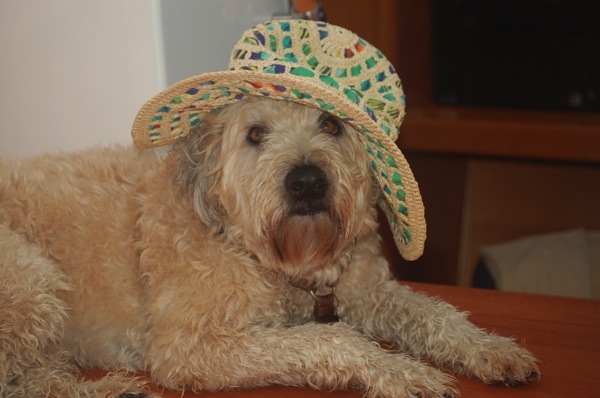
Then I realized she was focussed on something else entirely. And look what she made me wear.

Farley in Hat

“Take this hat off my head,” I bark.

“You’re my audience,” Kristina says.

“Audience for what?” I bark.

“I have to read aloud at the Audrey Jessup awards, and I need to practice.”

“Yeah, but why do have to wear a hat?”

“Because I’m pretending you’re sitting in a bar listing to me read my story.”

Okay, I get it. She’s nervous and wants to practice. She keeps mumbling something about the 10,000 hour theory and the more you do something to better you get at it.

So the night of the awards, she comes home all happy and dances around the living room. She won 🙂

Kristina Stanley Audrey Jessup

Now I just wag my tail. I’ll let her read to me anytime if it helps.

Woof Woof.

Capital Crime Writers


Bloody Words Conference

Danse Macabre: The Historical Dance of Death was the theme of the Bloody Words conference held in Toronto over the June 6th weekend.

The action packed conference started on Friday night and ended Sunday afternoon.

My favourite part: Meeting other authors. What a treat it was to meet with people who have been my “internet friends” for the last several years. I was pleased to see so many of the Crime Writers of Canada authors in attendance.

Learning in the sessions is a given, but learning in the hallway is fun too. Everyone spent time networking  – translate: experienced authors sharing trade secrets with the newbies. There was an opportunity to meet with agents and publishers.

Many thanks to the gang who ran the conference. The hard work put into the conference showed in the professional delivery. On a sad note, rumour has it this is the last Bloody Words conference. The year was my first and I’m glad I got to the event.

Thanks for reading  . . .