Mystery Mondays: Bonnie McCune on Writing and Today’s Book World

Today on Mystery Mondays, I’m happy to host author Bonnie McCune. Bonnie’s novel, Never Retreat, was published by Imajin Books on March 15th! Congratulations Bonnie.

Writing and Today’s Books World

by Bonnie McCune

IF IT LOOKS LIKE A DUCK AND IT WADDLES LIKE A DUCK AND IT QUACKS LIKE A DUCK, WHAT IS IT? WRITING AND TODAY’S BOOK WORLD

Are you a cowboy? A spy? A sexy lover? A child at heart? Somewhat intellectual? If so, you probably read in a genre like children’s books, westerns, mystery, romance, or literary.

But what if your tastes aren’t so cut and dried? What if the book has characters like my new novel, Never Retreat? Two regular people, Raye Soto, a feisty single mom, and Des Emmett, an ex-military, macho corporate star, meet at a telecommunications firm where both work. Thirty-something Raye is concentrating on her career in a major telecommunications firm and funding college for her teenaged son. Enter Des—a fast talker and smooth operator, who possesses every negative quality for a guy Raye should avoid.

My books to date have been women’s fiction with strong dollops of romance. But each contains mystery because, after all, who’s heard of a relationship without mystery? A relationship real or fictional might contain out-and-out subterfuge, like one of my early boyfriends who claimed he ran secret missions for a presidential candidate. Or the novel might include mysterious issues whose answers unravel over the course of the plot, such as why is Des trying to win a huge bonus?

Then there’s the mystery of “what’s gonna happen?” Who will survive? Who get ahead? My two heroes, thrown together at a corporate retreat in the wilderness, struggle to complete management’s extreme mental and physical tests for a huge reward. But only one can win the prize. Then when a massive flood imperils their love and survival, that becomes the unavoidable mystery of their situation.

No longer are book genres simple and innocuous. Sub-genre succeeds sub-genre. I’m not sure I even know what some of these mean. For example, urban romance fantasy. Is this several dragons who live in a large city off-world and become enamored of one another, or an historical period piece in which Cleopatra and her lover Marie Antoinette battle the evils of Czar Peter the Great in St. Petersburg? Or both?

Publishing is defined by specialized categories of book, which also identify readers by age, gender, interest, locale. These seem to become more targeted by the week. The process helps greatly in marketing books to try to insure readership.

Which brings me to authors who defy categorization and leap-frog genres: Michael Chabon, Margaret Atwood, Doris Lessing, P.D. James, among others. I’m sure their publishers would prefer they didn’t. It makes marketing their work more difficult. But these are big names, and they can do as they please. Successfully.

A challenge for both writers and readers. If a book doesn’t fit into a 30-second elevator pitch, should a writer ignore her creative urge? Should a reader refuse to purchase the novel? Instead let’s think about good writing. Even if a book is a particular genre (i.e., waddles like a duck), I think good writing should be possible in any genre and across genres.

“Women’s fiction,” close to my approach, covers the journey of the main characters to succeed in meeting life’s challenges. Of course, this also describes a great many novels outside that classification. Being a writer and always ready to split hairs or argue until I’m blue in the face, I don’t like to assign labels at all. Just be aware this category can incorporate a great deal of mystery as well as passion, depending upon author, plot, and publisher.

My story hurries on to show the mismatched couples, Raye and Des, see-sawing between attraction and antagonism, to face their biggest challenge: learning the meaning of true partnership. In a cliffhanger finale, when the torrent sweeps down the rocky canyon and threatens their survival, they must put aside their differences to rescue their colleagues—and their own possible future.

So if you read about a stormy human relationship in my future writings, don’t assume it’s a romance. It might represent mystery, thrills, even a whodunnit. A multitude of possible adventures lie before every character.

Never Retreat
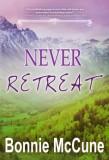
Never Retreat Create Space_240 - front cover webA feisty single mom clashes with an ex-military, macho corporate star at a business retreat in the wild Colorado mountains, where only one can win a huge prize. But when a massive flood imperils their love and survival, they learn the meaning of true partnership.

Years ago, Ramona (‘Raye”) Soto faced harsh reality when a roving con man knocked her up. Now at thirty-something she’s concentrating on her career in a major telecommunications firm and funding college for her teenaged son. Enter Desmond Emmett—a fast talker and smooth operator. New to the office, the ex-serviceman possesses every negative quality for a guy Raye should avoid. Thrown together at a corporate retreat in the wilderness, the reluctant duo struggles to complete management’s extreme mental and physical tests for a huge reward. But only one can win the prize, and Des needs the money to underwrite medical treatments for his adored younger sister.

See-sawing between attraction and antagonism, the mismatched couple, Raye and Des, face their biggest challenge: learning the meaning of true partnership. When a massive flash flood sweeps down the rocky canyon and threatens their love and survival, they must put aside their difference to rescue their colleagues—and their future as a couple.


WRITING: This is the new fiction for you: unafraid to debate contemporary concerns. . . pulls no punches. . .provides a fresh look at age-old issues. This is your kind of writing if you think. . .People are smarter than any phone. . .Feminism is just starting to come alive. . .You’ll always take a human over the most advanced app. . . .You can laugh at yourself. . . Women use four-letter words, including l-o-v-e.

Who is Bonnie McCune?
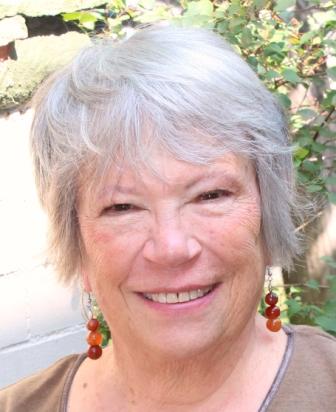
B 1 edited webBonnie McCune has been writing since age ten, when she submitted a poem about rain rushing down the gutter to the Saturday Evening Post (it was immediately rejected). This interest facilitated her career in nonprofits doing public and community relations and marketing. She’s worked for libraries, directed a small arts organization, and managed Denver’s beautification program.

Simultaneously, she’s been a freelance writer with publications in local, regional, and specialty publications for news and features. Her civic involvement includes grass-roots organizations, political campaigns, writers’ and arts’ groups, and children’s literacy. For years, she entered recipe contests and was a finalist once to the Pillsbury Bake Off. A special love is live theater. Had she been nine inches taller and thirty pounds lighter, she might have been an actress.

Her true passion is fiction, and her pieces have won several awards. Never Retreat is her third novel and her fifth book of fiction. For reasons unknown (an unacknowledged optimism?), she believes one person can make a difference in this world. Visit her at http://www.BonnieMcCune.com, Bonnie@BonnieMcCune.com, twitter.com/bonniemccune, facebook.com/authorBonnieMcCune, http://www.linkedin.com/in/BonnieMcCune.

PUBLICATION INFO: PUBLISHING MARCH 15, 2018, 978-1-77223-350-6 Kindle ebook, 978-1-77223-351-3 Trade paperback, 240 pages. https://www.amazon.com/dp/B079SY632Z, http://getBook.at/NeverRetreat or. Imajin Books, http://www.imajinbooks.com. Ebook and paperback.

ADVANCE PRAISE: “A breathtaking page-turner that will leave you exhausted but wanting more!” —Corinne Joy Brown, award-winning author of Hidden Star; “Likable, relatable characters…a real treat!” —Cindi Myers, author of The View from Here; “Intriguing…engaging…A great vacation read for sure!” —Meg Benjamin, author of the Brewing Love Trilogy; “A compelling story about a hard-working single mom who faces adversity head-on, learns from her mistakes, and perseveres.” —Kim McMahill, author of Marked in Mexico; “Few novels operate on such different levels, moving their characters to challenge not just each other, but their own not just each other, but their own perceptions. . .McCune provides just the right blend of comic relief, interpersonal encounters, and outside environment changes to make her story a powerful blend.” –Midwest Book Review

Tension and Conflict. What’s the Difference?

Tension and conflict will keep your reader engaged in every scene. Knowing the difference and when to use each will drive your story forward.

Tension

Tension is the threat of something bad happening. This creates suspense.

Tension can be subtle or in-your-face.

Subtle Tension: Imagine one character is hiding a secret that could destroy his life and another character is about to accidentally spill the secret. The reader will feel the tension if you’ve set up the scene so that the reader knows the second character can’t keep a secret.

In-your-face Tension: A woman is thrown off a boat at sea. The tension comes if the reader cares about the character and wants her to survive. Or the tension could be she’s an evil woman who is about to destroy the world, and the reader doesn’t want her to survive.


Conflict

Conflict is the fight that is actually happening. A physical fight, an argument, a battle to win a race.

Conflict can also be subtle or in-your-face action.

Subtle Conflict: Imagine a couple having dinner with friends. The wife is describing an event that happened in the past. The husband says, “Honey, that’s not what really happened.” The wife grits her teeth and smiles. She re-tells the story the way her husband wanted it told. She’s angry but hides it from others at the table. There is a silent argument going on between the couple.

In-your-face Conflict: Imagine that same couple having dinner in a restaurant. The woman knows her husband is having an affair but hasn’t let on she knows. The husband’s mistress enters the restaurant, and he winks at her. The wife loses control, grabs her drink, runs at the mistress, and throws it in her face. She attacks the woman and knocks her to the ground. That is direct conflict.


Do You Have Tension or Conflict in Every Scene?

Use conflict and/or tension in every scene and keep your reader engaged. You don’t need both in every scene, but you should have one in each scene.

Your challenge is to ask yourself if every scene in your novel has tension or conflict.

How does your manuscript measure up? Are you using tension and conflict to your advantage?


How Fictionary Can Help You

Fictionary is a new interactive web app for self-editing fiction that helps writers turn a first draft into a story readers love.

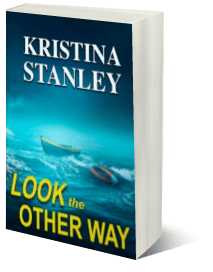
Below is the opening scene from Look The Other Way (by Kristina Stanley).

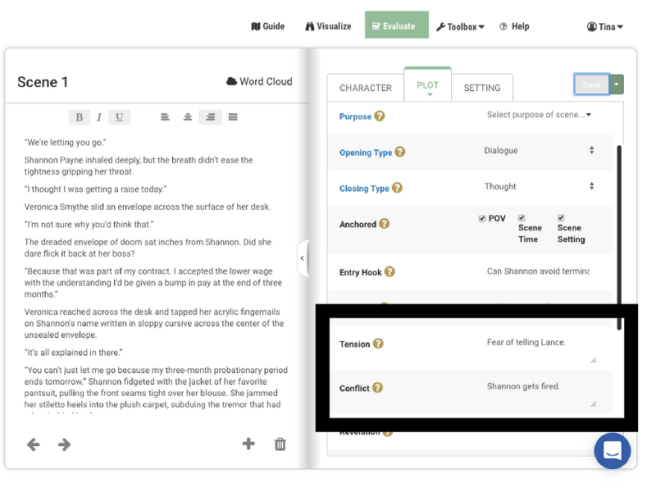
The “Conflict” in the scene is between an employer (Veronica) and employee (Shannon). Veronica is getting fired and Shannon argues against it, trying to keep her job.

The “Tension” in the scene occurs when Shannon is in the middle of being fired and she worries about how to tell her fiancé. They are just about to buy a house and need her income. The tension also foreshadows there will be problems between Shannon and her fiancé. A double use of a key element will make your story stronger.

The question marks in Fictionary contain information about each Key Element of Fiction and how to use the elements to make your story better.


Post written by Kristina Stanley, author of Look The Other Way (Imajin Books, Aug 2017).

Kristina Stanley is the best-selling author of the Stone Mountain Mystery Series and Look The Other Way.

Crime Writers of Canada nominated DESCENT (Imajin Books, July 2015) for the Unhanged Arthur award. The Crime Writers’ Association nominated BLAZE (Imajin Books, Oct 2015) for the Debut Dagger. Imajin Books published her third novel in the series, AVALANCHE, in June 2016.

Luzifer-Verlag published Abwaerts (Descent) in Germany in the fall of 2017.

Her short stories have been published in the Ellery Queen Mystery Magazine and The Voices From the Valleys anthology. She is the author of THE AUTHOR’S GUIDE TO SELLING BOOKS TO NON-BOOKSTORES.

Her short story, WHEN A FRIENDSHIP FAILS, won the 2014 Audrey Jessup with Capital Crime Writers.

Kristina is the CEO of Fictionary, and all of her books were edited using Fictionary.


Why not check out Fictionary’s free 14-day trial and turn your draft into a story readers love?

Mystery Mondays: Elena Hartwell on Research and the Fiction Writer

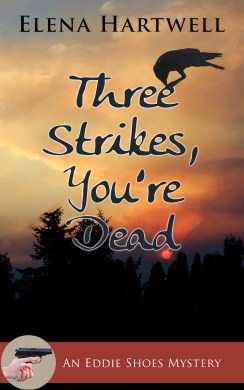
Today on Mystery Mondays we host Elena Hartwell, three time mystery author. I met Elena through the ITW (International Thriller Writers), an organization run by Lee Child. Her latest book Three Strikes, You’re Dead came out yesterday. Congratulations, Elena!

Writing Advice: Research and the Fiction Writer

by Elena Hartwell

Discussing research with other mystery writers fascinates me. Responses to it range from “it’s my favorite part of the writing process” to “I hate research.”

The good news is there’s no one-size-fits-all formula for how much to research. It’s very much a personal choice.

For those of us who love to research, here are some common pitfalls for us to avoid.

First: it’s easy to get consumed in research and forget to actually write.

One thing about being a fiction writer is nothing you write is “true” in the sense of factual accuracy. No one gets hurt when fiction writers get it wrong (other than our pride when it gets pointed out publicly). At some point, your imagination and the best way to tell the story takes precedence. You can always check facts or talk to an expert as you polish your draft. And if you are writing about a topic where experts disagree, make the best decision based on your characters and storyline.

Second: it’s easy to love our material so much we want to share everything we learn with our readers.

Often termed “info dumps,” too much information bogs down the forward momentum. It can also shift the tone of a story from your character’s point of view to a preachy pulpit where the author shouts at the reader. Either one of these situations will likely stop your reader from turning the page, or buying your next book.

One way to deal with this issue is write all the facts you want into your early drafts. Then, as you begin the rewriting/editing process, locate the places where you have long paragraphs of “facts” or where the description shifts out of your characters’ voices and into your own. Beta readers are great at finding these moments.

Keep in mind, readers want to know what your characters are doing and thinking far more than they want to know facts about Victorian architecture or the history of cameras or the best way to chink a log cabin. Sprinkle in details through single lines and short moments. Details like this are fascinating in small doses and when they are motivated by the storytelling, through an observation or action of a character, a line of dialogue, or a short description.

Lastly, it’s easy to write a scene so accurate it loses dramatic tension. The storytelling is what matters most in fiction. In most instances, an author can write around something that wouldn’t happen in the real world by: finding an alternate solution, creating a unique situation that explains the unlikely outcome, or using a different scenario altogether. But, in those places where you need to shorten up a timespan, have a person do something they wouldn’t or couldn’t in the real world, or defy the laws of physics, if it’s the only way to keep the story tight – just do it. You are, after all, writing fiction.

For those of you who hate research, don’t despair. There are a couple ways to deal with that too.

First, create primary characters and situations that exist in your own realm of experience. Write a cozy about an amateur sleuth who has the same day job you do. There is no rule that says all mystery writers must write police procedurals or legal thrillers. For those writers who don’t love to do research, perhaps stay away from writing historical fiction or creating multiple scenarios that require characters with a lot of specific expertise. While most manuscripts require some research, there are ways to minimize it.

Second, foster experts. People love to talk about their areas of interest. I’ve never had anyone turn me down for an interview when I’m researching my novels. Talking to experts can be a lot of fun. Experts are often even willing to read a section of your draft to check your work.

Lastly, readers love characters and stories. If you fully understand your craft as a writer, imbue your characters with complex interior lives, strong intentions, dramatic conflict, and high stake situations, readers are going to respond positively.

My final advice, do as much research as you can, only include as many facts as you need, and above all, story first.

Three Strikes, You’re Dead

ThreeStrikesCoverPrivate investigator Eddie Shoes heads to a resort outside Leavenworth, Washington, for a mother-daughter getaway weekend. Eddie’s mother, Chava, wants to celebrate her new job at a casino by footing the bill for the two of them, and who is Eddie to say no?
On the first morning, Eddie goes on an easy solo hike, and a few hours later, stumbles over a makeshift campsite and a gravely injured man. A forest fire breaks out and she struggles to save him before the flames overcome them both. Before succumbing to his injuries, the man hands her a valuable rosary. He tells her his daughter is missing and begs for help. Is Eddie now working for a dead man?

Barely escaping the fire, Eddie wakes in the hospital to find both her parents have arrived on the scene. Will Eddie’s card-counting mother and mob-connected father help or hinder the investigation? The police search in vain for a body. How will Eddie find the missing girl with only her memory of the man’s face and a photo of his daughter to go on?

Who Is Elena Hartwell?

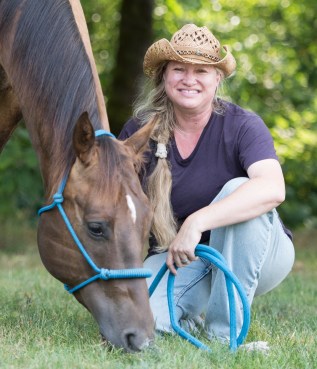
CREDIT MARK PERLSTEINElena Hartwell started out her storytelling career in the theater. She worked for several years as a playwright, director, designer, technician, and educator before becoming a novelist.

She lives in North Bend, Washington, with her husband, their two cats, and the greatest dog in the world. When she’s not writing, teaching writing or talking about writing, she can be found at a farm down the road where she and her husband keep their horses.

Elena also works as a writing coach and does one-on-one manuscript critiques.

For more information please visit www.elenahartwell.com. You can also follow her on Facebook, Twitter, Instagram, and Pinterest.

5 Ways to Hook Your Reader In Every Scene

Many writing books talk about the importance of the first line, first paragraph and first page of a novel.

If you don’t grab the reader early in your novel, you might lose them for good. Taking that thought and applying it to each scene means evaluating the entry hook for each scene.

There’s a lot of pressure on a writer to produce an extraordinary first line for a novel.

But as with most things, practice will make you better. So start practicing now with the first line of every scene in your novel. By the time you’ve evaluated every scene looking for the entry hook, and maybe rewriting the scene opening for a few, you’ll be ready to go back and rework the first line of your novel.


What Is A Scene Entry Hook?

How many times have you read a book, were a little tired, and not sure if you wanted to start the next scene or chapter? You might read the first few lines of the next scene and then decide to keep reading.

Whatever you read at the beginning of the scene that kept you reading was the scene entry hook.


5 Ways To Hook Your Reader

When creating an entry hook, consider:

  1. Starting in media res
  2. Foreshadowing trouble
  3. Using a strong line of dialogue
  4. Raising a question
  5. Not wasting words on extraneous description.

Alternate Your Technique

Alternate your technique so the reader doesn’t get bored. If you don’t know what the hook is or why the reader would keep reading the scene, think about rewriting the scene opening.

Sometimes you might find you’ve started the scene too early. Look at cuttingthe beginning of the scene until something exciting happens.

If there is description you need, move it to later in the scene if you can. You might just need a little reorganizing of the scene to make the opening sizzle.


How Fictionary Can Help You

Fictionary is a new interactive web app for self-editing fiction that helps writers turn a first draft into a story readers love.

Below is the opening scene from Look The Other Way (by Kristina Stanley).

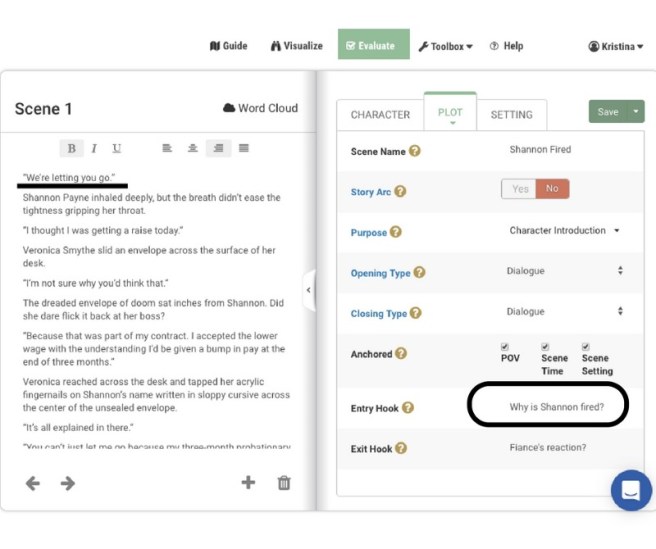
The “Entry Hook” key element makes me evaluate each scene and think about whether I’ve used a good entry hook. If I haven’t, then I need to rewrite the opening.

The entry hook is the first line of dialogue. “We’re letting you go.” leaves the reading wondering who is being fired and why.

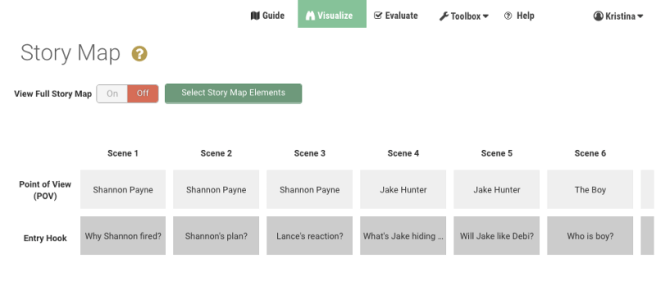
In Fictionary, you can use the Story Map so evaluate key elements of fiction throughout your story.

Here, I’ve chosen just the point of view character and the entry hook to be shown in the Story Map. This way I can evaluate how I’m drawing a reader into each scene.

Your challenge is to ask yourself if every scene in your novel is has an entry hook.


Post written by Kristina Stanley, author of Look The Other Way (Imajin Books, Aug 2017).

Kristina Stanley is the best-selling author of the Stone Mountain Mystery Series and Look The Other Way.

Crime Writers of Canada nominated DESCENT (Imajin Books, July 2015) for the Unhanged Arthur award. The Crime Writers’ Association nominated BLAZE (Imajin Books, Oct 2015) for the Debut Dagger. Imajin Books published her third novel in the series, AVALANCHE, in June 2016.

Luzifer-Verlag published Abwaerts (Descent) in Germany in the fall of 2017.

Her short stories have been published in the Ellery Queen Mystery Magazine and The Voices From the Valleys anthology. She is the author of THE AUTHOR’S GUIDE TO SELLING BOOKS TO NON-BOOKSTORES.

Her short story, WHEN A FRIENDSHIP FAILS, won the 2014 Audrey Jessup with Capital Crime Writers.

Kristina is the CEO of Fictionary, and all of her books were edited using Fictionary.


Why not check out Fictionary’s free 14-day trial and turn your draft into a story readers love?

Mystery Mondays: Haris Orkin on Finding Ideas

Today we welcome Haris Orkin. His novel You Only Live Once, was published by Imajin Books on March 21st. So it’s hot off the press, as they say. In addition to being an author, Haris is and playwright.

Over to Haris…

James Bond is Barking Mad

by Haris Orkin

Aspiring writers often ask me where I get my ideas. I don’t always have an answer for them on the spot. I’ll be glib or I’ll deflect, but in fact, it’s a very good question. Even though “You Only Live Once” is my first novel, I’ve been making a living as a writer for thirty years.

I’ve written radio and TV commercials for some of the largest companies in the world. I’m a produced playwright and screenwriter and for the last ten years I’ve been writing and designing video games. So I’m always generating ideas. Always. Sometimes I hesitate to delve too deeply into my process. I worry that if I pull it apart I may not be able to put it back together. I like the fact that my process seems mysterious and I trust that ideas will come to me, but the truth is the way I work is not all that complicated or mystical.

I’m a watcher, a reader and a listener. I’m endlessly curious and love eavesdropping on people’s conversations. (Okay, that sounded a little creepy.) I’m always reading newspapers and magazines and watching documentaries. I love movies and TV shows and my taste is incredibly eclectic.

It’s all grist for the mill. Those influences then collide with whatever internal conflict going on at the moment. (And I always have some internal conflict going on.) Writing is a way for me to work out those conflicts: a way to have a conversation with myself and the world.

Here’s an example.

When I found out I was going to be a father 28 years ago, I was happy and excited and terrified. My wife and I knew we were going to have a son and the prospect of impending fatherhood raised all kinds of questions and fears. What kind of example would I be? What would I teach my son? What kind of man was I? What kind of man would I like him to become?

It brought to mind my own childhood and the relationship I had with my own father. (And the relationship he had with his father.) With all those concerns and thoughts swirling around in my head, I started writing things down. It was a way to process my thoughts and feelings. Those thoughts and feelings eventually became a play that was performed in New York and at the La Jolla Playhouse in Southern California.

The play was called “Dada” and there was a scene in it that eventually became the spark that inspired “You Only Live Once.” The main character in the play, David, is an insecure father to be. He remembers a meeting he had with his guidance counselor when he was a junior in high school and it’s dramatized in the play.

The guidance counselor asks David what he wants to do when he graduates and he says doesn’t know. She pushes him, telling him, “Your grades are good. You’re clearly college material. You’ve always done well in math. Have you considered accounting?”

“My dad’s an accountant.”

“You want to follow in your father’s footsteps?”

“Definitely not.”

“Have you thought about actuarial science of the insurance industry?” Dave shakes his head, a painful look on his face. The counselor continues, “Well, there must be something that seems interesting to you. Isn’t there anyone you’ve read about or have heard of who has a career that seems the slightest bit intriguing?”

“Well, there’s one I guess, but it’s kind of dumb.”

“Why don’t you let me be the judge of that. You’re bright, you’re personable and if you apply yourself you probably could do most anything you want.”

“I want to do what James Bond does.”

“What?”

“James Bond. He gets to travel all over the world and drive really cools cars and he never has to sit in some dumb office and shuffle papers.”

“Very funny David,” she says as she sternly shuffles some papers. “But this is a serious question. What do you want to do with the rest of your life?”

Later in the play, grown up David has an imaginary conversation with James Bond and Bond confronts him on his choices, saying, “You settled. You gave up. You wanted to be me. How do you know you couldn’t have?”

“You’re not even real.”

“When you were fifteen I was more real to you than your own father. I embodied all your dreams. All your desires. You wanted to be suave and masterful and seductive and dangerous. You wanted men to fear you and women to fall all over you. Is that no longer true? Or do you know longer know what you want anymore.”

David stands up to him and says. “You kill people. You force people to have sex with you.”

“I have a license to kill and because I do I will brook no insolence from anyone. I take what I want and I do what I want and no one tells me how to live or what I can or cannot do.”

“But no one cares about you. And you don’t care about anyone else. What kind of life is that?”

“A life free of sticky and unnecessary encumbrances. To love is to allow someone inside so deeply the can cause you…unmentionable pain.” Bond’s eyes fill with tears. “Why give someone that power?”

David puts his arm around Bond and comforts him and, in that moment, finally puts the fantasy of James Bond to rest.

“You Only Live Once” examines the mythos of a Bond-like character in today’s world. It seemed to me that you’d have to be barking mad to actually do what James Bond does. And that brought to mind one of my favorite novels ever. Don Quixote. I could see the connections and from those connections “You Only Live Once” was born.


“You Only Live Once” Synopsis

James Flynn is an expert shot, a black belt in karate, fluent in four languages and irresistible to women. He’s also a heavily medicated patient in a Los Angeles psychiatric hospital. Flynn believes his locked ward is the headquarters of Her Majesty’s Secret Service and that he is a secret agent with a license to kill.
When the hospital is acquired by a new HMO, Flynn is convinced that the Secret Service has been infiltrated by the enemy. He escapes to save the day, and in the process, kidnaps a young Hispanic orderly named Sancho.

This crazy day trip turns into a very real adventure when Flynn is mistaken for an actual secret agent. Paranoid delusions have suddenly become reality, and now it’s up to a mental patient and a terrified orderly to bring down an insecure, evil genius bent on world domination.

http://getbook.at/YouOnlyLiveOnce

 You Only Live One

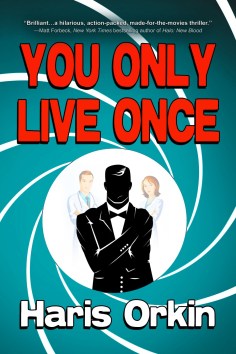
You Only Live Once Front Cover Official resized for websiteJames Flynn is an expert shot, a black belt in karate, fluent in four languages and irresistible to women. He’s also a long-term mental patient in a Los Angeles psychiatric hospital. Flynn believes his locked ward is the headquarters of Her Majesty’s Secret Service and that he is a secret agent with a license to kill.

When the hospital is acquired by a new HMO, Flynn is convinced that the Secret Service has been infiltrated by the enemy. He escapes to save the day, and in the process, Flynn kidnaps a young Hispanic orderly named Sancho.

This crazy day trip turns into a very real adventure when Flynn is mistaken for an actual secret agent. Paranoid delusions have suddenly become reality, and now it’s up to a mental patient and a terrified orderly to bring down an insecure, evil genius bent on world domination.

Reviews for “You Only Live Once”

“A brilliant homage to everyone’s favorite super-spy, and a hilarious, action-packed, made-for-the-movies thriller about a man suavely dancing along both sides of the thin line between heroism and madness.” —Matt Forbeck, New York Times bestselling author of Halo: New Blood

“Pacey and unrepentant fun, Haris Orkin’s You Only Live Once takes the James Bond mythos, gives it a swift kick in the backside and steals its wallet.” —James Swallow, New York Times bestselling author of Nomad 

“Fill shaker with ice. Add equal parts Ian Fleming and Quentin Tarantino. Shake (do not stir). Garnish with Douglas Adams, and you get You Only Live Once, a delicious martini as dry as the dusty California desert.” —Dan Jolley, USA Today bestselling author of the Gray Widow Trilogy

“If you’re looking—and who isn’t?—for a sexy, slapstick, razzle-dazzle, rock’em-sock’em re-imagining of Don Quixote as James Bond emerging from deep cover in a mental hospital to save the world, Haris Orkin’s hilarious yet touching You Only Live Once is the book for you.” —Charles Harper Webb, award-winning author of Brain Candy

WHO IS Haris Orkin?

Haris_1-25-18_120 FinalHaris Orkin is a playwright, screenwriter, game writer, and novelist. His play, Dada was produced at The American Stage and the La Jolla Playhouse. Sex, Impotence, and International Terrorism was chosen as a critic’s choice by the L.A. Weekly and sold as a film script to MGM/UA. Save the Dog was produced as a Disney Sunday Night movie. His original screenplay, A Saintly Switch, was directed by Peter Bogdanovich and starred David Alan Grier and Viveca Fox. He is a WGA Award and BAFTA Award nominated game writer and narrative designer known for Command and Conquer: Red Alert 3, Call of Juarez: Gunslinger, Tom Clancy’s The Division, Mafia 3, and Dying Light, which to date has sold over 7.5 million copies.
Haris has contributed chapters to two books put out by the International Game Developers Association; Writing for Video Game Genres and Professional Techniques for Video Game Writing.

www.harisorkin.com

https://twitter.com/HarisOrkin

Find Haris on Social Media

Website: https://www.harisorkin.com/you-only-live-once

Facebook: https://www.facebook.com/AuthorHarisOrkin/

Goodreads: https://www.goodreads.com/author/show/17753529.Haris_Orkin

Amazon Author Page:  https://www.amazon.com/Haris-Orkin/e/B07B2L75HH/ref=dp_byline_cont_ebooks_1

Camp Nanowrimo: Who is going to join me?

Camp-2017-Participant-Twitter-HeaderLast summer I wrote 50,000 words of my WIP progress, EVOLUTION, as part of CAMP NANOWRIMO 2016. Since then, I’ve added another 10,000 words.
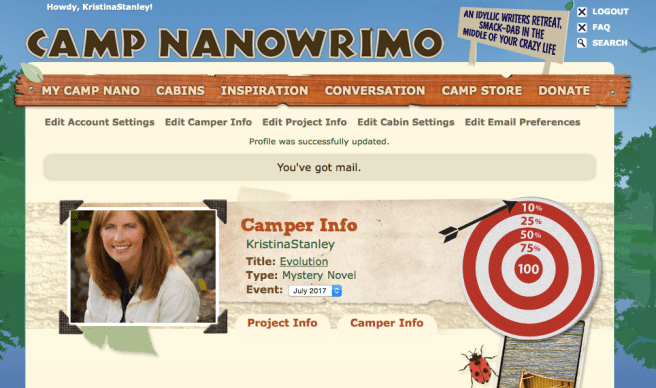
I’d like this novel to be around 80,000 words, meaning I need to write another 20,000 words.

Doesn’t sound like much, except when I think about launching Feedback  (A New Online Tool That Guides Fiction Writers Through A Big-Picture Story Edit), releasing my latest novel, LOOK THE OTHER WAY, published by Imajin Books, and the rest of life that keeps interfering with my writing.

Screen Shot 2017-06-25 at 1.02.08 PM

I decided I would join Camp Nanowrimo with the modest goal 20,000 words, so I can finish this book. Then, maybe I can join NANOWRIMO in December and write 50,000 of another book.

So who else is doing Nanwrimo? I’d love to connect and encourage each other. Let me know in the comments below.

Here’s an excerpt from my WIP.

I shut the refrigerator door for the fifth time. Why did I keep looking inside the box for answers? Food wouldn’t solve my problems.

Fatigue wrapped its heavy blanket around my shoulders, muting my strength. The sound of the grandfather clock intermixed with sleet hitting the windows in the early morning hours made me want to lie down on the kitchen floor and never get up.

The clock chimed past the time of day I now hated. A family heirloom that had belonged to my parents and before that my grandparents. Somehow I’d inherited it. My guess was my dad didn’t want the noisy contraption in his house, so when Nick and I had moved into our home on Loughborough Lake, my dad had “gifted” it to me, Jaz Cooper. Some gift.

Two weeks ago I was happy. Today, well, today was different. My stomach tightened. I wasn’t sure I could move away from the fridge. I didn’t know how to spend my time. And who would care about what I did, anyway?

I’ve never been one to feel sorry for myself. That’s not who I was, and it’s not who I would become. I bit the inside of my lip, mostly to refocus the pain in my gut. It was too early to go to work, but coffee might help.

I plodded across the empty kitchen, the floor creaking underneath me with each step, and hit the power button on the coffee maker. The timer wouldn’t go off for another two long hours.

Coffee was my new habit. Nick and I used to drink tea together. But no more. I was slowly getting used the strong aroma that wafted from the beans and to the acidy taste. It was the caffeine I needed, not a feel good drink.

Out of habit, I opened the bottom cupboard door and reached for the dog food, then my mind caught up to reality. An overwhelming sense of loss ripped at my heart. That horrible knife of pain.

I slammed the cupboard door, walked to the living room, and lowered myself into the dog bed. I curled into a ball and inhaled Bandit’s smell, like that would bring him back. At night, he used to sleep in my bed, tucked behind my knees, soothing me with his deep breathing. During the day, he’d slept here. Most of my waking hours were filled with the company of dogs. I only had Bandit as a pet, but I ran a dog training school, so I could have many dogs in my life.

Unable to bear the real reason from my grief, I focussed on the dog. I’d always known I would grow old without Bandit. Dogs owners all know that awful truth. They don’t like it, but they live with the knowledge.The dog’s loss I could handle. The other would break me.

Through the tapping of the sleet on the living room window, I heard a howl. I held my breath and listened. The wind rattled the trees beside the house and drowned out any other sound.

I waited.

Another howl followed by slapping water. I shuffled to the window but couldn’t see anything. I stepped onto my porch, a mere thirty feet from the lake, and concentrated on the sound.

A bark. More slapping water.

The moon broke through the clouds, streaming light onto the lake.

A dog had gone through the ice. Without thinking, I bolted outside and ran toward the lake. My slippers stuck in the snow and were ripped from my feet. The sting of cold hurt my bare skin, but that didn’t matter. I reached the icy surface and kept running.

Daisy, the neighbor’s Great Dane, battled the edge of the ice. Her rump was underwater. Her front claws strained against the snow. Her nostrils were flared.

My heel slid across black ice, and I tumbled backward. My tail bone slammed onto the hard surface, and my elbow cracked. I rolled onto my side, then onto my stomach. I slithered forward, closer but not close enough to grab Daisy’s paws.

Daisy slipped backward and into the water.  Her head dropped below the surface.

I froze.

She burst through the surface, snorted water, and scraped her paws over the edge of the ice. She barked. Her nails clawed at the ice but couldn’t grip the surface. Terror in her eyes? Pleading? Whatever it was, the message was clear. Get her out of the water.

I crawled forward on my stomach, ignoring my throbbing elbow. I should have grabbed a rope. A hundred-pound, panicking dog was not going to be easy to get out of the water. Sleet soaked my back and neck. My pajama bottoms clung to my legs.

I grabbed one paw. Daisy’s nails dug into my arm, and I let go. The dog had power in her limbs. I knew I shouldn’t, but I had to get closer. I’d have to leverage her out of the water.

Her rump remained below the surface, but her head stayed above water. For now.

Another howl. Anyone listening would think I was torturing the dog. I slithered closer. I could join her. Slide past her into the water. Moments would pass, and the pain would end. But then Daisy would drown, too. Selfish.

I could pull her from the water, then drop in. The darkness below welcomed me.

Crack.

The sound sliced through me. There wasn’t much time to save Daisy. One big shove with my feet, and my arms slid underneath her pits and around her shoulders. She dug her claws into the back of my neck. A warm liquid trickled across my skin. She’d cut me, but I didn’t let go.

I was living the nightmare of anyone who walked on a lake at the end of the winter season. Adrenaline pounded at my temples. My skin prickled. I felt her terror. The emotion was so strong, I gasped.

Daisy dug her claws deep into my neck and shoulders, gaining traction. She hefted herself out of the water. Her rear paws grabbed at the edge of the ice. She tumbled over my head, across my back, and away from the hole in the ice.

I knew I should get off the ice, but I couldn’t move. I lay on my back, panting. The black water called me. All I had to do was roll over and slide in.

Time is running out…on Book Sale

2015 is coming to close today, and I want to thank everyone who has interacted with me during the year. Connecting with other writers, readers and dog lovers has been fun.

Farley had a blast sharing his stories and reading my books.

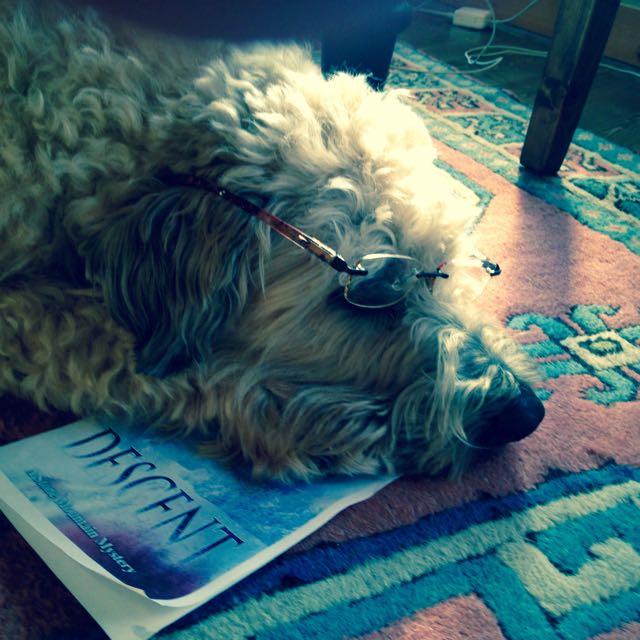
Farley reading DESCENT

DESCENT and BLAZE are on sale for a few more days and then life gets back to normal.

eBook Sale 1

Thanks for reading…

Happy New Year.


Mystery Mondays: C.S. Lakin on Showing Through Your Characters’ Senses

This week I have the pleasure of hosting C.S. Lakin.

C. S. Lakin is a novelist and writing coach who spends her time divided between developing new book ideas and helping writers polish theirs. She is the author of fourteen novels – six contemporary novels, seven in the fantasy/sci-fi genre, and one in historical Western romance. Whether she is exploring the depths of the human psyche and pushing her characters to the edge of desperation, or embellishing an imaginary world replete with talking pigs and ancient magical curses, she is doing what she loves best – using her creativity and skills to inspire and affect her readers.

I was first introduced to C.S. Lakin through her novel Time Sniffers and have been a fan ever since.

Today’s she’s sharing an excerpt from her latest non-fiction book. Just another indication of her willingness to help other authors.

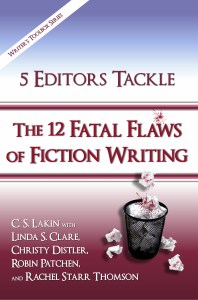
Excerpt from the newest release in the Writer’s Toolbox Series: 5 Editors Tackle the 12 Fatal Flaws of Fiction Writing.

 Fatal Flaws FINAL ebook coverShowing through Your Characters’ Senses

 One of the reasons readers willingly immerse themselves in a story is to be transported. Whether it’s to another planet, another era—past or future—or just into a character’s daily life, readers want to be swept away from their world and into another—the world of the writer’s imagination.

It’s challenging for writers to know how much detail to put in scenes to effectively transport a reader. Too much can dump info, drag the pacing of the story, and bore or overwhelm. Conversely, too little detail can create confusion or fail to evoke a place enough to rivet the reader.

In addition to knowing how much detail to show, writers have to decide what kind of details to use. I often read scenes in the manuscripts I critique, for example, that have characters engaging in lots of gestures, such as rubbing a neck, bringing a hand to a cheek, pushing fingertips together, turning or moving toward something—all for no clear reason.

Showing body movement, gestures, and expressions can be an effective way to indicate a character’s emotional state, but this needs thoughtful consideration so that the gesture or expression packs the punch desired.

It also important to show setting—and not just show it any old way. What is key to creating a powerful setting is to show it through your character’s POV and in a way that feels significant.

Showing Significant Settings

 When is setting significant to the reader? When it’s significant to the character.

That’s not to say every place you put your character has to evoke some strong emotion. A character who goes around gushing, crying, or jumping in excitement over every locale will appear to be missing some marbles.

But just as in real life, places affect us—some more than others. Each of us can think of numerous places in our past that bring a flood of emotionally charged memories. Showing setting colored by a character’s emotions is not only effective and powerful, it also captures real life.

But let’s talk about those other settings. The ones that aren’t emotionally charged. The many places in which you set your characters to play out your scenes. Some of those places are merely backdrops, places your character traverses daily or on occasion. They’re not important, right?

Let me just pose this possibility: even though you’ve thought a bit about the locales for your scenes, it may be that you aren’t truly tapping into the power of setting. In the rest of this chapter, we’ll look at ways to fix that.

Bring the Setting to Life

 You may need to write a scene that shows a tense discussion between two characters. So you stick them in the coffee shop, since it doesn’t matter where you put them. And, hey, a coffee shop makes sense. Everyone goes to them. It shows the characters doing ordinary things.

Sure, put your characters there (but please not twenty times in a novel). Or do something more interesting. I encourage writers to try to think up original, unique settings that bring a character’s bigger world—town, city, region—alive. But even if a writer thinks up fresh and creative locales in which to place her characters, those settings might still come across in a boring, ineffectual way.

But it’s the conversation that matters, the writer argues. That’s what I want readers to pay attention to. The setting is just a backdrop.

In many scenes, that may be true. But if a writer wants to transport her reader, she’ll think about bringing the setting to life via sensory details—which are observed by the POV character.

 Go through your scenes and look for these indications of flawed” telling” instead of showing:

  • Summarizing important moments instead of playing them out in real time
  • Lack of sensory details to bring the scene alive: sights, smells, sounds, and textures, brought out through the POV character’s senses
  • Detailing insignificant actions that aren’t important to the plot or don’t reveal anything helpful about the characters (showing too much)
  • Not starting in the middle of something happening in real time; instead, setting up a scene by explaining and filling in with information
  • Showing characters moving (driving, walking, etc.) from one location to another when those actions are not useful to the story
  • Numerous paragraphs of narrative that summarize interaction between characters and lack actual dialogue, gestures, and/or body language
  • Excessive use of gestures, body language, and “body feelings” to show emotion instead of alternating or replacing with internal thoughts that imply the emotion
  • Showing setting not presented through the POV character and void of sensory detail

Setting is so often overlooked, but it can be a powerful element in your story, so don’t neglect it.

Author C.S. Latin
Author C.S. Latin

S. Lakin is a multipublished novelist and writing coach. She works full-time as a copyeditor and critiques about two hundred manuscripts a year. She teaches writing workshops and gives instruction on her award-winning blog Live Write Thrive.

The latest book in The Writer’s Toolbox Series is now available for sale on Amazon: 5 Editors Tackle the 12 Fatal Flaws of Fiction Writing. Get yours here.

***

Next week on Mystery Mondays we welcome Gloria FerrisWinner of the 2012 Bony Blithe Award forCheat the Hangman” and Winner of the 2010 Unhanged Arthur for “Corpse Flower

The Dark Side of Alpine Skiing: Guest Blog with Donna Galanti

Reblogged from The Element Trilogy

The Dark Side of Arson
 by Kristina Stanley

KS bwI’m excited to have Kristina Stanley guest posting again! She’s on a hot topic today with the dark side of arson, featured in her newest book, BLAZE, the second book in the Stone Mountain Mystery Series with Imajin Books. 

Check out Kristina’s earlier post on the dark side of alpine skiing and check out BLAZE, releasing October 25th!

Please welcome Kristina….

See The Element Trilogy for full blog post…