New Release: The Goddaughter Does Vegas by Melodie Campbell

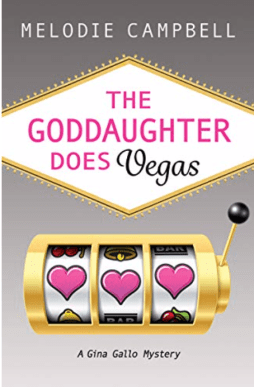
Funny Girl, Melodie Campbell, has a new book out in the Goddaughter series. Do you need a belly laugh? Answer yes? Then The Goddaughter Does Vegas is for you!

The Goddaughter Does Vegas

Gina Gallo is a mob goddaughter who doesn’t want to be one. She’s left her loopy family behind to elope with Pete to Vegas. Except that eloping may be a mortal sin in an Italian family. Between that and some weird deliveries and suitors, Gina’s nerves are frayed. Vegas is full of great acts, but one impersonation is real: Gina has a crime-committing double whose activities are making Gina front-page news. Gina has to track down this fiendish fraud before the police catch up with her. And, of course, cousin Nico is along for the ride.
Another madcap adventure for the loveable Gallo cousins that proves the rule “Why should things go right when they can go wrong?” Buy Now: https://amzn.to/2sZ7YOL


About Melodie Campbell

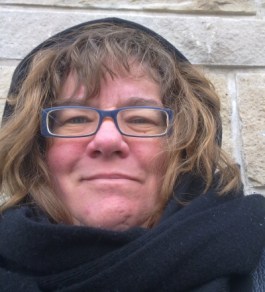
2015 author photo correctedThe Toronto Sun called her Canada’s “Queen of Comedy.” Library Journal compared her to Janet Evanovich. Melodie Campbell has won the Derringer, the Arthur Ellis Award, and eight more awards for crime fiction. Last year, Melodie made the Top 50 Amazon Bestseller list, sandwiched between Tom Clancy and Nora Roberts. She is the past Executive Director of Crime Writers of Canada. Her 13th book, The B-Team, launches this week. It’s in first person.

Creating a Strong Story by Rebecca Monterusso – Certified Story Grid Editor

I’m thrilled to host Rebecca Montrusso, a Story Grid certified developmental editor, as a guest. Rebecca is sharing her expertise on how you can become your own story editor.

Creating a Strong Story

(Before you call in an editor)

by Rebecca Monterusso

I am a developmental editor. Meaning, I help people learn to tell their stories better by focusing on the fundamentals (read: story craft and structure). I like to say that I help people write masterfully, read actively, and live intentionally because I believe they are all necessary to live as a creative person. I also teach people how to practice in the right ways to be the writer they’ve always wanted to be (see my latest post), but that’s beside the point in this case.

What’s most important is that I study how to write effectively, do so myself, and use those skills to help other people improve their work.

That said, it might be surprising when I tell you (beg you, perhaps) to become your own editor. And I mean before calling in someone like me to take a look at your work.

Wouldn’t it make sense for me to tell you I can fix any story no matter how rough? Shouldn’t I have you send me even the most cursory drafts so that I can earn a comfortable living? Perhaps, but that’s not how I run my business.

There are a number of reasons you should write and edit your own story before hiring an editor. 


First and foremost, I don’t want to take your money if I can’t help you make significant changes that will bring your workable draft closer to being finished.


Lying about how good or bad your novel is to make you feel better won’t make you a better writer and won’t allow me to do my job effectively. A draft that is so rough I can’t even begin to improve it (meaning, it lacks structure, consistency, movement, active characters, etc), isn’t something I feel good about taking on. I want to feel like I’ve made a difference in the work of the authors I help and I can’t do that if I can’t actually help. Save your money.

When you become your own editor, you learn, improve, and remember that knowledge for your future drafts.

I’m not saying you’re going to be able to write a perfect draft that will require no edits. But, your first drafts will (probably) require fewer and fewer edits the more you improve your craft. That’s because you’ll know where your novel is going and be more likely to get it there when you understand what your audience expects. Do the work now and you’ll be able to grow that much more when telling future stories.

Other writers self-edit themselves.

Not that I’m telling you to do something just because others do it. But, think of the most prolific authors, the most well-told stories. Chances are, those authors learned how to improve their own work before sending it to someone else. Compare that to the masses of people who write a novel in a month (or any designated amount of time) and send it off to an agent without even reading it through themselves. If you’re going to copy any sort of strategy, the one that gets authors published and out of the slush pile should be adopted.

Your next drafts will be better.

As you learn to critique your own work in an honest way (not too gentle or harsh), the future drafts of that story that you produce will become better and better. This is because of brain science and the fact that knowledge is cumulative. Taking time to study and you’ll gain more and more knowledge along that way that will enable you to challenge your initial ideas and build upon them to create unique stories.

You’ll better appreciate the books you read.

Learning how to write well and understanding the mechanics that make a story work will change the way you read. Reading stories and analyzing them will improve your writing, just as improving your understanding of the craft of writing will improve your understanding of the books you read.

All that aside, how do you improve your story before sending it to an editor?

Showing your work is a necessary step. Feedback is irreplaceable. That said, you could find an editor or coach who works with beginning writers (which might seem counter-intuitive, but there are people specifically interested in that). Or, use beta-readers or family members who read a lot and might be able to help. (Though I don’t recommend that route because they could do more harm than good, it is an option if you trust the people you send your work to.)


You could study every craft book you can get your hands on. The Story GridStory GeniusStory, Story Engineering, to name a few. Take the time to peruse websites like www.thecreativepenn.comwww.janefriedman.comwww.storygrid.com, etc. Listen to podcasts. Figure out and act on the habits of successful writers like Steven Pressfield, Stephen King, etc. Plenty of writers outline their learning methods in books for you to find. Or, you could attend events like Robert McKee’s Story Seminar or take Masterclasses by Margaret Atwood or Dan Brown.

Finally, you can use the tool at your fingertips and subscribe to Fictionary. Not only will you have access to the computational analysis, but you’ll get emails on craft to continue to teach you. Using this tool will enable you to take learning into your own hands. You’ll see your novel laid out in many different forms and learn what that means for what you’ve crafted. Then, you can act on that analysis and keep working to improve what you’ve learned. Though that doesn’t replace hiring an editor, it is a great first step to improve your first drafts immensely.

Rebecca Monterusso

Rebecca Monterusso is a Story Grid Certified Developmental Editor, which is a fancy way to say that she helps writers learn to tell their stories better by focusing on writing, reading, living, and practicing with intention.

She spends her time traveling the world, writing whatever takes her fancy, and deconstructing the many stories she reads on her blog to better understand the craft of writing. Ultimately, she believes that stories are the only way to change the world, which makes writers mighty powerful people.

Rebecca Monterusso Workbooks

If you’re looking for a method to get that book started and written well, Rebecca has a couple of workbooks that will help you.

Practice to Improve Your Writing workbook will help you learn by doing, by actually writing. It will help you practice in the right ways so that you improve, turn writing into a habit, and story stories you want to emulate. Use it to take actionable steps towards your goals.

Write A Story in 7 Days walks writers through the steps they need to take to come up with a fully-formed story that works. It helps them get words on the page and continue to improve their understanding of craft as they learn.

Ghost Writer: Another fabulous read!

As we continue on our journey through the wonderful mystery novels published by Imajin Books, the sale continues. Today, Alison Bruce is here to share a story that gives us insight into her and her characters…

Ghost Writer is on sale for $1.99.

Are all writers Stubborn?

By Alison Bruce

2013-Bruce-author-400My life isn’t so much an open book as a Columbo episode. 
Columbo, an American mystery series starring Peter Falk as the eponymous homicide detective, always started with the murder. The mystery wasn’t a whodunit; it was all about Columbo working it out, gathering the clues and getting a confession. Not that my life adventures required many confessions. But I’ve always been fascinated why things happen and why people do things…including myself. 

Once I decided to take a different route home from school. There was an apartment building at the end of my street.  That is, there was an entrance to the apartment building’s parking lot. I reasoned that the front of the building must be on Kingston Road, which was the road I walked along to get to my high school. If that was the case, I should be able to cut through the parking lot to get home.

This wasn’t a shortcut, by way. I had to go past the street that most directly led home. I was also wrong about the building. Another apartment building fronted Kingston Road. The one I knew backed onto it. The parking lots could have been connected, if someone hadn’t put an eight foot link fence in between.

A reasonable person would have backtracked. A more athletic person would have had no problem scaling the fence. I was neither athletic nor reasonable, but I was stubborn. I managed to climb the fence but just barely made it over. I left a swatch of denim and a chunk of my skin behind.

I do my best to make my protagonists different from each other. They have different family situations, different professions, different skill sets, different tastes (coffee excepted). However, I think all of them have the similar dumb episode in their past. Like me, they hate backing down.

GHOST WRITER

By Alison Bruce

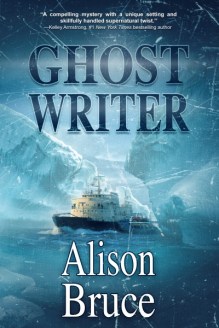
Bruce-GhostWriter-400She has to deal with two kinds of spooks: spies and ghosts.
But which one is trying to kill her?

Jen Kirby has seen ghosts since she was a child, but she can’t talk to them or help them cross over. And, after a violent death in the family, she doesn’t want to see them anymore. 

In her role as ghostwriter, Jen joins a Canadian Arctic expedition to document and help solve a forty-year-old mystery involving an American submarine station lost during the Cold War. The trouble is, there are people—living and dead—who don’t want the story told, and they’ll do anything to stop her.

Now Jen is haunted by ghosts she can’t avoid or handle alone. That means confiding in the one man she doesn’t want to dismiss her as “crazy.” But can he help? Or is he part of the problem?

http://getbook.at/GhostWriterAB

Alison writes novels that combine mystery, well-researched backgrounds, a touch of romance and lots of coffee. She is the Executive Director of Crime Writers of Canada.

Website: www.alisonbruce.ca 

Twitter: @alisonebruce 

Facebook: www.facebook.com/alisonbruce.books 

Pinterest: pinterest.com/alisonebruce  

Amazon Author Page: http://viewauthor.at/AlisonBruce 

Ties Up With Strings – On Sale!

The Imajin Books  Sale just keeps on giving. Today, Madeline McEwen is here with a funny story. What she doesn’t know is that the secret skill she’s sharing is one my husband also has. And Mathew used the skill to make the girls laugh – in grade 3! Can you guess what it is…

So listen carefully… Then check out Tide Up With Strings.  On sale for $0.99!

It’s All About the Ears

by Madeline McEwen.

author headshotKristina suggested we share a nugget of information with readers—something not generally known. However, my life is an open book or rather, an ancient Kindle without the software updates—as useful as a tablet of stone. Hence, I decided to go old school and announce I’m the only person I know who can wiggle their ears.
Ear wiggling is a vestigiality—a remnant of human development—like the coccyx, appendix, and wisdom teeth. I like to think this means that at one time in human history, everyone one of us could wiggle our ears—we were the norm and signaled emotions as simply as we do with our lips, smiling or pouting.

Now, we’re an anomaly as most people have lost the art and ability to greet and communicate with one another with a quick ear wiggle.

Sadly, this genetic trait, if not mutation, wasn’t inherited by any of my four offspring. I am the end of the line, the dodo, doomed to extinction.

TIED UP WITH STINGS

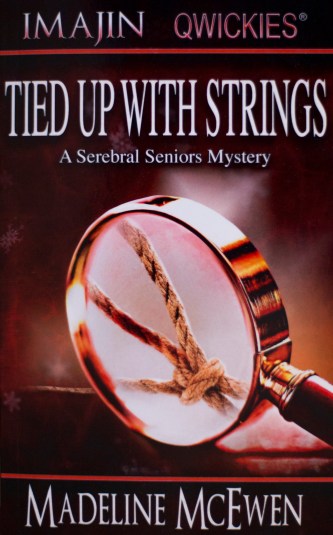
HiResCoverTUWS-1TIED UP WITH STRINGS, currently on sale for 99 cents
http://getbook.at/TiedUpwStrings

When curmudgeonly private detective Betty Grape visits a young friend, who is housesitting in a remote village in England for Christmas vacation, something seems out of place. Her friend, Catia, is visibly nervous. Is she worried about the young men in the decrepit caravan in next door’s back garden? Or is Catia involved in the disappearance of the homeowner’s invalid wife?

As an American, Betty discovers the locals are full of friendly gossip but taciturn about solid facts. Though they are determined to keep Betty from butting in on their territory, she blunders through the social morass of narrow-minded foreigners and their broad Dorset accents. Can she unravel the tight knots of this mystery? Will she find the perpetrator under thickly thatched rooves or behind floral chintz curtains?

Check out this very cool video about Tied Up With Strings:

https://www.youtube.com/watch?v=YP1OedSNmSk

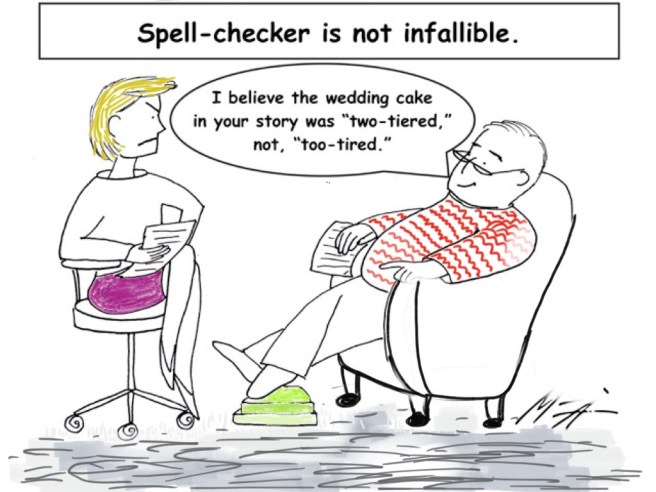
And let’s end with something funny.

CWCtwotiered

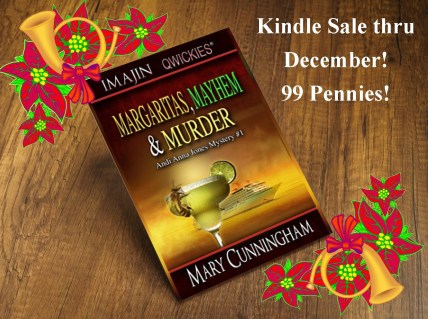
Margaritas, Mayhem & Murder

It’s an exciting month to find new books to read. This December, my fabulous publisher, Imajin Books is having a sale.

I thought it would be fun to share the books with you, so you can buy yourself a present or give the gift of reading to friends or family. I’ve read everyone of these books, and they rock.

Who doesn’t want to read about Margaritas, Mayhem & Murder? That’s sound fun, right? Ok, maybe not the mayhem and murder…

To keep with the fun theme, I’ve asked the authors to tell me something fun about themselves.  You’ll find that below.

Dec 2018 saleFirst up is author, Mary Cunningham.

Margaritas, Mayhem & Murder – Andi Anna Jones Mystery # 1

Andi’s step-mother is a real piece of work! But is Ruby a murderer?

Andi Anna Jones, so-so travel agent/amateur sleuth, puts aside her resentment of her father’s widow and books a 60th birthday cruise to Cancun for Ruby and three friends. Never does Andi imagine the cruise will lead to the murder of a has-been lounge singer—or that Ruby will be the main suspect.

Flirting with more than danger after arriving in Mexico, Andi connects with the charming local sheriff, Manual Rodriquez. After an embarrassing night involving the sheriff, too many margaritas, and a Mariachi band, a chance to check out an eyewitness to the murder leads her to Las Vegas. 

In Vegas, a mysterious meeting in the Bodies Exhibition, a body preserving in the prep-room, and an evasive owner of a dance studio, give Andi clues to help Ruby. But when Andi is mercilessly drugged and locked in a storage room, she realizes dear old step-mom isn’t the only one in jeopardy.

A confession from the author:

Andi Anna Jones, mediocre travel agent, with an inferiority complex about her job, her looks, and her single status, discovers her “inner sleuth” in Margaritas, Mayhem & Murder. 

Keeping with some excellent advice I got years ago, to “write what you know’, her character and job are loosely based on a horrifying stint I had in North Miami Beach as a travel agent. I was truly awful and would duck down behind my computer whenever a customer came in the door. 

Fortunately, I worked with a fabulous agent named Ellen who recognized my fear and would usually jump in to help when I got stuck. In honor of Ellen, Andi’s sidekick and true manager of Graves Travel Agency is Ellie. She saves Andi’s butt in the same way Ellen saved mine. The only thing Andi finds irritating about her assistant is that she always calls her, Jonesy. 

I hoped writing the book will help exorcise the experience from my memory by giving Andi a positive course for her curiosity and love of a good mystery. 

Purchase Margaritas, Mayhem & Murder:

Amazon: https://www.amazon.com/dp/B076N6KBM3

Smashwords: https://www.smashwords.com/books/view/756600

Google Play: https://play.google.com/store/books/details/Mary_Cunningham_Margaritas_Mayhem_Murder?id=0jU8DwAAQBAJ

Kobo: https://www.kobo.com/ca/en/ebook/margaritas-mayhem-murder

Find Mary on Social Media: 

Links: 

Website: https://www.marycunninghambooks.com

Facebook: http://www.Facebook.com/Cynthiasattic

Facebook author page: https://www.facebook.com/marycunninghambooks/

Twitter: http://twitter.com/MaryCunningham

Pinterest: https://www.pinterest.com/gus65/

LinkedIn: https://www.linkedin.com/in/marycunningham1/

Goodreads: http://www.goodreads.com/author/show/367223.Mary_Cunningham

Amazon Author Page: https://www.amazon.com/-/e/B002BLNEK4

Imajin Books: http://www.imajinbooks.com

Farley’s Friday: Doggy Friendships

Farley here,

Living with a guide dog in training has certain benefits.

I have a cuddle partner. Kinta has lots of play time with me, and sometimes we get a little tired out. So what do we do?

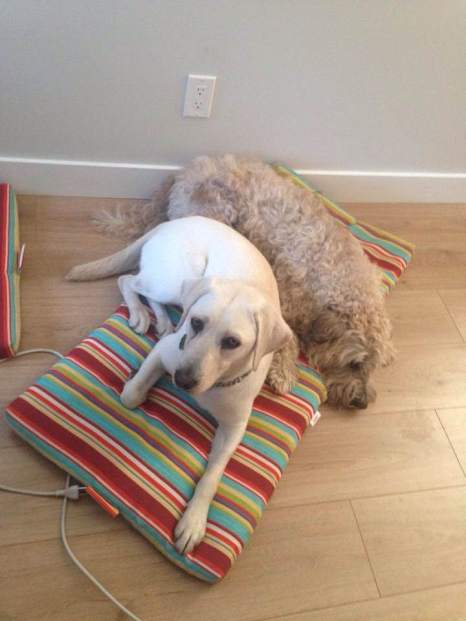
We chill on Kristina’s cushions that she’s trying to dry out. It’s not our fault she left it in the rain and then put it on the floor.

F&K cushion

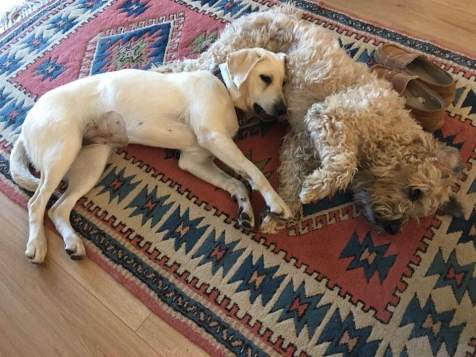
After getting kicked off the cushion, we snuggle on the rug.

F&K Rug

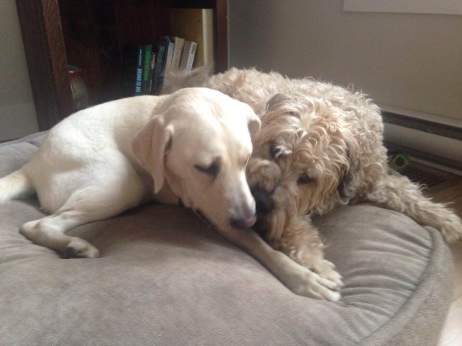
And when that got boring, we move to the dog bed where I like to chew on Kinta’s leg.

Kinta Farley


Some days are just fun.

Woof Woof.

Farley’s Friday: Learning To Heel

Farley here,

Life as a guide dog trainer is exhausting. Kinta is just over a year old and has a ton of energy.

The first thing I had Kristina teach Kinta was to only play with me when I feel like it. I’m 10, you know.  When Kinta gets too rambunctious, Kristina tells her to leave it, and magically she leaves me alone.

If I’m by myself with Kinta, I get up on the middle of the bed where she can’t reach me. She’s not allowed on the bed, so it’s a great hiding place for me.

Today, I spent my morning teaching Kinta how to heel without pulling on the leash. I’m an expert 🙂 At least in my mind.

Heeling

Having a new pal in the house is awesome!

Woof Woof

Need a Book Endorsement? The Advance Reader Copy is Your New Best Friend. #AuthorToolboxBlogHop

Thank you, Raimey Gallant for organizing the #AuthorToolboxBlogHop.

This is a monthly blog hop on the theme of resources/learning for authors: posts related to the craft of writing, editing, querying, marketing, publishing, blogging tips for authors, reviews of author-related products, anything that an author would find helpful.

To continue hopping through other great blogs in the monthly #AuthorToolboxBlogHop or to join, just hop on over to Ramey Gallant!

This month, I’m writing about how to get endorsements from other authors.


I have a confession to make: when a novel of mine is close to being published, I get nervous.

I get nervous because I know that it’s almost time to start sending out Advance Reader Copies (ARCs) – an almost-but-not-quite-final version of my book – for endorsements. ARCs are sent before the final editing and proofreading is complete. Why do I stress myself out this way?

Despite my misgivings, there’s a method to the madness. When your book hits the shelves, endorsements on the front and back cover adds legitimacy. It’s added promotional material every time someone picks up your novel. It’s important to get endorsements early, so they can be incorporated into your book’s cover design and online listings.

The endorsements that go on your cover are ones that connect with your readers. You want to find authors who write in your genre that readers will recognize. Having an endorsement from your mom is nice, but it won’t help sell your book. (Unless your mom is a famous author. In this case, go ahead and use her!)

Endorsements are critically important, and it all starts with the ARC. It makes me nervous to have people I know and admire read an unfinished version of my book, but the payoff is so worth it.

Here are my tips on how you can spin your ARCs into book marketing gold:

Networking and the ARC

I learned early in my writing career that networking long before I finished my first novel is critical to the publishing journey.

How does one find established authors willing to spend their time reading an about-to-be-published-for-the-first-time author’s novel? That’s where networking comes in.

I’ve attended writing conferences, workshops and awards dinners. Each of these gave me a way to meet other authors. I started a blog. Got active on Twitter, Facebook, LinkedIn etc.

When I first joined the Crime Writers of Canada (CWC), I sent every CWC author a LinkedIn message asking them to connect with me. Hundreds did. I was amazed. I kept a spreadsheet of the authors I’d sent a message to, which ones accepted my invitation and included a check mark when I sent a thank you. Since then, I’ve kept up communication with authors, sending them a message when I’d read their book and posted a review..

Who To Ask For An Endorsement

I chose authors that I had some connection with. Either I’d met them in person, or I’d connected with them on the Internet. I looked for authors where our writing had something in common.

I wrote a letter to each author as I would a query letter. I included my writing credentials and the reason I was asking a specific author. Part of asking is the condition that if they didn’t like the book, I wouldn’t expect an endorsement.

What Format to Send

When possible, ask the author which format they prefer (i.e. PDF, mobi, epub, print, etc.). This shows them respect and it means they won’t be distracted from the story because they’re reading in a format they don’t like.

For one author, I was so thrilled they said they would read an ARC, I had it printed and bound at my local print store.

How Many Endorsements Are Enough?

I recommend a minimum of three. One for the front cover of your novel and two for the back. My covers have the highest profile endorsement on the top of the front cover. The next two endorsements are on the top and bottom of the back cover. When potential readers pick up my novel, they don’t even have to open the cover to see the promotional material.

For anything more than three endorsements, jump up and down and do the happy dance. Then plan to put the endorsements after the copyright page.

What Should An Endorsement Look Like?


The endorsements on the outside cover are edited to contain only the most enticing words. The full endorsement is written on the inside of the book after the copyright page.

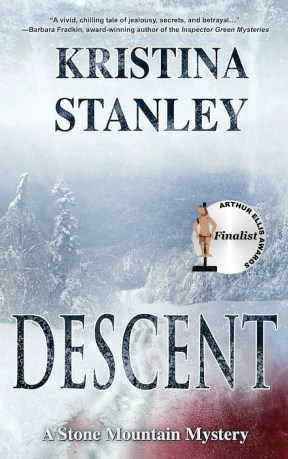
For my novel DESCENT, the front jacket endorsement is:

“A vivid, chilling tale of jealousy, secrets, and betrayal…”
– Barbara Fradkin, award-winning author of the Inspector Green Series.

The full endorsement printed inside the book is:

In this impressive debut, Kristina Stanley weaves a vivid, chilling tale of jealousy, secrets, and betrayal in a close-knit mountain ski village. Like its likeable young heroine, Kalin Thompson, DESCENT is both tender and tough. – Barbara Fradkin, award-winning author of the Inspector Green Series.

Readers have two chances to discover the endorsements, and that’s two chances that they will buy your book.

A Thank-You

We all know a thank you goes a long way. After my book is published, I mail a  signed print edition of my novel to any author who endorsed it. I know I love to receive a copy of any book I’ve endorsed, so I’m assuming others like this too.

On that note, thanks for reading!


kristina stanley.jpg

Kristina Stanley is a bestselling author, editor, and the CEO of Fictionary. Fictionary helps writers tell better stories with breakthrough online software that simplifies story editing. She’s the author of the Stone Mountain Mystery Series, Look The Other Way, and The Author’s Guide to Selling Books To Non-Bookstores.

Perform An Awesome Author Reading #AuthorToolboxBlogHop

Thank you, Raimey Gallant for organizing the #AuthorToolboxBlogHop.

This is a monthly blog hop on the theme of resources/learning for authors: posts related to the craft of writing, editing, querying, marketing, publishing, blogging tips for authors, reviews of author-related products, anything that an author would find helpful.

To continue hopping through other great blogs in the monthly #AuthorToolboxBlogHop or to join, just hop on over to Ramey Gallant!


Writing means learning — all the time — for the rest of your life.

And in the modern world of publishing, writing a great novel is only the beginning of the journey if you want your work to have a wide audience.

Public readings are a part of that journey. They’re a great place to build your readership and sell books — but they can also be incredibly daunting.

The first time I read out loud was intense. It was 2014, and I was nominated for the Audrey Jessup Award for short story crime writing from the Capital Crime Writers. Part of being nominated meant reading aloud before the winner announcement was made. To say I was nervous would be an understatement. I hadn’t read out loud before and had no idea how to go about it.

As luck would have it, I attended the Bloody Words conference in Toronto a week before the event and heard seven authors read there. Days later, I found myself at another reading, this time by three Scandinavian authors. That’s 10 readings I could learn from. Some of the readings were great and some could have used a bit of practice.

I watched and learned from these readings and thought I was ready. But not quite. There was a time limit of five minutes on the reading. I practiced and had my timing down perfectly, but I didn’t account for the time it took to be introduced and say thank you to my hosts. I was cut off about 30 seconds before I’d finished — literally. The hosts turned the microphone off. It stung a bit, but other authors were cut short too. (At least it wasn’t just me, and I didlearn from the experience.)

I won the Audrey Jessup Award, even though my reading wasn’t the greatest. After winning, I sold that story to Ellery Queen Mystery Magazine. My first sale!

Since then, I’ve read in some strange places. One reading took place in a senior’s residence. Another in a ski lodge. One in a bookstore — which you’d expect. Each time I do a reading, I get better at it and I’m less nervous.

I’m here today to help you get comfortable with holding an author reading of your own.

How to prepare & practice

  • Don’t leave it until the last minute. Practice every day, even for short periods of time. If you can, read to an audience.
  • Practice pausing for commas, periods, paragraph breaks, and starting new scenes.
  • Practice until you can take your eyes away from the words and make eye contact with the audience. This will engage them in your reading. Reading to a mirror will allow you to see if you’re looking up.

Technical tips

  • Don’t staple the pages. Stapled pages are noisy when turned and awkward to hold in place.
  • Number your free pages in case you drop them.
  • Ask how many minutes you have to read. Then prepare for a few minutes less, the exact amount of time and a few minutes more. If other readers don’t show up, you may be given more time. If the proceedings are running long, you might be given less time. Be ready so you can end with a cliffhanger or a dramatic spot that will leave people wanting more.
  • If you’re reading from printed pages, print in font large enough to read. Remember: the lighting could be dark or there could be glare. If the font in your printed book is small, you can always print the pages you want to read and place your book in front of you while you’re reading.
  • Ask what the setup will be. Is there a podium where you can set your pages? Will you be holding a microphone? Will you be standing or sitting?

At the event, before you read

  • If you’re not first, watch the other readers for what works and doesn’t work. Standing with the microphone too close to the sound system can cause feedback, having the microphone too far or too close to you can make understanding your words difficult.
  • Have your material ready. Don’t start looking for the section you want to read after you’re at the podium. This distracts the audience.

During your reading

  • Once you’re on stage, thank the hosts of the event. This will make you look professional and give you time to let your voice and your nerves settle before you start reading your story.
  • Breathe. This sounds obvious, but breathing will make your speech clear. During my first reading, I was so nervous that I couldn’t bring air into my lungs. At the end of the first page, when I had to flip to the next page, I moved the microphone away from my mouth and took a deep breath. This helped me calm down.
  • Don’t explain your work in the middle of reading. Let your words speak for themselves.
  • Only brief the audience about the story if you’re not starting at the beginning.
  • Speak slowly.

Remember: the audience came to hear you and they want you to succeed, so smile and have fun.


Fictionary: Tell Better Stories

I’m the CEO of Fictionary, and we help writers tell better stories. Fictionary is software that simplifies story editing and helps you improve characters, plot, and settings. After a Fictionary story edit, you’ll know your story is ready to share with others.

Fictionary is an automated approach that helps you evaluate your story against 38 key elements for Characters, Plot, and Settings.

Fictionary draws your story arc and compares it to the recommended story arc. You can see how to improve the structure of your story within seconds.

This week we’ve teamed with ProWritingAid to offer you an amazing bundle. Check out how Fictionary and ProWritingAid work together.

Until September 22nd, get annual subscriptions to both Fictionary ($200) and ProWritingAid Premium ($50) for just $99.

Click here to get the Fictionary and ProWritingAid bundle now!

Thanks for reading.

Farley’s Friday: Beach Time For Dogs

Farley here.

Woof Woof. Wag Wag. It’s fall and that means the beaches on Vancouver Island start to open to dogs.

Yup, that means swimming! That means running off leash.

Farley on beach

And it means getting full of sand and shaking it off in the back of the car. Kristina loves that part. Maybe love is a stretch, but she takes me to the beach anyway.

I love fall!

Woof Woof