Farley’s Friday

Farley here.

Kristina still won’t write my blog, so here I am typing again. She clipped my nails this week, so it’s a little harder for me to hit the keys accurately. Good thing there is a delete key, and it’s bigger than the others.

So I’m celebrating. Today is my 4th year anniversary living with Kristina and Mathew. Can you believe how time flies? My friend Kermit the Frog says, “Time’s fun when you’re having flies.” I don’t really get it. Who wants flies?

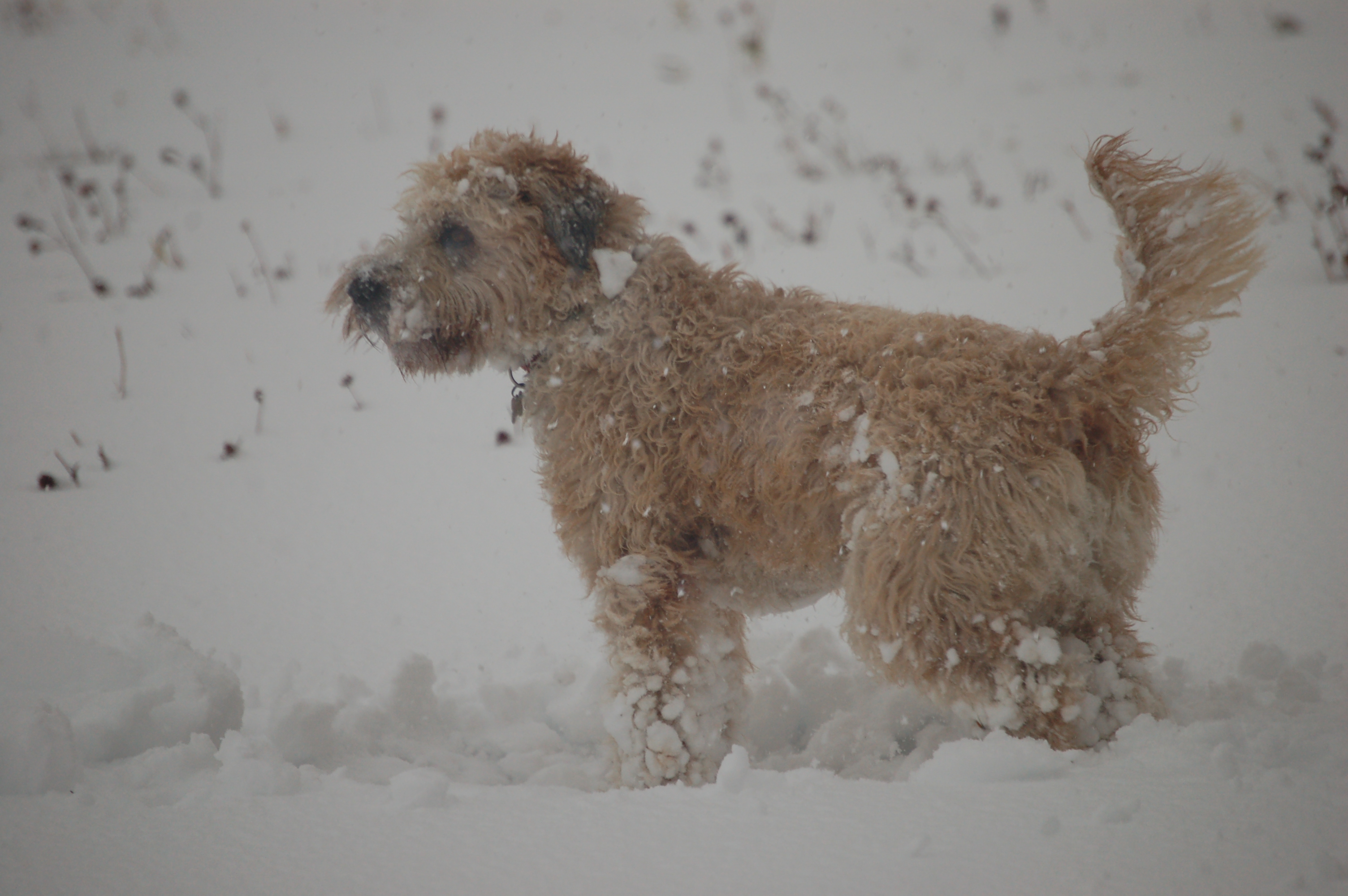
I love this white stuff. Where did it come from?

So this week, I jumped of the back deck and look what I found. SNOW. The smells are incredible. I chased a deer and one rabbit, but they’re too fast for me.

The snow sticks to my fur and gets between my pads. All I have to do is sit and look pathetic. I hold up my paw and my owner picks the snow out of my pads for me. She’s so easy to train. I lower my nose and lift my big brown eyes at her, and Kristina does whatever I want. If any anyone needs help on training their owners, just let me know. Mine gets a gold star for her behaviour.

A couple more weeks of cold weather in Winnipeg and then I head south to start my cruising season. I’m glad I got the chance to see snow. I’d forgotten it existed.

Happy Snowball Chasing.

Woof Woof,

Farley

Copyediting – Proofreading Comments Summary (Part Two)

 So we continue with copyediting and proofreading comments . . .

After my five-part blog on copyediting and proofreading, I collected the comments from this blog and from the LinkedIn writing group called Crime Fiction managed by Theresa de Valence.

Today I’ll focus on Having Others Proofread Your Work:

I received some interesting ideas about having others proofread your work and have grouped the comments below. Some comments gave a similar message so I picked one of them to post. I hope you find these helpful.

  • I threw a party…after my manuscript had been proofread by a pro (and she was good). I invited five well-read, literate friends and gave them each five page stacks of non-chronological parts of the manuscript. They were to read them over, mark what was wrong, tag those pages with coloured stickers and then trade with someone across the table. I reassembled the manuscript and made the CX where needed. It’s a constant process as you know. Not perfect, but darn close . . . I was in the room because . . . when my readers had questions about dialect or some military or nautical term I could answer them immediately. They read silently for the most part . . . unless they had questions. Having the pages out of context made for closer scrutiny . . . helping eliminate the usual tendency to mentally fill in words automatically . . . which the writer may do when reading one’s own book. . BTW, the manuscript was 102,000 words and having five readers meant it was accomplished in about four hours. I had a thank you card and gift for each reader when we were done. They liked the chore so much they volunteered to do it with future books . . . and I’m going to take them up on it.


  • If you can, have two of your most obsessive compulsive friends or relatives read the galley. They’ll work hard to find the little mistakes, the kinds that editors miss. However, in the end, don’t beat yourself up over every error; we are human. 


  • As a newspaper reporter, I knew many editors, but only a handful as meticulous as needed for a book manuscript. When I receive galleys, I ask two really good editors to read copies. Each of the three of us has her own copy. It is amazing to see how many errors each of us find, mistakes not duplicated by the other readers. And this is after the books have been through editors at the publishing house. Wow! For the first several books I used editor friends whose work I knew. I took them to dinner or some other entertainment as compensation. In all, five different editor friends have read for me. Now, I write them checks, which are never enough for what they contribute. They fuss, but will cash the checks. They get a kick out of reading the first print-outs, even boast about doing it. Others have volunteered, but I need pros. It works for me.


  • Genre is extremely important. You have to know the
genre to be able to tell the timing, rhythm, wording and nuances of the
story. Each one has its own blood pressure and heartbeat. Editors are
inclined to pick out things that they say are wrong, and may actually take 
more
away from the story than they put in. They tend to be superior in demeanour. 
For
example, an editor might tell me that the language in EINAR is too formal, 
but
they do not know Scandinavian speech patterns. I speak Norwegian, Danish,
Swedish , as well as English, German and Dutch to varying degrees and know the
rhythm of all the languages. It also helps in research. It is their opinion
unless they are on the payroll of one of the major publishers. In that case you
kind of have to do what they say for the most part if you can’t prove your
point.


  • Be careful who you go with as an editor. Be absolutely sure that they are well versed in your specific genre. If you write horror, do not settle for a fantasy editor, it is not the same thing. Always look for personal compatibility. It is your baby that you are entrusting them with, not some mangy red boned mutt from the pound.


  • Trade with someone – you proof theirs & they proof yours. Errors tend to get less detectable with repeated readings, until they look more “normal” than more “correct” usages. And that script reading by your characters is probably a good idea for reasons way beyond proofing – might want to do it while you’re doing drafts as well, to try out alternative sequences. An audience helps, although they’ll get testy after a while, no matter how good the writing is.

Thanks for reading and thanks for the comments . . .

Copyediting – Proofreading: Summary of Comments (Part One)

Now that I have completed  my five-part blog on copyediting and proofreading, I’ve grouped the comments into topics and ended up with too much information for one blog, so . . . I’ll split it into several. I’ll add information that I didn’t include in my original blogs and that was kindly contributed by readers of my blog.

I collected the comments from the blog series and from the LinkedIn writing group called Crime Fiction managed by Theresa de Valence.

The topics from the comments are:

  • DON’T TRUST YOUR SPELL CHECKER
  • Having Others Proofread Your Work
  • The Eye Sees What it Wants to See
  • Read it Backward
  • Read it Out Loud
  • Read it Big
  • Adjectives and Adverbs
  • Split Infinitives
  • E-Readers
  • Computer versus Paper
  • Templates
  • Taking Breaks
  • Proofreading versus Copyediting

And yup, you guessed it. I’m going to cover the bolded topic today.

DON’T TRUST YOUR SPELL CHECKER

One theme among the comments was the quest for a list of the most common words authors have issues with. You can find that list a little farther down in the blog.

The following is a humorous excerpt (paraphrased a little) from one comment I thought summed up why we have difficulty seeing the typos, and I’ll call them typos, because most of us know how to spell and we know the correct word choice, but our fingers seem to have a will of their own and type what they want.

Never met a spelling you didn’t like, eh? Well they’re (their?) hard to (too?) spot, even for those of us who can spell some and know lots of words. They hide or just sit there defiantly, while your integrative, Gestalt brain fills in the gaps and skips over extra letters on its own, without telling you. That’s why proofing is so difficult, aside from the tediousness. And you’re (your?) usually doing it at the 11th hour, under time constraints, and all your (thy?) helpful friends have abandoned you to your dire fate.
What happens to me kicking out the stops on the mighty netbook, is letters get omitted due to detritus among the keys, and the spell checker thinks “ad” instead of “and” is good to go. Etc., or is it Ect.?

There was consensus that homophones and typos that create a correct word, but not the word you want,  are a problem in manuscripts. The following are the words I received in the comments to the blog. This list contains words that other authors have stated they have issues with. I’ve bolded the ones that I didn’t include in my original blog.

  • Ad/And
  • Aisle/Isle/I’ll
  • Barely/Barley
  • Calf’s/Calves
  • Ect./Etc.
  • Here/hear
  • Heard/herd
  • He’ll/Hell
  • It’s/Its
  • Flee/Flea
  • For/Fro
  • Form/From
  • Grown/Groan
  • Manor/Manner
  • No/Not/Now
  • Own/Now
  • Series/Serious
  • So/Sew (use needle and thread)

  • Sit/Sight
  • Then/Than
  • Then/The
  • There/Their
  • There’s/Theirs
  • Throne/Thrown
  • Thin/Thine/Thing
  • Thy/Thigh
  • To/Too
  • Were/We’re
  • Whelps/Welts
  • Where/Were
  • Who’s/Whose
  • Wringing, Ringing
  • Your/You’re

For those of you who dictate your copy, you may find the dictation software created homophones throughout your manuscript. So guess what? You get to be especially careful when checking for them.

To help find this type of error, one reader suggested: the smaller your device or viewing window is, the better it will be for proofreading. Also, since such narrow focus is both tense and tedious (contradictory, but true), take frequent breaks – maybe alternate with another task that has nothing to do with this or any other book.

Another reader said: this isn’t 100% on topic, but I use the “Add to Dictionary” and “Ignore” feature in MS Word to stop the software from picking up odd character and place names as mistakes in my manuscript. If I don’t do that, then those words get flagged so frequently that I start ignoring Spellcheck completely…and then miss things like “teh” and “tihng.”

Thanks to everyone who shared how they create an error-free (okay – so as close to error-free as possible) manuscript. It’s helpful to learn how others work.

If you have other words that are often a problem, don’t be shy. Please share them with me.

Thanks for reading . . .

Copyediting – Proofreading Process (Part Five)

What a week! I can’t thank everyone enough for their contributions. I’m going to have to work hard at getting the comments and ideas summarized.

So you’ve finished copyediting – proofreading the manuscript, and it’s time to send it back to the author. This is usually when I think about the work I’ve done and have I done what the author asked of me. It’s a good time to pause and re-read ALL the comments. I ask myself:

  • Are the comments clear?
  • Are the comments consistent?
  • Have I introduced any errors?

If I am working on a computer copy of the document, I’ve asked the author not to touch their version until I’m done (I probably should have mentioned this in part one). With only one version active, the author can accept or reject changes without introducing new errors. Also, I figure if I’m going to spend the time editing, the author should wait for me and not create another version of the manuscript. It’s frustrating to have to repeat the editing process.

I usually summarize my detailed comments in an overview. I remember to tell the author what I liked about the story. This is important. Every writer needs to hear what he/she does well. It’s easy to focus on criticism, and my goal is to motivate the author to continue to write. I don’t want to de-motivate them because I made too many comments.

In the summary, I remind the author to do the following before shipping the manuscript to an agent, publisher or uploading it to an e-book site (if they are self-publishing):

  • accept or reject suggested changes
  • delete any remaining comments
  • turn off mark-up or track changes
  • remove bookmarks
  • check under properties that the title is correct

When you’re ready, ship the manuscript back to the author and see what he/she thinks. I’m usually nervous at this point. It’s an honour to read and work on another author’s manuscript, and I hope I’ve found a balance between being helpful and not being overly critical.

One final caution: I find it difficult to edit my own work. My eye reads what I think I wrote and not what I actually wrote. I do my best to correct my manuscript before I give it to someone else to edit, but I try to have a sense of humour and laugh at myself when errors are found. Nobody’s perfect ☺

Thanks again for reading . . .

Going Sailing: Medical Kit For Dogs

Our dog Farley, spends his winters in the Bahamas on our Lagoon 380 S2.

We’ve entered the part of the year where we need prepare for the season. This includes provisioning for Farley. In Going Sailing With Your Dog? I gave a high level list of what to bring on a cruising boat.

Today I’ll focus on his medical kit.

The soft cone stops Farley from fussing with an injury on his front leg.

Before entering the Bahamas, Farley needs to get a health certificate. This has to be done right before we cross, so I don’t leave anything critical until then. Sometime during the summer, I have a discussion with Farley’s vet about what he needs for the upcoming season. If your dog required any medication, it’s best to order early. Sometime the vet won’t carry a six month supply.

For Farley we bring

  • Doxycycline – for lyme’s disease. This horrible disease can be cured, but only if you have the right medication.
  • Advantix – some years are worse than others in the Bahamas for ticks.
  • Heartworm pills
  • The cone of shame, both a soft one, as shown in the photo and a hard plastic one.  They can be stored flat underneath a bunk.
  • Ear cleaning fluid. Farley tends to get ear infractions when he swims in salt water. The fluid seems to held reduce this.
  • Antibiotic ear drops – for a serious infection
  • Antibiotic eye drops – for a serious infection
  • Muzzle – in case of severer injury, it might avoid a dog bite.
  • Shampoo – think lots of sand! I put this under medical and not grooming as I believe it keeps Farley from having skin issues.

There are  items from our medical kit that we could use for Farley.  This includes large bandages, scissors, gloves,  and antibiotic cream. I never give Farley medication from our kit unless a vet tells me it’s okay.

Before I leave for the season, I talk to my vet and make sure I can contact them while I’m away. There are vets in the Bahamas, and my experience there has been very good, but when sailing away from civilization, sometimes the only way to get a consult is through email

Please remember, this is what I bring based on what Farley needs. It’s best to consult your vet to get the right things for your dog.

If you have other items you bring, please let me know.

Copyediting – Proofreading Process (Part Four)

First – thank you to everyone who has contributed thoughts on my blog and in LinkedIn. I’ve enjoyed putting my process out there and improving it based on the new ideas I’ve received.

We’ve made it through two readings of a manuscript. During the third reading, we get to propose changes that are subjective, and even though, as an editor, I want all my suggestions included in the next version of the manuscript, I have to accept that the author gets to decide how to handle each idea I put forward.

The first three blogs in this series are: Proofreading Process (Part One), Copyediting – Proofreading Process (Part Two) and Copyediting Proofreading Process (Part Three).

So here we go . . . Things to check during the third reading:

PASSIVE versus ACTIVE

Point out passive clauses but don’t change them. Passive or active is the author’s choice, but what if the author slipped into passive without noticing? I comment and then move on.

TENSE

Keep an ear out for tense and check for consistency. Tense can change during the course of a novel. Linwood Barclay uses past tense and present tense in his new novel Trust Your Eyes, but he keeps the tense consistent in each scene. The result is a fast paced, exciting novel. My point: It’s important to understand the author’s intent for tense and then edit accordingly.

FIRST, SECOND or THIRD PERSON      

This can change throughout a novel, but is it consistent per scene? If switching person takes away from the story, mention it to the author, but again, the author gets to decide whether to change it or not.

THAT

Check every use of that and decide if it’s needed. If that is not needed for clarity, suggest its removal. Here’s an example of when you don’t need that:

I used to think that it was easy to use a comma.

I used to think it was easy to use a comma.

The meaning of the second sentence without that is clear. Now compare the following two sentences, and I think you’ll agree that is needed.

Ignoring the shadows that vaguely reminded him of his long dead relatives, . . .

Ignoring the shadows vaguely reminded him of his long dead relatives, . . .

The meaning changes in the second sentence. That is needed  for clarity. The first sentence tells us the shadows remind him of dead relatives. The second sentence tells us ignoring the shadows reminds him of dead relatives.

ADJECTIVES

Are there cases where more than one adjective describes a noun? Yes? Then I ask if the author could pick the most important one and delete the others.

REPEATED WORDS

If a word jumps out at you as overused, it probably is. It’s okay to suggest alternatives, but it’s the author’s job to come up with a new word (if he/she agrees the word is overused).

WHAT’S NEXT?

I’ll post the final touches on Monday . . .

Thanks for reading 🙂

Copyediting – Proofreading Process (Part Three)

We are finally getting to the end of the second reading of a manuscript. Thank you to everyone who commented on the previous two blogs. It’s great to add new ideas to my process.

In Proofreading Process (Part One) and Copyediting – Proofreading Process (Part Two) I covered my process for the first and second reading of a manuscript. In the comments section of the blogs you can find lots of interesting ideas on the subject.

Today, I’m going to cover a few more technical areas and finish off the second reading. In the next blog, I’ll cover areas that involve making suggestions to an author but aren’t hard rules.

What about Mom and Dad?

Search for mom, dad, aunt, uncle, etc. and check if they are capitalized correctly. The capitalization of the first letter is easy to type wrong and difficult for the eye to see. A global search will force you to look at each case.

Mom is capitalized for direct address.

“Hey, Mom. I got a tattoo.”

Mom is not capitalized when referring to her.

“My mom doesn’t like my tattoo. Can you believe that?”

Acronyms

Acronyms should be added to your “list” as you read the manuscript. Then it’s easy to check if they are written in a consistent manner. For example:

PH.D or PhD or P.H.D.

AM or am or a.m.

It’s a good idea to check the style manual the author uses and pick the format from there.

Dialogue Format

When editing dialogue pay attention to punctuation and capitalization.

  • Is the punctuation inside the end quote correct?
  • Is the first word after the end quote capitalized when it shouldn’t be?

Correct: “I love my new car,” she said.

Incorrect: “I love my new car.” She said. (Did you notice the 2 errors?)

Correct: “Why did you steal my car?” he asked.

Incorrect: “Why did you steal my car?” He asked.

Possessive or Plural?

Look for words ending in ‘s’ and check if they were meant to be possessive or plural. Remember, it’s the dog’s tail, not the dogs tail – unless there are multiple dogs that share one tail, but then it would be the dogs’ tail. Now that I think about it, I guess that creature could exist in a fantasy or sci-fi novel.

The Dreaded Comma

I used to think I knew how to use a comma. Ha ha. The joke was on me. During my mentorship program with Joan Barfoot through the HSW Correspondence Program, Joan kindly pointed out I needed to learn how to use a comma.  I literally spent two months studying the comma. I guess the saying– you don’t know what you don’t know – is true. I can’t thank Joan enough for pointing this out to me.

I won’t go into the comma rules as there are enough books on the topic, but I wanted to mention how important the pesky little punctuation mark is. To create a professional looking manuscript, it’s worth the effort to learn how to use the comma.

What’s next?

Phew. I feel sweat dripping down my forehead. We are finally at the end of the second reading. The next blog, you guessed it, will start with the third reading.

I’m keeping track of suggestions and comments, and in the final blog in this series, I will post all the great ideas people have been generous enough to send me. I used some of the ideas to proofread this blog. I hope you don’t find a typo 🙂

Thanks for reading . . .
Going Sailing with Your Dog?

. . . then here is a list of things to bring if you plan to cruise with your pup.

Farley on the deck of Mattina.

Farley, my wheaten terrier, has spent three winters on our Lagoon 380 S2 catamaran and is about to start his fourth.

This week Farley’s permit to enter the Bahamas arrived in the mail, and it was a good reminder for me to prepare for the season.

Farley can’t to this on his own, so I get to do it for him.

After a few weeks in Florida, we’ll sail across the Gulf Stream and spend the winter in the Bahamas. I created list  below from my experience in the Bahamas. I’m sure there are other things you need to consider for sailing to other countries.

Before each season, I review what I use for Farley at home and assume I won’t be able to get the items while I’m sailing.

Farley’s Provisioning List:

  • Dog food and treats
  • Medical Kit
  • Grooming Kit
  • Extra leashes and harness
  • Safety gear
  • Toys
  • Permit to enter Bahamas
  • Health certificate – including proof of immunization for rabies, distemper, hepatitis, parvovirus, leptospirosis, adenovirus and coronavirus.

I’ll expand on some of the items above in future blogs.

Did I miss anything you might bring?

Copyediting – Proofreading Process (Part Two)

Today’s blog focuses on a list you can create to help you copyedit.

Creating a list is part of my process when reading another author’s manuscript. I use the list for my work too, but if you’ve edited your own writing, you’ll know how hard it is to find your mistakes.

Before I start – thank you to the people who pointed out the difference between proofreading and copyediting. Their definitions are in the comments of Proofreading (Part One). Also, thanks to everyone else for their comments. I had fun reading them all.

Monday’s blog took us part way through the second reading of a manuscript, but there’s still work to do on this pass.

While reading the manuscript for the second time, I create a list that includes:

  • Words with hyphens or words I think should have a hyphen.

While writing a novel, it’s easy for an author to forget which format they used for a word. It’s better to keep word formats consistent, which can be difficult, especially when the dictionary offers a choice or two dictionaries disagree with each other.

  • Words that are easy to type incorrectly, but the spell checker won’t find the error. There are many, so here are a few examples:

It’s/its

Their/there

Hear/here

Heard/herd

Where/were

Then/than

Then/the

This list grows with each new manuscript I read. Heard/herd came from the manuscript I’m currently editing.

  • Words that are spelt differently in Canadian or American spelling. This is hard to catch because some spell checkers allow both forms.  A difficult situation occurs if the author uses a Canadian spelling for one word and American for another.  For example:

My pyjamas are the color of green olives. Pyjamas is in Canadian spelling. Color is in American.

Search for words that can be spelt with ‘ou’ or ‘o’ and words where a consonant may or may not be doubled, such as:

Favourite/favorite

Travelling/Traveling

  • Words that can be spelt (spelled in the USA) two ways.

Toward/Towards

Backward/Backwards

Both are correct, but again consistency is important.

But what do you do with this list?

Even if you have read the manuscript in printed form, this is the point where a computer can help you eliminate errors.

In whatever word processing program you use, turn tracking on. Search the manuscript for each word in the list you’ve created during your second reading and make the appropriate changes. The author can decide to accept or reject the changes when he/she reads the suggested corrections.

Call me crazy, but I thought I was going to finish this subject in two blogs. We’re still not on to the third reading, but we’re getting there.  My next post on copyediting will be on Monday.

If you have any tips to share, I’d love to add them to my process.

Thanks for reading . . .