Who Will Read Your First Draft And How Do You Help Them #AuthorToolboxBlogHop

Nano Blog and Social Media Hop2Thank you, Raimey Gallant for organizing the #AuthorToolboxBlogHop.

This is a monthly blog hop on the theme of resources/learning for authors: posts related to the craft of writing, editing, querying, marketing, publishing, blogging tips for authors, reviews of author-related products, anything that an author would find helpful.

To continue hopping through other great blogs in the monthly #AuthorToolboxBlogHop or to join, just hop on over to Ramey Gallant!

This month, I’m going to focus on what I’ve learnt from working with beta readers.

When I finished the first draft of my first novel, Descent, I was exhilarated and terrified. Exhilarated because I’d accomplished my dream of writing a novel, and terrified because I now had to share it with someone.

But who?

My lucky husband got to be my first beta reader. He understood how important my story was to me. He’d be kind yet helpful. So I took a deep breath and hit the print button.

I couldn’t be in the same room with him as he read. That was just too stressful.

Once he finished, he gave me one of the most useful pieces of advice that I still use today. It came in the form of a question.

“Do you know you start every scene in a doorway?”

I hadn’t noticed that. His question made me do a full rewrite of every scene, looking at the opening. This is when I discovered the term in medias res — start in the middle of the action.

Now, before I share my story with anyone, I check the beginning of each scene and choose the opening carefully. I try to open with a hook for each scene.

As the years have gone by, I’ve had many beta readers and received a lot of valuable advice, comments, and questions. I couldn’t write the way I do without these precious people.


What’s a Beta Reader?

A beta reader is a person who reads your manuscript before it’s published and provides you with feedback on your story. The feedback is usually on characters, plot, and settings. (Although you may get comments on copyediting and proofreading, too.)

A helpful beta reader gives you honest feedback, positive or negative, that you use to improve your story.

An ineffective beta reader says, “That’s a nice story. I liked it.” While that feels good, it doesn’t help you write a better story.


Tips for Getting Useful Feedback

Convincing friends to give you honest feedback is difficult. People who care about you usually don’t want to hurt your feelings and may be worried about beta reading.

Questions like “What if I don’t like the story?” or “How will I tell you if I find something I don’t like?” may swirl around their heads while they’re thinking of a way to say no.

Make sure your readers understand you won’t be hurt or offended by negative feedback. Feedback on what’s not working is the only way for you to tell a better story.

To make it easy for your beta readers to know what you want, provide a list of specific questions or instructions. This will help your reader know what you want from them.

I ask beta readers to do or answer the following:

  1. Mark anywhere you skim. This is an easy way to know that the writing is boring.
  2. Did you get confused on who a character was? Maybe you need more clues or dialogue tags.
  3. Did you lose track of who was speaking? I like to write with minimal dialogue tags, so this is critical.
  4. Note anytime you suspect a character of being the villain or know the ending. This helps to determine if you’ve done enough to too much foreshadowing.
  5. Mark each passage where you stopped reading. Get your beta readers to mark this each time, even it was to have dinner, go to work, etc. If all your beta readers put the book down at the same passage, there may be a problem with the story.
  6. Did you notice any story inconsistencies? To help your beta reader, give them an example of what you mean. I read a story where a dog was left at home in one scene, and in the next scene, the dog was still with the owner. The author had forgotten where the dog was.
  7. Avoid asking for copy editing or proofreading from beta readers. It’s ok if your readers notice errors and point them out, but what you want at this stage is input on your story, not on the grammar or typos.

Make Your Beta Reader Feel Special

Image Source: Pixabay

Once you’ve put a lot of time into finding helpful beta readers, you want to keep them for your next book.

The first time a beta reader gives you negative feedback, thank them. If you make the suggested change, let them know. A beta reader will put a lot of effort into reading your story and seeing that their comments resulted in changes can be very satisfying.

When you ask someone to beta read, make it easy for the author by asking what format he/she would like to receive the manuscript in. I offer a PDF file first, but some prefer a printed copy and others mobi. Some like to receive manuscripts in .docx format as it’s easy to convert and read on a Kindle. I try to send the manuscript in the format the beta reader prefers. I believe it’s a sign of respect for the person.

In the acknowledgment section of your published book, thank your beta readers. Mine all love to see their names in the book.

Make your beta reader feel really special and send them a signed copy of your book once it’s published.

Let us know if you have any suggestions for working with beta readers. We’d love to hear from you!


Perform a Story Edit Before Sharing with Beta Readers

Fictionary is online software that simplifies story editing. Fictionary will help you evaluate your story on a scene-by-scene basis. You’ll be able to focus on problem areas in your manuscript and improve it quickly. Then your beta readers will be impressed!

Why not check out Fictionary’s free 14-day trial and tell better stories? We don’t ask for a credit card until you’re ready to pay, so there’s no risk.

Thanks for reading!

Learn How To Self-Edit #AuthorToolboxBlogHop: Flashback Vs. Backstory

Nano Blog and Social Media Hop2Thank you, Raimey Gallant for organizing the #AuthorToolboxBlogHop.

This is a monthly blog hop on the theme of resources/learning for authors: posts related to the craft of writing, editing, querying, marketing, publishing, blogging tips for authors, reviews of author-related products, anything that an author would find helpful.

To continue hopping through other great blogs in the monthly #AuthorToolboxBlogHop or to join, just hop on over to Ramey Gallant!

Flashback Versus Backstory

flashback takes the reader from the current time to a previous time. This usually happens quickly, and then they are returned to the present.

A flashback is told as an action scene.

Backstory is the story that happens before your novel begins. Sometimes during the story, you need to inform the reader of something that happened earlier in a character’s life. You may have files upon files of information you store elsewhere that you use to develop your characters, but what we’re concerned with here is what the reader needs to know.

Backstory is told as narrative.


Flashback

A reader lives a flashback is if it were a regular scene. Flashbacks can be a sentence, a paragraph, a scene, or an entire chapter.

The importance of a flashback should influence its length. So look at each flashback and ask yourself how important is it to the story. This is where the rewrite comes in. You may have a flashback in which a murder occurs, and the murder is the driving motive for your protagonist in this story. In that case, give the flashback time to develop on the page. Don’t shortchange your reader with only a few sentences.

Remember a flashback is a scene. It must be immediate. It must have conflict or tension. You’re taking the reader out of the story and into the past, so make it worthwhile.

When you’re revising your flashback, check how you got into and out of the scene. Did you give the reader a clue you were jumping back in time? How do you let them know you are back in the present.

You can use an object to do this. An object in the present can trigger a character to think about something in the past, and that’s your lead into the flashback.

A sound or loud noise can jar the character from the flashback and back into the present. Any of the senses will work for this.

Are the flashbacks clustered together or spread throughout the story. If too many flashbacks occur close together, maybe they could be repositioned or grouped into one flashback.


Flashback Checklist

  1. How important is the flashback?
  2. Is the flashback written as a scene?
  3. Did you give the reader a clue you were jumping back in time?
  4. How do you let readers know they are back in the present?
  5. Are there too many flashbacks clustered together.

Backstory

By keeping track of the backstory, you can decide if you’ve started your novel in the right place.

If you have more backstory than current story, you may want to start your novel earlier in the character’s life.

A good backstory is an event that hurts your characters before page one. The backstory can create motives or character flaws.

You may be writing a novel that is over half backstory. In this case, you’ll be using a technique where you bounce between the present and the future. Do you give a fair balance to past and present?

If you’re writing a novel with a small amount of backstory, then you don’t want too much backstory early on in the manuscript. Only dole out the information as the reader needs to learn it. You don’t want to give too much backstory at one time. This can cause the reader to lose interest in the story if they are jarred out of the immediate story.

Part of re-writing backstory may include moving some of the backstory to later in the manuscript. If you find you have a lot of backstory in the first scene or chapter, consider moving some of it to later in the novel.

Ask yourself, does the reader need the backstory information? If the answer is no, then cut it from your story. If the answer is yes, ask yourself does the reader need the information in the current scene or can you move it to later?

Your characters need to do something interesting before too much backstory is included.

One final thought on backstory. Curiosity is what drives the reader forward. If your character has a past that’s driving their motivation, then don’t tell the reader too soon.

Keep the reader curious.


Backstory Checklist:

  1. Do you have more backstory than current narrative?
  2. How early in your novel does backstory occur?
  3. Does the reader need to know what you’re sharing in the backstory?
  4. Does the backstory cause a character pain?
  5. Is the backstory important enough to be shown as a flashback

How Fictionary Can Help You

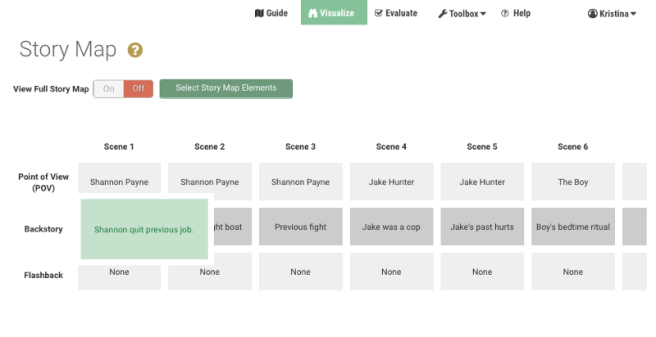
Below is the Story Map in Fictionary for Look The Other Way (by Kristina Stanley). In Fictionary, you can select only the key elements of fiction you want to evaluate

In the Story Map, I’ve selected the POV character for the scene, backstory and flashback

You’ll notice I don’t have a flashback in any of the first 6 scenes. I have one later in the novel for a key event in Shannon’s past.

For Backstory in each scene, I’ll show why the backstory is included.

Scene 1: Shannon quit previous job. This is important to the scene because Shannon is being fired. Now she’s regretting leaving her last job.

Scene 2: Debi’s boat history. The story takes place on a sailboat and this lets the reader know Debi is qualified to go sailing.

Scene 3: Previous fight. Shannon and Lance are engaged, but I let the reader know there is trouble in paradise.

Scene 4: Jake was a cop. Now the reader knows Jake’s purpose in the novel. He’ll be believable when tracking a killer.

Scene 5: Jake’s past hurts. Here, I’m letting the reader know Jake is carrying a past that was difficult and it will serve as the reason why he has trouble getting close to Shannon.

Scene 6: Boy’s bedtime ritual. This backstory shows a closeness the boy feels to his father, so when the father dies, the reader will understand his pain.

I hope the above illustrates who using select backstory can engage your readers.

The History of Fictionary

Fictionary is a new interactive web app for self-editing fiction that helps writers turn a first draft into a story readers love.

Creating Fictionary began when I (Kristina) finished the first draft of my first novel. By then I’d read over 50 how-to-write and how-to-self-edit books. I’d taken writing courses and workshops, and had 100s of writing and rewriting tips swirling about in my head.

I knew I had to begin the rewriting process and improve the quality of my draft before sharing my work but I didn’t know how to go about it. How was I supposed to remember the torrent of advice and apply it to each scene? To address this problem, we built Fictionary.


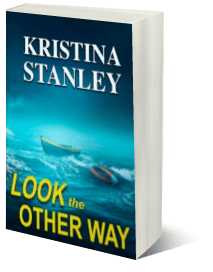
Post written by Kristina Stanley, author of Look The Other Way (Imajin Books, Aug 2017).

Image Source: Kristina Stanley

Kristina Stanley is the best-selling author of the Stone Mountain Mystery Series and Look The Other Way.

Kristina is the CEO of Fictionary, and all of her books were edited using Fictionary.


Why not check out Fictionary’s free 14-day trial and turn your draft into a story readers love?