 Thank you, Raimey Gallant for organizing the #AuthorToolboxBlogHop. Today is the 5th post of this new series!
This is a monthly blog hop on the theme of resources/learning for authors: posts related to the craft of writing, editing, querying, marketing, publishing, blogging tips for authors, reviews of author-related products, anything that an author would find helpful.
To continue hopping through other great blogs in the monthly #AuthorToolboxBlogHop or to join, just hop on over to Ramey Gallant!
I’ll focus my entire series on self-editing. Here is what I’ve covered so far in the series:
- Why Learn To Self-Edit.
- Characters In The Context of Editing.
- Emotional Impact of Setting
- Opening A Scene
Today’s topic is PURPOSE OF A SCENE.
The first plot element I evaluate is the purpose of the scene. The purpose of the scene must relate to the overall story. If it’s not driving the story forward, then ask yourself what is the point of including the scene in your novel.
Here are some examples of the way the purpose of a scene can drive the story forward. You can choose one of these to define your purpose or come up with your own definitions.
- Build suspense
- Character development
- Character Introduction
- Climax
- Establish mood
- Establish setting
- Inciting Incident
- Intensify Conflict
- Move the story forward
- Plot point 1
- Plot point 2
- Resolution (after climax)
HOW PURPOSE OF A SCENE HELPS WITH THE OTHER ELEMENTS
I articulate the purpose of the scene first, so I can address other elements of the scene and test if they are in line with the purpose.
Let’s say you fill out the list of objects in a scene. You can weigh the objects against the purpose of the scene and see if there is a way to use them to further the purpose. This goes for revelations, tension, conflict, weather, etc. Basically, every scene element can be tested against the scene purpose.
After you whittle down the purpose of a scene to a few words, one of three things will happen.
- You’ve got the purpose nailed, and you understand why this scene is included in your novel.
- You have a weak purpose, but there is still some value in the scene.
- You have no idea what the purpose is.
So you’ve got the purpose nailed. Yay! Move on to the next scene.
If the point of the scene is weak, see if you can take what is important in a scene and move it to another scene, then delete the weak scene. You can also enhance the scene to give it a stronger purpose.
If you can’t articulate the purpose of a scene, think about removing the scene.
More Self-Editing Advice
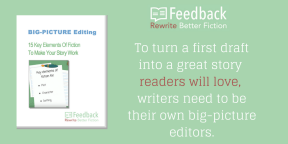
If you’re looking for more help on self-editing download the free eBook, BIG-PICTURE Editing 15 Key Elements of Fiction To Make Your Story Work and learn how big-picture editing is all about evaluating the major components of your story. We call these components the Key Elements Of Fiction.
Our eBook shows you how to use the key elements of fiction to evaluate your story and become your own big-picture editor.
Interested In An Automated Approach To Big-Picture Self-Editing?
Why not try Fictionary?
A new online tool for serious fiction writers. Turn your first draft into a story reader love by becoming your own structural editor. Fictionary is the first web app to help fiction writers evaluate their own work with a focus on story, not words.
AVAILABLE FOR FREE TRIAL NOW!
With Fictionary, you can focus on plot, character, and setting. You can evaluate on a scene-by-scene basis or on the overall novel structure. Fictionary will show you the most important structural elements to work on first.
Fictionally will guide you through the rewriting process by asking you questions specific to your manuscript, enabling you to evaluate your own story.
Fictionally helps you visualize your manuscript. Forget about yellow stickies or white boards. Fictionary will draw character arcs, provide reports on scene evaluation, and show your rewriting progress.
Happy editing and thanks for reading…


