Thanks to HSW Literary Agency

Life as a writer is often spent behind closed doors working hard, but there are moments when a writer catches a glimpse of hope that her work may actually entered the world of the published.

Margaret Hart and Natalie St. Pierre at the HSW Literary Agency have been working hard behind the scene to help me get my novels published.

Their last post at HSW Literary Agency:News certainly made me smile, so here’s a shout out to say thanks.

Sometimes a girl just has to share her happiness.

Thanks for reading . . .

Here is what HSW wrote about me:

Persons Unknown? Crime Writer Kristina Stanley Makes Her Name

Author Kristina StanleyThe life of an author, quietly perfecting her craft, is often anonymous. But the efforts of crime writer Kristina Stanley are at last getting the attention they deserve: Stanley has three works up for separate crime writing awards!

Descent, the first book in Stanley’s Kalin Thompson series, is nominated for the Unhanged Arthur, the Arthur Ellis Award recognizing the year’s most promising piece of unpublished crime fiction. Over in the UK, the Crime Writers’ Association honours book two in the series, Burnt, with a nomination for their Debut Dagger. Finally, just in time for Short Story Month, Stanley’s “When a Friendship Fails” is nominated for the Capital Crime Writers‘ Audrey Jessup Short Story Award.

Congratulations, Kristina! We anxiously await the results!

Farley’s Friday: My Human Is Doing The Happy Dance

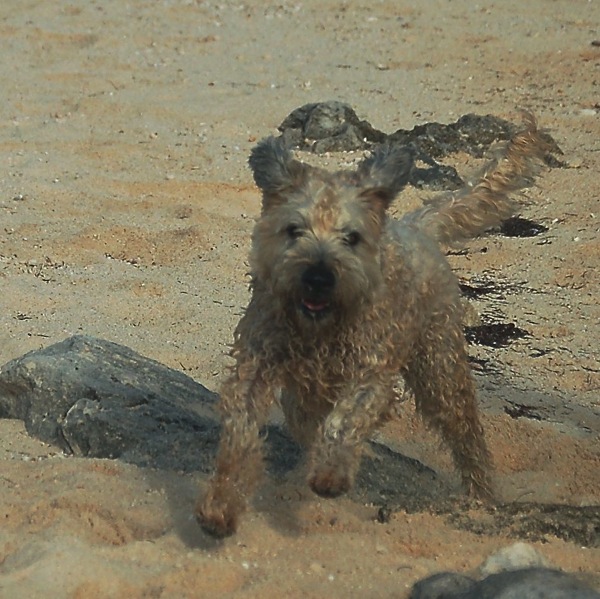
Farley here.

My human is singing “Debut Dagger Shortlist” and doing the happy dance. Sometimes Kristina looks really silly, but she’s so happy I won’t mention that to her.

I give her my confused look to ask her what’s going on. Seriously, she’s freaking me out.

Farley looking interested

She makes we wait until I settle down. Then she says, “My novel BURNT has been shortlisted for the Debut Dagger Award.”

“Huh,” I bark.

“It’s from the Crime Writers’ Association in the UK for unpublished authors.”

I decide I better do the happy dance too.

Farley Happy Dance

Then I bring her a present. Who doesn’t like an already chewed stick?

Farley With Stick


Well apparently Kristina. She won’t chew it, but she’s still dancing.


Woof Woof


See Mystery Fanfare: CWA Nominations

He Said/She Said When Reading Aloud

Last Monday, I wrote about reading aloud. I’m on a bit of a discovery mission and figuring out how to do this well.

I think if you’re an actor or have training as an actor, this might come easy to you. For those of us that have only read aloud to children, it’s hard.

After creating a recording of a short story, I quickly discovered listening to a story is different than reading a story.

When a person reads the story they see the paragraph breaks between speakers. This tells them the speaker has changed. When listening the person doesn’t have the visual to aid in understanding the change of character.

So if you’re not a person who can talk in many voices, what do you do?

I’m trying to add he said/she said in the audio version. Sometimes placing the tag before the spoken sentence instead of after of adding the tag near the beginning. For example:

“Thanks,” Bob said. “I need to hear that.”

The other option is to add a character movement or action before they speak. Something simple like: She sighed.

I’m not sure if this is a proper method for reading aloud.

Any suggestions on how to do this?

Thanks for reading . . .

To Plot or Not To Plot

Do you plot your story before writing it or do you write and then plot?

I write first. Then I get serious and look at my plot after I have a first draft written.

There is lots of writing advice out there telling writers to have major events at 25%, 50% and 75%. These are major plot points where something happens to change the direction of the story or the character arc.

So I went through my novels to see if I’d done this and was surprised to find I was close. I ended up with plot points between 22% and 27%, 45% and 53% and again between 72% and 77%. I figure this is close enough. There must be something about reading many books that makes this structure appear naturally when writing.

I used the kindle to find look at the percentages. This was easier than counting words. Now in my scrivener, I add a per cent number at each chapter heading. One more way to see if my writing is on track.

So, how to you know if you’re plot is laid out properly? and does it matter?

Thanks for reading . . .

Writing Novels With A Spreadheet

If you’ve been reading my blog, you know I love to write with a spreadsheet. I’m still amazed by how helpful  I find the tool and that I still find new ways to use it.

One of the columns in my spreadsheet lists objects. Originally I put this column in to make sure my scenes weren’t empty sets. I also list smell, sights, and sounds for this purpose.

Sometimes with the objects, I’ll use the object in a later scene. Like an innocent little baseball bat. The list reminds me to check what I’ve placed in an earlier scene and see if I can use it in an inventive and unusual way in a following scene. Like an innocent little baseball bat that’s not so innocent.

I knew all this. What I discovered this week is the object column can also help me find errors.

In one scene I have two characters eating lunch together. I list a fork. Later in the scene, I list a spoon as an object. But wait! I’m writing about the same character eating the same meal, so why has her utensil changed?

I went back in the scene and discovered I’d changed the utensil. Silly, but unnoticed when I read the scene without listing objects.

I love discovering new ways my spreadsheet can help.

Let me know if you use a spreadsheet and how it helps you write.

Thanks for reading . . .

Related articles:

Writing a Series: Spreadsheet

Keeping Track of Scenes

How to Use a Spreadsheet for Your Synopsis

Tips For Ordering Scenes In A Novel

Why Blog About Something You Want To Learn?

I had a friend in medical school who told me when she was learning a new medical procedure she was taught:

  1. Learn one
  2. Teach one
  3. Do one

I think this process can be applied to learning grammar and punctuation. When I’m unsure about a rule, the first thing I do is check my grammar books and read about it. This is the Learn One phase.

Next, I blog about it. If I can explain the rule, then I probably understand it. This is the Teach One phase. If you’re doing this, be careful to use your own words. Don’t cheat and look at the grammar book for help. You need to be able to explain the rule without any aids. Sometimes I don’t blog about the rule, but I do try to write the rule in my own words. Even if it’s on a scrap piece of paper, it helps me remember the rule.

Lastly, I write using the rule. This is the Do One phase. You can edit and proofread to ensure you’re using the rule properly too. I consider editing part of the Do One phase.

I figure if this is how medical students learn, it must work for other areas of knowledge too.

Do you have any tips for learning?

Thanks for reading . . .

As If Subordinating Conjunctions Can Be Confusing

Did you know if you want to spend a lifetime learning something, punctuation and grammar can give you the opportunity.

This week while proofreading my  novel, I noticed I wasn’t using ‘as if’ consistently. Sometimes I put a comma before the words and sometimes I didn’t.

I noticed this while I was reading on my Kindle. Last week I blogged about How To Avoid Errors In E-books, and here is one more instance where the new addition to my process helped me. As if!

I looked up ‘as if’ and found out it’s a subordinating conjunction. I knew this but had forgotten. Now I know the rules for comma use with ‘if’, another subordinating conjunction, so all I had to do was apply the rule to sentence containing ‘as if.’

The rule, you ask?

A subordinating conjunction joins two clauses of unequal importance. If the clause containing the subordination conjunction comes before the main clause then follow the clause with a comma. If it doesn’t, don’t.

  • As if he could stop the bleeding with his eyes, he stared at the knife impaling his calf. (subordinating conjunction before main clause)
  • He stared at the knife impaling his calf as if he could stop the bleeding with his eyes. (subordinating conjunction after main clause)

Attention to detail is a must when writing a novel, but how can you do that if you don’t know the rules? This brings me back to the lifetime of studying idea.

Keep on the look out for areas in your writing where you’re not consistent and you might find areas where you don’t know the rules. Grammar: How to Learn What You Don’t Know gives another idea on learning grammar.

How do you figure out what you don’t know?

Thanks for reading . . .

Tips For Ordering Scenes In A Novel

Have you ever had trouble deciding the best order to put your scenes in?

Once you have a first draft written do you try different combinations to see what works best?

If you’ve been reading my blog, you might have guessed I’ve added a new row to my spreadsheet. I call it Scene Dependency.

First, I was just using it to list what scenes had to come before the scene I was reviewing. Then I discovered something even better.

Was it possible to link the end of one scene to the beginning of the next?

You bet. There are different ways to achieve this. For example:

  • Have one character end a scene. Have the next scene start with another character thinking of the previous character.
  • Put an object important to the story at the end of one scene and beginning of the next.
  • Use the same location at the end of one scene and the beginning of the next.
  • End a scene at night, start the next scene the following morning.
  • Reference the same weather in both scenes.
  • Reference the same sight. Maybe the moon setting or an avalanche at the end of one scene and the beginning of the next.
  • Use emotions to link the scenes.

In the end, have it all listed in your spreadsheet. You might be surprised how it changes the order of your scenes and gives you a fluid motion throughout your novel. The reader will feel more connected to your story if one scene links to the next even if the scenes are about different events.

Can you add to this list? Do you have any tips to ordering scenes? I’d love to hear them.

Thanks for reading . . .

Leaving a job? How To Get a Dream Reference Letter

When leaving a job on good terms, you’ll want a reference letter in hand. Ask your employer for a letter. If they agree, offer to write a draft for them.

While working as the Director of Human Resources for five and half years, I was asked regularly for a reference letter.  From an employer’s point of view, I found it easiest when the employee prepared a draft letter for me.

In a busy job, with my own deadlines, I found it difficult to make time to write a reference letter from scratch. That meant I had to look up employment dates and main job responsibilities, and I had to think of the person’s best characteristics. All easy to do,but time consuming.

Employees were sometimes shy about writing the letter, maybe thinking it was presumptuous, but what it really is, is helpful.

But what do you put in your letter?

  • Job title
  • Start and end dates
  • Main job responsibilities
  • Qualifications required and held for position
  • What you were good at. This is important. Don’t be shy about saying what you did well.

End the letter with some form of the following sentence: Given the opportunity, I would happily rehire – insert your name here.

The last sentence means the company was pleased with your work and is code within the HR circles that the reference is good.

Next, print two copies with room for a signature. Put one copy on a storage device. Present both to your employer. Thank them for giving you a reference, and state that you have prepared a draft for them as a starting point.

In many cases, I signed the letters as they were presented to me. In some cases, I felt the person under sold themselves and added a few things, and only rarely did I think the person went overboard and I took a few things out.

I hope this helps you get the reference letter you need.

Thanks for reading . . .

Offline Blogging Software

There is always something new to try or learn. This month, I decided to try the 30 day free trial of MarsEdit.

Why? I work offline most of the time. Living on a sailboat means I don’t have regular internet access, hence I need to write my blogs and upload when I have access.

I downloaded the free trial – I love a free trial. The free trial gives me time to decide if I want to spend my money on the software without taking the risk that I won’t like it.

My advice on first use: Once you download the free trial, check how many blogs you’ve written and set the refresh limit to this number. The first time in the software all of your blogs will download to your computer. After that’s done. reset the button to a lower number to speed up the process.

My likes:

  • When you write a scheduled post, the date columns lists the date the post is scheduled for so you can see your upcoming posts without having to go online. Sometimes I forget how far in advance I’ve written posts.
  • Easy addition of photos.
  • Adding categories and tags offline.
  • Works with WordPress – since that’s what I use for a blog platform.
  • Any time an idea strikes me for a blog and I happen to be working on my computer, I can pop over to MarsEdit and store the idea.
  • Free Trial.
  • MarEdit will download the latest version of a post when you hit the refresh button. This is helpful as I often write the blog but make changes when I see it online. These changes get sent back to my computer and then I have the latest version of the post.

Where I would like to see improvements:

  • Help file could be better. For example I couldn’t find an explanation of the Refresh vs. Refresh All command. I didn’t  try the community forum or the support function. Since I work mostly off line these are not features I would use.
  • I’d like to create folders so I can organize my blogs and couldn’t figure out how to do this.
  • I’d like to be able to add a link but I guess that’s not a reasonable expectation from software what is meant to be used offline. To do this, I underlined the text to remind myself to add the link once I was online. Then I submitted the post in draft status so it wouldn’t go public on my blog. There is a link function, but you have to know the URL, and if you’re offline . . .
  • If you do add a link offline, and you want to the linked URL to open in another page, you need to go online and set this feature
  • Even though I set the post date to a later date and left the Post Status button as published I thought the post would be published on the date I chose. Instead the post published immediately. This is fine, except that I have a schedule I like to keep. I thought If I set the date, then it would post on that date. I learned I had to set the Post Status to draft and the go online and set accordingly.
  • Not all of my pages downloaded to my computer.

I think the software is a little over priced. After the thirty day trial I’m not sure I’ll buy the software. I’m still very positive about it, but I think I’ll look around and see what else it out there. If the price was $29 or lower, I think I’d buy in now.

These are just my views on trialling the software. If you’ve had a different experience I’d love to hear about it.

Are there any programs you use to help you write or blog? I’d like to try something else before I make my final purchase decision.

Thanks for reading . . .