When people hear I’m a writer, they often respond with something like, “Oh, I’ve been thinking about writing a book,” as if a novel can be conjured up over a long weekend. And when I mention that I write romance, the respect level usually drops, even though it shouldn’t.

Romance is the top-selling genre in fiction, accounting for nearly a quarter of all sales, about $1.5 billion in annual revenue. That’s a lot of readers eager to fall in love with a story. But before you grab your favorite mug, settle in with your keyboard, and start crafting that ode to love, it helps to know that there’s a real precision to storytelling. Writing a strong romance isn’t just about chemistry; it’s about structure that supports emotional payoff.
Learn How to Write a Romance
That idea is what inspired Kristina and me to write Secrets to Writing a Romance. We wanted to help writers understand not just how all stories work, but what makes a romance feel different. Every successful novel relies on what we call the five story arc scenes, the key turning points that give a story its spine. Without that foundation, pacing drags, tension fizzles, and the story can lose its way. Structure holds everything together, even in a genre built on emotion.
If you love romance, you already know that a happy ending, whether it’s a Happily Ever After or a Happy For Now, is non-negotiable. But what many writers don’t realize is that the other story arc scenes in a romance differ from other genres. In our book, we map how romance delivers its emotional beats through its core structure: from the meet-cute, to the admission of attraction, to the middle’s emotional pivot, the break-up moment, and finally the declaration of love. These specialty scenes are what make readers sigh, swoon, and turn the pages late into the night.
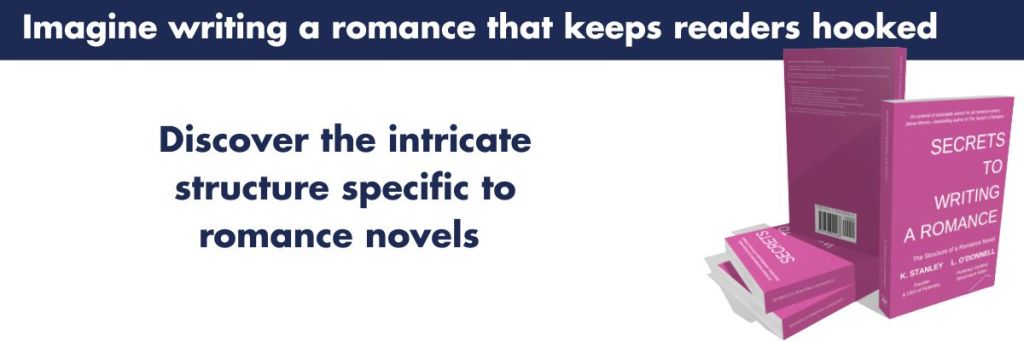
Imagine writing a romance with a clear sense of direction, one that keeps readers hooked through every emotional high and low. Secrets to Writing a Romance offers exactly that: a guide to pairing structure with purpose and letting emotion be informed by design. Think of it as a toolkit for crafting love stories that truly work, both on the page in the heart.
Kristina Stanley, CEO and founder of Fictionary, award-winning writer, and the driving force behind The Fictionary School for Writers & Editors, laid the foundation for this book with her deep expertise in story structure. Together, we shaped our shared knowledge into practical strategies romance writers can use.
Tips for Writing a Romance
Each month, I’ll be sharing a blog post with a practical tip from the book, bite-sized lessons on structure, specialty scenes, and emotional craft you can apply to your own project, no matter where you are in the process. I hope you’ll follow along and join the conversation as we explore how to turn the timeless magic of romance into stories that truly connect.
If you’re ready to dive deeper into the craft of romance, Secrets to Writing a Romance is now available in eBook and print. I hope you’ll pick up a copy and bring its tools into your own writing practice.
Written by Linda O’Donnell
 Linda O’Donnell is a writer, certified structural editor, certified copy editor, and a writing and editing instructor. She co-authored Secrets to Writing a Romance with Kristina Stanley and together, they’re working on their latest book, Secrets to Writing a Novel. Linda’s romance novel, Behind the Scenes, is coming soon.
Want to Learn to Self-Edit?
Join the Fictionary School for Writers and Editors
Discover more from Kristina Stanley
Subscribe to get the latest posts sent to your email.

