How to Structure a Commercially Successful Novel

Want to write a bestseller? We’ve got a free webinar just for you.

Learn the fundamental structure of a commercially successful novel.

Are you tired of staring at a manuscript that feels “stuck”? Most stories don’t fail because of the prose; they fail because the structural foundation isn’t strong enough to support the weight of the reader’s expectations.


Join us for a deep dive into the five non-negotiable structural pillars that turn a good idea into a page-turning commercial success.


The 5 Essential Scenes Breakdown


1. The Inciting Incident: The Shake-Up

The Reader Hook: If nothing changes, there is no story.

2. Plot Point 1: The Point of No Return

The Protagonist’s Commitment: This is where the protagonist steps out of their comfort zone and into the unknown.

3. The Midpoint: From Reactive to Proactive

The Pivot: A “False Victory” or “False Defeat” shifts the stakes entirely.

4. Plot Point 2: The “All Is Lost” Moment

The Crisis: This is the character’s lowest ebb, testing their growth and resolve.

5. The Climax: The Final Confrontation

The Payoff: The highest point of tension in your novel.

Get that bestseller started.

Sign Up Today

Presenters

Ramona Pina

Senior Publishing Specialist, Bookbaby

Ramona Pina is a seasoned publishing expert with over eight years of experience in both independent and traditional publishing. As an author herself, she brings a comprehensive understanding of the industry from every angle, guiding writers through the publishing process with strategies tailored to align with their unique goals and creative vision.

Kristina Stanley

CEO Fictionary

Kristina Stanley is the founder and CEO of the Fictionary: The complete fiction writing ecosystem with powerful storytelling software, live classes from certified editors, and the kindest community in genre fiction. She is an award-winning author of both fiction and non-fiction books as well as being a structural editor.

Romance Novels and the Protagonist’s Wound

Why the Protagonist’s Wound Is the Beating Heart of Every Romance

Every romance novel begins with a promise: two people will find their way to love. But beneath the banter, chemistry, and swoony moments lies the true engine of the story—the protagonist’s wound, misconception, or flaw. This internal struggle is what gives a romance its emotional weight, its stakes, and ultimately, its meaning.

In a romance, the protagonist isn’t just moving through plot beats; they’re pursuing a story goal that is shaped, and often distorted, by the wound they carry. Until that wound is confronted and healed, love cannot truly take root.

This is why identifying your protagonist early matters so much. Before you can outline or draft effectively, you need to know whose emotional journey the reader is meant to follow. One of the simplest tools for doing this is the skeleton blurb, a single sentence that captures the protagonist’s goal and the stakes attached to it:

[Love interest] must [story goal]; otherwise, [the stakes].

When you write a skeleton blurb for each character, the wound becomes visible. The character’s misconception shapes the goal they believe they want, while the stakes reveal exactly what they fear losing if they fail.

If the characters have different goals, one character’s emotional arc will naturally dominate—and that character is your single protagonist. But if both characters share the exact same romance goal and stakes, you are writing a combined protagonist.

Regardless of your book’s structure, the wound is the compass. Every major scene, starting with the first scene, must impact the protagonist in a clearly positive or negative way. These scenes aren’t just plot points; they are emotional pressure points that force your characters to confront the beliefs holding them back from love.

Consider how this plays out in modern romance, depending on how you choose to frame the journey:

  • The Single Protagonist (The Bodyguard by Katherine Center): Hannah is the sole POV character. The reader only gets her interpretation of the hero’s feelings. Whatever tension Hannah feels because she doesn’t know what her love interest is thinking, the reader feels it too.
  • The Combined Protagonist (The Flatshare by Beth O’Leary or The Wedding Date by Jasmine Guillory): Both love interests share the spotlight with a balanced scene split. Because they share a unified romance goal, they function as a combined protagonist. This creates a wonderful knowledge gap where the reader knows what both characters are thinking, creating high tension because we can see the misunderstandings coming long before the characters do.

Whether you choose a single or combined protagonist, the core principle remains the same: the romance doesn’t work unless the wound does. A romance isn’t just about two people coming together, it’s about the protagonist becoming someone capable of receiving that love.

So, as you plan or revise your manuscript, return to the wound. Name it. Understand how it shapes your protagonist’s worldview, and then let every scene, every conflict, every moment of connection, every setback, push them toward healing. Because when the protagonist transforms, the love story transforms with them.

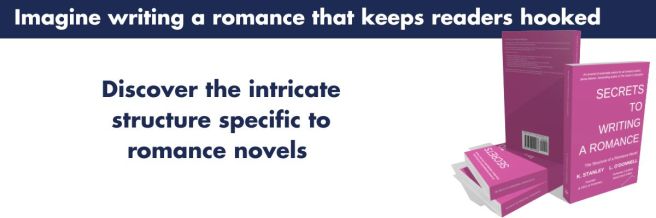
To learn more about Happily Ever Afters and other romance topics, pick up a copy of Secrets to Writing a Romance

Post Written by Linda O’Donnell

Linda O'Donnell

Linda O’Donnell is a writer, certified structural editor, certified copy editor, and a writing and editing instructor. She co-authored Secrets to Writing a Romance with Kristina Stanley, and together they are working on their latest book, Secrets to Writing a Novel. Linda’s contemporary romance novel, Behind the Scenes, is coming out soon.

The Heart of the Start: The Romance Meet-Cute

In the world of commercial fiction, structure is your best friend. It provides the guideposts that keep a story moving and ensures readers stay buckled in for the ride. But when you are writing romance, there is one specific “guidepost” that carries more weight than almost any other: the inciting incident, better known in our genre as the Meet-Cute.

In our book, Secrets to Writing a Romance, Kristina Stanley and I do a deep dive into why this moment is the literal spark that lights the fire of your story. If you’re looking to level up your manuscript, here is how to craft a meeting that keeps readers turning pages.

1. Make it an “Active” Event

A common pitfall is placing the meeting in the backstory. You might be tempted to start the book with your protagonist reminiscing about a “gorgeous jerk” they saw yesterday. Don’t. In romance, the inciting incident must happen on the page in an active scene. Readers don’t just want the information; they want to be in the thick of it. They need to feel the pulse spike and the breath hitch along with your characters. If you skip the “good stuff” at the start, the reader loses their emotional investment before the story even begins.

2. The Power of the “Re-Meet”

While many stories focus on strangers, remember that a powerful meet-cute can also be a re-meet. This is perfect for friends-to-lovers or second-chance arcs. In these cases, the “meet-cute” is a transformative event where two people who already know each other—perhaps as lifelong neighbors, bickering coworkers, or platonic best friends—suddenly see one another in a brand-new light. This shift in perspective acts as the catalyst, launching their existing relationship onto an entirely new, romantic course.

3. Disruption is Key

A great meet-cute should flip your protagonist’s “normal” upside down. This is the moment their ordinary world goes “poof.” Crucially, this disruption should be caused by the love interest. If the world is falling apart because of a meteor strike, you’re writing an action movie. If the world is falling apart because a specific person just walked into the room (or finally looked at them differently) and challenged their status quo—now you’re writing a romance.

4. Lean Into the “Meet-Ugly”

It doesn’t always have to be sunshine and roses. In fact, many of the most memorable pairings start with a meet-ugly. Whether it’s an awkward misunderstanding, an unwanted encounter, or a heated argument, the goal is friction. The initial interaction should be characterized by high emotional intensity. Whether that is instant attraction or instant annoyance doesn’t matter, as long as the emotion is powerful.

5. Early and Intertwined

To keep the pacing tight, aim to have your characters meet (or have their “re-meet” moment) early—ideally before you are 15% into the book. Once they collide, give them a reason they must stay in close proximity. Whether it’s a shared project, a family crisis, or a forced living situation, proximity keeps the tension simmering.

6. Leave Them Wanting More

The meet-cute raises a vital question in the reader’s mind: How on earth are these two going to end up together? Keep that question alive. Let your characters resist the attraction and fight the goal. Readers love knowing what’s right for the characters before the characters do—it’s what makes them cheer for that final “Happily Ever After.”

To learn more about Happily Ever Afters and other romance topics, pick up a copy of Secrets to Writing a Romance

Post Written by Linda O’Donnell

Linda O'Donnell

Linda O’Donnell is a writer, certified structural editor, certified copy editor, and a writing and editing instructor. She co-authored Secrets to Writing a Romance with Kristina Stanley, and together they are working on their latest book, Secrets to Writing a Novel. Linda’s contemporary romance novel, Behind the Scenes, is coming out soon.
The Secret to Bestselling Fantasy:The Magic of Opening Images and First Chapters

The first page of a fantasy novel isn’t just paper and ink—it’s a portal. But how do you ensure your readers actually want to step through it? In our latest guide, Secrets to Writing a Fantasy, we pull back the curtain on the mechanics of world-building, starting with the two most vital components of your debut: the Opening Image and the Opening Chapter.

While they sound similar, understanding the nuance between them is the difference between a reader who browses and a reader who buys.

The Opening Image: Setting the Tone

The opening image is the very first visual or conceptual seed you plant. In fantasy, this often takes the form of “pre-text”—perhaps a haunting quote from a fictional ancient tomb or a snippet of a forgotten prophecy.

Its primary duty is to support two pillars: the external plot and the supernatural plot. You may want to check out Why Your Story Needs Two Story Arcs. You have a crucial choice here: does your “ordinary world” include magic from the start, or is the supernatural something that breaks into a mundane reality? Your opening image sets that expectation immediately. Here are some options for what this scene can accomplish.

  • Establish life-or-death stakes.
  • Hint at what the protagonist loves (and what they stand to lose).
  • Set the atmospheric tone before a single line of dialogue is spoken.

The First Chapter: The Engine of Engagement

If the opening image is the atmosphere, the first chapter is the engine. This is where genre-agnostic duties kick in. Regardless of whether you have dragons or starships, your first chapter can:

  1. Introduce the Protagonist: Unless there is a high-level narrative reason to wait, the reader needs someone to root for now.
  2. Define the Ordinary World: This is the status quo. We need to see your hero in their natural habitat before the inciting incident blows it all to pieces.
  3. Mirror the Closing Image: Expertly crafted novels often begin with a visual or thematic beat that finds its “answer” or reflection in the final pages of the book.

Case Study: Fourth Wing by Rebecca Yarros

In Secrets to Writing a Fantasy, we analyze bestsellers to see these rules in action. Take Fourth Wing.

Yarros utilizes a powerful opening image: a paragraph explaining that the text was transcribed by a scribe to honor the dead. This immediately signals that the stakes are lethal. She follows this with a quote from the Dragon Rider’s Codex, weaving the supernatural (dragons) into the very fabric of the world before Chapter One even begins.

When we reach Chapter One, we meet Violet Sorrengail. Her ordinary world is a library, but the inciting incident—her mother forcing her into the Riders Quadrant—has already happened. Yarros uses clever backstory beats to show us what Violet is leaving behind, proving that you don’t need a linear timeline to create an emotional connection.


Excel at the Art of the Beginning

Are you showing the ordinary world in action, or are you weaving it through backstory? Is your tone consistent from the first sentence?

Don’t leave your opening to chance. Whether you’re writing a grimdark epic or a cozy portal fantasy, the transition from the “Opening Image” to the “Opening Chapter” is your first and best chance to cast a spell on your audience.

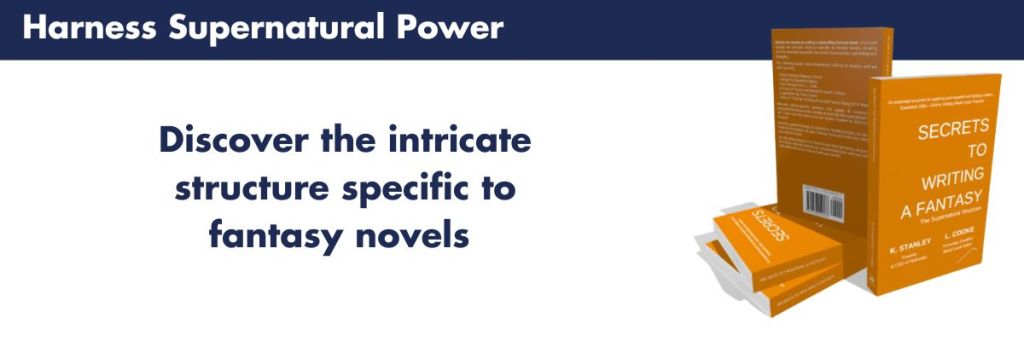
Ready to build a world readers never want to leave? Check out Secrets to Writing a Fantasy for the full story.

Don’t leave your structure to chance. Stop guessing and start building a structurally sound novel, scene by sensational scene. 

Romance: Keeping the Promise

One of the most common questions I hear when I tell people I co-authored a craft book on writing romance is, “Does it really have to end with a happily ever after?” The short answer is yes. The longer answer is far more interesting, because it gets to the heart of what makes romance such a powerful and enduring genre. If you’re new to writing romance, understanding this expectation will save you a lot of confusion and revision down the road.

Romance isn’t defined by the presence of a love story. Plenty of novels contain love stories — literary fiction, thrillers, historical, even horror. A romance is defined by its promise: the central relationship must resolve in a way that is emotionally satisfying for the reader. In other words, it must end with either an HEA (Happily Ever After) or an HFN (Happy For Now). Think of an HEA as “we’re in it for the long haul” and an HFN as “we’re together and happy, and we’ll see where life takes us.”

This isn’t a formula. It’s a contract.

When a reader picks up a romance, they’re entering into an agreement with the author. They’ll endure the wounds and fears, the complications and obstacles you put in the character’s path, trusting that, in the end, their heart is safe. The HEA/HFN is the fulfillment of that promise. It’s the moment when the emotional arc lands, the internal epiphanies click into place, and the characters choose each other in a way that feels earned.

An HEA is the classic version: the couple is together, committed, and looking toward a shared future. It doesn’t require a wedding, a ring, or a baby. It simply requires clarity: the reader closes the book knowing the relationship is solid, and the characters have done the work to make it last.

An HFN offers a future that’s hopeful, even if it’s not fully mapped out. HFNs are especially common in romance series arcs or in stories where the characters are still in transitional phases of life. The key is that the ending feels emotionally complete, even if the future isn’t yet spelled out.

If you’re new to romance, you might worry that this makes your story predictable or less “serious.” In reality, readers choose romance because they want that emotional payoff. Your job isn’t to surprise them with whether it ends happily, but to surprise and move them with how it happens. Genre expectations don’t limit creativity; they shape it. Mysteries must solve the crime. Thrillers must stop the threat. Romance must resolve the relationship. Readers want to feel hopeful and secure about the couple’s future. Within that framework, authors set their stories apart through character depth, emotional complexity, unique conflicts, and fresh settings. The HEA/HFN simply ensures that the emotional journey lands where romance readers need it to.

And readers do need it. Romance is one of the few genres that consistently affirms hope — not in a naïve way, but in a deeply human one. These stories remind us that people can grow, relationships can heal, and love is worth the risk. In a world that often feels chaotic and uncertain, that promise matters.

So yes, a romance requires an HEA or HFN. Not because the genre is rigid, but because the emotional payoff is the point. It’s what makes romance comforting, cathartic, and profoundly satisfying. It’s what keeps readers coming back. And it’s what makes writing romance such a joyful, meaningful pursuit.

To learn more about Happily Ever Afters and other romance topics, pick up a copy of Secrets to Writing a Romance

Post Written by Linda O’Donnell

Linda O'Donnell

Linda O’Donnell is a writer, certified structural editor, certified copy editor, and a writing and editing instructor. She co-authored Secrets to Writing a Romance with Kristina Stanley, and together they are working on their latest book, Secrets to Writing a Novel. Linda’s contemporary romance novel, Behind the Scenes, is coming out soon.

Secrets to Writing a Romance

When people hear I’m a writer, they often respond with something like, “Oh, I’ve been thinking about writing a book,” as if a novel can be conjured up over a long weekend. And when I mention that I write romance, the respect level usually drops, even though it shouldn’t.

Romance is the top-selling genre in fiction, accounting for nearly a quarter of all sales, about $1.5 billion in annual revenue. That’s a lot of readers eager to fall in love with a story. But before you grab your favorite mug, settle in with your keyboard, and start crafting that ode to love, it helps to know that there’s a real precision to storytelling. Writing a strong romance isn’t just about chemistry; it’s about structure that supports emotional payoff.

Learn How to Write a Romance

That idea is what inspired Kristina and me to write Secrets to Writing a Romance. We wanted to help writers understand not just how all stories work, but what makes a romance feel different. Every successful novel relies on what we call the five story arc scenes, the key turning points that give a story its spine. Without that foundation, pacing drags, tension fizzles, and the story can lose its way. Structure holds everything together, even in a genre built on emotion.

If you love romance, you already know that a happy ending, whether it’s a Happily Ever After or a Happy For Now, is non-negotiable. But what many writers don’t realize is that the other story arc scenes in a romance differ from other genres. In our book, we map how romance delivers its emotional beats through its core structure: from the meet-cute, to the admission of attraction, to the middle’s emotional pivot, the break-up moment, and finally the declaration of love. These specialty scenes are what make readers sigh, swoon, and turn the pages late into the night.

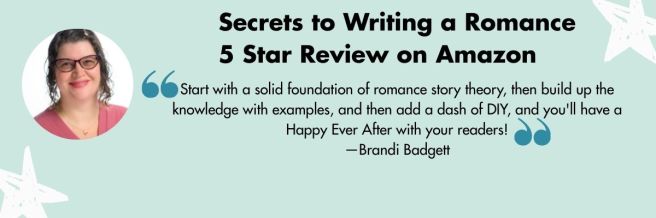
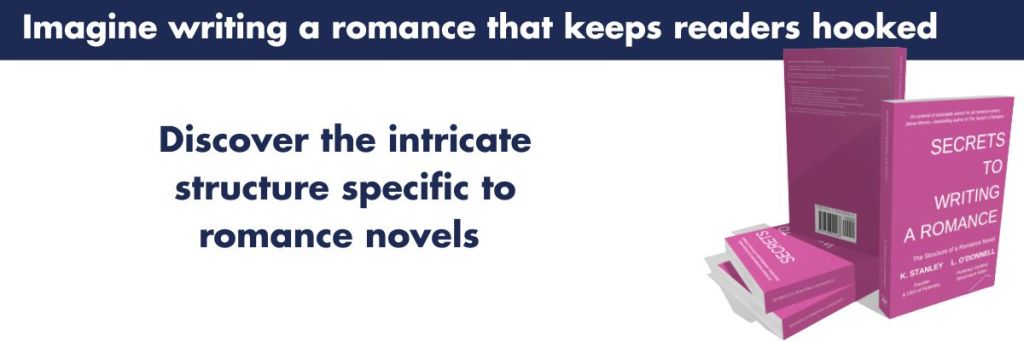
Imagine writing a romance with a clear sense of direction, one that keeps readers hooked through every emotional high and low. Secrets to Writing a Romance offers exactly that: a guide to pairing structure with purpose and letting emotion be informed by design. Think of it as a toolkit for crafting love stories that truly work, both on the page in the heart.

Kristina Stanley, CEO and founder of Fictionary, award-winning writer, and the driving force behind The Fictionary School for Writers & Editors, laid the foundation for this book with her deep expertise in story structure. Together, we shaped our shared knowledge into practical strategies romance writers can use.

Tips for Writing a Romance

Each month, I’ll be sharing a blog post with a practical tip from the book, bite-sized lessons on structure, specialty scenes, and emotional craft you can apply to your own project, no matter where you are in the process. I hope you’ll follow along and join the conversation as we explore how to turn the timeless magic of romance into stories that truly connect.

If you’re ready to dive deeper into the craft of romance, Secrets to Writing a Romance is now available in eBook and print. I hope you’ll pick up a copy and bring its tools into your own writing practice. 

Written by Linda O’Donnell

Linda O'Donnell Linda O’Donnell is a writer, certified structural editor, certified copy editor, and a writing and editing instructor. She co-authored Secrets to Writing a Romance with Kristina Stanley and together, they’re working on their latest book, Secrets to Writing a Novel. Linda’s romance novel, Behind the Scenes, is coming soon.

Want to Learn to Self-Edit?

Join the Fictionary School for Writers and Editors

Learn How To Self-Edit #AuthorToolboxBlogHop Opening A Scene

Nano Blog and Social Media Hop2

Thank you, Raimey Gallant for organizing the #AuthorToolboxBlogHop. Today is the fourth post of this new series!

This is a monthly blog hop on the theme of resources/learning for authors: posts related to the craft of writing, editing, querying, marketing, publishing, blogging tips for authors, reviews of author-related products, anything that an author would find helpful.

To continue hopping through other great blogs in the monthly #AuthorToolboxBlogHop or to join, just hop on over to Ramey Gallant!

I’ll focus my entire series on self-editing. Here is what I’ve covered so far in the series:

Today’s topic is OPENING A SCENE.

Treat every scene like you would treat the opening scene in your novel. You’ve got to hook the readers so they don’t put your book down. You want them to be so intrigued by your scene opening, that they HAVE to keep reading.

You can do this be evaluating the scene opening type,  the scene entry hook, and scene anchoring.

Scene Opening Type

Don’t Bore Your Reader With Repetitive Scene Opening Types. You have four choices for scene opening type:

  • Dialogue
  • Thought
  • Description
  • Action

Go through each scene of your novel and label the scenes with one of the above. Then check that you haven’t been repetitive. Do many scenes in a row starting with one type is tiresome.

Scene Entry Hook

Get The Reader’s Attention With A Great Scene Hook

When creating a scene entry hook, consider:

  • Starting in media res (opening in the middle of action)
  • Foreshadowing trouble
  • Using a strong line of dialogue
  • Raising a question
  • Not wasting words on extraneous description

After your first draft is complete, check each scene and list how you created a hook. As with the scene opening type, you want to vary the method you use. Variety will keep the reader engaged.

Scene Anchoring

Anchor Your Readers, And They Won’t Put Your Book Down

Anchor The Point Of View:

Check whether the reader will know who has the point of view within the first paragraph or at least within the first couple of paragraphs of each scene. If not, the reader might find this frustrating.

If you write your entire novel from one point of view, like many first-person novels, then you don’t need to worry about this.

Anchor The Setting:

You know where the character is because you wrote the scene, but does your reader? If the reader can’t figure out the setting within the first couple of paragraphs, you may lose them–the reader I mean and not the character.

There are exceptions to this. If your scene is about a character waking in a dark place and confused about where she is, then it’s okay for the reader to be confused about where she is, too. This will add to the tension. The reader does need to understand the lack of setting is done on purpose

Anchor The Timing:

 The timing of the scene can mean:

  • Time of day
  • Time passed since the previous scene
  • A particular date

Your readers will get disoriented if they can’t follow the timeline. Check each scene and make sure the timing is clear.

Want to Learn to Self-Edit?

Join the Fictionary School for Writers and Editors

Learn How To Self-Edit #AuthorToolboxBlogHop Emotional Impact of Setting

Nano Blog and Social Media Hop2

Thank you, Raimey Gallant for organizing the #AuthorToolboxBlogHop. Today is the third post of this new series, and I’m very excited to be part of it.

This is a monthly blog hop on the theme of resources/learning for authors: posts related to the craft of writing, editing, querying, marketing, publishing, blogging tips for authors, reviews of author-related products, anything that an author would find helpful.

To continue hopping through other great blogs in the monthly #AuthorToolboxBlogHop or to join, just hop on over to Ramey Gallant!

I’ll focus this entire series on self-editing. The first blog in my series covers Why Learn To Self-EditThe second blog covered Characters In The Context of Editing.

Today’s topic is setting.

THE EMOTIONAL IMPACT OF SETTING

I once read a book where I didn’t skim any of the setting descriptions. Afterward, I wondered why. Engaging settings generate emotion.

I admit I’m impatient with too much description. To learn what captured me, I re-read the book and highlighted every sentence that described the setting. I realized the author only described things or places that were relevant to the plot.

That was the moment I went on a mission to learn everything I could about setting and how to use it to make my novels more enjoyable.

Location

Location is the place where a scene happens. 

When describing the location, ask yourself: Is the location important to the plot, characters, or theme? If no, fewer details are required. If yes, be more generous with the details.

Once you’ve determined the location for each scene, ask yourself if the setting is the best place for emotional impact. This one little question helps you:

  • Increase or decrease conflict
  • Increase or decrease tension
  • Set the mood
  • Highlight emotion
  • Show characterization
  • Slow down or speed up pacing

Thinking about location in terms of emotional impact will wake up your creativity. Let me give you an example.

Suppose you have a character who is afraid of the dark. Imagine the character is about to have a confrontation with an employee. If the character feels confident being in his office and you want the character to be in a position of strength, then use the office as a setting.

If you want him to feel vulnerable during the confrontation, try locating him outside, at night, in an isolated parking lot. And make it very dark. The streetlight is broken. There is no moon. Maybe it’s windy, so a yell for help won’t be heard.

Do you see the difference? The location can help you bring out emotion in the scene by showing conflict, tension, mood, and characterization. Conflict is action that is happening. Tension is the suspicion/dread something will happen.

You decide what emotion you want the reader to feel, then decide how the location can help elicit that emotion.

If you think the location is not the best place for emotional impact, it’s time for a rewrite. Set the scene where you can elicit strong emotions, then rewrite the scene in that location.

More Self-Editing Advice

Join the Fictionary School for Writers and Editors

The Secret to Bestselling Fantasy: Why Your Story Needs Two Arcs

The Power of Two Arcs

Did you know that every commercially successful fantasy novel actually contains two complete story arcs?. Discover how to weave a high-stakes external adventure together with a gripping supernatural journey to create a narrative that satisfies every reader’s expectation.

Most fantasy writers start with a spark of magic—a unique dragon bond, a complex spell system, or a world-ending curse. But somewhere between that initial idea and the finish line, many manuscripts stall because they lack the foundation to support such a complex narrative. If you’ve ever felt like your plot is a “jumbled ball of words,” the solution isn’t adding more magic; it’s writing using deep structure.  

Before you get down to the level of copy editing or proofreading, make sure your story structure is strong. You can do this while you write your novel, or you can do this during the self-editing phase.

In Secrets to Writing a Fantasy, we reveal one of the most powerful patterns found in commercially successful novels: the dual-arc system.  

The Two Hearts of Your Story

A sensational fantasy novel is a perfect balance of two distinct but intertwined plot lines :  

  • The External Plot: This is the universal adventure narrative. It is the challenge issued to your protagonist that forces them to leave their ordinary world. Without this, you don’t have a story.  
  • The Supernatural Plot: This is the unique factor that satisfies genre expectations. It tracks the protagonist’s journey from their first inkling of magic to harnessing (or losing) it in the final battle. Without this, you don’t have a fantasy.  

Weaving The Story Arc Scenes

The key to a page-turner is how you weave these two arcs together. Every story needs five core “story arc scenes” to form its spine: the Inciting Incident, Plot Point 1, Middle Plot Point, Plot Point 2, and the Climax.  

In a fantasy novel, that means you are actually managing ten pivotal moments—five for the adventure and five for the magic. When you align these scenes, you create a story that is both balanced and believable. For example, the supernatural inciting incident often happens right after the external one, proving to the reader that your character isn’t just on an adventure—they are on a magical one.  

The Guiding Light: The Combined Skeleton Blurb

How do you keep track of all these moving parts without getting lost? It starts with a Combined Skeleton Blurb. This single sentence captures your protagonist, their dual goals, and the high-stakes consequences of failure.  

Formula: [The protagonist] must [external goal] and [supernatural goal]; otherwise, [external stakes] and [supernatural stakes].  

By defining this promise early, you ensure that every scene you write—from the first goal attempt to the final resolution—works hard to support your story’s core mission.  

Don’t leave your structure to chance. Stop guessing and start building a structurally sound novel, scene by sensational scene.  Read Secrets to Writing a Fantasy and write your best novel.

Everything You Need to Know About Fiction Editing

Posted on Alliance of Independent Authors

Getting your first book edited can be an overwhelming experience. There’s different types of editors, huge swings in price ranges and that’s all before you receive the feedback itself. ALLi partner member and CEO of Fictionary.co Kristina Stanley, is here to explain everything you need to know about fiction editing.

Why is Fiction Editing so Complicated?

Let’s start with the terms. Substantive, developmental, structural, line, copyedit, proofread. Lost yet? When I started as an author, I researched these terms to figure out what they meant. Now that I’m a fiction editor, I want to uncomplicate this for you.

Read More…


We’re proud to announce Fictionary is now a vetted, trusted Partner Member and affiliate of Alliance for Independent Authors (ALLi).


Fictionary Logo

Why not check out Fictionary’s StoryTeller free 14-day trial and tell powerful stories?   No credit card required unless you love StoryTeller as much as we do and decide to subscribe.

Like to learn more about StoryTeller, check out our blog StoryTeller: Creative Editing Software for Fiction Writers.