Story Editing. Copyediting. Proofreading. What in the world are they?

Nano Blog and Social Media Hop2Thank you, Raimey Gallant for organizing the #AuthorToolboxBlogHop.


This is a monthly blog hop on the theme of resources/learning for authors: posts related to the craft of writing, editing, querying, marketing, publishing, blogging tips for authors, reviews of author-related products, anything that an author would find helpful.

To continue hopping through other great blogs in the monthly #AuthorToolboxBlogHop or to join, just hop on over to Ramey Gallant!

In today’s publishing environment, it’s up to an author to ensure all the major steps of revision/self-editing have been completed.

After you’ve written your first draft, you’ll need to work your way through the revision process. So what are the different steps in self-editing fiction?

Here is our take on it. After you write your story, the first step is a story edit,followed by your rewrites. Then you’ll do a copyedit and finally a proofreadStory editing, copyediting, and proofreading combined make up the revision process.

Following this order will save you time on editing. If you copyedit or proofread too early, you may have to repeat this work. Of course, you can fix obvious errors when you see them, but don’t spend time on copyediting until you’ve finished a comprehensive rewrite.


Write

Image Source Fictionary

Create your story and complete your first draft. Easier said than done 🙂

That’s why there has been so much written about how-to-write fiction! Whether you’re a plotter or a panster, it’s up to you to decide how to best write your story.


Story Edit & Rewrite

You’ve completed a draft and may have been told to put your work in a drawer for a few weeks and then come back and reread it with fresh eyes. This never worked for me. Even if I ignored my draft for weeks, I needed a structured process to evaluate and rewrite my manuscript. I realized I was doing my own story edit.

A story edit focuses on the big-picture of the novel. You’ll evaluate:

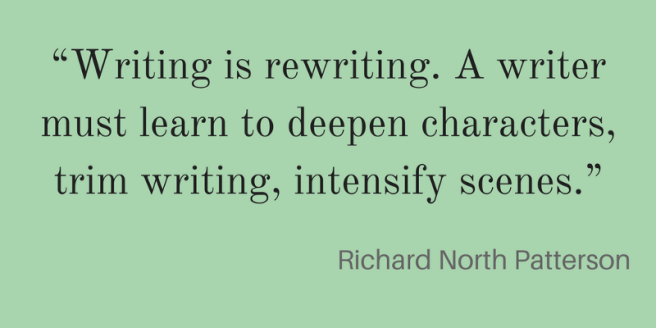
You’ll check for consistency and clarity, and you’ll end up rewriting scenes in your manuscript to improve content and structure. This is the most time-consuming step of self-editing, however, your effort spent on evaluating and rewriting your draft will ensure your story makes sense and is ready to polish and share.

So no surprise…this is where Fictionary will come to the rescue!


Copyedit

Now you’re getting into the details of each sentence with a focus on style. It’s time to check for:

  • Language errors including punctuation, grammar, and spelling
  • Run-on sentences (you may want these in dialogue or thought — just make sure you do this on purpose)
  • Repeated information or words
  • Clichés
  • Too much description
  • Unclear or confusing passages
  • Boring or passive language
  • Showing versus telling
  • Too many adverbs
  • Sentence length variation
  • Consistent spelling (For example: US versus Canadian)
  • Consistent hyphenation, fonts, and capitalization

Both ProWritingAid and Grammarly are great online tools for copyediting and proofreading. I use both, ‘cause I like them both.


Proofread

At this phase, you shouldn’t be finding too many errors. This is the final check before publishing your manuscript. You’ll notice you’re not changing your story or your style. Here you’ll check for final spelling or grammar mistakes, then ask yourself:

  • Are all chapter headings formatted the same?
  • Are any pages or headings omitted?
  • Is the page numbering consistent?
  • Are the headers and footers formatted the same?
  • Are italics consistently used?
  • Are paragraph indents formatted the same?
  • Are there any double or triple spaces between words?
  • Are there any double spaces after a period?
  • Are times formatted the same — am, a.m. AM?
  • Is the spacing between ellipses consistent (… and not . . . )?

How Will Fictionary Help You Story Edit

Fictionary is a new interactive web app for self-editing fiction that helps writers turn a first draft into a story readers love.

Developed by writers to help fellow writers, Fictionary is the first online tool for editing the story, not just the words. Writers are guided through a scene-by-scene evaluation of their manuscript by analyzing key story elements for characters, plot, and settings.

With interactive reports and writing advice for each element, writers can visualize their story and see where and how to improve their writing. With automated progress tracking, writers save time on self-editing and can be confident that their work is ready to share.

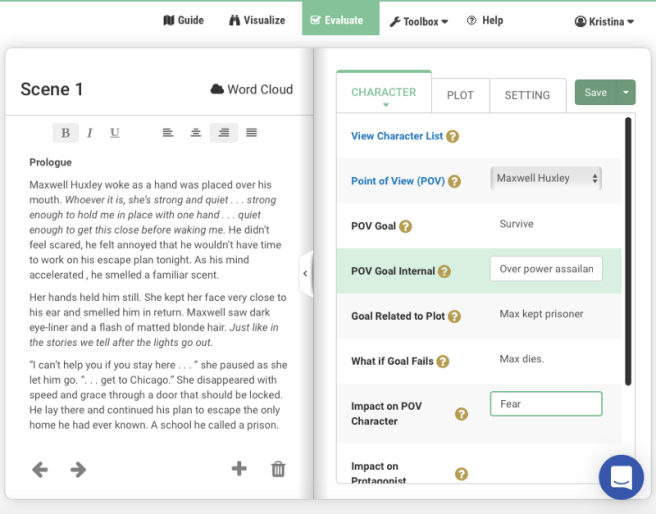
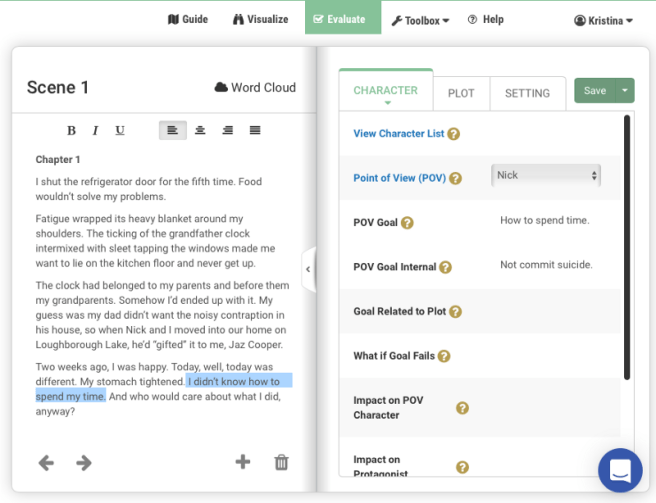
How Fictionary Works: A writer imports a manuscript. Within seconds, Fictionary automatically creates a character list, links characters to scenes, plots word count per scene, and draws a story arc.

The writer then inputs key story elements for each scene, evaluates and edits the manuscript based on output from Fictionary, and then exports the updated manuscript. The output from Fictionary is dependent on the writer’s input and is specific to each manuscript.

Why not check out our free 10-day trial?

95146-17nieqznvern2ojqp-djvow

Farley’s Friday: My Life As An Office Dog

Farley in Office

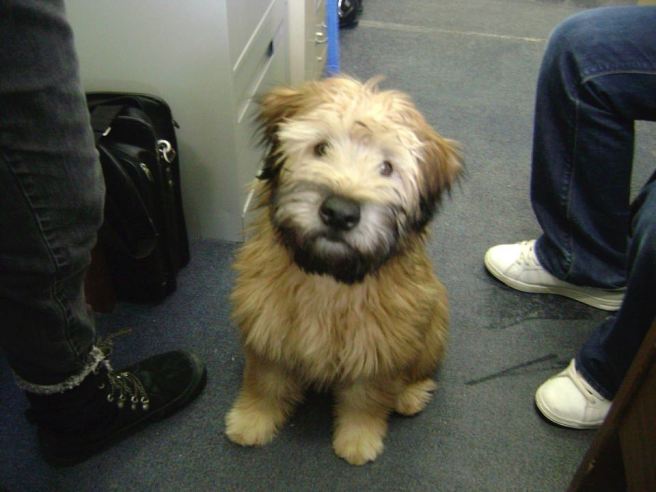
Farley here. I started my career as an office dog at Panorama Mountain Resort. I was 9 weeks old and already office friendly – meaning no peeing inside the building, no barking, and no rough play.

Then I spent years in the office on our sailboat, Mattina.

Farley Mattina

Same rules applied in the cockpit.

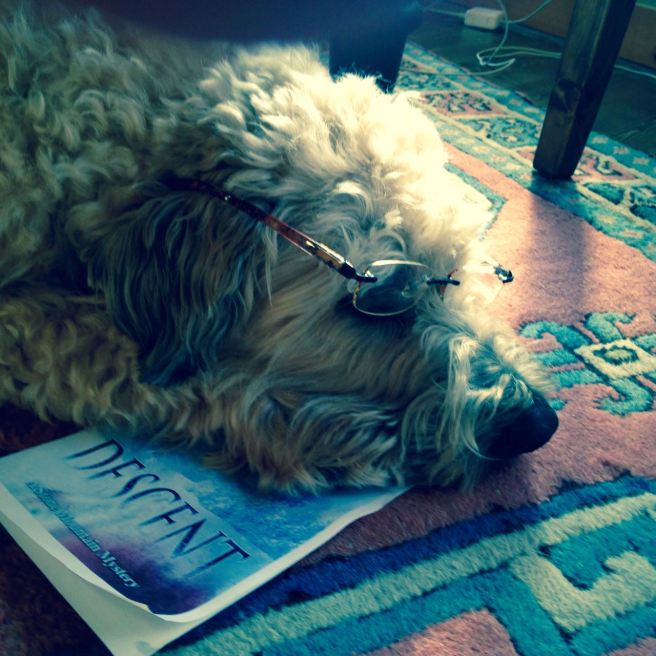
Now I work from home – but Kristina expects me to proofread.

Farley reading DESCENT.jpg

The one constant…I spend my days with Kristina working on whatever she wants 🙂

Woof Woof.

Two Questions For Choosing A Point Of View Character and Style

When writing a series, choosing both the point of view characters and point of view style are HUGE decisions an author must make.

AVALANCHE is the third book in the Stone Mountain Mystery Series and was released in June 2016. When I first started writing the series, I thought I was writing a standalone novel. Of course my characters took over, and now I have a series.

Early on, I decided to write in close third person from multiple points of view. Little did I know, that once I made that decision, I would have to stick to that for the rest of the series.

The second question in Top 3 Story Editing Questions For Fiction Writers was “Who has the point of view?”

Here are two questions to ask yourself when you begin your novel. And when you ask these questions of yourself, don’t assume you’ll be writing a standalone novel. You just never know.

1. Do you plan to switch POV characters?

If you’re going to have multiple POVs in your novel, it’s important to let your reader know this early on in the story.

It could be jarring for a reader to get half way through a novel, and the POV is ripped from underneath their feet and a new character steps in.

Changing POVs in the first few chapters will warn the reader this is your style, and hopefully, they’ll enjoy your book more. They’ll expect different characters to have their say, to drive the novel, and to provide surprises. They won’t get so attached to one POV character that they can’t bear the change and toss the novel aside.

2. What POV type will you choose?

When you choose the type of point of view to write from, consider what it will take to be consistent for an entire novel or several novels.

  • If you chose first person, do you stay in first person? Do you reference anything the first person character can’t possibly know?
  • For third person, are you writing third person, third person limited, or omniscient? Once you make the choice, it’s important to be consistent and only change the style if you make a conscious decision to do so.

For the second book in your series, follow the same POV pattern you used in the first. Your readers will expect a similar style and voice in the second and following books.


Books I’ve Read and Recommend on POV

The Power of Point of View by Alicia Rasley

Characters and Viewpoint by Orson Scott Card

Characters, Emotions and Viewpoint by Nancy Kress


How Fictionary Can Help You With POV Characters

If you’ve written your draft from multiple points of view, Fictionary will help you make sure you’re making the best use of the POV characters.

When thinking about which character should have the POV in each scene, ask yourself:

  1. Who is in the scene and who is just mentioned?
  2. Who is the best choice for the POV character for the scene?
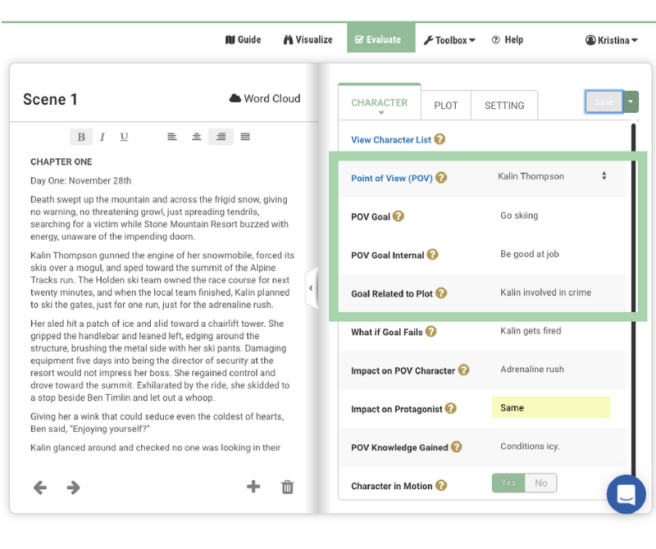
  3. What is the POV character’s goal for the scene?

Who Is In The Scene?

In Fictionary, you can visualize who is in each scene and who is mentioned. Seeing your character names will help you decide if you’ve chosen the best POV character for the scene.

Who did you choose for a POV character and what is the goal?

Here is an example of how to answer these 3 questions using my novel DESCENT. The characters in the scene are shown above. The point of view character is Kalin Thompson (she’s also the protagonist), and her goal is to search the ski-tuning room.

Evaluate each scene to ensure the reader will understand the answers to the 3 questions. You can show, tell, or imply the answers. It’s up to you to find the right balance. The more important the event, the more you should show the reader what’s happening. The less important events can be told quickly, so the reader can move on to the good stuff.

Balance The Point Of View Characters

To help you visualize the balance of your POV characters, Fictionary shows you how many POV scenes each character has, the order they have the POV, and the percentage of POV scenes compared to other characters.

Below you can see Kalin Thompson has the most POV scenes (good because she’s the protagonist), Ben has the next (also good because he’s her love interest) and so on. The initials on the bottom show you the order. The green means a character has had 3 scenes in a row where he/she is the POV character.


Fictionary is a proud sponsor of the National Novel Writing Month Now What Months.

To encourage you to finish your novel and get published, we’ve partnered with FriesenPress and are hosting a contest together.

Grand Prize

One lifetime Fictionary subscription and a $1999 FriesenPress Publishing Package.

Additional Prizes

$200 annual Fictionary subscription for 3 lucky writers!

Check out the details and enter the contest.

Winners are chosen at random. No purchase necessary.

Entrants accepted until February 18th, 2018.

Mystery Mondays: Melodie Campbell on First Person

I’m so pleased to host Melodie Campbell on Mystery Mondays today. Melodie was one of the first authors to connect with me when I started out. She’s generous with her advice.  She’s full of encouragement. And she’s an award winning author who also teaches writing.

Check below for Melodie’s newest release, The B-Team. So new, in fact, it just came out this week.

So over to Melodie…

First Person Rocks! Here’s what you need to know about the rules…

By Melodie Campbell

(First published on Sleuthsayers Crime Blog in the U.S., 2017)

The rules, the rules…

Always, in my Sheridan College Crafting a Novel class, beginning students are alarmed to find out there are rules to writing.

I’m not keen on rules in general. After all, I became a writer so I could thumb my nose at reality, right? Control the world of my fiction in a way I can’t control real life.

All that said (and I could make a blog post out of just that line above) there ARE rules to writing. A bunch of middle-aged guys behind a baize-covered door didn’t make them up for no reason (double negative – Ha! Rule-breaker, you.)

The rules are there for a purpose. They’re all about logic. Here is one that is perhaps least understood. You don’t have to follow it (more on that later.) But you do need to understand why it is a rule, so that you know the consequences of breaking it.

WRITING IN FIRST PERSON:

Many, many people don’t know the rules of first person viewpoint. So here goes:

The protagonist becomes the narrator. As a writer, you make a promise to the reader. (Remember that phrase: promise to the reader.) In first person, the character that is telling you their story is telling it directly to you. No third party writing it. You are in her head.

I love first person. I *become* the protagonist when reading or writing first person. Studies confirm this. Readers become more involved in the story and protagonist when reading first person. That’s what makes first person rock. In my books <sic> it’s the ultimate escape.

But first person has huge limitations for the writer: the person telling the story must be in every scene. Otherwise, they won’t know what is going on in that scene and can’t convey it to the reader (unless you employ a second person to run back and forth, telling the protagonist. Note the use of the word ‘tell.’ Telling is ho-hum. You won’t want to do that often.)

If your story is in first person, you can’t be switching to another character’s viewpoint. Ever. Nope, not even another viewpoint in first person. Why? Because your reader thinks this: “What the poop is happening here? The book started in first person. The protagonist is supposed to be telling me the story. Now someone else is telling it. What happened to my beloved protagonist? Are the original protagonist and protagonist number two sitting next to each other at twin desks writing the story at the same time and passing it back and forth? This doesn’t make sense.”

In a phrase, you’ve broken your promise to the reader.

So here’s what to do: if you need to write the story in more than one viewpoint in order to show every scene, write the whole story in third person. Then you can change viewpoints as needed.

One more first person restriction: if your protagonist is telling the story directly, then he can’t die at the end of the story. This should be obvious: if he died, who wrote the darn manuscript?

Finally, do NOT write a first person story and have the viewpoint character a surprise murderer at the end! We are supposed to be in his/her head. Logically, we would know.

Okay, those are the rules. You can write what you want, of course. That’s the delight of being an author. I’m sure you’ll be able to name a few crime books that break the rules of viewpoint.

But in my class, you will hear this: The rules are there for a reason. Of course you can break the rules, but if you do, you will lose something (usually reader continuity and engagement.) It’s up to you to decide if you gain more by breaking the rules than you lose by doing so. BUT: If you break them in your first novel, publishers (and readers) will think you don’t KNOW the rules.

So at least go in knowing the rules. And then do what you damn well please.

Final words: Don’t publish too soon. Take the time to learn your craft. And then…be fearless.

About Melodie Campbell

2015 author photo correctedThe Toronto Sun called her Canada’s “Queen of Comedy.” Library Journal compared her to Janet Evanovich. Melodie Campbell has won the Derringer, the Arthur Ellis Award, and eight more awards for crime fiction. Last year, Melodie made the Top 50 Amazon Bestseller list, sandwiched between Tom Clancy and Nora Roberts. She is the past Executive Director of Crime Writers of Canada. Her 13th book, The B-Team, launches this week. It’s in first person.


THE B-TEAM!

B-TeamThey do wrong for all the right reasons…and sometimes it even works.

Perhaps you’ve heard of The A-Team?  Vietnam vets turned vigilantes?  They had a television show a while back.

We’re not them.
But if you’ve been the victim of a scam, give us a call.  We deal in justice, not the law.
We’re the B-Team.


Figuring out Fictionary

My many thanks to Roland Clarke for this in-depth review of Fictionary.

Roland Clarke's avatarWriting Wings

Fictionary-Logo-200-002-1

When I was approaching the final third of my fourth rewrite of Fates Maelstrom, I felt that I had ‘lost the plot’. I wasn’t sure what to do until I was introduced to the online editing tool Fictionary by their CEO and lead developer, mystery writer Kristina Stanley who said it might help.

Although my draft wasn’t finished, the rewrite in Scrivener had the final third of draft three as guide notes. Fictionary showed me how to create and upload a docx file from Scrivener.

From that file, Fictionary automatically generated the following overviews:

  • Story Arc
  • Word Count per Scene
  • Scenes per Chapter
  • Characters per Scene
  • Scenes Per Character
  • Point of View

Before I could start using the editing features, I was prompted to confirm my cast of thousands – well almost two hundred. Many of these were characters mentioned but who never appeared like ancestors and other relations.

View original post 1,306 more words

Farley’s Friday: Dogs At Canadian Tire

Farley here,

You many have guessed I moved from the mountains to a city. Things are sure different here.

The other day, I went to a place called Canadian Tire. Everybody loved me there. And I mean everybody. I could barely trot down an aisle without someone stopping to pet me.

Farley At Canadian Tire

Not all stores are dog friendly,  but Kristina is really good at finding the ones I can go to.

The best aisle was the dog food aisle. I sniffed out the most wonderful smelling treat and stuck my nose onto the bag until Kristina got the hint that she should buy them for me.

As usual, when I got to the till there was a cookie waiting for me.

I’m meeting lots of new humans in this town, and so far they’ve all been awesome.

Woof Woof.

Ensure The Purpose of A Scene Is Engaging Your Readers

A great scene makes your reader feel an emotion.

What Is A Scene?

A scene is a section of your novel where a character or characters engage in action or dialogue. You can think of a scene as a story with a beginning, middle, and an end.

Usually, you’ll start a new scene when you change the point of view character, the setting, or the time. You may start a new scene if the scene your working on is too long to fit the structure of your manuscript.

Fictionary will take you through the process of evaluating each scene in your novel.

The Purpose of a Scene

The first question in my post Top 3 Story Editing Questions For Fiction Writers was “What is the purpose of a scene?”

I’d like to share my thoughts in more detail.

The purpose of the scene must relate to the overall story. If it’s not driving the story forward, then ask yourself what is the point of including the scene in your novel.

Here are some examples of the way the purpose of a scene can drive the story forward. You can choose one of these to define your purpose or come up with your own definitions.

  • Build suspense
  • Character development
  • Character Introduction
  • Climax
  • Establish mood
  • Establish setting
  • Inciting Incident
  • Intensify Conflict
  • Move the story forward
  • Plot point 1
  • Plot point 2
  • Resolution (after climax)

How Purpose Of A Scene Helps With Other Elements Of Fiction

I articulate the purpose of the scene early in my story editing, so I can address other elements of the scene and test if they are in line with the purpose.

Let’s say you fill out the list of objects in a scene. You can weigh the objects against the purpose of the scene and see if there is a way to use them to further the purpose. This goes for revelations, tension, conflict, weather, etc. Basically, every scene element can be tested against the scene purpose.

After you whittle down the purpose of a scene to a few words, one of three things will happen.

  1. You’ve got the purpose nailed, and you understand why this scene is included in your novel.
  2. You have a weak purpose, but there is still some value in the scene.
  3. You have no idea what the purpose is.

So you’ve got the purpose nailed. Yay! Move on to the next scene.

If the point of the scene is weak, see if you can take what is important in a scene and move it to another scene, then delete the weak scene. You can also enhance the scene to give it a stronger purpose.

If you can’t articulate the purpose of a scene, think about removing the scene.


The Fictionary Finish Your Novel Contest.

Fictionary FYNC

Fictionary is designed for the serious author who wants to produce a high-quality manuscript.

To encourage you to finish your novel and get published, we’ve partnered with FriesenPress and are hosting a contest together.

Grand Prize

One lifetime Fictionary subscription and a $1999 FriesenPress Publishing Package.

Additional Prizes

$200 annual Fictionary subscription for 3 lucky writers!

Check out the details and enter the contest.

Winners are chosen at random. No purchase necessary. Entrants accepted until February 18th, 2018.

Fictionary is a proud sponsor of the National Novel Writing Month Now What Months.

Ensure The Purpose of A Scene Is Engaging Your Readers

Farley’s Friday: Cookies at the Hardware Store

Farley here,

Life is good. Not only am I welcome in the local hardware store, everyone talked me and told what a great dog I am! Seriously, at least 5 different people stopped to pet me.

Farley at Hardware Store (1)

Then when it was time to leave, this nice lady gave me a cookie.

And I didn’t have to do any tricks. I like her.

Woof Woof

Conquer Your Story Edit and Finish Your Novel (NaNoWriMo Guest Blog)

Conquer Your Story Edit and Finish Your Novel

Every year, we’re lucky to have great sponsors for our nonprofit events. Fictionary, a 2018 “Now What?” sponsor, is a breakthrough tool for editing fiction. Today, author and Fictionary co-founder Kristina Stanley shares her editing expertise, as well as the details of the Fictionary Finish Your Novel Contest:

Tell me a story!” your reader demands. “I want to feel happy, sad, frightened. Take me to a new world and make me care about what happens.

That’s a big ask of a writer. How do you go from the first draft of your novel to a story that works and captures readers? Think about some of the best novels you’ve read. What do you remember?

Read More…

Mystery Mondays: 2018 Call For Authors

Promoting Reading – Promoting Authors

Mystery Mondays began in July 2015. Authors from many genres who write with a hint of mystery have told you about their books, answered your questions about writing, and shared their thoughts with you. Every Monday, you’ve be introduced to another author and maybe discovered someone you’re not familiar with.

Are you interested in guest blogging?

I am now accepting guest blog requests for 2018 starting on February 29th. If you’re interested contact me here.

If you’d like to participate, here’s what you need to qualify:

  • you are a published author – traditional or Indie or any other way that I don’t know about,

OR

  • you are about to publish and have a launch date within a week of blog post,

AND

  • you want to promote other authors and spread everyone’s successes,
  • you write novels with a hint of mystery,
  • you are willing to engage in the comments section when readers comment on your post.

All I ask from you is that you follow my blog, comment on author’s posts and help share via Twitter and Facebook.  If you’re interested send me a message via my contact page.

The Requitements:

You’ll have to send me your bio, back text of your novel, author photo and book cover.

I’d like you to write something about yourself, your novel, your research, a writing tip or a publishing tip. Please keep in mind I am a family friendly blog.

I do reserve the right to edit anything I think might be inappropriate for my audience, which I will discuss with you first. I think anything under 700 words is great, but it’s your book so up to you.

I’m looking forward to hearing from you and sharing your novel with the Internet world.