Mystery Mondays: Angela Petch on Location (The Life of Fiction)

This week on Mystery Mondays, lets take a trip to Tuscany. We have Angela Petch, author of Tuscan Roots, here to share her thoughts on why setting is so important to a novel.

An Observation About Setting by Angela Petch

I was up front with Kristina when she accepted me here for Mystery Monday. My first novel is not a mystery novel in the truest sense of the word. But there is plenty of mystery involved: a young woman, Anna Swilland, is at a difficult stage in her life. She’s tired of being a mistress to a married man, she’s lost her job and her mother has just passed away. Anna inherits a diary in her mother’s will. She decides to travel to Italy to her mother’s birthplace – a village nestled in the Tuscan Apennines. There she begins to piece together unimaginable parts of her mother’s life that she could never have dreamt of. Anna falls in love with her new location and stays longer than planned…and the mystery of her background unfolds.

I’ve been thinking a lot about the beautiful settings where I live, and I recently came across a Southern American writer’s observations on the subject.

Eurora Welty said, “Every story would be another story, and unrecognisable if it took up its characters and plot and happened somewhere else…Fiction depends for its life on place. Place is the crossroads of circumstance, the proving ground of, what happened? Who’s here? Who’s coming…”.Writers describe the world they know. Sights, sounds, colors and textures are all vividly painted in words as an artist paints images on canvas. A writer imagines a story to be happening in a place that is rooted in his or her mind.”

I’ve come to realise that location plays a huge part in my writing: the way it impacts on my imagination, research, descriptions and ultimately my characters.

And this past week I’ve been confused.

Why? Let me explain: I live a “bi-life” – that’s how best to describe it.

I’m so lucky to live and work for six months of the year in a breathtakingly beautiful corner of Eastern Tuscany. Then during the winter months I live by the sea in Sussex, England, which is equally as stunning but very different. This week my routine suddenly changed and my location switched from Italy to England.

Having just launched my second novel “Now and Then in Tuscany”, the characters from this story are still very much with me… I see them when I walk up the mule tracks or shop in the village piazza. I see what they buy, watch them tend their vegetable plots and guide their sheep to the meadows. Ten days ago I ate in a house in the village of Montebotolino, where I’m convinced my main character, Giuseppe, lived.

In this narrow stone building with wide oak floorboards I shared wine, ate soup made from nettles gleaned from the hillside and frittata seasoned with Old Man’s Beard – surprisingly tasty fruits of the land. The window was ajar on a panorama of hazy blue Apennines, a nightingale provided song and I imagined Giuseppe outside, leaning against the warm stone walls. Was he waiting there to tell me of inaccuracies in my book? Or did he want to pass on the latest news of his wife and son?

But this week I’ve walked along the shingly flint-scattered shore of southern England and Giuseppe isn’t there beside me. Instead, two new personalities are dawdling in front of me, picking up shells, gossiping, nudging each other as they make their way to the café for tea and scones. And they are characters from my WIP.

It begs the question – is my imagination by itself – powerful enough to transport me where I need to go in a story? Or do I need to be in that location to kick-start my writing? What would I do if I were imprisoned in a tiny cell, with no window to look out over the world? Could I do it?

In fact, last year I did end up in a police cell in Arusha, Tanzania and I’d managed to smuggle in my pen and diary…and I scribbled down some thoughts while the guards weren’t looking… But that story is for another day.

WHO IS ANGELA PETCH?

OLYMPUS DIGITAL CAMERAI’m an award winning writer of fiction – and the occasional poem. Now that my children are independent I am freer to dive into my writing and have begun to extend my readership through social media. I find this hard but also weirdly exciting in the new horizons it offers. I’m a child of the 1950’s and free time was spent with my nose in books. My three year old grandson loves books too but he is much better than I am with an I-pad. “It’s never too late,” whispers a voice in my head as I merrily tweet or press “Like”.

Every summer I move to Tuscany for six months where my husband and I own a renovated watermill which we let out to holidaymakers from across the globe. When not exploring this unspoilt corner of the Apennines, I disappear to my writing desk at the top of a converted stable.

In my Italian handbag or hiking rucksack I always store notebook and pen, for I never know when an idea for a story might strike and I don’t want it to drift away.

The winter months are spent in England, on the Sussex coast where most of our family live. When not helping out with grandchildren, I catch up with writer friends and enjoy walking along the shore, often moody and squally in the winter months. But very inspiring.

I’ve lived abroad for most of my life, including several childhood years in Italy. After graduating with honours in Italian from the University of Kent at Canterbury, I worked for a short spell for The Times newspaper, before moving to new employment in Amsterdam. The job relocated to Sicily, where I met my half-Italian husband. We married near Urbino and then went to live for three magical years in Tanzania. Wherever I travel I store sights, sounds and memories of those places for stories I feel compelled to record.


TUSCAN ROOTS:

 Front Cover“Tuscan Roots” is my first novel.

First published in 2012, as “Never Forget”, my publishing company went bankrupt and having lost control of my book and all royalties, I was forced to edit and reissue under this new title in 2016.

Inspired by the true story of my Italian mother-in-law, Giuseppina Micheli, who met and later married a dashing army captain in 1944, “Tuscan Roots” combines their story with the events that took place along the so-called Gothic Line. This defensive barrier crosses the area where the author lives. It is still possible to visit gun emplacements and remains of fortifications scattered across the hills. A fluent Italian speaker and graduate of Italian literature and language, I was able to interview local people for their memories of the war years.

“Tuscan Roots” is a story of two women living in two different times. In 1943, in occupied Italy, Ines Santini’s sheltered existence is turned upside down when she meets Norman, an escaped British POW.

In 1999, Anna Swilland, their daughter, starts to unravel accounts from assorted documents left to her after her mother’s death. She travels to the breathtakingly beautiful Tuscan Apennines, where the story unfolds.

In researching her parents’ past, she will discover secrets about war, her parents and herself, which will change her life forever…”

PRAISE FOR TUSCAN ROOTS


“…moving and interesting” – Julia Gregson, bestselling author of “East of the Sun”.

“The fascination of this extremely readable novel is how the author deftly handles the multifaceted cultural differences: Italy of the 1940s and today but also between Italy and England of yesteryear and the difficulties encountered by the war brides coming to a cold and distant land and finally, the experiences of the heroine, Anna, who even today is plunged into a different world on her ‘time travels’ which will change her own life completely.” John Broughton – Amazon reviewer.

“There are small echoes of Forster’s “Where Angels Fear to Tread” and of Hemingway’s “For Whom the Bell Tolls”. The book’s essential of discovery and revelation through “diaries” is reminiscent of Victoria Hislop’s successful and moving “The Island”, but “Tuscan Roots” is better written and a much better book. The characters are very real…” Amazon reviewer.

“Once I started to read I simply couldn’t stop and fell in love with the location and the characters. Tuscan Roots has a little something for everyone. As far as history is concerned it certainly it has a fascinating insight into the war years in Italy and its immediate aftermath in England. There is sadness, there is drama and absolutely there is a love story. All with the most beautiful descriptions of a country that the author both knows and loves. Can’t wait to read her next book. Highly recommended. Vivienne Wendy Jones – Amazon reviewer.

“A feast of a book. Angela writes with assurance and a descriptive power which transports you to Tuscany; the taste; the scenery; the history. It comes from a deep love and knowledge of the area.” Rosemary Noble – GOODREADS

(The sequel to “Tuscan Roots” was launched on April 30th 2017. “Now and Then in Tuscany” is available on Amazon, in Kindle and paperback: http://bit.ly/NTuscany)

WHERE TO FIND ANGELA

 Facebook Author Page

Amazon Author Page

Twitter

Arun scribes – Facebook: https://www.facebook.com/groups/1124757317646074/

Il Mulino: www.ilmulinorofelle.com (where I live in the summer)

Goodreads:

Website – (Under construction but to be published soon)

Link for “Tuscan Roots”: mybook.to/TuscanRoots

Link for “Now and Then in Tuscany”: https:bit.ly/NTuscany


10 Benefits of Feedback for Big-Picture Editing – Feedback For Fiction

One of our early testers asked: “How will Feedback help my manuscript?”

What a great question!  It made me think about a better way to explain the benefits of using Feedback and becoming your own big-picture editor.  Read on for my answer. I hope this helps you think about your manuscript in new ways!


Feedback can identify and help you fix problems within your manuscript by focusing on the structure of your story, not on the words. Some of the critical structural areas are:

  1. Pacing                 
  2. Character names and appearances
  3. Point of view characters and goals
  4. Story arc
  5. Plot holes (scenes without a clear purpose)
  6. Flow from scene to scene
  7. Absence of tension or conflict
  8. Empty stage syndrome
  9. Confusing timelines or missing objects


The 10th benefit of using Feedback comes from the built-in Rewrite Tips. These tips provide you with specific advice on the area of the manuscript you are working on just when you need it! No more endless searching for writing advice.


1. Pacing

Problem: The pacing is not working in your novel. The story is too slow or too fast.

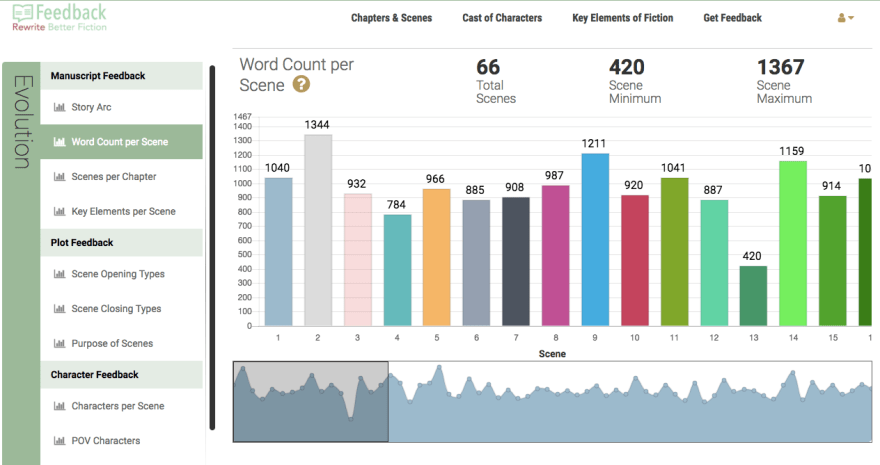
Knowing your word count per scene helps you control the pacing in your novel. Sometimes you want to slow down the story, using the time to build tension and suspense. Sometimes you want quick action to drive the story forward. Use longer scenes to slow the pacing and shorter scenes to speed it up.

The word count per scene insight lets you quickly visualize the pacing.


2. Character Names and Appearances

Problem: Your readers are telling you they don’t feel a connection with your characters or they are confused by your characters’ names

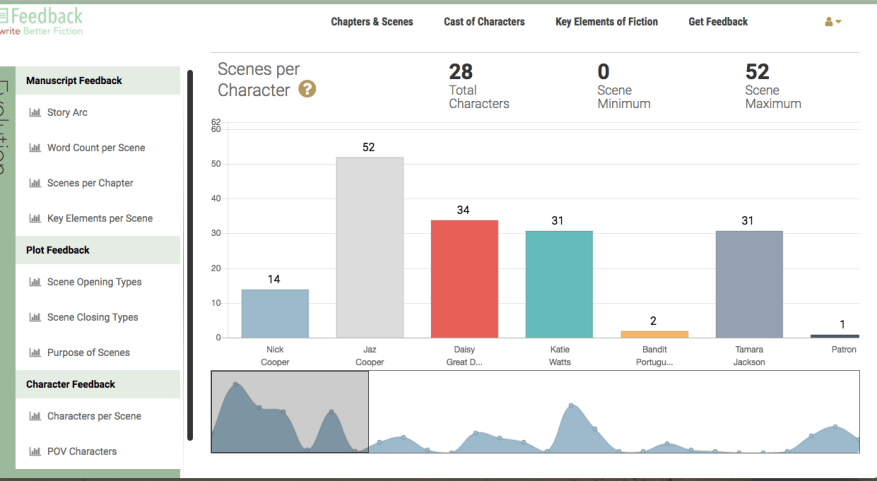
Scenes Per Character and Cast of Characters help you visualize all your character names to ensure you don’t have too many characters per scene and that your main characters are getting enough time in your novel.

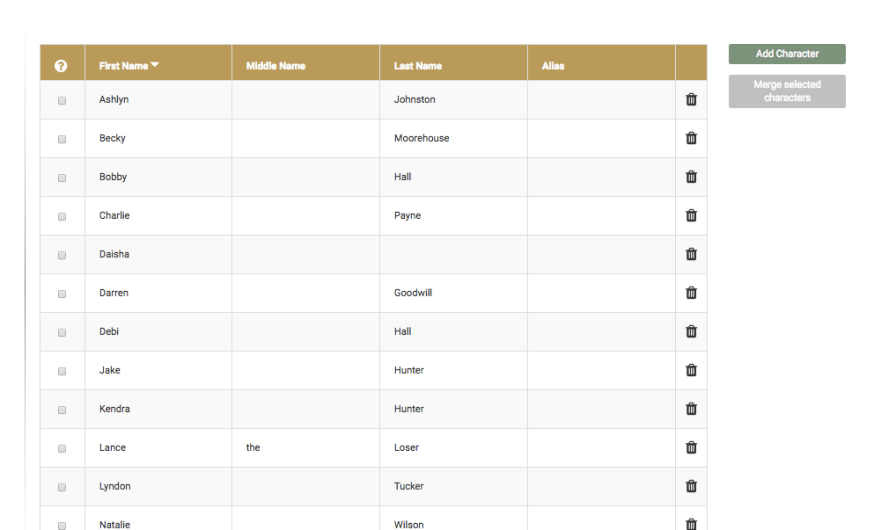
When you can see the cast of characters in one place, you’ll be surprised how easy it is to see if character names are too similar.


3. Point Of View (POV) Characters and Goals

Problem 1: You’re not sure if you’re giving the right number of scenes to your POV characters or if you’re using them in the best order for dramatic effect.

Problem 2: Your characters don’t have strong goals that drive the story forward.

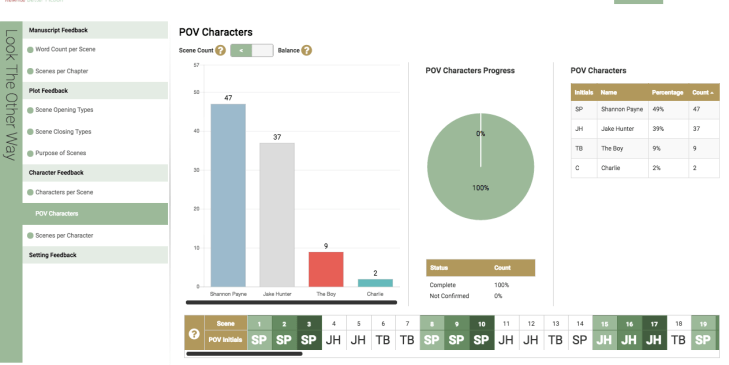
See how many POV characters you have and what order they appear in. You control who is telling the story. Everything that happens in a scene should occur through the eyes of the POV character. The reader will connect with the POV characters if you don’t have too many. The reader will also get to know your POV characters by how they experience the scene. The longer a reader spends with each POV character, the more time they have to like or dislike them.


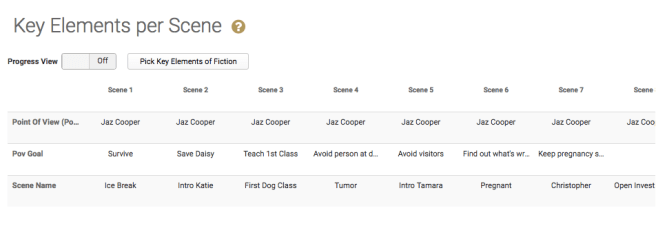
You can see the Point of View character goals per scene and ensure your characters have strong goals in every scene that drive the story forward. The novel shown is written from one point of view. Multiple points of view can be shown too.


4. Story Arc

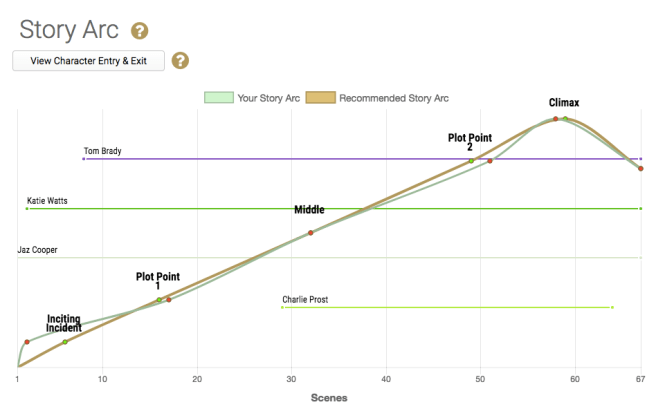
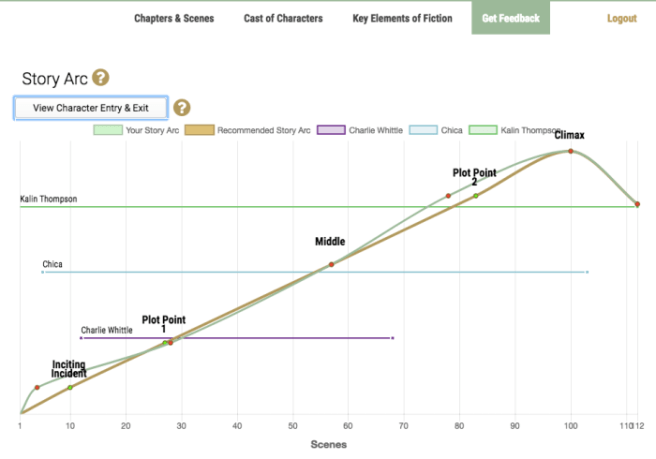
Problem: Your readers don’t stay engaged for the entire story. Are your key scenes in the correct place? The story arc will show you where the inciting incident, plot points, and climax should be. You’ll be able to place these key scenes for the highest dramatic effect.


This story arc shows my work in progress on Evolution (my latest novel), along with several of the character entry and exit points overlaid.


5. Plot Holes (scenes without a clear purpose)


Problem: Some scenes cause plot holes by not being connected to the story.


This usually means the scene doesn’t have a purpose. If you don’t know the purpose of each scene in your novel neither will your reader, and you most likely have a plot hole.


6. Flow

Problem: Readers stop reading at the end of a scene or at the beginning of the next scene.

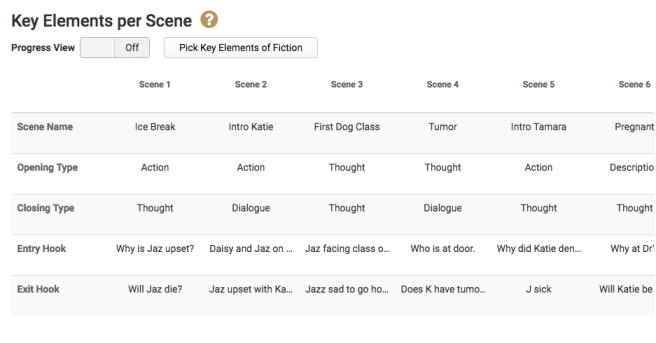
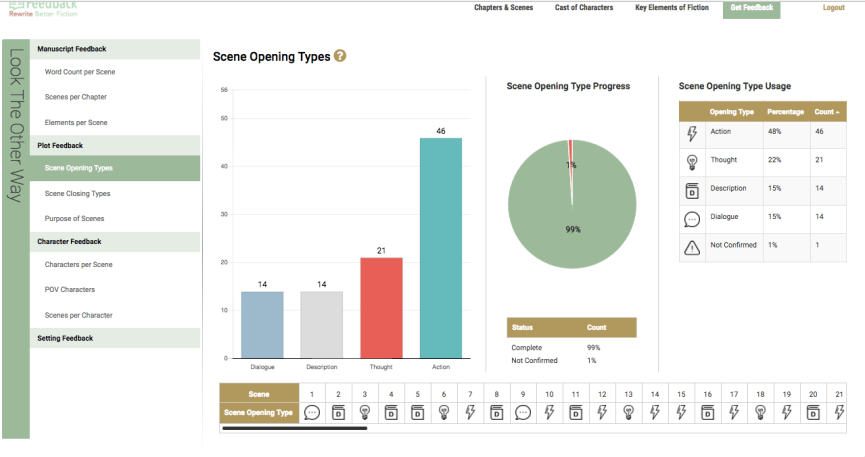
How do you open and close each scene? What are the entry and exit hooks? The flow of your novel depends on leading the reader into and out of your scenes. Feedback helps you work on how you’re entering and exiting scenes. You can quickly see if you’re using repetitive opening and closing types that might bore your reader. You can ensure you’ve used dramatic entry and exit hooks to get the reader into the next scene and keep them there.

You can also see just your scene opening or closing types. Check out how many times you use each type, the percentage of use, and the order the types appear in. You can see quickly if you have the balance right for your genre. Here’s a peek at my upcoming novel, Look The Other Way. You can see I’ve opened almost half of the scenes with action.


7. Tension and Conflict

Problem: Your readers are telling you they are bored or skimming in places.

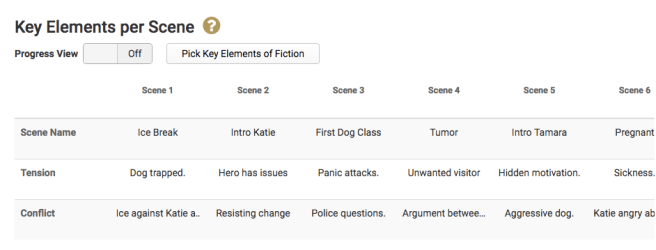
Do you have enough tension and conflict in each scene? Too many scenes in a row without tension or conflict will bore your reader.


8. Empty Stage

Problem: Your readers can’t visualize your settings and are not moved emotionally by them.

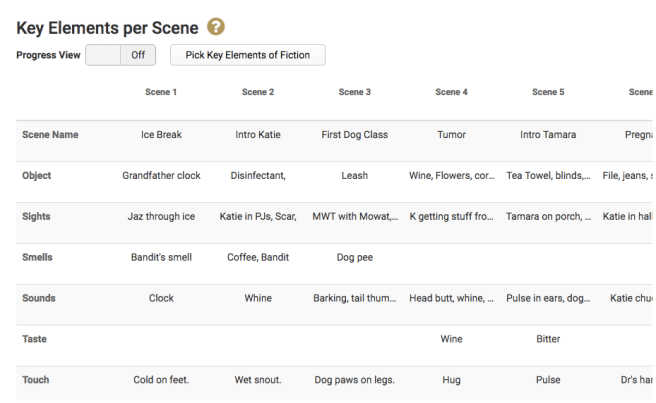
Are you using senses and objects to fill the stage? You’ll know quickly if your stage is empty, and an empty stage means unengaged readers.


9. Confusing timelines or missing objects

Problem 1: Your readers are lost in time or complaining they can’t keep track of time.

Problem 2: You’re not sure where key objects appear in your novel.

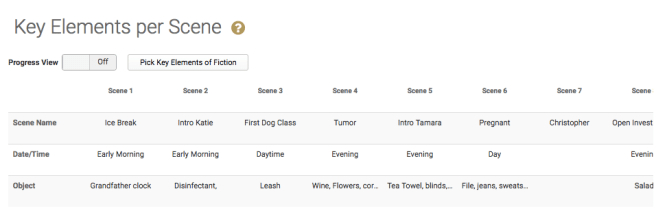
You can keep track of the time in which a scene takes place. You can also see which scenes important objects appear in. If you want, you can even add a row that shows which characters are in the scene, too. Then it’s clear who knows about the objects and when they know about them.


10. Rewrite Tips

Problem: You don’t have time to search through how-to-write or self-edit books to find the knowledge you need to turn your first draft into a great story readers love.

If you’re struggling with finding advice on big-picture editing, Feedback provides this at your fingertips. The rewrite tips are focused on the area you’re working on, eliminating time-consuming searches through books or the internet.

Source: 10 Benefits of Feedback for Big-Picture Editing – Feedback For Fiction

Announcing WINNER of Death Takes No Bribes by Susan Van Kirk

Congratulations to Karen Wood! You’ve won a copy of Death Take No Bribes.

Susan generously offered a copy of Death Takes No Bribes to a randomly chosen commenting on this week’s Mystery Mondays.

Karen – please contact me via my Contact Page and I’ll get you connected with Susan!

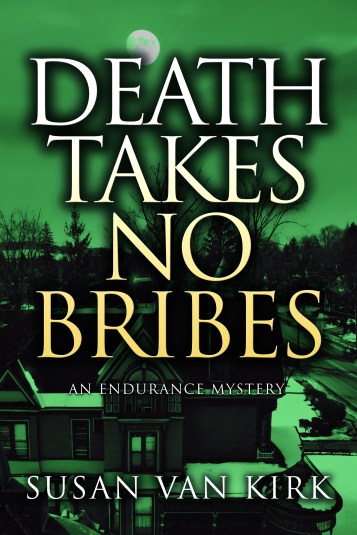
DEATH TAKES NO BRIBES

NoBribes_CMYK_300dpi.jpg WHO POISONED ENDURANCE HIGH SCHOOL PRINCIPAL JOHN HARDY?

Retired teacher-turned-sleuth Grace Kimball returns to her old haunt with Detective TJ Sweeney to investigate Grace’s former colleagues. Could one of them be a killer?

The chemistry teacher who designed a poison unit? A spurned lover or her betrayed husband? A soon-to-be wealthy widow? Sweeney and Grace have plenty of suspects. To top that off, the drama teacher at the high school is producing “Arsenic and Old Lace.”

Meanwhile, Grace’s boyfriend and editor of the Endurance Register, Jeff Maitlin, has disappeared on some mysterious errand from his past. Then, Grace gets devastating news.

Death is stalking the halls of Endurance High School, and Grace Kimball and TJ Sweeney are only a few steps ahead.

WHO IS SUSAN VAN KIRK?

IMG_0032Susan Van Kirk was educated at Knox College and the University of Illinois. Three May Keep a Secret, her first mystery novel about the small town of Endurance, was published in 2014 by Five Star Publishing/Cengage. The Locket: From the Casebook of TJ Sweeney, is an e-book novella available on Amazon. Marry in Haste and Death Takes No Bribes are also available from Amazon in Kindle and paper formats.
Farley’s Friday: There’s a Mouse in the Hot Tub

Farley here,

I am one busy dog. I don’t know how my humans would take care of this place if I wasn’t here.

They, my humans, don’t seem to have any sense of smell and are a little hard of hearing.

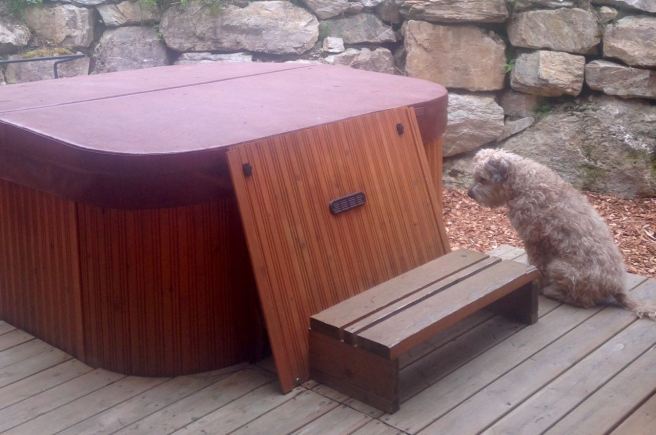
I hear a squeak. I smell the mouse from inside our house.

I run to the door, wag my tail, and stare outside. This is where the humans are quite smart. Kristina knows this means she must open the door for me. I don’t bark, whine, or scratch the door. She can read my mind. I just stare, and she does what I want.

I burst outside and circle the tub. I know a mouse is hiding inside, but I can’t get to it. All I need to to is scare it, and it will run away.

After an hour or two, I get a little tired and just sit and stare. Maybe the mouse can read my mind too, and it will know it should leave.

Farley Hot Tub

Darkness comes. My humans make me come inside and go to bed. I don’t want to, but I know I have too. I’m getting a little cold anyway.

Morning comes, and before I do anything else, I run to the hot tub and search for the mouse. I can’t hear it and I can’t smell it. It’s gone.

I’ve done my job and scared the mouse away!

Woof Woof.


The EDITING App You Need – Guest Blog Post by Kristina Stanley | Dan Alatorre – AUTHOR

Dan Alatorre

is author of numerous best sellers, host of the YouTube video show Writers Off Task With Friends, blogger… and father to a hilarious and precocious daughter, “Savvy” of the bestselling book series Savvy Stories. His novels, short stories, illustrated children’s books and cookbooks have been translated into 12 different languages and are enjoyed around the world.

So why am I talking about Dan? Dan graciously hosted my guest post yesterday on his blog, and I’d like to share that with you.

So over to Dan’s blog: The EDITING App You Need – Guest Blog Post by Kristina Stanley | Dan Alatorre – AUTHOR

***

Kristina Stanley has been a friend of the blog for quite a while. As a fellow author she noticed several things we writer types struggle with and set about finding a way to help. I’ll let her…


Mystery Mondays: Susan Van Kirk on Writing After Retirement

Today on Mystery Mondays, author Susan Van Kirk talks to us about writing after retirement AND she’s giving away a copy of DEATH TAKES NO BRIBES to a randomly chosen commenter (limited to U.S., Canada, and the UK.). She’ll mail her book to the lucky winner. Any comments posted by Friday, June 9th, 2017 are eligible.

Over to Susan…

Always a Late Bloomer by Susan Van Kirk

Watershed events in my writing life have usually been marked with ages that end in zero. I guess you could say I came to writing late in life. It’s a trend. I went back to school and got my Master’s degree when I turned fifty. Maybe I’m just a late bloomer.

I began writing in 2006 when I was teaching at a local college. That year I turned sixty. Before that teaching job, I’d spent 34 years teaching high school English in a public school in the small town of Monmouth, located in west central Illinois. My first book was a creative nonfiction teaching memoir called The Education of a Teacher (Including Dirty Books and Pointed Looks.) The odd title is a result of the longest chapter in the book, a chapter describing a book challenge in my classroom. A set of parents wanted to throw out Kurt Vonnegut’s book, Breakfast of Champions, that their high school daughter was reading for a book report in my classroom. The story describes what happened next.

My teaching memoir came about because a college student suggested I write a story I had told in my education class. Eventually, I did write that story, and Teacher magazine bought it two days after I sent it. That began my writing career. I wrote fourteen other stories from my four decades in a high school classroom, and collected them in a book which has sold every quarter since September 2010. I began to think of myself as an author!

Once I retired from teaching, I decided to write a mystery because I’d always loved reading mysteries. I spent a year researching and reading about the craft of writing fiction, and then I began writing my Endurance Mysteries.

Three May Keep a Secret is the first book of the series. I’ll let you in on a secret: I’m terrible at coming up with titles. Since my main character, Grace Kimball, is a just-retired teacher who taught American Literature, I thought she would like Benjamin Franklin. His Poor Richard’s Almanac contains aphorisms about human behavior. “Three may keep a secret, if two of them are dead,” led to my first title. That was quickly followed by Marry in Haste, from Franklin’s “Marry in haste, repent at leisure.” The final novel in the series, just out June 1, is Death Takes No Bribes, another of Franklin’s sayings.

In between the first and second book, I self-published a novella about the detective in my series, TJ Sweeney. It does not have a Franklin title and is simply in e-book format: The Locket: From the Casebook of TJ Sweeney.

The entire series takes place in the small, Midwestern town of Endurance. The town’s name indicates a major theme of the series: the strength and endurance of women. Grace Kimball, my protagonist, survived a tragedy during her college years, an experience so horrific she has been dogged by it ever since. After college, her beloved husband died young, leaving her with three children to raise alone. The first book of the series introduces her, TJ Sweeney, and their circle of friends. It also introduces a potential love interest, Jeff Maitlin. Oh, right. I almost forgot. A murder (or two) occurs. Before the story ends, even Grace Kimball is in deadly trouble. This first book of the series was bought in just two weeks by Five Star Publishing/Cengage.

Each book in the series has a theme or idea. The first book is about overcoming your past; the second is about why domestic abuse happens. The third book is about how the world has become so big that often people fall through the cracks and cause chaos. TJ Sweeney’s e-book novella puts her center stage, and concerns a cold case from the 1940s. The topic is hate crimes.

Now Five Star/Cengage has ended their entire mystery line, so I’m starting a new series and will be looking for a publisher once again at age seventy. So far, I have been terribly lucky, and I hope that streak continues.

I am just a late bloomer, sigh, and I am learning so much!

DEATH TAKES NO BRIBES

NoBribes_CMYK_300dpi.jpg WHO POISONED ENDURANCE HIGH SCHOOL PRINCIPAL JOHN HARDY?

Retired teacher-turned-sleuth Grace Kimball returns to her old haunt with Detective TJ Sweeney to investigate Grace’s former colleagues. Could one of them be a killer?

The chemistry teacher who designed a poison unit? A spurned lover or her betrayed husband? A soon-to-be wealthy widow? Sweeney and Grace have plenty of suspects. To top that off, the drama teacher at the high school is producing “Arsenic and Old Lace.”

Meanwhile, Grace’s boyfriend and editor of the Endurance Register, Jeff Maitlin, has disappeared on some mysterious errand from his past. Then, Grace gets devastating news.

Death is stalking the halls of Endurance High School, and Grace Kimball and TJ Sweeney are only a few steps ahead.

WHO IS SUSAN VAN KIRK?

IMG_0032Susan Van Kirk was educated at Knox College and the University of Illinois. Three May Keep a Secret, her first mystery novel about the small town of Endurance, was published in 2014 by Five Star Publishing/Cengage. The Locket: From the Casebook of TJ Sweeney, is an e-book novella available on Amazon. Marry in Haste and Death Takes No Bribes are also available from Amazon in Kindle and paper formats.
Links:

Website and blog:    http://www.susanvankirk.com

Facebook:    https://www.facebook.com/SusanVanKirkAuthor/

Twitter Handle:    @susan_vankirk

GoodReads:     https://www.goodreads.com/author/show/586.Susan_VanKirk

Pinterest:      http://www.pinterest.com/sivankirk/

Romancing Your Novel With A Big-Picture Edit

In honor of the Get Social Blog Hop, I’d like to cover editing a romance novel. You can find other blogs on the hop are here.

get2bsocial2bevent

Some of you may know, my upcoming book is a mystery, but it’s different from the Stone Mountain Series in that it has more romance in it.

There are many areas to cover when you’re editing your first draft, and today I’ll cover four Key Elements of Fiction important to romance novels.

Screen Shot 2017-06-03 at 9.33.09 AM Point of View

Screen Shot 2017-06-03 at 9.33.09 AM Characters on Stage

Screen Shot 2017-06-03 at 9.33.09 AM Spice (Conflict and Tension)

Screen Shot 2017-06-03 at 9.33.09 AM Purpose of each Scene

Even in real life, romance takes effort. The same is true for creating a romance novel that sizzles.

Screen Shot 2017-06-03 at 9.33.09 AMPoint of View


Point of View (POV) is the perspective the story is told from. It is generally accepted that each scene is written from the point of view of one character.

In a romance novel, you have to make choices on who the POV character will be. It can be mostly the hero, mostly the heroine, or an equal balance between the two. By using both points of view, you’ll be showing the feelings and thoughts from both characters.

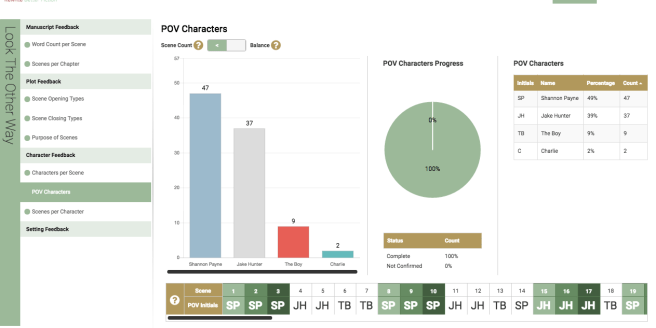
The Feedback tool for writers illustrates how many scenes each POV character has and what order they appear in. In Look The Other Way, Shannon (heroine) has the POV for 47 scenes, and Jake (hero) has the POV for 37 scenes. The graph along the bottom shows the order of the point of view, allowing me to make sure I’m switching between the hero and heroine regularly.

POV Characters

Screen Shot 2017-06-03 at 9.33.09 AMCharacters on Stage


There can only be romance if both the hero and heroine are in a scene together. Keep track of how many scenes you have where only one is in the scene versus scenes where both characters are onstage. The Feedback app does this for you.

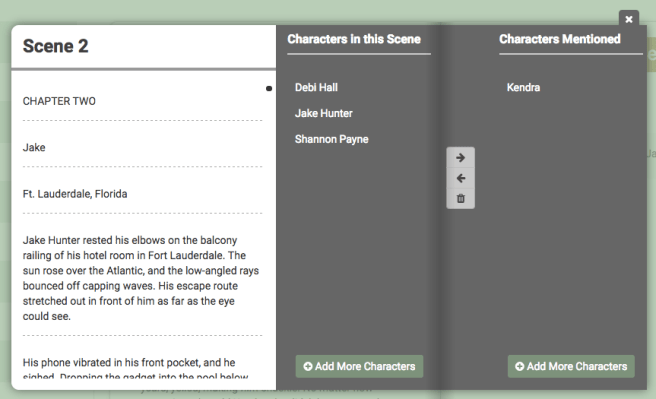
Below, Jake and Shannon are both in the scene along with another character Debi Hall. Kendra is Jake’s cousin and is only mentioned in the scene. The scene is from Jake’s point of view, so the reader will see and hear things from his view point only. The reader won’t know what Shannon thinks or feels unless Jake comments on it or thinks about it or Shannon says something.

Character in Scene LTOW

Screen Shot 2017-06-03 at 9.33.09 AMSpice


To keep the story exciting there must be conflict and tension between the hero and heroine. If you’re writing a happy-ending romance, the hero and heroine will resolve the conflict and tension by the end of the story and live happily ever after.

The two can be working toward the same goal, but maybe they go about it differently and that causes the tension.  This resolution must not happen until the end. Each scene until the end must have conflict or tension or both.

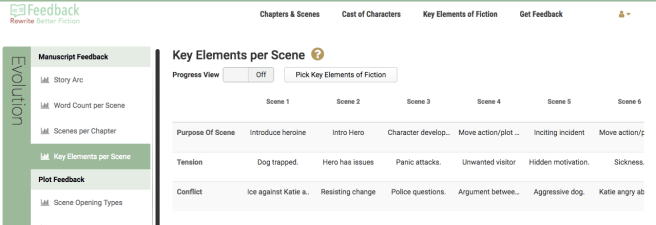
Feedback enables you to see what conflict and tension are in each scene. You can see if the tension and conflict are in line with the purpose of scene. Just make sure you have either conflict or tension in every scene. You don’t have to have both.

Here you’re getting a sneak peek at my work in progress, Evolution.

Conflict Tension

Screen Shot 2017-06-03 at 9.33.09 AMPurpose of Each Scene


The romance genre requires a special look at the purpose of each scene. In a mystery, the sole purpose of a scene may be to drop a clue or a red herring into a scene. But in a romance novel, the purpose of a scene may revolve around character development, driving the romance forward, or driving the romance backward.

Here are some of the key scenes you’ll need.

  • Introduce heroine and set up her world
  • Introduce hero and set up his world
  • Inciting incident – something happens in their world that will cause them to meet.
  • First kiss
  • Plot point one – the hero and heroine face something difficult
  • Middle – the characters can’t turn back to the story. They may also decide they are not right for each other.
  • First quarrel
  • Plot point two – their relationship is at its worst
  • Finally get together
  • Resolution

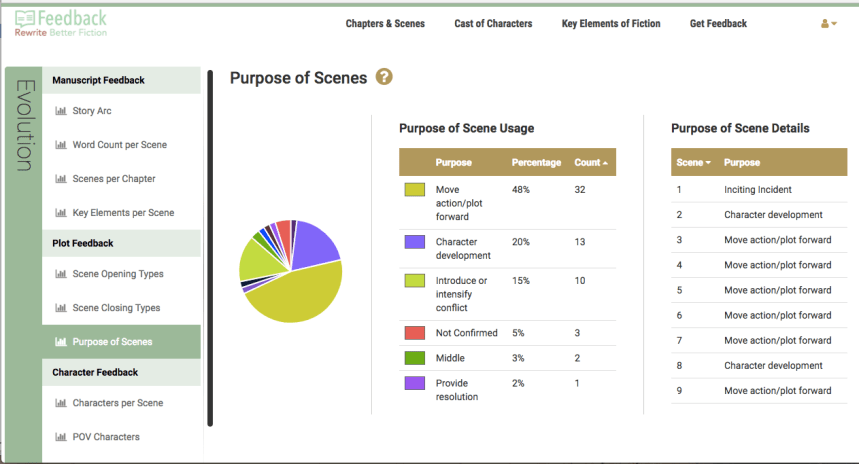
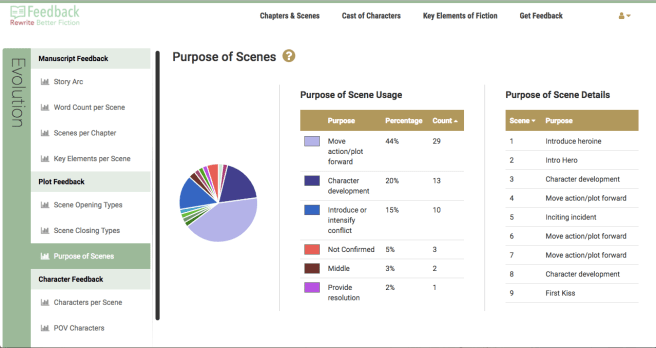
In the following, which is the Feedback insight into Purpose of Scene for my work in progress Evolution, you can see in the first 9 scenes, the hero and heroine meet, there is tension between them and they have their “first kiss.” You can also see 44% of the scenes in this novel are moving the story forward.  This means there is more than romance in the story and the hero and heroine have a goal they are desperate to achieve.

Feedback will help you keep track of the romance and its progression as you self-edit your novel.

Purpose of Scene Romance

More Self-Editing Advice

BIG-PICTURE EditingIf you’re looking for more help on self-editing download the free eBook, BIG-PICTURE Editing And The Key Elements Of Fiction and learn how big-picture editing is all about evaluating the major components of your story. We call these components the Key Elements Of Fiction.  Our eBook shows you how to use the key elements of fiction to evaluate your story and become your own big-picture editor.

Interested In An Automated Approach To Big-Picture Self-Editing?

Feedback Innovations (which I happen to be the CEO of) is building the Feedback app.

Feedback is the first web app to help fiction writers evaluate their own work with a focus on story, not words.

With Feedback, you can focus on plot, character, and setting. You can evaluate on a scene-by-scene basis or on overall novel structure. Feedback will show you the most important structural elements to work on first.

Feedback will guide you through the rewriting process by asking you questions specific to your manuscript, enabling you to evaluate your own story.

Feedback helps you visualize your manuscript. Forget about yellow stickies or white boards. Feedback will draw character arcs, provide reports on scene evaluation, and show your rewriting progress.

Happy editing and thanks for reading…

Farley’s Friday: Dog and Bear

Farley here.

Deep sleep to wide awake. I smell it. I stand and walked stiff-legged to the window.

DSC_1109.JPG
Farley’s Bear Impersonation

I take a deep sniff. There’s a bear behind my house.

I growl. Deep in my throat and that wakes my human.

“What’s wrong?” Kristina asks but doesn’t raise her head.

I bark.

She rolls over.

I bark again and jump on her. This gets her attention.

I run back to the window and bark some more. This gets the neighbor’s dogs going.

My humans turn on the flood light, and sure enough, there’s a bear in the back yard.

I run to the basement, hide in the closet, and bark as loud as I can.  My barks echo here, so I know I’m loud.

When I hear all is quiet, I slink  back upstairs and check.  The bear is gone.

Good thing I was here to talk care of things.
Woof Woof.

SIGN UP– Get Social Blogger Event! (June 4-17)

Here is a cool opportunity for bloggers to get to know each other…

Romance books, Food, Crazy Animals, Man Candy, Blogging Tips and more. Yep. Blogger ADD is happening, folks. And it’s a blast 😉

Source: SIGN UP– Get Social Blogger Event! (June 4-17)

Mystery Mondays: Call For Authors

Promoting Reading – Promoting Authors

Mystery Mondays began in July 2015. Authors from many genres who write with a hint of mystery have told you about their books, answered your questions about writing and shared their thoughts with you. Every Monday, you’ve be introduced to another author and maybe discovered someone you’re not familiar with.

Are you interested in guest blogging?

I am now accepting guest blog requests for the remainder of 2016 starting on June 26th (although some spots are books throughout the summer). If you’re interested contact me here.

If you’d like to participate, here’s what you need to qualify:

  • you are a published author – traditional or Indie or any other way that I don’t know about,

OR

  • you are about to publish and have a launch date within a week of blog post,

AND

  • you want to promote other authors and spread success,
  • you write novels with a hint of mystery,
  • you are willing to engage in the comments section when readers comment on your post.

All I ask from you is that you follow my blog, comment on author’s posts and help share via Twitter and Facebook.  If you’re interested send me a message via my contact page.

The Requitements:

You’ll have to send me your bio, back text of your novel, author photo and book cover.

I’d like you to write something about yourself, your novel, your research, a writing tip or a publishing tip. Please keep in mind I am a family friendly blog.

I do reserve the right to edit anything I think might be inappropriate for my audience, which I will discuss with you first. I think anything under 700 words is great, but it’s your book so up to you.

I’m looking forward to hearing from you and sharing your novel with the Internet world.