Mystery Mondays: Sheri Levy On Inspiration

Today on Mystery Mondays we welcome Sheri Levy, award-winning author of Seven Days to Goodbye. If you’re interested in service dogs, there’s a little bit for you at the end of the blog, so read on. Sheri’s book intrigues me. I’ve often thought of getting a service dog but haven’t lived near enough to an urban center to take part in a program.

Sheri is hear to tell us about where her inspiration came from to write Seven Days To Goodbye.

Inspiration for Seven Days to Goodbye By Sheri S Levy

Before retiring from teaching, writing about my experiences with dogs, special needs children, and my favorite beach setting played out like a movie in my mind as I walked my dogs every day.

My story memories began soon after my husband and I moved from California to Georgia. We rescued our first dog, a German shepherd. She lived with us six years, and after her death, we knew we could never live without another dog. Our children wanted an eight-week-old white German shepherd puppy.

Eleven years later with our children grown, our house echoed emptiness. We chose our very first Aussie, Sydney. Six months later, a black Lab, blew into our yard during a snow storm. We continued through the years with three more Aussies, our last one being a difficult rescue. He required me to get involved in extensive dog training.

My teaching experience with special needs children created the idea of using a service dog in my story. Since I had used positive reinforcement with my students, I understood the newest techniques in dog training. Agility training helped my rescue overcome his fears, and taught me commands. When I began writing Seven Days to Goodbye, I chose Sydney as my main character.

I researched service dogs online throughout the U.S. until I made a connection with PAALS. Since they were close to my home, the founder included me in training sessions. I interviewed a young girl who worked as a puppy raiser and used her ambition of helping others as the goal for my main character, Trina. One generous parent shared her son’s difficulties with autism. They lived on the coast, and had a boat. I incorporated his needs of a water dog into my story and created Logan, a seven year old boy with autism. For more conflict, Trina needed a best friend, Sarah, whose interest in guys had changed her overnight.

Edisto Beach became my setting, and I used Sydney’s many beach adventures. My husband and I and our closest friends spent long weekends in a rented old house with two bedrooms and one bath, and a screened-in porch over-looking the ocean. We sat in rockers, with music blaring, enjoying the salty air and the crashing waves.

When I closed my eyes, I visualized Sydney and Jake romping on the sand with our friends’ Springer Spaniel, Darby. Sydney herded the waves and bit the white foam rolling on to shore. When he pursued the sea gulls, Jake chased Syd, and Darby raced after Jake. They made figure eights on the sand until they collapsed with their tongues drooping sideways. After writing my first version, Jake was pulled from the story to add more of an emotional impact.

During the months of May through October, outside lights are forbidden. Each female turtle returns to their birth place to lay their eggs. If they see a light, they get distracted, and head back to the water. One dark night, we spotted a trail going up to the dune and tip toed to our discovery. A loggerhead turtle using her fins, dug her nest and laid over a hundred eggs. Then she moved the sand to camouflage the eggs. It was a first for us, but a common event on Edisto, and had to be woven into the story.

I strived to capture the intense feelings of being on Edisto. Beginning with the drive through oak trees dripping with Spanish moss. Watching the pelicans soar over the ocean in a V-formation against the sapphire blue sky, and an occasional bird diving for breakfast. Tossing crumbs to the squawking sea gulls. Eating boiled shrimp freshly caught. Having your breath sucked away by pink sun rises and orange sunsets. Flinging away the distressing roaches and mosquitoes. And burying your feet in the sand.

I call Seven Days to Goodbye my heart book. There’s as much truth in the story as fantasy. It was great fun creating my characters, plot, and conflicts.

Coming, July of 2017, Starting Over. More fun with dogs, horses, and many new conflicts!

Seven Days To Goodbye

510x765-goodbye-275x413After Trina’s beloved dog dies, she swears she’ll never have another one. But then she learns about service dogs, and realizes that if she becomes a puppy raiser, she could train puppy after puppy and never worry about them dying. But like all great ideas, this one has a serious flaw: Her first service dog must be returned to his kennel at the end of their week long summer vacation. And saying goodbye to Sydney is going to be much tougher than she ever imagined.

Trina’s last week with Sydney is made that much harder by her newly strained friendship with her best friend, Sarah, who’s become so over-the-top boy crazy that she’s almost like a stranger. Sarah is determined to have them hang out with every boy on the beach, but when a boy named Chase takes an interest in Sydney and Trina, it puts an even bigger strain on the friendship.

It’s hard enough to deal with losing Sydney, but now she may lose her best friend, too. And even if she manages to patch things up with Sarah—and figures out what to do about Chase—she still must face a daunting decision: is she strong enough to take on another service puppy?

Who is Sherri Levy?

007_sheri_levyAfter twenty-five years of teaching special education and training her own dogs in obedience and agility, Sheri finds the subject of dogs and special needs children close to her heart. Sheri S. Levy’s magazine article about a diabetic alert dog, “Scent with Love,” was published in Clubhouse Magazine in July 2010. This story was nominated for a Maxwell Medallion Award at the Dog Writers of America Association, February, 2011, awards banquet in New York.

In 2015, Sheri’s debut novel, Seven Days to Goodbye, won another Special Interest Award with DWAA. She is a member of the Society of Children’s Book Writers and Illustrators (SCBWI) Carolinas, teaches writing workshops, enjoys doing author visits, tutor’s students, and volunteers with an accredited, nonprofit service dog kennel, PAALS.


Feedback For Fiction | Rewriting: What Is it And How Do You Go About It?

Sharing a draft of your novel with anyone for the first time can be scary. The stress of waiting to hear back from your readers or editor, of worrying about what they might say, and wondering if your writing is ready to submit can take its toll.

So why would you share your work with anyone before you’ve revised your first draft, improved it, making sure it’s as good as you can make it before anyone else reads it?

You wouldn’t. That’s why you rewrite.

Rewrite: to write (something) again especially in a different way in order to improve it or to include new information – Merriam-Webster Dictionary

A comprehensive rewrite is the first step in the self-editing process. I’m not talking about copyediting or proofreading. You can do that after you’ve completed your rewrite.

Rewriting your first draft means analyzing your story from a high-level perspective and fixing

Source: Feedback For Fiction | Rewriting: What Is it And How Do You Go About It?

NaNoWriMo and What Comes After…

NaNoWriMo starts in 10 days. I’m already planning how I’m going to get through the crazy month, and I”m a little nervous. I did Camp NaNoWriMo last July and made it past the 50,000 word mark. But it was hard.

What worked for me? A participant needs to write 1667 words every day to get to 50,000. I wrote 2000 words a day (ok tried to) at the beginning of the month, so I would have less to write each day when the end of the month drew close and I was getting tired.

Then the big question. What happens after NaNoWriMo?

To answer that question, I decided to build my own app for rewriting. Feedback is an app to help writers turn a first draft into a great story.

I’m looking for early input from other writers. Would you help by dropping over to my new site and checking out what we’re building? Perhaps signing up to our newsletter.

Here’s is my latest blog from www.FeedbackForFiction.com


***

Whether you’re a plotter or a panster, you’ve completed a first draft. Congratulations! Now what?

If you’re anything like me, you’re asking yourself:

  • Where do I start my manuscript rewrite?
  • How do I keep track of all the writing tips I’ve read and apply them to my story?
  • What should I change to make my story better?
  • Am I ready to share my manuscript…

Source: Feedback For Fiction | FEEDBACK: A New App To Turn Your First Draft Into A Great Story

Farley’s Friday: What’s In The Seaweed

Farley here,

Have you ever seen this much seaweed? And how many dogs does it take to pick up a stick?

Farley Seaweed 2

I met two new dogs at the beach. The big one is named Butter. I have no idea who the middle dog is, but she wanted my stick. It got buried in seaweed, and  seaweed is gooey and very slippery.

I had the best angle, but Butter was quicker. She grabbed the stick, leaving the two of us to chase her. By the end of the game, we were all covered in seaweed, which sticks to your hair, by the way.

This seaweed is very confusing. Some days we go to the beach, and there is none. Other days, the sand is covered. But either way, I think I love the beach.

Woof Woof

Feedback For Fiction | Welcome to Feedback-Rewrite Better Fiction

The other day, I let you know about Feedback-Rewrite Better Fiction. Just to keep things exciting in my life, I’m going to blog on FeedbackForFiction as well as on this site.

Here’s my first blog out to the world on my new site…

***

I’m excited to be writing the first post introducing our app to the writing community (coming 2017). Feedback helps fiction writers turn a first draft into a great story by providing a new, automat…

Source: Feedback For Fiction | Welcome to Feedback-Rewrite Better Fiction

The Stone Mountain Mysteries On Sale

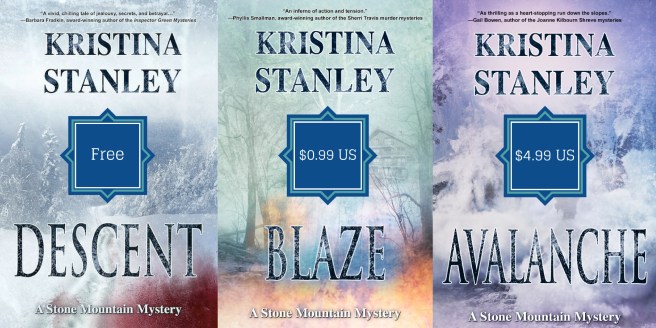
Thanks to Imajin Books for putting DESCENT and BLAZE on sale.  Why not buy yourself a present, curl up, and read.

Just to entice you, here’s a little endorsement for Descent.

In this impressive debut, Kristina Stanley weaves a vivid, chilling tale of jealousy, secrets, and betrayal in a close-knit mountain ski village. Like its likeable young heroine, Kalin Thompson, DESCENT is both tender and tough.” – Barbara Fradkin: author of the Inspector Green Mysteries and two-time winner of the Arthur Ellis Award for Best Novel.

stonemountain-sale

DESCENT shortlisted for the 2014 Arthur Ellis Unhanged Arthur for excellence in crime writing.

When Kalin Thompson is promoted to Director of Security at Stone Mountain Resort, she soon becomes entangled in the high-profile murder investigation of an up-and-coming Olympic-caliber skier. There are more suspects with motives than there are gates on the super-G course, and danger mounts with every turn.

Kalin’s boss orders her to investigate. Her boyfriend wants her to stay safe and let the cops do their job. Torn between loyalty to friends and professional duty, Kalin must look within her isolated community to unearth the killer’s identity.

BLAZE shortlisted for the 2014 Crime Writers’ Association Debut Dagger.

Instead of exchanging vows, Kalin Thompson spends her wedding day running from a forest fire near Stone Mountain Resort, and the pregnant friend trapped with her has just gone into labor. Meanwhile, Kalin’s fiancé, Ben Timlin, hangs from the rafters of a burning building, fighting for his life. Can the situation get any hotter?

When the fire is declared as arson, finding the firebug responsible becomes Kalin’s personal mission. In the course of her investigation as Director of Security, she discovers that some people will go to extreme measures to keep her from exposing their secrets.

Thank you 🙂

Thanks to all my readers who have bought and read the books in the Stone Mountain Series. It’s a wonderful feeling to know others have read my stories.

FEEDBACK: A New App To Turn Your First Draft Into A Great Story

For those of you who’ve been reading my blog and my series called Write Better Fiction, you know I’ve been seriously engaged in creating an automated method to guide me through the rewriting step of the writing process.

I’ve co-founded Feedback Innovations Inc. along with Mathew Stanley and Michael Conn, and together we’re building an app called Feedback-Rewrite Better Fiction.

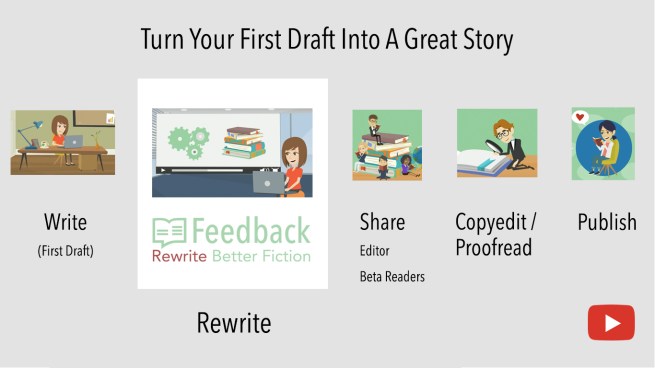
writing-steps-with-video-button

Feedback helps fiction writers turn a first draft into a great story by providing a new, automated approach to rewriting fiction.

With Feedback, writers can quickly evaluate their own work and complete a comprehensive, structural rewrite.

IN THE BEGINNING

Creating Feedback began when I (Kristina) finished the first draft of my first novel. By then I’d read over 50 how-to-write and how-to-self-edit books. I’d taken writing courses and workshops, and had 100s of writing and rewriting tips swirling about in my head.

I knew I had to begin the rewriting process and improve the quality of my draft before sharing my work but I didn’t know how to go about it..

HOW TO REWRITE?

How was I supposed to remember the torrent of advice and apply it to each scene? A spreadsheet, that’s how!

I created a spreadsheet with a chapter-by-chapter, scene-by-scene structure. Then I listed the different writing advice I needed to consider for EVERY scene. I ended up with over 75 “key elements of fiction”. I used the reports from the spreadsheet to visualize my novel.

VALIDATION

After the hard work of self-evaluating and rewriting my drafts, the high quality of my fiction was validated when my first two novels were shortlisted for prestigious crime writing awards and I landed my publisher (Imajin Books).

My first editor said: “If every manuscript was this good, my job would be so easy!”

The next exciting moment came when DESCENT, my first novel, hit #1 on Amazon’s hot new releases. I’ve since sold the German rights to Luzifer-Verlag for publication in Germany. Imajin Books also published BLAZE and AVALANCHE.

THE SEARCH

Along came Michael with MAXWELL HUXLEY’S DEMON and THE RIGHT TURN, and we ran the same spreadsheet on his novels. By this time we’d covered the mystery, horror, and young adult genres.

Surely we weren’t the first authors to struggle with rewriting our first drafts, so we searched for an app to address our problem but found nothing. We did discover that many writers struggled with rewriting drafts and ended up using tools such as spreadsheets, whiteboards, or yellow stickies.

THE IDEA

That’s when it hit us. We thought other writers could benefit from our immediate approach to evaluating and rewriting first drafts.

The excitement was too much for Mathew to sit by and watch, so he decided to get involved. He knows technology and how to run a business.

THE PROTOTYPE

Michael, Mathew, and I worked on the concept and developed the prototype for Feedback

Now, we’d love to hear from you, understand your rewriting issues, and incorporate your ideas into Feedback.

Our goal is to launch Feedback in the spring of 2017. In order to create an app that is truly useful to writers, we’d like your input on building Feedback. By signing up to our newsletter, we’ll send you updates on the development progress and ask you the occasional question to help define the product. As a bonus, we’ll send you rewriting tips available only to our subscribers.

Show your support by helping us spread the word and share this post.

Your support means a lot to us, so thank you!

Mystery Mondays: Debra Purdy Kong on Starting and Sustaining a Series

This week on Mystery Mondays we welcome Debra Purdy Kong. I first came across Debra’s writing when I read Opposite of Dark. I loved the book and reached out to Debra on LinkedIn and was very excited to hear back from her. She’s an author who is generous with her time and her advice, which you’ll get some of below.

As you can imagine, I’m happy to host Debra on Mystery Mondays again.

Starting and Sustaining a Mystery Series by Debra Purdy Kong

Have you started to write a mystery series? With six published books in two series and more in the works, I’ve faced a number of challenges. Hopefully, these five tips will help you start and keep your series on track.

  • Create your protagonist carefully. If you intend to write a lengthy series, do you want to start with a younger character and have her (or him) age a little more with every book, or do you want her to stay static like Agatha Christie’s Miss Marpole? Will your protagonist be complex enough to explore hidden and complex personality traits with each installment? The books in my Casey Holland series cover Casey’s life from ages thirty to forty, which becomes a unique and tumultuous time for her. Based on the feedback I’ve received, readers enjoy following the ups and downs in a protagonist’s personal life.
  • Settings change. I write about Metro Vancouver, where the landscape changes every year. Sure, landmarks like Vancouver’s Stanley Park will always be there, but with infrastructure development (in my case, a new light rapid transit line close to my home in Port Moody), things can look quite different over time. The Port Moody I wrote about in Fatal Encryption eight years ago wasn’t as busy and complex as it is today. If real settings are a crucial part of your story, changes could have an impact on future plots.
  • Pace yourself, and I mean this in two ways. From the get-go, decide how much time will pass between stories. If some of the key characters in your series are children, they’ll grow and change a fair bit from the first to the last book in your series, unless you intend to keep everything static. If you intend to show a passage of time, do you want your main characters to age a few weeks or months between books, or longer?

Secondly, consider pacing yourself as a writer. It’s a good strategy to focus on the first three novels in your series. Once you’re ready to submit your work to publishers, they’ll be happy if you have a long-term plan. Start thinking about the end game early in the process. How would you like to see the series end? How many books might it take to get there? Do you have the discipline and tenacity required to commit to a project that could take years to complete? Now that I’ve started the seventh book and have been working on this series for well over a decade, it’s something I struggle with.

  • To avoid confusion, forgetfulness, and contradictions, keep detailed and accurate records about your series. I use an Excel spread sheet to provide an overview of the entire series. Column one lists the first installment, The Opposite of Dark. Beneath the title, I type the date and time of year the book takes place, Casey’s age, and that of her young ward, Summer. I briefly state the book’s plot and theme. I also note details about the murder. Trust me, it’s far too easy to forget these things over time.

Because my plots blend Casey’s workplace (Mainland Public Transit) with her personal life, I keep a record of every MPT employee mentioned in each book on a second Excel sheet. I like to bring back secondary characters now and then, so it’s important to track when employees appear in the series.

For each book, I maintain a Word document that contains detailed profiles of all main characters, plus those who are only featured in a specific book. The document is copied into every folder I create for each book. New characters are added, along with fresh aspects about ongoing characters. Experiment with recordkeeping ways that work for you.

  • If you’re growing weary of the series, let it go, at least for a while. An author’s best work comes from caring about their characters and plots, and staying solely with the same characters year after year can be tiring. Unless you have deadlines to meet, it’s okay to take a break. I’ve found that launching new writing projects helps stimulate ideas for my Casey series. So, go ahead and stretch your creative wings when you need to. You’ll be surprised at all the good things that can happen.

WHO IS DEBRA?

Promo Photos 009Author of six full-length mysteries, a novella, and over fifty short stories, Debra has won numerous awards for her short fiction. Drawing on her work experiences in security, she’s created transit security cop, Casey Holland in The Opposite of Dark, and campus security cop, Evan Dunstan in her first novella Dead Man Floating When she’s not writing, she’s employed part time at Simon Fraser University and is a facilitator for the Creative Writing program with Port Moody Parks & Recreation. More information about Debra can be found at www.debrapurdykong.com



Just in case you’re as excited to read Debra’s books as I was, here are the links:

oppositeTHE OPPOSITE OF DARK: myBook.to/TheOppositeofDark


Kobo: https://store.kobobooks.com/en-ca/ebook/the-opposite-of-dark-2


fatalencryption

FATAL ENCRYPTION: myBook.to/FatalEncryption

Kobo: http://tinyurl.com/z5sagyl


screen-shot-2016-10-15-at-3-07-25-pmDEAD MAN FLOATING: myBook.to/DEADMANFLOATING

Kobo: https://store.kobobooks.com/en-CA/ebook/dead-man-floating


Farley’s Friday: I Met A Giant

Farley here,

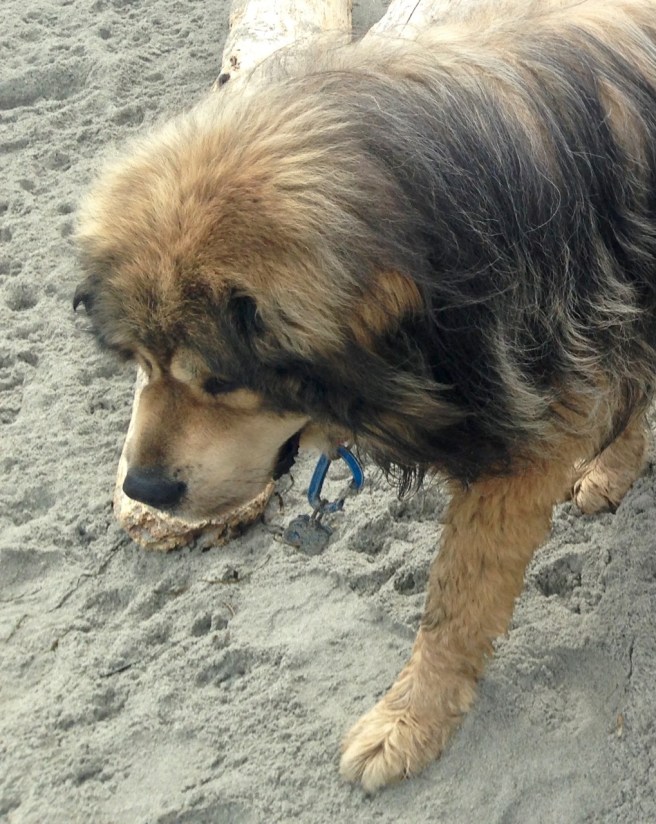
Check out this guy. He’s a Tibetan Mastiff, otherwise known as the giant of dogs. Okay, I made that up, but he was a seriously big dog.

Farley and the giant

I met him at the beach. The same beach I met my sister at last week. I think I’ll start calling it my lucky beach. At first, his size frightened me. I think you can tell by the look on my face. But check out how friendly he looks.

Mastiff

Tibetan Mastiffs are strong-willed, self-reliant dogs who attempt to take control of every situation unless you are an assertive leader who demands respect.

That doesn’t sound like me, does it?  I’m a funny, playful kind of guy. Not exactly the leader who demands respect. But I know how to respect the leader.

My new friend didn’t play much. Too big for that nonsense, but he did let me walk with him. I just had to calm down a little. I can play sophisticated too.

Who knows who I’ll meet next time I’m there?

Woof Woof.

Farley’s Friday: How I Met My Sister

Farley here.

I’m eight years old and for the first time, I met one one my siblings.

I was running along the beach when I saw her. There was something familiar about her, so I ran closer.

Kristina said to Mathew,”Check it out. There’s a Wheaten.”

I bolt even faster. We meet, we greet, we do the usual sniffing.

By this time, my humans have caught up to us. We don’t see many Wheaten Terriers who still have a full tail.

“Where did you get her?” Kristina asked.

“From a breeder near Comox,” the man said.

My heart pounded. I knew something special was about to happen.

Farley and HIs sisterA little more discussion goes on, and we find out we’re sister and brother. I didn’t even know I had a sister. She’s a bit smaller than me and a bit blonder. But don’t you think we look like siblings?

Talk about exciting!

Woof Woof.