
This week on Mystery Mondays we welcome Debra Purdy Kong. I first came across Debra’s writing when I read Opposite of Dark. I loved the book and reached out to Debra on LinkedIn and was very excited to hear back from her. She’s an author who is generous with her time and her advice, which you’ll get some of below.
As you can imagine, I’m happy to host Debra on Mystery Mondays again.
Starting and Sustaining a Mystery Series by Debra Purdy Kong
Have you started to write a mystery series? With six published books in two series and more in the works, I’ve faced a number of challenges. Hopefully, these five tips will help you start and keep your series on track.
- Create your protagonist carefully. If you intend to write a lengthy series, do you want to start with a younger character and have her (or him) age a little more with every book, or do you want her to stay static like Agatha Christie’s Miss Marpole? Will your protagonist be complex enough to explore hidden and complex personality traits with each installment? The books in my Casey Holland series cover Casey’s life from ages thirty to forty, which becomes a unique and tumultuous time for her. Based on the feedback I’ve received, readers enjoy following the ups and downs in a protagonist’s personal life.
- Settings change. I write about Metro Vancouver, where the landscape changes every year. Sure, landmarks like Vancouver’s Stanley Park will always be there, but with infrastructure development (in my case, a new light rapid transit line close to my home in Port Moody), things can look quite different over time. The Port Moody I wrote about in Fatal Encryption eight years ago wasn’t as busy and complex as it is today. If real settings are a crucial part of your story, changes could have an impact on future plots.
- Pace yourself, and I mean this in two ways. From the get-go, decide how much time will pass between stories. If some of the key characters in your series are children, they’ll grow and change a fair bit from the first to the last book in your series, unless you intend to keep everything static. If you intend to show a passage of time, do you want your main characters to age a few weeks or months between books, or longer?
Secondly, consider pacing yourself as a writer. It’s a good strategy to focus on the first three novels in your series. Once you’re ready to submit your work to publishers, they’ll be happy if you have a long-term plan. Start thinking about the end game early in the process. How would you like to see the series end? How many books might it take to get there? Do you have the discipline and tenacity required to commit to a project that could take years to complete? Now that I’ve started the seventh book and have been working on this series for well over a decade, it’s something I struggle with.
- To avoid confusion, forgetfulness, and contradictions, keep detailed and accurate records about your series. I use an Excel spread sheet to provide an overview of the entire series. Column one lists the first installment, The Opposite of Dark. Beneath the title, I type the date and time of year the book takes place, Casey’s age, and that of her young ward, Summer. I briefly state the book’s plot and theme. I also note details about the murder. Trust me, it’s far too easy to forget these things over time.
Because my plots blend Casey’s workplace (Mainland Public Transit) with her personal life, I keep a record of every MPT employee mentioned in each book on a second Excel sheet. I like to bring back secondary characters now and then, so it’s important to track when employees appear in the series.
For each book, I maintain a Word document that contains detailed profiles of all main characters, plus those who are only featured in a specific book. The document is copied into every folder I create for each book. New characters are added, along with fresh aspects about ongoing characters. Experiment with recordkeeping ways that work for you.
- If you’re growing weary of the series, let it go, at least for a while. An author’s best work comes from caring about their characters and plots, and staying solely with the same characters year after year can be tiring. Unless you have deadlines to meet, it’s okay to take a break. I’ve found that launching new writing projects helps stimulate ideas for my Casey series. So, go ahead and stretch your creative wings when you need to. You’ll be surprised at all the good things that can happen.
WHO IS DEBRA?
 Author of six full-length mysteries, a novella, and over fifty short stories, Debra has won numerous awards for her short fiction. Drawing on her work experiences in security, she’s created transit security cop, Casey Holland in The Opposite of Dark, and campus security cop, Evan Dunstan in her first novella Dead Man Floating When she’s not writing, she’s employed part time at Simon Fraser University and is a facilitator for the Creative Writing program with Port Moody Parks & Recreation. More information about Debra can be found at www.debrapurdykong.com
Just in case you’re as excited to read Debra’s books as I was, here are the links:
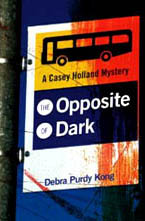 THE OPPOSITE OF DARK: myBook.to/TheOppositeofDark
Kobo: https://store.kobobooks.com/en-ca/ebook/the-opposite-of-dark-2

FATAL ENCRYPTION: myBook.to/FatalEncryption
Kobo: http://tinyurl.com/z5sagyl
 DEAD MAN FLOATING: myBook.to/DEADMANFLOATING
Kobo: https://store.kobobooks.com/en-CA/ebook/dead-man-floating




 A little more discussion goes on, and we find out we’re sister and brother. I didn’t even know I had a sister. She’s a bit smaller than me and a bit blonder. But don’t you think we look like siblings?
 Twelve-year-old Amanda Ross finds herself on an elegant riverboat with her bestie, Leah, cruising down the beautiful Danube, passing medieval castles, luscious green valleys and charming villages. When she is entrusted with a valuable violin by a young, homeless musician during a stop in Germany, a mean boy immediately attempts to take it from her.
 Darlene Foster was brought up on a ranch in southern Alberta, Canada, where she dreamt of writing, travelling the world and meeting interesting people. Following her dreams, she’s now an award-winning author of the exciting Amanda Travels series featuring spunky 12-year-old Amanda Ross who has adventures in unique places.Her books include Amanda in Arabia – The Perfume Flask, Amanda in Spain – The Girl in The Painting, Amanda in England – The Missing Novel and Amanda in Alberta – The Writing on the Stone. Readers of all ages enjoy travelling with Amanda as she unravels one mystery after another. She is also the author of a bi-lingual book, Pig on Trial/Cerdito a juicio. Darlene divides her time between the west coast of Canada and the Costa Blanca, in Spain. She believes everyone is capable of making their dreams come true.
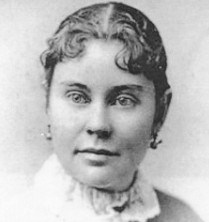 who was arrested, tried and then declared not guilty of murdering her father and stepmother in August, 1892.
 For entertainment, sheet music was big with families playing and gathering around the piano. Most everyone knew the words or the tune to songs like Daisy Bell (A Bicycle Built for Two), a big hit in 1892. And it still is a fun song, reminiscent of a much sweeter age, isn’t it?



 Since 2004 Garry Ryan has published nine novels with NeWest Press. The second, The Lucky Elephant Restaurant, won a 2007 Lambda Literary Award. In 2009, Ryan was awarded Calgary’s Freedom of Expression Award.

