Write Better Fiction: Scene Word Count

Today on Write Better Fiction we’ll cover Scene Word Count. Write Better Fiction is a process to help you critique your own manuscript and give yourself feedback. This will help you improve your novel, so you’re ready to submit it to an editor.

When writing genre fiction you should know the length of the novel that is acceptable for your genre, but what about words per scene?

Do you think word count per scene is important?

I do, and here’s why.

Word count per scene is the number of words in a scene. A scene or several scenes will make up a chapter, the chapters get you to the novel. I know, obvious, right? But how can you analyze your word count to improve your novel?

Same number of words per scene: An author may choose to write scenes that are all a similar length. Let’s say 1800 to 2200. They create a novel in this format, then they acquire readers, and the readers come to expect the flow a similar word count per scene would generate. It might be risky for the author to change once she has established a following for her style.

Variable Number of Words Per Scene: In theory, you could have a scene as short at one work and as long as the entire novel. These are extremes of course.

Potential pitfalls with word count:

One long scene: You write a novel with scenes that range from one paragraph in length to 1200 words, but you have one scene that is 2500 words. When the reader gets to this scene, he is going to wonder why so much time has been allocated to the scene. Either the author didn’t notice one scene was way too long, or he did on purpose because something very important is happening in the scene.

My spreadsheet has a column for scene word count. I then have Excel graph the scene lengths.  I have a quick look for anything that stands out as unusual and ask myself why I wrote the scene this way. This graph would extend to the number of chapters in the novel.

Screen Shot 2016-05-15 at 5.53.30 PM

What Stands Out?

Chap 2: The first scene in only 50 words long. This is very short compared to the other scenes in the novel.

Is it too short compared to the rest of the scenes? In this case, am I trying to create an effect of shock, or fast pace, or intrigue?

Chap 3: This chapter only has two scenes where every other chapter in the novel has three scenes.

Was this done on purpose? Was it a mistake? Ask yourself what you’re trying to achieve by the number of scenes in a chapter. You could also create this graph on a per chapter basis and ask yourself the same questions as per on a chapter basis.

Chap 4:  This scene is 2500 words long. The graph shows you it’s out of balance with the other scenes in the novel.

Is a scene too long compared to others? In this case, I must ask what is so special about this scene. If nothing, then I’ll consider breaking the scene into two or more scenes.

This type of analysis is done when an author has finished her first draft. It’s a bird’s eye view of the structure and allows her to check the pacing and flow of her story.

I critiqued DESCENT, BLAZE and AVALANCHE using the techniques I’m sharing in Write Better Fiction, and I believe this helped me sign with a publisher. And speaking of publishers, Imajin Books has released  AVALANCHE for pre-order at $0.99 USD for a limited time. This way, my readers get a little gift of a sale price before the novel is released.

Please let me know in the comments below if you examine your word count by scene and why you do this?

Thanks for reading…

Helping Authors Earn A Living

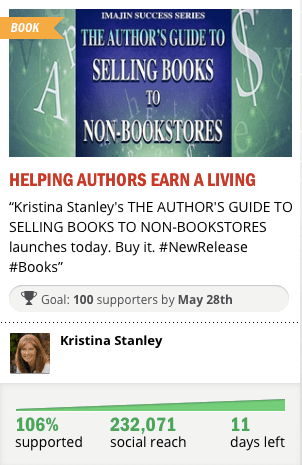
Helping authors earn a living is the tag line I used for the Thunderclap.it  campaign I created for THE AUTHOR’S GUIDE TO SELLING BOOKS TO NON-BOOKSTORES.

I’d love to have your help in spreading the word for my first non-fiction book. It’s easy. All you have to do is click the link below. Thunderclap.it will take you to a page where you can support the campaign by choosing FaceBook, Twitter, or Tumbler.

If you do…It means one post will go out on May 28th on your platform of choice. You won’t receive any spam or other messages. You don’t have to buy book.

This could be your way of helping authors earn a living, but helping me -an author 🙂 – spread the word about my next book.

The Thunderclap.it campaign is live for another 11 days at http://bit.ly/KSAuthor

Screen Shot 2016-05-17 at 7.08.11 AM

Thunderclap.it is a crowdspeaking platform that helps people be heard by saying something together. It allows a single message to be mass-shared, flash mob-style, so it rises above the noise of your social networks. By boosting the signal at the same time, Thunderclap helps a single person create action and change like never before.

On a side note, THE AUTHOR’S GUIDE TO SELLING BOOKS TO NON-BOOKSTORES is on sale for a limited time at $0.99 USD.

Thanks for reading…

Update Tuesday PM: 2 more people have joined the campaign, and I’m up to 108 people.  Thank you! I’m at 233,999 reach…That’s one short of 234,000. You could be the one to bump me up at bit 🙂


Mystery Mondays: Judy Alter on Instincts and Writing

Mystery Mondays is back with Judy Alter, author of Kelly O’Connell Mysteries and Blue Plate Café Mysteries, is here to discuss writing instincts? Let us know in the comments hor you use your instincts when writing.

Listen to your instincts

by Judy Alter
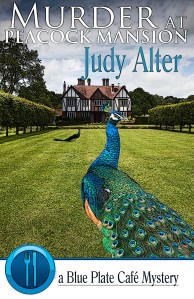
rev2-MurderatPeacock-JAlter-LG_edited-1The writer’s world today is filled with advice for using computer programs to track your characters, follow the time elapsed in your WIP, keep track of plot episodes, and even plot. I don’t use a one of them. Partly because I fear a steep learning curve but more because I am not only a pantser but what you might call an unstructured writer. I simply sit down and write. Somewhere along the way I may make a list of characters—helpful in book five to go back to the book two list and see what that guy’s name really was (I once wrote a children’s three-book series in which Jeb was featured in the first two but became Josh in the third. “Who’s Josh?” my editor wrote). I generally have a loose idea of where the novel is going, but then a character surprises me, or an idea comes out of the blue, and the whole thing changes course. That’s why I hate having to write a synopsis until the book is finished.

I’m not sure I believe writing is a precise craft. I think it’s an important art in which the words should flow as they come to you, rather than you getting them from a spreadsheet or folder of incidents. I remember Erma Bombeck writing that she’d rather scrub floors than face an empty computer screen (or was it a typewriter page in her day?). I’m sure artists feel the same way about a blank canvas, but few paint by numbers.

Old wisdom says “Listen to your characters, and they’ll tell you what’s going to happen.” I know few successful writers who don’t adhere to that maxim. Sometimes it may surprise you; sometimes, as it recently did with me, it may require rewriting whole sections—or a whole book. Sometimes a minor character will try to take over a book—let him or her. They were probably meant to be more prominent. My favorite example is not a mystery: it’s the award-winning The Wolf and the Buffalo, by the late Texas novelist Elmer Kelton. Kelton started out to write about a buffalo soldier—a recently freed slave who joins the army and is sent to Texas. But a Comanche chief kept intruding on the story, and Elmer couldn’t quiet him. The book turned out to be equally about them—the chief representing a dying culture, the buffalo soldier representing new opportunity.

I once sat at a stop sign, looked at the house katty-corner from me, and thought, “There’s a skeleton in a dead space in that house.” And that was the birth of my novel, Skeleton in a Dead Space. Another time I was three-quarters of the way through a novel, and I still didn’t know who the bad guy was. One day it came to me—and I had to go back and write him more prominently into early parts of the story.

One more example: I was working on a novel tentatively titled Murder at the Mansion, a title I found very ordinary though I was pleased with the way the novel was progressing. One day as the protagonists drove onto the mansion grounds, suddenly there was a peacock. The whole flock of peacocks became central to the plot, and the title was Murder at Peacock Mansion. A whole lot more interesting, and it led to a gorgeous cover, one of my all-time favorites.

This is unconventional writing advice, and I recognize it. It may also be why I’m not a best-selling author. But it works for me.


Judy’s Bio:

judyAn award-winning novelist, Judy Alter is the author of six books in the Kelly O’Connell Mysteries series: Skeleton in a Dead Space, No Neighborhood for Old Women, Trouble in a Big Box, Danger Comes Home, Deception in Strange Places, and Desperate for Death. She also writes the Blue Plate Café Mysteries—Murder at the Blue Plate Café, Murder at the Tremont House and the current

Murder at Peacock Mansion. Finally, with the 2014 The Perfect Coed, she introduced the Oak Grove Mysteries.

She is also the author of several fictional biographies of women of the American West, including Libby Custer, Jessie Frémont, Wild West Show roper Lucille Mulhall, pioneer physician Georgia Arbuckle Fix (in Mattie), and Etta Place of the Hole in the Wall Gang. Her latest book, just released, is The Gilded Cage, set in late nineteenth-century Chicago.

Her work has been recognized with awards from the Western Writers of America, the Texas Institute of Letters, and the National Cowboy Museum and Hall of Fame. She has been honored with the Owen Wister Award for Lifetime Achievement by WWA and inducted into the Texas Literary Hall of Fame and the WWA Hall of Fame.

Judy is retired as director of TCU Press, the mother of four grown children and the grandmother of seven. She and her dog, Sophie, live in Fort Worth, Texas.

And on to a oten about Sleuthing Women:
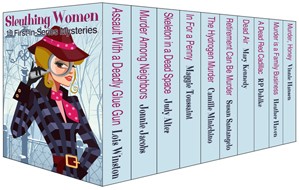
Sleuthing WomenSleuthing Women is a boxed set of ten, first-in-a-series books by ten different authors. It offers readers a chance to meet ten authors they may not have discovered before and to read over 3,000 pages of murder and mayhem—all for the low price of $2.99. The set launched May 1. Award-winning novelist Lois Winston (the Anastasia Pollack Crafting Mysteries came up with the idea not only as a way to introduce readers to new voices but also as a way to attract new readers for fellow authors. She figured if a reader was hooked on the first book, he or she might well want to explore additional books in the series. Each series represented has at least three titles.

I’m delighted that Lois included my first published mystery, Skeleton in a Dead Space. It introduced Kelly O’Connell Mysteries, and there are now six books in the series. Each takes place in the Historical Fairmount District of Fort Worth, Texas, where Kelly O’Connell is a realtor and renovator of Craftsman house, a single mother of two, and the ex-wife of someone she decides she never really new. A skeleton, an unsolved old murder, vandalism, and a new murder plunge Kelly into the amateur sleuth role in spite of the stern warnings of Neighborhood Police Officer Mike Shandy. I had fun writing it, and I hope readers have fun reading it.

Other authors and titles in the set include:

Assault with a Deadly Glue Gun, an Anastasia Pollack Crafting Mystery by Lois Winston—Working mom Anastasia is clueless about her husband’s gambling addiction until he permanently cashes in his chips and her comfortable middle-class life craps out. He leaves her with staggering debt, his communist mother, and a loan shark demanding $50,000. Then she’s accused of murder…

Murder among Neighbors a Kate Austen Suburban Mystery by Jonnie Jacobs — When Kate Austen’s socialite neighbor, Pepper Livingston, is murdered, Kate becomes involved in a sea of steamy secrets that bring her face to face with shocking truths—and handsome detective Michael Stone.

In for a Penny, a Cleopatra Jones Mystery by Maggie Toussaint—Accountant Cleo faces an unwanted hazard when her golf ball lands on a dead banker. The cops think her BFF shot him, so Cleo sets out to prove them wrong. She ventures into the dating world, wrangles her teens, adopts the victim’s dog, and tries to rein in her mom…until the killer puts a target on Cleo’s back.


Farley’s Friday: A Special Announcement

Farley here,

My friend, Joan Y. Edwards, is having a special day.

As you know, I’m getting older. I’m almost 8 now, and that’s a lot in dog years. Kristina will take care of me as I get older, but humans need care too. So, Joan has written a guide about caring for the elderly, and I think it might help my human friends.

Screen Shot 2016-05-12 at 9.25.36 AMToday, Joan’s book, JOAN’S ELDER CARE GUIDE, is available.

Joan asked me to help spread the word, and how could I not? She’s been following Farley’s Friday for years, and always has  a word of encouragement for me.

So here I am, wagging my tail in encouragement at Joan.

Go, Joan, Go.

What’s her book about…

Joan’s Elder Care Guide: Empowering You and Your Elder to Survive gives you, the caregiver, ways to meet your physical, mental, emotional, spiritual, and social needs and those of your elder to promote healing, well-being, and survival. Based on the author’s research and fourteen years of experience caring for her mother, this book provides many resources to find the right place for your elder to live, explains ways to improve communication to help find solutions to problems, and gives organization ideas for medical, financial, insurance, and legal documents.

It offers ways for a caregiver to get time away from caregiving responsibilities and contains information substitute caregivers must have to keep their elders safe. Along with all this, the book explains the signs of the end of life, ways to celebrate an elder’s life, and gives duties of an executor of an estate. It also includes ten useful charts to assist in assessing and recording an elder’s needs and capabilities.

Woof Woof.

BOOM. How To Create A Successful Thunderclap Campaign

As I move through my publishing journey, I’m trying new ways to make my work visible, and I’m sharing what I try with you. THE AUTHOR’S GUIDE TO SELLING BOOKS TO NON-BOOKSTORES is my first non-fiction book, and probably needs a different marketing strategy than my novels.

My latest venture is with Thunderclap.

Thunderclap is a crowdspeaking platform that helps people be heard by saying something together. It allows a single message to be mass-shared, flash mob-style, so it rises above the noise of your social networks. By boosting the signal at the same time, Thunderclap helps a single person create action and change like never before.

The first step in creating a Thunderclap campaign is creating an account. Just follow the instructions. I supported various campaigns, so I understood what it meant to ask others to support my campaign.  It’s easy and not intrusive in any way.

I discovered that by supporting a campaign one post went out on my facebook account as a specified time. You can also support campaigns on Twitter and Tumbler or on all three platforms.

The second step is to create your campaign. I searched through the successful campaigns for non-fiction books and studied how to create a campaign.

Here’s mine.

Screen Shot 2016-05-12 at 9.32.30 AM

The third step is to get 100 people to support your campaign. Once that’s done. Your message will go live on the date you specified. If you don’t get at least 100 people to support your campaign, then no message will be posted and you won’t get the visibility you were striving for.

To get 100 people takes a bit of work. I went through my list of contacts and chose 150 people who I thought would support my campaign. I sent them a personal message asking for help. It took me just under a week to hit 100.

I’m posting today because yesterday I reached the 100 mark. My campaign is successful and one message will be sent on May 28th on the networks of everyone who has supported me.

Right now, my reach is just under 225,000 people. I would love to reach 500,000 people.

To support my campaign, just click here.

Let me know if you try a Thunderclap campaign, and I’ll be sure to support it.

Thank you to everyone who has already supported this new venture.

Thanks for reading…


Write Better Fiction: Point Of View

Today on Write Better Fiction we’ll cover Point Of View. Write Better Fiction is a process to help you critique your own manuscript and give yourself feedback. This will help you improve your novel, so you’re ready to submit it to an editor.

What is Point of View?

I use the Point Of View (POV) in many of my spreadsheet columns and have been asked to describe what POV is.

POV is the perspective the story is told from. There are three main types of POV.

  • Omniscient
  • First Person
  • Third Person

There is also second person, but this doesn’t seem to be used much in commercial fiction, so I won’t spend any time on it.

OMNISCIENT is when the narrator of the story knows all. The narrator can get into the head of any character to drive the story forward.

An excellent of a novel written in omniscient POV is the Da Vinci Code by Dan Brown. One way to determine this is to notice that the narrator provides information that the characters are unaware of.

FIRST PERSON means the narrator is speaking directly to the reader. This comes in the form of ‘I’.

Janet Evanovich writes the Stephanie Plum novels in first person. Often, near the beginning, she’ll write something like: My name is Stephanie Plum. I work as a bond enforcer…

THIRD PERSON is written from the he said / she said narration.

Of course, I have to mention my novels for third person point of view narration. I wrote  DESCENTBLAZE,  and AVALANCHE in third person. I like to change points of view and get into the heads of more than one character, so this style suits me.

My favorite book on point of view is The Power Of Point Of View: Make Your Story Come To Life by Alicia Rasley. If you want an in-depth description of all the points of view and their variations, this is a great book to read.

Please let me know in the comments below if you have any thoughts on POV. What form do you write in and why?

Thanks for reading…

Mystery Mondays: Darlene Foster on Location of a Novel

As we continue our journey through Mystery Mondays writing advice, Darlene Foster is here to talk to us about location. Just check out the titles of the four books below, and you’ll see why she chose this topic.

Location, Location, Location

by Darlene Foster

AmandaBooks


Jane Austen gave us English country villages, Charles Dickens took us along the streets of Victorian London, and Lucy Maude Montgomery made us fall in love with Prince Edward Island. The location of many well-known works of fiction are an important element to each story. Think of one of your favourite novels and I am sure a vision of a place comes to mind.

Real estate agents declare the three most important things to selling a property are – location, location, location. The same applies to writing a story. It doesn´t have to be a real place. In fantasy, writers create worlds of their own. But it still should feel real. The reader should be able to picture the place and to feel they are there with the characters, in order to hold their attention.

A skilled author does this by using all the senses and by weaving action and dialogue within the description. Today’s readers no longer like large chunks of description. Young people in particular are used to a faster pace and get bored by description quickly.


Amandaonthe Danube
To Be Released Oct 1, 2016


In my Amanda adventure novels, I start with a location and create a story around it. This may not work for every writer but it works well for me. Initially, I wanted children to read about places I had visited that they may not know much about. After writing pages of detailed description, I came to the conclusion that what I wrote was totally boring and kids wouldn’t read it. I started to think about what a twelve-year-old would notice and how she would feel in that location. Then I created a main character and a mystery for her to solve. The adventure developed naturally from there. I continue to use the same main character, but the location changes in each novel of the series.

I have learned to pare down descriptions and write about the location using all five senses. I want the readers to feel the heat as Amanda crosses the desert on a camel, experience the fear as she is being chased through Gaudi´s buildings in Barcelona, smell the musty underground tunnel at Windsor castle and taste the sweet gingerbread in Nuremberg.

One of the best compliments I received was from a reader who used to live in the United Arab Emirates. After she read Amanda in Arabia – The Perfume Flask, she told me she felt like she was back home. That is what keeps this writer writing!

Whether I am out for a walk or travelling, I take many pictures, not just of regular tourist sites but of unique things that kids would find interesting. I keep my photo albums close at hand to refer to while I’m writing. They provide me with great ideas and a visual to help with descriptions.

As a writer, I am constantly on the lookout for the perfect location, location, location.

Darlene’s Bio:

th

Brought up on a ranch in southern Alberta, Darlene Foster dreamt of travelling the world, meeting interesting people and writing novels. She is the author of the exciting adventure series featuring spunky 12-year-old Amanda Ross who loves to travel to unique places. Her books include: Amanda in Arabia – The Perfume Flask, Amanda in Spain – The Girl in The Painting, Amanda in England – The Missing Novel and Amanda in Alberta – The Writing on the Stone. Readers of all ages enjoy travelling with Amanda as she unravels one mystery after another. Darlene and her husband divide their time between the west coast of Canada and Orihuela Costa, in Spain. She believes everyone is capable of making their dreams come true.

The fifth book in the series, Amanda on The Danube – The Sounds of Music, will be available October 1, 2016

To find out more about Darlene…


Farley’s Friday: Animals in Need

Farley here.

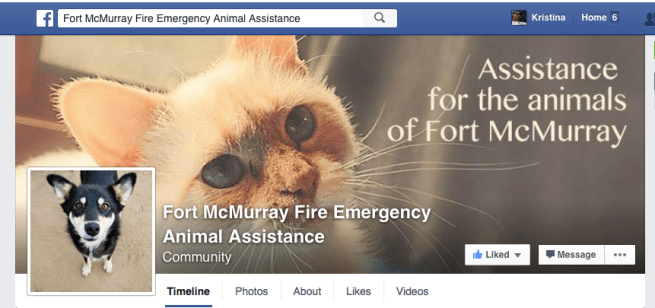
Today I’m worrying about all the humans who have been separated from their pets and all the pets separated from their humans because of the fire in Fort McMurray.

If you haven’t heard, there is a great facebook site connecting people with their pets.

If you’ve lost a pet or found a pet, this is the place to list it. There are cats, dogs, donkeys, horses and even a dragon.

Here’s the link: https://www.facebook.com/Fort-McMurray-Fire-Emergency-Animal-Assistance-1585681045093011/
Thank you to all the wonderful people looking after the animals.

Screen Shot 2016-05-06 at 9.16.26 AM

Woof Woof.

Mystery Mondays: A Year of Advice

I can’t believe one year is coming up since the first Mystery Monday post.

It’s been a year of collecting great writing advice. So as a thank you to all my readers, I’ve created a book containing the advice from more than 30 of the author that I’ll give away starting June 20th, 2016.

The contributing authors have all given consent that their advice can be included in the book. They will retain all rights to their work. But they have generously allowed me to compile it into a book.

It’s with great excitement that I show you the cover today.

Screen Shot 2016-05-05 at 2.24.17 PM

I’ll be starting a newsletter, and for those who sign up the book is yours. I plan to create both a PDF and Mobi format. This is a learning experience, so bear with me as I try this out. All contributing authors will receive a copy directly from me.

Next, I just have to  figure out how to use  MailChimp and how to create a newsletter…

Thank you to all how have been reading and commenting, and thank you to the contributing authors.

Write Better Fiction: Avoid Repetitive Scene Openings

Today on Write Better Fiction we’ll cover Scene Entry Types. Write Better Fiction is a process to help you critique your own manuscript and give yourself feedback. This will help you improve your novel, so you’re ready to submit it to an editor.

Over the last few weeks, we covered scene entry, scene middle, and exit hooks. I’d like to back up a bit and look at scene entries again.

My husband was my first beta reader, and he read the first draft of the first novel I wrote. As it turns out, that novel is AVALANCHE, to be published this spring by Imajin Books.

His first comment to me, and I was a little crushed, was:

“Do you know you start every scene with a character in a doorway?”

I was expecting, “I love this book,” not actual critique. Well, I’ve since toughened up and have realized critique is much more helpful than unwarranted praise if you’re trying to write better. His comment drove me to figure out how to vary scene openings.

As you know, I use a spreadsheet to self-edit my novels.

I have a column called entry type. The choices are:

  • Dialogue
  • Thought
  • Narrative
  • Action

If you have other categories, please let me know in the comments below.

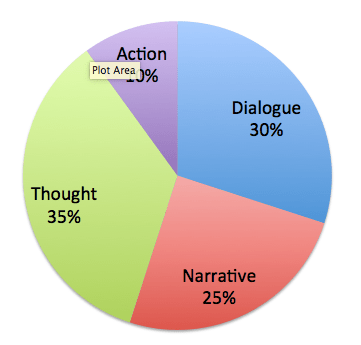
Once I’ve filled out my spreadsheet, I create a pie chart to see if my novel is balanced.

Screen Shot 2016-05-02 at 10.00.51 AM


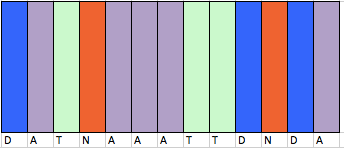
Then I create a graph, to check if I’ve start the scenes in a variety of ways and didn’t get stuck in a pattern.

Screen Shot 2016-05-02 at 2.11.27 PM


D is dialogue

A is action

T is thought

N is narrative.

The idea is to ensure I haven’t started too many scenes in a row in the same way. If I have, I go back and revise the scenes, looking for a different way to write the opening. I don’t want to bore a reader by getting into a pattern.

I critiqued DESCENT, BLAZE and AVALANCHE using the techniques I’m sharing in Write Better Fiction, and I believe this helped me sign with a publisher.

Please let me know in the comments below if you have any suggestions how to check for repetitive scene entries?

Thanks for reading…