Mystery Mondays: Lisa de Nikolits on The Writer’s Seeing Eye

BTCSF_FrontCoverLisa de Nikolits sat in front of me at The Bloody Words conference, and what I remember is her great bit smile. This week, I’d like to welcome this very friendly and talented author to Mystery Mondays. Lisa’s going to tell you about the Writer’s Seeing Eye.

THE WRITER’S SEEING EYE by Lisa de Nikolits

 Ideas for crime novels. Where do they come from? 

“We need to watch another episode of Forensic Files,” I said to my husband. 

“It’s 2 a.m. on Christmas Day,” he replied, “We need to get some sleep so we can enjoy Christmas.”

“Ah, just one more,” I encouraged him. “It’s all research for me and I’ll make you a fresh cup of tea. Just one more!”

Research? 

That’s what I tell myself anyway. 

And it’s true that I have learned a lot about ethylene glycol and ketotic hyperglycinemia, blood spatter, fingerprint analysis, handwriting analysis, the ever-famous DNA, toolmarkings and ballistic analysis.

While the things those guys can do is just mind-blowingly amazing, two things struck me with this program. The first is how stupid some people are, when it comes to committing a crime. Most of the time they leave behind a trail of evidence that is nearly a paint-by-numbers for the detectives to solve. 

And the second thing is the impulsivity of the crimes, which occur on the spur of the moment. 

While I am full of admiration for Forensic Files, when it comes to novels, things are very different. Readers have very little patience with stupid protagonists and they are very quick to spot any story inconsistencies or things that might not ring true in the flow of a crime committed. 

In real life, how many times you have found yourself staying “real life really is stranger than fiction” and it is stranger because it’s not reasoned out in the same way that we plot books, real life crime just happens and then people try to mop up the mess and sometimes they succeed and sometimes they don’t. 

My ideas for the crime in my novels comes from flights of my imagination. The big ‘what if?’

For example, my husband and I got confused while taking a ferry back from Sydney to Cremorne Point – he got off while I didn’t and in that nano-second, I was convinced that he had fallen into the black water of the Sydney harbor and drowned. 

He was fine, of course he was, he had got off while I had been photographing something and there was nothing to it. 

But my writer’s seeing eye saw him being ushered off the boat, with a gun tucked under his armpit, and a gothic anarchist girl leading him away. I saw that a human trafficking gang had confused him with his doppelganger, and that an innocuous picture that he had posted on Instagram had caused all the confusion. I saw that my husband’s niece was involved in the kidnapping, and that she was being haunted by the ghost of a woman who had been locked up in an insane asylum. 

None of which could have come from Forensic Files or crime stories from real life, but that said, nothing is going to stop me from watching my favourite program – all for ‘research’ of course!

Bio

WhiteShirtBioPicLisa de Nikolits is the author of five novels: The Hungry MirrorWest of Wawa, A Glittering ChaosThe Witchdoctor’s Bones and Between The Cracks She FellBetween The Cracks She Fell was reviewed by the Quill & Quire and on recommended reading lists for Open Book Toronto and 49th Shelf. Canadian Living magazine called it ‘a must-read book of 2015’. 

Lisa has also been published in various anthologies and journals including Postscripts To Darkness, Volume 6, 2015, Thirteen O’ClockMaud.Lin House, the Canada Woman Studies Journal, Hood and the Jellyfish Review.


Links:

www.lisadenikolitswriter.com 

twitter: @lisadenikolits

www.facebook.com/lisa.denikolits

https://www.facebook.com/lisadenikolitsauthor

http://www.goodreads.com

http://pinterest.com/lisadenikolits/

LinkedIn: http://linkd.in/1r8H9Df

Instagram: http://www.instagram.com @lisadenikolits

Wattpad: https://www.wattpad.com/user/LisadeNikolits

The Mesdames of Mayhem: http://mesdamesofmayhem.com/about/

Crime Writers’ Association Interviews Kristina Stanley

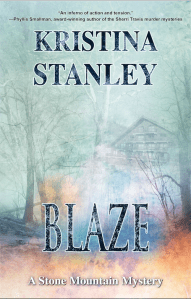
I had the honour of being interviewed by Kate White, Head of Press, at the Crime Writers’ Association about my experience having BLAZE shortlisted for the Debut Dagger in 2014. Here’s the kickoff to the interview.

If you’re just starting out and haven’t published yet, The Debut Dagger is a great way to garner interest in your novel. Be brave and submit. You just never know where it will lead.

REBLOGGED FROM THE CRIME WRITERS’ ASSOCIATION LATEST NEWS

AV1DEBUT DAGGER TIPS: KRISTINA STANLEY

3/02/2016 by The CWA 1

Prepare to be deeply jealous when you find out the circumstances in which Kristina Stanley penned her Debut Dagger shortlisted novel, Blaze. However, despite a deeply glamourous writing story, the Canadian newcomer faced the same struggle as all other would-be authors as she approached getting published. Here Kristina explains how getting on the Debut Dagger shortlist changed everything, and why she thinks it’s a brilliant gateway for writers to get their work noticed.

What made you decide to enter Blaze in for the 2014 Debut Dagger competition?

… For the complete interview see The Crime Writers Association Latest News.

***

If you’d like to check out DESCENT or BLAZE the links are below:

myBook.to/Descent

When Kalin Thompson is promoted to Director of Security at Stone Mountain Resort, she soon becomes entangled in the high-profile murder investigation of an up-and-coming Olympic-caliber skier. There are more suspects with motives than there are gates on the super-G course, and danger mounts with every turn.

myBook.to/BLAZEbyKristinaStanley

Instead of exchanging vows, Kalin Thompson spends her wedding day running from a forest fire near Stone Mountain Resort, and the pregnant friend trapped with her has just gone into labor. Meanwhile, Kalin’s fiancé, Ben Timlin, hangs from the rafters of a burning building, fighting for his life. Can the situation get any hotter?

Thanks for reading…

Farley’s Friday: A Dog Goes To Work

Farley here,

Did you know when humans go to work, they are very distracted? I went to my human’s office, and he stared at a screen, talked to people and did some other things I didn’t understand.

I have a bed, a water bowl and random strangers pet my head and gave me dog treats. That part was great.

I was good all day, really I was, but by four o’clock it was time to go outside. I don’t think my human can tell time, or he’d know it was time.

Farley at Work

I put my head on his knee and with my eyes, I said to him, “Can you not see the sun shining? Let’s go for a walk. I’ll show you the park next door.”

And guess what, he took me outside. What a guy.

Woof Woof

Thrilling Review of BLAZE On Writers Who Kill

REBLOGGED FROM WRITERS WHO KILL

An Interview with Kristina Stanley by E. B. Davis 

Instead of exchanging wedding vows in front of friends and family,

Kalin Thompson prepared her home for evacuation.

–Kristina Stanley, Blaze (Kindle loc. 35)

BLAZE CoverAfter the first six months of interviewing authors here on WWK, I realized that an interview, in and of itself, was an endorsement. So, when I agree to read and interview authors, I now do so with the condition that I like what I read unless I’m already a fan. It was a condition that I gave to Kristina Stanley because I was unfamiliar with her writing. What I found, after being hooked by the first sentence, which I’ve quoted above, was a primer on how to write a novel. I turned the page to the second chapter and realized she’d hooked me right from the start…


For the full review and interview checkout Writers Who Kill

A little about E.B. Davis who wrote the review and asked the interview questions:

 A writer and beach bum of note, E. B. Davis writes short stories and novels in the mystery and paranormal mystery genres. Ms. Davis graduated from George Washington University with a Masters Degree from the Elliot School of International Service, and continued degrading her writing skills working as a government contractor. 

Write Better Fiction: The Antagonist

Feedback icon
Self Critique Your Novel


Today on Write Better Fiction we’ll cover the Antagonist. Write Better Fiction is a process to help you critique your own manuscript and give yourself feedback. This will help you improve your novel, so you’re ready to submit it to an editor. Check the bottom of this post for links to previous Write Better Fiction articles.

This is similar to last week’s post except you are looking at when your antagonist shows up in your novel instead of the protagonist.

The antagonist should show up early and be visible throughout the novel. This doesn’t mean they can’t disappear for a while, but controlling the appearances will give you power to create the most tension.

The antagonist may or may not have the point of view in any scene. That’s a choice for you to make. In the thriller genre you may be pitting your protagonist against the antagonist, so you’ll want to give both point of view scenes.

In a mystery, you may choose NOT to write any scenes from your antagonist’s point of view so you don’t have to give away inner thoughts.

The goal of this column is to have you look at how early the antagonist arrives in your novel, how many scenes he/she appear in, and most importantly, is he/she in the climax scene.

Same as last week, sort the spreadsheet by the antagonist column. Are you giving your antagonist enough time for the reader to be surprised but not blindsided that he/she is the villain?

Your challenge this week is to count the number of scenes your antagonist is in. Does this seem balanced compared to the number of scenes your protagonist is in?

Previous blog posts on Write Better Fiction:

  • Number 1 Question to ask yourself about PLOT
  • Number 1 Question to ask yourself about CHARACTER
  • Number 1 Questions to ask yourself about SETTING.
  • ACTION in a scene
  • NAME of a scene
  • GOAL of point of view character
  • The PROTAGONIST

I critiqued DESCENT and BLAZE using the techniques I’m sharing in Write Better Fiction, and I believe this helped me sign with a publisher.

Please me know in the comments below if you agree with the advice on counting scenes for your antagonist? Does the genre impact if the antagonist has a point of view scene?

Thanks for reading…

Mystery Mondays M.H. Callway on NaNoWriMo

Mystery Mondays welcomes M.H. Callway to talk about riding NaNoWriMo Tiger.

If you don’t know what NaNoWriMo is: read on!

I know M.H. Callway as Madeleine. We met online through other authors. Madeline has a special place here as she provided an endorsement for my second novel, BLAZE. It’s difficult to ask another author for an endorsement and Madeleine said yes right away. Her generosity with her time and thoughtfulness in writing an endorsement has pushed my writing career along.

So please help me welcome M.H Callway.

RIDING THE NANOWRIMO TIGER by M.H. Callway

Many thanks to Kristina for inviting me to her blog! I’m delighted to be here.  Today I want to share with you my experiences doing last November’s National Novel Writing Month or NaNoWriMo.

Print

My friend and fellow author, TO Poet, encouraged me to join him and his friends for this 50,000 word marathon adventure. He has ridden the NaNoWriMo tiger no less than six years running.

So I jumped in feet first with little – well, let’s be honest – no preparation!


What is National Novel Writing Month?

November is pretty dull so every year hundreds of thousands of authors around the globe try to write 50,000 words to fill up the 30 days. Chris Baty and 21 of his writer friends came up with the idea in San Francisco more than 15 years ago. Thanks to the internet, participation has since gone viral. In 2015, writers located as far away as central Russia and Micronesia took part. No restrictions, no writing experience necessary.

How did y’all keep going? 

TO Poet set up a Facebook page for our team, the NaNoWriMo Misfits.  He kept us inspired with daily posts and we logged on to report our progress. Peer pressure proved to be a compelling motivator for me.

And coffee. Lots and lots of coffee.  TO Poet’s coffee mugs rival goldfish bowls.

Why embark on this marathon?

Like most newly published authors, I’d spent the past 12 months promoting my debut novel, Windigo Fire,  through conferences, meet-ups, bookstores and libraries. On my own or with our group, The Mesdames of Mayhem, I literally did hundreds of events. I needed to do get back to work on the second novel in my Danny Bluestone series, Windigo Ice.

Not that my keyboard was idle. I managed to write a suspense novelette, “Glow Grass”, for the Mesdames of Mayhem’s second anthology, 13 O’clock.

What plan / approach to use? 

As a scientist and MBA-type, I knew that an overwhelmingly large project can be broken down into incremental steps. That meant 1700 words over 30 days to reach the required 50,000 word count. I did a couple of test runs to prove to myself that I could pull it off. November 1st dawned and I was off and writing!

How did NaNoWriMo go? Did you make 50,000 words?

I did indeed make the grade: 50,048 words to be exact.  Here are the stats from my trusty Excel spreadsheet: my daily output ranged between 1600 and 2200 words. On my last day, I wrote 3300 words just to get done – my record for the month! It’s “the barn door syndrome” familiar to runners: we get a charge of life-saving energy when we spot the finish line.

What worked with NaNoWriMo?

For me, NaNoWriMo was a lifesaver. I refocused on writing and pushed aside life’s nagging demands to make it a priority.

Meeting my daily word count meant turning off the editor in my head. I tend to be a deliberate, measured writer so NaNo felt immensely freeing. I got to know my characters again, resolved tricky plot problems, churned out fun action sequences and created an encounter between Danny and Santa, the escaped villain from Windigo Fire that was a joy to write.  I now have several ideas for the core theme(s) and a goodly chunk of words to draw on – or to store for Books 3 and 4.

What challenges remain? 

After the freedom of NaNo, the hard work really begins, the tough thinking especially. I had to put my “plotter” hard hat back on while surrendering my “pantser” plumage with a sigh. I reviewed the 50,000 words I wrote and organized everything into a plot-logical order.

Right now I’m developing the details of the crime at the heart of Windigo Ice. And fleshing out the villain who made his first ghostly appearance to me during NaNo.

A thriller runs 80,000 to 100,000 words so even if all my 50,000 words were useable, I’d only be halfway there. That’s the keyword: useable. Editing is the next big step so in February, we NaNo Misfits are will be supporting each other during our Edit Month.

Would you recommend NaNoWriMo to other authors?

Most definitely! I’m pumped about Windigo Ice and can’t wait to finish writing Danny’s winter adventures. It’s a great way to get refocused on writing and to bond with fellow authors.

In an ideal world, I’d recommend having one’s plot meticulously laid out so that one’s first draft would be done by the end of November. But no matter, anyone who participates will be infinitely farther ahead than sitting around worrying about finding time to write.


Madeleine’s BIO:

madeleineM. H. Callway’s critically acclaimed debut novel, Windigo Fire (Seraphim Editions) was short-listed for the 2015 Arthur Ellis Award for Best First Novel. Under different titles, it was nominated for both the Unhanged Arthur and the Debut Dagger Awards. Margaret Cannon of The Globe and Mail called her “a writer to watch”.
Madeleine’s crime fiction stories, many of which have won or been short-listed for major awards, have appeared in anthologies and magazines. Most recently, her speculative fiction story, “The Ultimate Mystery” in World Enough and Crime (Carrick Publishing), was a 2015 Derringer finalist.

Madeleine blogs regularly about the weird things she encounters and about the wonderful people in her life. Visit her at www.mhcallway.com.

In 2013, she founded the Mesdames of Mayhem, a group of 15 established Canadian women crime writers. Two anthologies showcase their work: Thirteen and 13 O’clock. Stories in Thirteen were finalists for the Arthur Ellis and Derringer awards. Learn more about the Mesdames at www.mesdamesofmayhem.com

Madeleine is a longstanding member of Crime Writers of Canada and Sisters in Crime. An avid cyclist, runner and downhill skier, she has participated in the Toronto Ride to Conquer Cancer every year since 2008.  She and her husband share their Victorian home with a spoiled cat.

***

Thanks for reading…

Next week we welcome Lisa De Nikolits


Farley’s Friday: A Wheaten’s Dancing Shoes

Farley here,

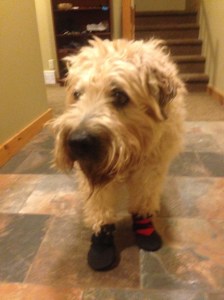
I lost a boot and look what my humans made me wear. One red shoe. All the others are black. Farley with Red BookI’m calling it my dancing shoe.

I’ll make the best of it if and try impress the other dogs with my skills on the slopes and maybe they won’t notice my mismatching shoes…

Maybe I can persuade Kristina to go shopping.


Woof Woof.

Book Deal with Luzifer-Verlag in Germany

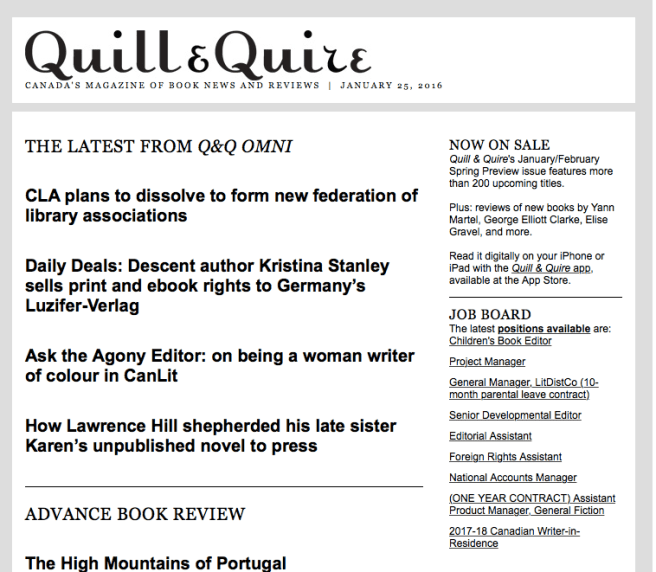
How to announce something so exciting…I’ve signed a deal with Luzifer-Verlag for the the print and ebook rights for the German translation of DESCENT.

Screen Shot 2016-01-26 at 6.25.11 AM

How did this happen?

Liliana Conn translated the English version of DESCENT in to German. My publisher, Imajin Books and Cheryl Kaye Tardiff, brokered the deal. Essentially, my publisher acted as my agent. I can’t thank Liliana, Cheryl and Luzifer-Verlag enough for supporting me.

What happens next?

A new book cover for DESCENT to fit the German market.

Final translation and editing of the German version.

Off to print DESCENT goes.

I’ll let you know how this goes and what I learn in the process.

What is DESCENT about?

When Kalin Thompson is promoted to Director of Security at Stone Mountain Resort, she soon becomes entangled in the high-profile murder investigation of an up-and-coming Olympic-caliber skier. There are more suspects with motives than there are gates on the super-G course, and danger mounts with every turn.

Kalin’s boss orders her to investigate. Her boyfriend wants her to stay safe and let the cops do their job. Torn between loyalty to friends and professional duty, Kalin must look within her isolated community to unearth the killer’s identity. 

If you’d like to try DESCENT in English, you can find it at: myBook.to/Descent

Has anyone else had their book translated to another language? I’d love to know what your learned in the process.

Thanks for reading…


Write Better Fiction: Protagonist Point Of View Scenes

Feedback iconToday on Write Better Fiction we’ll cover the Protagonist. Write Better Fiction is a process to help you critique your own manuscript and give yourself feedback. This will help you improve your novel, so you’re ready to submit it to an editor. Check the bottom of this post for links to previous Write Better Fiction articles.

Last week I wrote about Point Of View Goal. This week we’ll keep track of which scenes your protagonist is in.

The spreadsheet has a column for who is the point of view character in a scene, but we also need a column for your protagonist if you write from multiple points of view. If you write from a single point of view, your protagonists POV, throughout the novel, then you don’t need this column.

Screen Shot 2015-11-30 at 5.06.20 PM

This column is easy. All you have to do is put the protagonists name in the row where your protagonist is in the scene. The protagonist doesn’t have to be the point of view character for the scene.

The protagonist should show up early in your novel. Some argue the protagonist must appear in the first scene. That’s up to your creative instincts. Whichever way you choose, do so with thought. By keeping track of the first scene the character appears in will part of the process in deciding if you’ve chosen the right protagonist.

Use this column to see if there are long gaps in your scene progression where the protagonist isn’t in a scene. This may jar the reader from the story. The reader may lose track of who they are supposed to be cheering for.

You can sort the spreadsheet by this column and count how many scenes your protagonist plays a part in your novel. If the protagonist isn’t in more than three quarters of the scenes, maybe you’ve chosen the wrong protagonist. You should ask yourself whose story is this.

If you’re writing a romance novel you may follow the pattern where you alternate scenes between the romantic partners. This column can tell you if you’re giving both partners equal time in the novel. You can also sort the point of view column to check the balance of POVs given to each main character.

Your challenge this week is to count the number of scenes your protagonist is in and balance that with how many scenes the protagonist has the point of view.

Previous blog posts on Write Better Fiction:

  • Number 1 Question to ask yourself about PLOT
  • Number 1 Question to ask yourself about CHARACTER
  • Number 1 Questions to ask yourself about SETTING.
  • ACTION in a scene
  • NAME of a scene
  • GOAL of point of view character

I critiqued DESCENT and BLAZE using the techniques I’m sharing in Write Better Fiction, and I believe this helped me sign with a publisher.

Please me know in the comments below if you agree with the advice on counting scenes for your protagonist? Do you write in a genre where it doesn’t matter?

Thanks for reading…

Mystery Monday: R.J Harlick on When Dreams Become a Reality

This week I have the honor of hosting R.J. Harlick on Mystery Mondays. I was lucky enough to have R.J. provide an endorsement of BLAZE which I proudly display on the cover, so it is a true pleasure to have her on Mystery Mondays.

R.J is here to talk to us about When the dream becomes a reality.

By R.J. Harlick

Hi Everyone.

I’m thrilled to be speaking to you today on Kristina’s blog . Thanks, Kristina for inviting me.

Today I thought I would address a question I am often asked by readers. At what point did I know I wanted to be a writer?

Though some of my confrères knew at a very young age, for me it was a more gradual transformation. There was no lightening bolt moment when I shouted, “Yes, I want to be a writer.” I more or less slid into it, starting where most writers start, as a reader.

As a child, I devoured books, in particular mysteries beginning with Nancy Drew and the Hardy Boys, eventually graduating to Agatha Christie, Sherlock Holmes, Dorothy Sayers, Raymond Chandler, Nero Wolf and the like. Sometimes I thought it would be fun to write one of these myself.

I even tried writing a mystery for a grade seven English class. But I blush at the memory. I’m afraid this first attempt was far too long and, I hate to say it, far too boring. Nonetheless I kept this idea of writing a mystery buried in the far reaches of my mind.

Though I loved reading, English was never my favourite subject in high school. I found the piecemeal taking apart of a story would destroy the magical hold it had over me. But I loved the creative writing part of English classes. I’d spend many an hour on class assignments making the stories swirling around my head come alive with words. Needless to say many had a mystery angle to them.

In university, I continued to enjoy playing with words. I excelled at making essays sound as if I knew something about the topics about which I was writing, when I didn’t. Studying wasn’t one of my strengths. Perhaps this is where my penchant for creative writing started.

I also continued to read voraciously branching out into the world of the greats. Though I thought it might be fun to become a writer, like Ernest Hemingway or Somerset Maugham, I didn’t treat it seriously. I didn’t really think I had it in me.

This enjoyment for words continued on into my work life as an information technology consultant. I invariable preferred the writing part of my job to other aspects. But it was business writing; letters, proposals and reports. Nonetheless I continued to harbour the dream of being ensconced somewhere bucolic penning the next great Canadian novel, or should I say mystery.

To satisfy my need to write, I started recording my time spent at my log cabin in a journal. Finally, one day after reaching a significant birthday, I decided it was time to find out if I could become the fiction writer in the bucolic setting of my dreams. The setting was easy. I was already sitting in it; the screened-in porch of my log cabin overlooking the surrounding forests. And so I set out to write what would eventually be published as my first Meg Harris mystery, Death’s Golden Whisper.

My first goal was to see if I could write a novel. Up till then, none of my business writing had approached the one hundred thousand word length of a typical novel. The next goal was to determine if I could write fiction, for I quickly discovered fiction writing was a totally different animal from business writing. As I marched along this new adventure, scene after scene, chapter after chapter, toward the climactic end, I realized I really, really enjoyed it. I decided writing was what I wanted to do for the rest of my life. The third goal, of course, was to see if I could get it published. But this is a story best left for another day. Let’s just say it was a long haul with many disheartening rejections.

Seven books and the odd short story later I am still having fun. I’m in the midst of continuing my adventure with Meg. I’m midway through the writing of the eighth Meg Harris mystery. Though I do have a title, I’m not quite ready to share it, in case I change my mind. But I will tell you that the colour for this book is purple and it will be set in the Northwest Territories.

What about you? Was it a slow gradual slide into becoming a writer or did you know from the get-go that you wanted to be one?

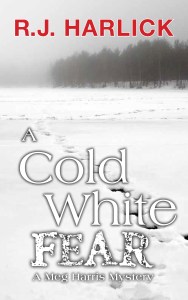
Cold White Fear final coverNow for some BSP – If you happened to live in the Toronto area, I will be reading from and signing my latest book A Cold White Fear on Thursday, January 28 from 6:00 pm to 7:30 at Sleuth of Baker Street on Millwood Ave. It would be fabulous to see you there.


OLYMPUS DIGITAL CAMERA

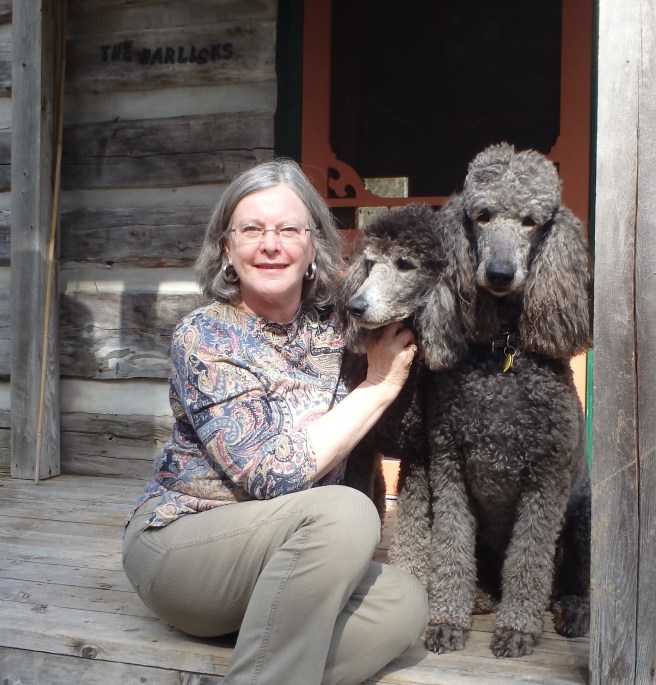
RJ Harlick is an escapee from the high tech jungle. After working for over twenty-five years in the computer industry, first for major computer corporations such as IBM and DMR Group, then with her own management consultancy practice, she decided that pursuing killers by pen would be more fun than chasing the elusive computer bug.

Originally from Toronto, R.J., along with her husband, Jim, and their standard poodles, Sterling and Miss Molly, now bides her time between her home in Ottawa and log cabin in West Quebec. A lover of the outdoors, she spends much of her time roaming the forests of the Outaouais. Because of this love for the untamed wilds, she decided that she would bring its seductive allure alive in her writings. This she has done in her Meg Harris mystery series, where the wilderness setting plays almost as large a role as the main character, Meg Harris.