Mystery Mondays began in July 2015 and every week a different author posts about their favourite writing or publishing topic. It’s a chance to showcase your latest novel, engage with new readers and share your knowledge.
Are you interested in guest blogging?
January spots are already full, but I’m taking requests from February 8th onward.
If you’d like to participate, here’s what you need to qualify:
your novels contain a hint of mystery (I’m very lose on what mystery means),
you are a published author – traditional or Indie or any other way that I don’t know about,
you are about to publish and have a launch date within a week of blog post,
you want to promote other authors and spread success,
you write novels with a hint of mystery,
you are willing to engage in the comments section when readers comment on your post.
All I ask from you is that you follow my blog, comment on author’s posts and help share via Twitter and Facebook. If you’re interested send me a message via my contact page.
The guidelines:
You’ll have to send me your bio, back text of your novel, author photo and book cover. I’d like you to write something about yourself, your novel, your research, a writing tip or a publishing tip. Please keep in mind I am a family friendly blog. I do reserve the right to edit anything I think might be inappropriate for my audience, which I will discuss with you first. I think anything under 700 words is great, but it’s your book so up to you.
I’m looking forward to hearing from you and sharing your novel with the Internet world.
This week I have the pleasure of hosting C.S. Lakin.
C. S. Lakin is a novelist and writing coach who spends her time divided between developing new book ideas and helping writers polish theirs. She is the author of fourteen novels – six contemporary novels, seven in the fantasy/sci-fi genre, and one in historical Western romance. Whether she is exploring the depths of the human psyche and pushing her characters to the edge of desperation, or embellishing an imaginary world replete with talking pigs and ancient magical curses, she is doing what she loves best – using her creativity and skills to inspire and affect her readers.
I was first introduced to C.S. Lakin through her novelTime Sniffers and have been a fan ever since.
Today’s she’s sharing an excerpt from her latest non-fiction book. Just another indication of her willingness to help other authors.
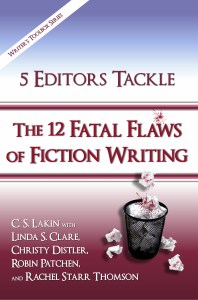
Excerpt from the newest release in the Writer’s Toolbox Series: 5 Editors Tackle the 12 Fatal Flaws of Fiction Writing.
Showing through Your Characters’ Senses
One of the reasons readers willingly immerse themselves in a story is to be transported. Whether it’s to another planet, another era—past or future—or just into a character’s daily life, readers want to be swept away from their world and into another—the world of the writer’s imagination.
It’s challenging for writers to know how much detail to put in scenes to effectively transport a reader. Too much can dump info, drag the pacing of the story, and bore or overwhelm. Conversely, too little detail can create confusion or fail to evoke a place enough to rivet the reader.
In addition to knowing how much detail to show, writers have to decide what kind of details to use. I often read scenes in the manuscripts I critique, for example, that have characters engaging in lots of gestures, such as rubbing a neck, bringing a hand to a cheek, pushing fingertips together, turning or moving toward something—all for no clear reason.
Showing body movement, gestures, and expressions can be an effective way to indicate a character’s emotional state, but this needs thoughtful consideration so that the gesture or expression packs the punch desired.
It also important to show setting—and not just show it any old way. What is key to creating a powerful setting is to show it through your character’s POV and in a way that feels significant.
Showing Significant Settings
When is setting significant to the reader? When it’s significant to the character.
That’s not to say every place you put your character has to evoke some strong emotion. A character who goes around gushing, crying, or jumping in excitement over every locale will appear to be missing some marbles.
But just as in real life, places affect us—some more than others. Each of us can think of numerous places in our past that bring a flood of emotionally charged memories. Showing setting colored by a character’s emotions is not only effective and powerful, it also captures real life.
But let’s talk about those other settings. The ones that aren’t emotionally charged. The many places in which you set your characters to play out your scenes. Some of those places are merely backdrops, places your character traverses daily or on occasion. They’re not important, right?
Let me just pose this possibility: even though you’ve thought a bit about the locales for your scenes, it may be that you aren’t truly tapping into the power of setting. In the rest of this chapter, we’ll look at ways to fix that.
Bring the Setting to Life
You may need to write a scene that shows a tense discussion between two characters. So you stick them in the coffee shop, since it doesn’t matter where you put them. And, hey, a coffee shop makes sense. Everyone goes to them. It shows the characters doing ordinary things.
Sure, put your characters there (but please not twenty times in a novel). Or do something more interesting. I encourage writers to try to think up original, unique settings that bring a character’s bigger world—town, city, region—alive. But even if a writer thinks up fresh and creative locales in which to place her characters, those settings might still come across in a boring, ineffectual way.
But it’s the conversation that matters, the writer argues. That’s what I want readers to pay attention to. The setting is just a backdrop.
In many scenes, that may be true. But if a writer wants to transport her reader, she’ll think about bringing the setting to life via sensory details—which are observed by the POV character.
Go through your scenes and look for these indications of flawed” telling” instead of showing:
Summarizing important moments instead of playing them out in real time
Lack of sensory details to bring the scene alive: sights, smells, sounds, and textures, brought out through the POV character’s senses
Detailing insignificant actions that aren’t important to the plot or don’t reveal anything helpful about the characters (showing too much)
Not starting in the middle of something happening in real time; instead, setting up a scene by explaining and filling in with information
Showing characters moving (driving, walking, etc.) from one location to another when those actions are not useful to the story
Numerous paragraphs of narrative that summarize interaction between characters and lack actual dialogue, gestures, and/or body language
Excessive use of gestures, body language, and “body feelings” to show emotion instead of alternating or replacing with internal thoughts that imply the emotion
Showing setting not presented through the POV character and void of sensory detail
Setting is so often overlooked, but it can be a powerful element in your story, so don’t neglect it.
Author C.S. Latin
S. Lakin is a multipublished novelist and writing coach. She works full-time as a copyeditor and critiques about two hundred manuscripts a year. She teaches writing workshops and gives instruction on her award-winning blogLive Write Thrive.
The latest book in The Writer’s Toolbox Series is now available for sale on Amazon: 5 Editors Tackle the 12 Fatal Flaws of Fiction Writing. Get yours here.
***
Next week on Mystery Mondays we welcome Gloria Ferris, Winner of the 2012 Bony Blithe Award for“Cheat the Hangman” and Winner of the 2010 Unhanged Arthur for “Corpse Flower“
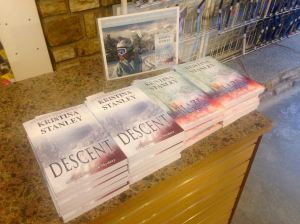
Locally owned businesses love to support local artists. The General Store in Panorama is now selling both DESCENT and BLAZE.
The wonderful employees placed both books right at the register where every person who enters the store sees them.
DESCENT and BLAZE at the register.
Billy, the manager, listened to my blurb about the books and what he might say to customers who ask about them, and he put up sign in case more was needed to drive a customer’s eyes to the books .
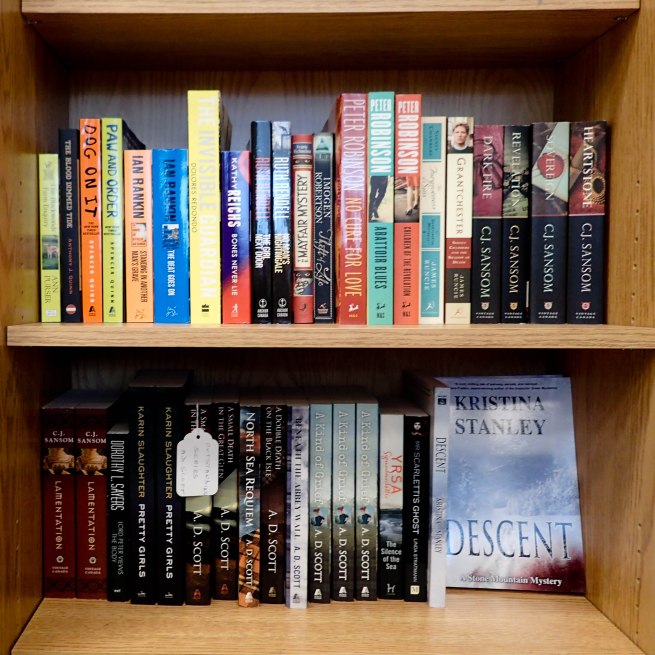
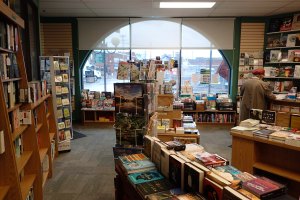
Books on Beechwood is an independent, locally owned, bookstore in Ottawa, Canada. And I owe them a great big thank you for placing DESCENT on their shelves.
Descent On the Shelves at Books On Beechwood
Being born in Ottawa and spending many years there, I consider the city one of my homes, and having DESCENT selling in one of my towns is exciting.
Inside Books On BeechwoodHow to Find Books On Beechwood
BLAZE will make its debut on the shelves within the next couple of weeks.
If you’re thinking of gifts to buy for Christmas presents, why not a book from an independent bookstore? DESCENT and BLAZE will be waiting to meet you.
DESCENT: When Kalin Thompson is promoted to Director of Security at Stone Mountain Resort, she soon becomes entangled in the high-profile murder investigation of an up-and-coming Olympic-caliber skier. There are more suspects with motives than there are gates on the super-G course, and danger mounts with every turn.
BLAZE: Instead of exchanging vows, Kalin Thompson spends her wedding day running from a forest fire near Stone Mountain Resort, and the pregnant friend trapped with her has just gone into labor. Meanwhile, Kalin’s fiancé, Ben Timlin, hangs from the rafters of a burning building, fighting for his life. Can the situation get any hotter?
Please share this post with your friends in Ottawa.
And Max too. Max is my neighbour, and on a good day, Kristina brings him along for a walk. Notice – no leashes – the bears must be hibernating. Or Kristina is getting braver – ha ha.
“Farley,” Max barks. “Come here. I’ve got a squirrel.”
“Where’d he go?” I bark.
Max points at the tree with his nose. “He was here a second ago.”
I scramble close. “I can smell him. He’s not far.”
Max whips around the tree, but the squirrel isn’t on the other side. “Up! Go up.”
“Jump higher.” I’m a short fluff ball. Max is sleek and athletic, so maybe he can reach the chattering rodent.
“What if we catch him?”
“I don’t know,” Max barks. “I’ve never caught one.”
Anyone know what to do with a squirrel if you catch one? I think we need instructions.
Amazing people. That’s who helped me with BLAZE. Every time I read this list, I smile. I think of all the questions I asked, all the discussion we had, all the critiquing on the manuscript and am truly thankful.
The myth about writing being lonely is just a myth. How could I be lonely with all these friends to assist me? Near the beginning of BLAZE you can find the acknowledgements.
***
Mathew, the love of my life, is the person I need to thank first.
A heartfelt thanks goes to my friends for life who read, reread, commented and commented again: Liliana Conn, Michael Conn, Adrienne Cristelli-Stewart, Janice Janczyn, Sue Kreiling, Debi Sarandrea and Libby Simon.
A burning thank you to Calgary firefighters extraordinaire, Chris Ganzewinkel, Billy Stewart.
For expert advice in their fields, thank you to Dr. Rama Behki, Jeff Dodge, George Duncan, Derrick Francis, and Tony Trimble.
I would like to thank Humber School for Writers through which I received feedback from Joan Barfoot and Mary Gaitskill, and Garry Ryan for his support and mentorship through Crime Writers of Canada.
And of course, thank you to Cheryl Kaye Tardif and Imajin Books for believing in me.
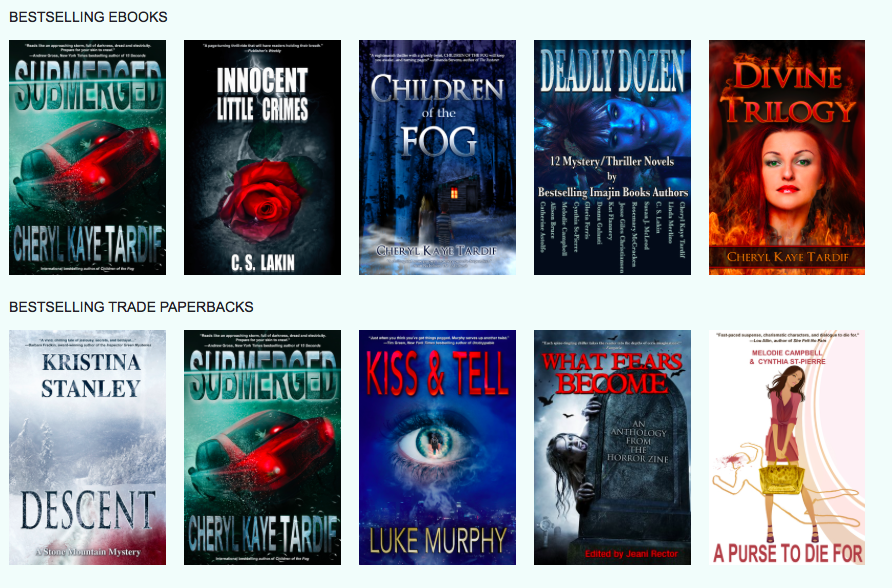
You’ll be taken to their website. Enter your email address and receive a free book from one of the Imajin Books authors. Then you’ll receive their newsletter and be the first to find out what they are up to.
Some of their books include:
There are many more books and authors on their list, so be sure to check them out.
This week I have the pleasure of hosting Kat Flannery. Now I’m going admit I haven’t read much romance, but when I read CHASING CLOVERS by Kat Flannery, I was hooked. I was just going to read a couple of pages and get on with my day, but then I couldn’t get off the couch. So it’s with great excitement today that I get to share Kat’s writing tips.
Before getting to the tips, I have some breaking news. HAZARDOUS UNIONSby Kat Flannery and Alison Bruce is on sale from Nov. 8-12 for $1.99
Now let’s get find out what Kat has to say.
5 Tips to Help You Write a Novel by Kat Flannery
Start with a Bang!
The beginning of a book is where you will set the stakes for your story. How do you do this? Start your story with tension, action, or a problem. I always begin with a conflict. This enables me to introduce the reader to the plot in a way that will grip them and hopefully keep them turning the pages.
In freelance, journalism, short stories, novellas etc. the key ingredient is to hook your reader, just as you’d hook a publisher when querying them; writing a novel is no different. Bring the reader into your story by setting up the action. Keep your reader engaged by giving droplets of information about your character and the plot, or sub plots while building toward the climax of the story.
Backstoryand Exposition
As authors we are always told to keep the story moving forward. When telling backstory writers often get confused with how to continue forward when it is a contradiction to the rule. Tell, not show the reader in a paragraph, or page important facts relevant to the character or setting.
Exposition is breaking away from the action to give information. You will need to decide when it is appropriate to place necessary background facts within your novel. This can be tricky, but always remember the story comes first.
Do not bog down the plot with flashbacks of exposition. What I like to always remember for exposition is…telling it when the story allows.
* Three ways to present your exposition is to place it into the scene, put it between scenes, or let a character explain.
Characters
Write them to be tangible. If your character is the antagonist, who is a serial killer, explain how they became this way by foreshadowing, inner dialogue, and actions of other characters. Do not assume your reader doesn’t care who the antagonist is because he is the bad guy. Make it believable, and always ask yourself why, when flushing out character biographies.
Do not change the rules. Characters that don’t follow his/her actions will pull the reader from the story. When you’ve written a character that is shy and timid then all of a sudden she is argumentative and abrasive you will piss your reader off. There is nothing like being stopped dead in a book from poor characterization. If your character starts out meek and mild but you want her to become stronger, build toward it. Do not change her in a few pages. People don’t behave this way. Keep it real.
Sub plots
Well handled, subplots can deepen the story’s background, and be used as pacing to turn the action from a break in the plot. If you’re going to have one or two subplots pertaining to the main characters, start the first one right in the beginning of the story. If you’re choosing to have your subplot around someone other than your protagonist, allow the reader to get to know them first before starting the subplot.
Subplots should be woven throughout the novel, each taking a turn at being the central point of the story. This can be complicated and I’d advise taking notes on subplots so you don’t get confused.
Tie up loose ends. Like plots, subplots need development, crisis, and resolution. Even if the subplot is minimal, treat it the same way you would your plot. Mention to it once in a while throughout the story. Try to write the subplots predicament to be directly involved with the main plot.
Resolution
This is the end of your story. Similar to the beginning, the end will solve the problem you’ve built the reader up to throughout the whole story. Endings can come in three ways, happy, unhappy or both together. It is up to you, and the story you’ve written as to which way you will end things.
The resolution is the winding down of the rocky middle. Here you will resolve the central conflict. The main plot will end, and if you choose to write a series, you can keep a sub plot open, but do not leave the reader guessing on your central plot. Wrap it up!
Happy Writing!
Bio:
Kat Flannery
Kat Flannery’s love of history shows in her novels. She is an avid reader of historical, suspense, paranormal, and romance.
A member of many writing groups, Kat enjoys promoting other authors on her blog. She’s been published in numerous periodicals throughout her career.
Her debut novel CHASING CLOVERShas been an Amazon bestseller many times. LAKOTA HONORand BLOOD CURSE(Branded Trilogy) are Kat’s two award-winning novels and HAZARDOUS UNIONSis Kat’s first novella. Kat is currently hard at work on her next book.
There are some useful tips here for anyone trying to grow their blog. Thanks to Confetti & Curves for putting this together.
As a proud blog mama, creating an online haven is most definitely something I’d highly recommend to anyone. Not only is it bundles of fun but you also get to meet droves of like minded blog buddies from all over the globe. It’s therapeutic, creative and oddly addictive (in the best kind of way) however when starting off it can be a little frustrating pouring all your creative juices into great features but not having an audience to fully appreciate your hard work & efforts.
Although blogging should never be solely about the numbers, it’s still incredibly fulfilling when your readership expands & the support rolls in to reflect your passion. So if you’re new to blogging or just simply want to learn more about growing your audience as organically as possible, then check out these handy hints and tips that have really helped me along the way…
.
Unless you’ve hours to burn each day, keeping a proactive presence on…
I’ve never done a blog party before, but I thought I’d share this anyway. If you host one let me know. I’d love to take part. Thanks to Suzie Speaks for posting this.
Blog parties are one of my favourite things to do, and in my experience they are an incredibly fun and successful way of boosting traffic to your blog and building a readership.
For those who have never heard of a blog party before, the concept is simple. The host will create a post which states a set of rules. Other bloggers will then share a link to a post from their blog in the comment section and will go and visit other links from the people participating. I love participating in these sorts of events, and have discovered many wonderful blogs and bloggers by doing so.
Hosting a successful party, however, takes a little bit of preparation and time in advance, and requires 100% commitment on the day.
Want to host your own blog party? Here’s my easy step-by-step guide to planning and developing a party that will get the…










 Before getting to the tips, I have some breaking news.