Before You Submit: Sentence Length

Do you have a draft of your novel or short story and are thinking of submitting to an agent, publisher or writing contest? My series called Before You Submit might help. This series contains hints and tips I’ve received from professionals in the publishing industry. Each week I’ll share a new tip.

This week I’ll write about Sentence Length.

My editor wrote: Simple declarative sentences are powerful but tend to lose power if repeated too often.  If all your sentences are the same length, the writing can come across as dull, and I’m going to guess none of us want to create a dull novel.

There are software programs that provide a graph of your sentence lengths. Autocrit and ProWritingAid are two of them. I haven’t reviewed either product fully, so this is not a product plug. If you don’t want to use another software program, you can take a section of your text, hit return after each sentence and “see” the sentence lengths on the page. This will give you an idea if you vary your sentence lengths.

If the text is shaped like a rectangle, your sentence lengths are too similar.

If all your sentences are short, try joining two sentences with a conjunction making a longer sentence. You can leave in or take our the subject if the subject is the same in both original sentences. This is a subjective choice. Just make sure you get the comma right.

If all your sentences are long, try breaking a sentence into two or even three sentences.

I hope this helps improve your writing.

See Before You Submit:Likeable Characters for the first blog in this series and an introduction the benefits of submitting even if you get a rejection letter.

Thanks for reading . . .

Farley’s Friday: A Terrified Wheaten Terrier

Farley here,

I’m terrified. A vat of boiling water sits in my back yard. Right outside the backdoor. After a snowfall, this thing looks harmless, scenic even. But’s it’s a dangerous place.

Hot Tub

Once the snow stops, my humans do something really dumb. They shovel the snow off the lid. They have a ritual. Kristina puts towels near the back door.

I start to whine.

“Shh,” Kristina says.

I whine louder.

The crazy humans ignore my warning and walk across the snow in their bare feet. They don’t have fur like I do. This can’t be good for them. Now you won’t believe the next part. They actually get in the boiling water. Who get’s in boiling water, I ask you.

“Get out,” I bark.

“No,” Kristina says.

But does that mean no barking or no, I’m not getting out? Things get worse. Kristina and Matt both have a useless sense of smell. I’m not sure they smell anything. My house backs onto a forest. In the evening, wildlife are active. I can smell a bear, cougar, or a moose even if I can see the creatures.

I run to the back off the hot tub, lifting my front paws off the ground, and sniff wildly. “There is a bear on the ridge,” I bark.

“I wonder what he smells?” Matt asks.

“Should we get out?” Kristina asks.

“Yes. Yes. Yes,” I bark.

“No,” Matt says. “He’s just mad we’re in the hot tub and not playing with him.”

I give up. I run to the front of the house. lie down, put my paws over my eyes and hide. The bear scent is ebbing, so I know it’s walking away from us. We’re safe. This time. But how do I keep my peeps out of the hot tub?

Woof Woof.

Before You Submit: Dialogue Tags

Do you have a draft of your novel or short story and are thinking of submitting to an agent, publisher or writing contest? My series called Before You Submit might help. This series contains hints and tips I’ve received from professionals in the publishing industry. Each week I’ll share a new tip.

This week I’ll write about dialogue tags.

Are you using too many dialogue tags? Does he said/she said sound repetitive? Here’s a tip on how to reduce the number of tags you are using.

Try using a character’s action to indicate who’s speaking. The following sentence uses a dialogue tag: Kendra said.

“You dropped this,” Kendra said. She held a crumpled piece of paper in her outstretched hand.

The editor recommended I rewrite the sentence as follows:

Kendra held a crumpled piece of paper in her outstretched hand. “You dropped this.” 

By  moving the character action to the beginning of the sentence, it’s clear Kendra is speaking. There is no need for the dialogue tag. When you remove a dialogue tag, you must update the punctuation. Don’t forget to change the comma to a period inside the dialogue quotes.

I hope this helps improve your writing.

See Before You Submit:Likeable Characters for the first blog in this series and an introduction the benefits of submitting even if you get a rejection letter.

Thanks for reading . . .

Farley’s Friday: Puppy Love

Farley here,

The doorbell rings. I blast out my doggie bed, slide across the newly stained hardwood floor and hustle down the stairs.

I push my human, Matt, out of the way. It’s very Important I get to the door first. There could be danger on the other side. There could be a friend. You just never know. I choose friend and wag and wiggle as best I can.

I can’t open the door by myself. I bark at Matt, wiggle some more. Doesn’t he get the urgency. “Come on, buddy,” I bark.

I then I hear it. A voice I’ll never forget. It’s Joe. I’m sure it’s Joe. I haven’t seen him since I was one. That’s five years.

I jump up, trying to get Matt to hurry. He laughs and opens the door. I explode through.

We bound, we rough-house, we run around in circles. The humans stand back and watch.

My muscles are sore, I’m panting hard. I think It’s time for a break. I invite Joe in to share my bed. We used to snuggle together all the time, but something has changed.

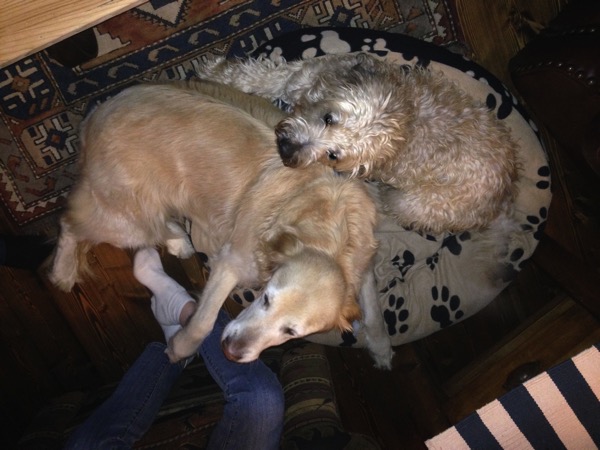
This is us 5 years ago.

Joe and Farley  then

This is us now.

Farley And Joe Age 6 an 8

I think the bed got smaller, but I still love Joe.

Woof Woof.

Before You Submit: Hyphenated Adjectives

Do you have a draft of your novel or short story and are thinking of submitting to an agent, publisher or writing contest? My series called Before You Submit might help. This series contains hints and tips I’ve received from professionals in the publishing industry. Each week I’ll share a new tip.

This week I’ll write about Hyphenated Adjectives.

If you’ve been reading Before You Submit, you’ll know I love getting feedback from an editor. Some of the tips I’m presenting are from the  early days of my writing career, and I’m almost embarrassed to admit I made these mistakes. I say almost, because we all have to learn, and not all of us remember everything we learned in grade school.

The editor corrected the following sentence:

Young people living in a dorm type facility . . .

to:

Young people living in a dorm-type facility . . .

Instead of trying to describe the nuances around hyphenated adjectives, I’m going to refer you to Grammar Girl for an explanation. If you don’t know about Grammar Girl, it’s an excellent site to look up grammar rules. The hyphen is a tiny mark on the page, but one that will show an acquiring editor you are serious about your trade if you get it right, or you have homework to do if you get it wrong. The lack of a hyphen when you need one could throw your novel back into the slush pile, especially if it’s on the first page.

I hope this helps improve your writing.

See Before You Submit:Likeable Characters for the first blog in this series and an introduction the benefits of submitting even if you get a rejection letter.

Thanks for reading . . .

Farley’s Friday: A Shoulder Injury

Farley here,

I don’t want you to feel sorry for me, but I hurt my shoulder this week, and I used  gestures to let Kristina know I had a boo boo. The only problem with my gestures is I made her sad instead of making myself feel better. Sometimes I wish I could talk.

Kristina loves to interpret my gestures, and she always errs on the soft side. Sometimes I’ll be bad, and she’ll read something positive into it. I chewed Matt’s sock this week, and Kristina said it was because I was hurt and wasn’t getting enough exercise. How cute.

What she doesn’t  know is Matt waits until she’s not around,  his eyes twinkle – that’s his gesture for we’re about to be mischievous but don’t tell Kristina – and he runs to the sock drawer. Yup you heard me. There’s a magic place called the sock drawer. Matt rolls his sock into a ball and throws it at me, repeatedly. He thinks it’s  funny when I play with his sock. I chewed the sock because ripping material with my teeth is satisfying. My behaviour has nothing to do with lack of exercise, but just in case you’re worried, I know not to chew Kristina’s socks.

So back to my injury. I was playing with my friend Beans, and I don’t know what happened. One minute all was fine. We were rolling around in the mud at the base of the ski lift station, and the next minute, sharp pain drove through my shoulder.

At first I pretended nothing happened, but half way home, I had to admit to the pain and I started to limp.

Kristina and Matt slowed down for me. We were almost to the house when I remembered a gesture that gets her every time. I sat and raised my paw. This is my universal signal for something is wrong with me.

My softie of a human turned around, came back for me and then . . . She picked me up and carried me home. I weigh 42 pounds and am a bit awkward to carry, but she didn’t care. I could feel her heart pumping against me. She was worried. I didn’t mean to make her worry, I just wanted a ride home.

When we got home, I curled up on her lap and cuddled her. Her heart rate lowered, and she began to relax. I was trying to tell her I was okay and she shouldn’t worry. But she’s a human. Worry seems to come naturally to them.

Farley sad

Later, just to make sure she’s okay, I’ll sleep in bed with her.

Woof Woof

Before You Submit: Point of View Goal

Do you have a draft of your novel or short story and are thinking of submitting to an agent, publisher or writing contest? My series called Before You Submit might help. The series contains hints and tips I’ve learned from professionals in the publishing industry that I’d like to share.

See Before You Submit:Likeable Characters for the first blog in this series and an introduction the benefits of submitting even if you get a rejection letter.

This week I’ll give you questions to ask yourself for each scene in your novel when you are thinking about your Point of View (POV) character. The POV may be the same throughout the novel, change per scene, or change within a scene. However you structure your novel, the following questions can help ensure you POV character is active and interesting.

  1. What is the goal of the scene POV?
  2. What hinders the goal?
  3. How is the goal important to the overall story?
  4. How does the goal move the story forward?
  5. What happens if the POV character doesn’t succeed?
By answering the questions you might surprise yourself and come up with new ideas for your plot. You may find areas where you can deepen the character, intensify the action, or dare I say it, cut a scene.
 
Thanks for reading . . .

Farley’s Friday: A Wheaten Meets Snow

Farley here,

The snow’s a-comin! British Columbia is turning into a Wheaten Terrier paradise.


BC Snow

Running in the snow is awesome. I never overheat and I can eat the stuff if I get thirsty.

Farley and Snow

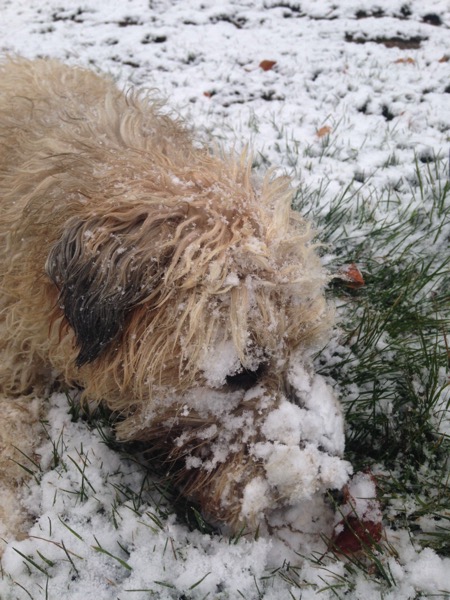
Snowballs stick to my fur is not so awesome. What’s a dog to do?

Farley Snowball


I mean literally what’s a dog to do?

Anyone have any idea how to get this stuff off my nose?  I’d really like some advice, and please don’t say stop rubbing my nose in the snow. I’m having too  much fun, and there is now way I can control the urge. I keep telling Kristina is an instinct. She’ll believe anything I woof at her, but it’s really about playing.


Woof Woof

Before You Submit: Scene Opening and Closing

Do you have a draft of your novel or short story and are thinking of submitting to an agent, publisher or writing contest? My series called Before You Submit might help. The series contains hints and tips I’ve learned from professionals in the publishing industry that I’d like to share.

See Before You Submit:Likeable Characters for the first blog in this series and an introduction the benefits of submitting even if you get a rejection letter.

This week I’ll write about how to start and end scenes throughout a novel without being monotonous.

Sometimes it’s easy to get into a habit and open or close scenes in the same manner.

A dramatic line of dialogue is a great way to hook the reader and keep them reading. But what if you do this every scene? The dramatic tension will decrease. The same goes for other ways to start a scene.

Here are your options for opening and closing a scene.

  1. Dialogue
  2. Narrative
  3. Action
  4. Thought

When you are reviewing your manuscript prior to submitting, make a list of how you enter and exit scenes. I do this in excel so I can graph how many scenes start or finish in each way. The result gives me an idea of whether I’ve used one technique to often or not.

Entering and exiting scenes in a balanced and thought out approach will make your writing more interesting and keep the dramatic tension flowing.

If you have any tips on entering and exiting scenes, please share.

Thanks for reading . . .

Farley’s Friday: A Wheaten Loves Leaves and Cold Weather

Farley here,

I’m a dog who has lived on a boat in the Bahamas since I was 9 month old. All of a sudden, my humans decide enough of the sea life, it’s off to the mountains we go. British Columbia to be exact.

At first, I thought they were crazy. But now, I’m rethinking this situation.

Did you know leaves fall off trees in the fall? No one told me that.

Did you know a dog has more energy in cold temperatures? I didn’t either.

Did you know sticks are free in the forest? I’m kinda figuring this one out on my own.

Farley in Leaves

Rolling in leaves while chewing on a stick is the best. I miss boat life, but wilderness living is cool too.

Woof Woof.