Mystery Mondays: Robin Leigh Morgan on Changing Genres

Author, book reviewer, and blogger,  Robin Leigh Morgan joins us today to discuss changing genres. Robin is a member of the RWA [Romance Writers of America] and the SCBWI [Society of Children’s Book Writers and Illustrators].

CHANGING GENRES by Robin Leigh Morgan

Some of us who have chosen to write fiction come from a variety of places. And by “a variety of places,” I’m not referring to a physical location; I’m referring to our writing experiences.

There are some of us who have enjoyed writing since we were children, and each year, by writing something in school, it improved. For some of us, it continued until we graduated college and began working. Some of us entered the work force taking jobs, which required us to write, whether it was procedures, handbooks/manuals, or news stories. But all of these are non-fiction, and each one has a set of “rules” that need to be followed to write something well enough to be acceptable.

As for myself, while my regular job did not require me to write, for eleven years I wrote articles [commentaries/viewpoints] of what was happening in my community and my feelings about it. When I started to write these items, my writing skills were not honed. I didn’t have my ideas organized in a tight manner, although my writing had been informative. By the time I’d written my last item, I’d become quite adept at it.

When I started to write fiction, I somehow drifted to writing a contemporary romance story with a paranormal element running through the storyline, but after almost 9 years I still hadn’t completed it. That is, until someone suggested I should try writing for a much younger audience, which is what I did; cumulating in my first YA Paranormal/Time Travel/First Kiss romance novel entitled I Kissed a Ghost.

Anyway, making the transition from non-fiction to fiction, I’ve had to learn a new set of rules on how to write. Most of these involved dialogue, showing not telling, where before I just told. I now had to learn about the use of tags. I had to learn not to be overly descriptive of something, but allow my reader to create the image for themselves in their minds. In the beginning I found it hard to break my old writing habits. Now I’m finding myself with these habits essentially gone. The biggest issue I still have and am trying to get a good handle on, is POV [Point of View]. Regardless of what’s happening or being said it has to be in one character’s perspective, and you can’t flip-flop between two characters within a scene. There needs to be a transition from one character to another.

All these things have helped me mold myself into the author I’m today. I’ve also learned there are additional rules within a genre, depending on the sub-genre you’ve decided to write in. These rules apply to the dialogue spoken, which needs to be true to the time period you’re writing in, as well as how your characters are dressed, and their titles, if any, as is the case with the regencies sub-genre of romance novels.

So as you can see, writing is not merely a string of words you put together. There are rules that need to be followed if you’re to be well received by your readers. And not wanting to pegged to only one genre I decided to expanded my reach.

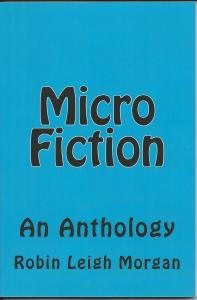
For about two years, starting in January 2013, I wrote a Five Sentence Flash Fiction in response to the prompt word given by Lillie McFerrin her website: http://www.lilliemcferrin.com. And on December 2, 2014, I published my second book, “Micro Fiction – An Anthology,” which is a collection of 100 hundred of these flash fictions I’ve posted on my blogs and others which I responded to only in the book. In the editing process some of these items increased in the number of sentences they contain, and with the longest of these containing about 390 words. The collection contains various genres.

Here’s the link to check out my two books:

http://www.amazon.com/Robin-Leigh-Morgan/e/B00BWXT4VU
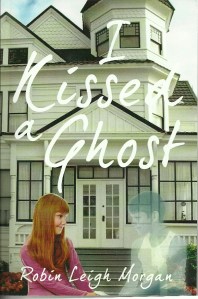
I Kissed a Ghost0001

MICRO FICTIONWhile I’ve had quite a lot of personal and family distractions this year, I’m still in the midst of several writing endeavors, which are currently on the back burner. I’m writing an adult Contemporary romance, with a working title of “His Darkest Secret.” The story has a paranormal element running through parts of the storyline. I’m also writing a YA Urban Fantasy entitled “The Secret of the Well,” which is a stand-alone sequel to “I Kissed a Ghost.”

Wanting to increase my knowledge of writing I decided to become a serious Book Reviewer at the end of August/beginning of September so I can be exposed to different genres and styles of writing with each genre. As of November 10, 2015, I’ve read/reviewed a total of 204 books on Amazon. I apparently have become quite good at writing reviews since my Amazon approval rating is fluctuating between 95% and my Amazon Reviewer Ranking as of this date is 5,870. And I can’t tell you how much more about writing I’ve already learned about writing simply by reading other authors. I also post my reviews on GoodReads, LibraryThing, Shelfari, and my two blog sites.

PLEASE NOTE: I DO NOT accept requests to do reviews, all the reviews I do I’ve either won through the countless giveaways I enter for books I’m interested in reading, or those I choose myself to read. If you looking for your next book to read, you’re invited

RLM imageThe best place to go to learn more about me, my writing and my links is to go to: http://www.about.me/rlmorgan51 If you would like to interview me or have me post this on your blog, please contact me through one of my links listed here,



Farley’s Friday: Top 5 Reasons Dogs Should Be Welcome At Work

Farley here,

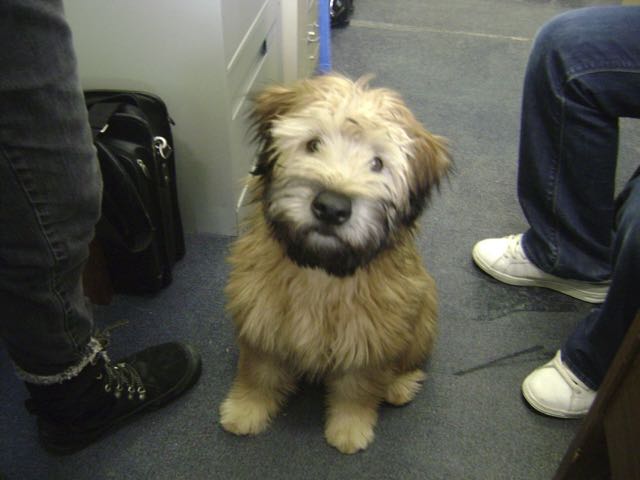
When Kristina was the director of security at a ski resort, and I was just a young pup, I got to go to work with her.

Tell me I wasn’t the cutest…That’s Kristina’s foot in the black boot on the left. I don’t remember who is wearing the white shoes, but I’m sure I was nice to him/her.

Farley in Office

Here are my top 5 reasons why dogs should be welcome at work

  1. Stress relief – it’s been proven blood pressure goes down when you pet a dog
  2. Good for morale – a dog is happy to see you every time you enter the office
  3. Facilitating team work – joint care of an animal brings people together
  4. Healthy lifestyle – the lunch time walk.
  5. Workplace safety – it’s hard to be angry when the cutest dog ever is wagging its tail at you.

So why wouldn’t you want a dog at work?

I loved going to the office, hanging out, letting everyone who walked by pat my head.

Woof Woof


Mystery Mondays: Kathy Prairie On Inner Voices and Her New Release

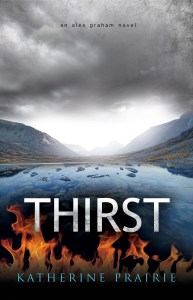
Thirst webToday on Mystery Mondays we welcome Canadian author Kathy Prairie. This is a special week for Kathy. Her novel, THIRST, is now available for pre-order and the official launch is February 18th. Yup, That’s this Thursday.

I’m thrilled to be part of Kathy’s launch and to have her share her writing advice on “inner voices.”

To entice you to have a look at THIRST, R.J Harlick, a previous guest on Mystery Mondays has this to say:

“With compelling characters and an extraordinary setting, THIRST is a fast-paced thriller that will keep you on the edge of your seat until the very last word.” – R.J. Harlick, author of the popular Meg Harris mystery series

That’s just a teaser for now. The description of THIRST is as the bottom of the blog.

So on to Kathy and her advice on finding your inner voice…

INNER VOICES by Kathy Prairie

I’m delighted to join a fellow B.C. author today – thanks for the invitation, Kristina.

I’ve heard the advice “find your voice” at almost every writing workshop I’ve attended and while the concept seemed simple enough, trying to achieve it has been anything but. So today I’d like to share the three elements that were key to finding my voice: characters, perspective and style.

First a simple defintion of voice: It’s your signature, your way of telling a story. But I think it’s also that sweet spot where your sentences flow with ease and your characters come to life. If you find that spot you’re sharing your personality with your readers and your writing will be as unique as a fingerprint.

I’d suggest that you start with your characters because they tell your story. In our lifetimes we probably meet thousands of people and no two of the them are exactly the same and your characters should be unique too. There are many decisions here including gender, profession, physical appearance, personality and motivations and it can be tough! I’ve heard much advice about writing what you know, but I believe it’s more important to write about what interests you.

I’m fascinated by science and intrigued by politics and through my geologist Alex Graham, I’m able to weave these elements into my stories. She’s an interesting character to me, someone I’d like to know in real life and I look forward to writing more stories about her. Ask yourself what kind of personalities most interest you. Are you intrigued by the psychology of the criminal mind or the intellect of the puzzle-solving detective? If you follow your passion, you’ll create memorable characters and perhaps find a protagonist you love enough to include in another book.

Next focus on how your characters will tell their story. First person proved the most challenging for me, but I liked the resulting scenes. Omniscient on the other hand, never really felt right because of its impersonal nature. But limited third person felt right from the start because my story flowed effortlessly through each character’s viewpoint.

You might find that you naturally gravitate towards first person, omniscient or third person but it’s worth exploring each of them fully. A simple change from “she” to “I” can profoundly affect your scenes and I found that my style, the dialogue, the details – everything shifted as I moved from one perspective to another. I wrote three complete scenes in each perspective before finally deciding on third person and even now when I’m having trouble with a particular scene, I’ll switch to first person because it changes how I see the scene and often identifies the problem.

Once you’ve decided on perspective and characters it all comes down to how you tell your story. If you allow your characters to guide you, you may find that your style develops naturally. For example, a hard-boiled detective would tell a story differently than a twelve-year-old girl.

The nature of your sentences – smooth, choppy, long, short. The kind of language you use – gritty, soft. The level of description – too many adjectives, too few, too flowery, too blunt. All of these elements contribute to your unique writing style and you need to find what suits you best. I’ve found that some of the most interesting authors break the grammar rules, so go ahead and explore. Don’t get me wrong, your story has to be readable and you should never ignore the good advice of your editor, but you also don’t need to sound exactly like everyone else.

How you paint a scene or describe a character is equally important. Some authors include few details while others write long descriptions and especially if you’re a new author, you’ll likely favour one extreme or the other. Read your favourite authors. Do you skip over the details or read every word? You probably won’t feel any more comfortable writing loads of description if you don’t like to read it. But your challenge is to balance your natural writing style against the reader’s need for detail. Push beyond your comfort zone here and add a little more descriptive detail as you write, and vice-versa and you may find your answer.

Through characters, perspective and style I finally feel that I’ve found my voice and focusing on these elements might also work for you. Your voice will evolve over time as your writing matures – I’ve seen that happen already in my own work – but your overall approach should stay steady. And if you stay true to your personality your voice is guaranteed to be unique!

Kathy’s Biography

Screen Shot 2016-02-14 at 3.22.32 PMKatherine, a geologist and IT specialist, stepped away from the international petroleum industry to follow her passion for writing. An avid traveller with an insatiable curiosity, you never know where you’ll find her next! But most days, she’s in Vancouver, Canada quietly plotting murder and mayhem under the watchful eye of a cat. She is an award-winning presenter and the author of the thriller THIRST.
 

Links

www.katherineprairie.com

www.facebook.com/katherine.prairie

THIRST

Science. Politics. Deadly Intent.

Deep in a Columbia River valley rocked by violence and tightly controlled by a U.S.-Canada military force, geologist Alex Graham is on the hunt for silver. Her plans are derailed when she joins the search for a suspected toxic spill as the victim count rises. But the lethal contamination is no accident.


Farley’s Friday: A Dog Runs Downhill

Farley here,

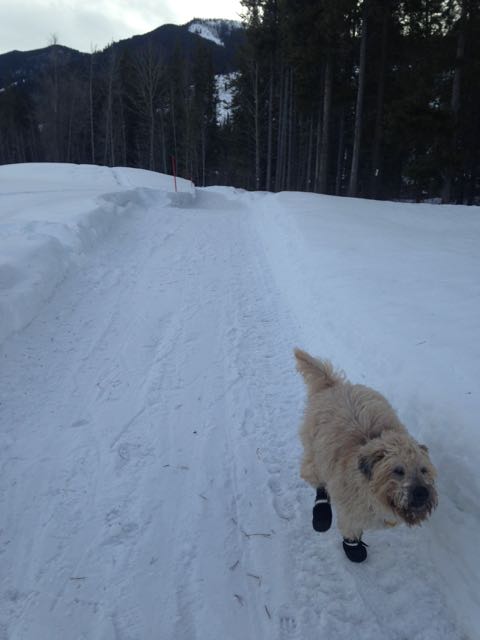
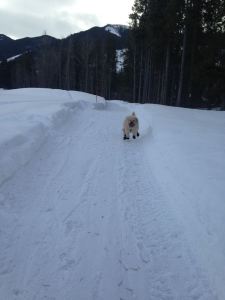
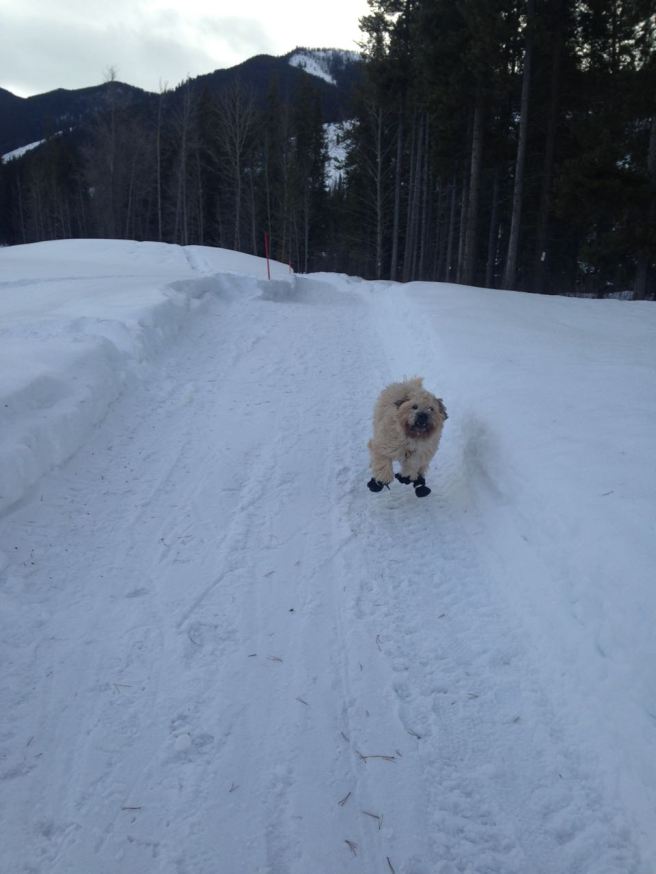
Remember my one red dancing shoe? I still have it, but Kristina bought me a new matching set, and I tried them out yesterday while snowshoeing.

You may think snowshoeing is a slow sport, and it is for humans, but I have a trick.

What goes up must come down, right?

We arrive at the crest of the hill and I chill out while Kristina heads down the other side. I wait until she’s at the bottom and I test my new boots a full speed. Here I go..

Farley Running 1

Farley Running 2


Farley Running 3

At the bottom, my feet are going so fast, I run right around Kristina and keep going.

Now I’ll save my red dancing boot for special occasions.

Woof Woof.


Write Better Fiction: Characters in a Scene – too few/too many?

Today on Write Better Fiction we’ll cover the Characters In A Scene. Write Better Fiction is a process to help you critique your own manuscript and give yourself feedback. This will help you improve your novel, so you’re ready to submit it to an editor. Check the bottom of this post for links to previous Write Better Fiction articles.

We’ve discussed using our spreadsheet to balance the number of scenes the protagonist and antagonist are in. But what about other characters? There is a columns for that too.

In the column called characters, list all characters in the scene. This includes characters that don’t have a name. The bartender, the skier, the person on the street, etc. I include animals as characters. The animal may or may not have a name. If you’ve read DESCENT, you know Chica is a character that is a yellow labrador. In BLAZE, a grizzly bear has a scene, but it’s not named. They both get listed in this column.

The character column helps

  • keep track of characters from one scene to another. If a character is in one scene, and the next scene is in the same location, then either the character has to still be there or you must write his/her exit. This column will keep you from having randomly disappearing characters.
  • you assess whether you have too many characters or too few in a scene.
  • you count how many times the protagonist and antagonist appear together.

If you get feedback from beta readers that you have too many characters, this column will help look for places you could cut characters or combine two characters into one.

Your challenge this week is to list all the characters in each scene.  Have you given your protagonist and antagonist a fair amount of time in your novel?

Please me know in the comments below if keeping track of characters in a scene helped you tighten your writing. Did you edit out any characters?

Thanks for reading…


If you’d like to check out DESCENT or BLAZE the links are below:

myBook.to/Descent

When Kalin Thompson is promoted to Director of Security at Stone Mountain Resort, she soon becomes entangled in the high-profile murder investigation of an up-and-coming Olympic-caliber skier. There are more suspects with motives than there are gates on the super-G course, and danger mounts with every turn.

myBook.to/BLAZEbyKristinaStanley

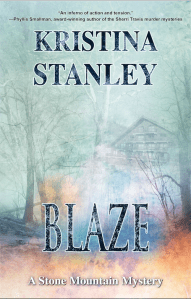
Instead of exchanging vows, Kalin Thompson spends her wedding day running from a forest fire near Stone Mountain Resort, and the pregnant friend trapped with her has just gone into labor. Meanwhile, Kalin’s fiancé, Ben Timlin, hangs from the rafters of a burning building, fighting for his life. Can the situation get any hotter?

Mystery Mondays: Lisa de Nikolits on The Writer’s Seeing Eye

BTCSF_FrontCoverLisa de Nikolits sat in front of me at The Bloody Words conference, and what I remember is her great bit smile. This week, I’d like to welcome this very friendly and talented author to Mystery Mondays. Lisa’s going to tell you about the Writer’s Seeing Eye.

THE WRITER’S SEEING EYE by Lisa de Nikolits

 Ideas for crime novels. Where do they come from? 

“We need to watch another episode of Forensic Files,” I said to my husband. 

“It’s 2 a.m. on Christmas Day,” he replied, “We need to get some sleep so we can enjoy Christmas.”

“Ah, just one more,” I encouraged him. “It’s all research for me and I’ll make you a fresh cup of tea. Just one more!”

Research? 

That’s what I tell myself anyway. 

And it’s true that I have learned a lot about ethylene glycol and ketotic hyperglycinemia, blood spatter, fingerprint analysis, handwriting analysis, the ever-famous DNA, toolmarkings and ballistic analysis.

While the things those guys can do is just mind-blowingly amazing, two things struck me with this program. The first is how stupid some people are, when it comes to committing a crime. Most of the time they leave behind a trail of evidence that is nearly a paint-by-numbers for the detectives to solve. 

And the second thing is the impulsivity of the crimes, which occur on the spur of the moment. 

While I am full of admiration for Forensic Files, when it comes to novels, things are very different. Readers have very little patience with stupid protagonists and they are very quick to spot any story inconsistencies or things that might not ring true in the flow of a crime committed. 

In real life, how many times you have found yourself staying “real life really is stranger than fiction” and it is stranger because it’s not reasoned out in the same way that we plot books, real life crime just happens and then people try to mop up the mess and sometimes they succeed and sometimes they don’t. 

My ideas for the crime in my novels comes from flights of my imagination. The big ‘what if?’

For example, my husband and I got confused while taking a ferry back from Sydney to Cremorne Point – he got off while I didn’t and in that nano-second, I was convinced that he had fallen into the black water of the Sydney harbor and drowned. 

He was fine, of course he was, he had got off while I had been photographing something and there was nothing to it. 

But my writer’s seeing eye saw him being ushered off the boat, with a gun tucked under his armpit, and a gothic anarchist girl leading him away. I saw that a human trafficking gang had confused him with his doppelganger, and that an innocuous picture that he had posted on Instagram had caused all the confusion. I saw that my husband’s niece was involved in the kidnapping, and that she was being haunted by the ghost of a woman who had been locked up in an insane asylum. 

None of which could have come from Forensic Files or crime stories from real life, but that said, nothing is going to stop me from watching my favourite program – all for ‘research’ of course!

Bio

WhiteShirtBioPicLisa de Nikolits is the author of five novels: The Hungry MirrorWest of Wawa, A Glittering ChaosThe Witchdoctor’s Bones and Between The Cracks She FellBetween The Cracks She Fell was reviewed by the Quill & Quire and on recommended reading lists for Open Book Toronto and 49th Shelf. Canadian Living magazine called it ‘a must-read book of 2015’. 

Lisa has also been published in various anthologies and journals including Postscripts To Darkness, Volume 6, 2015, Thirteen O’ClockMaud.Lin House, the Canada Woman Studies Journal, Hood and the Jellyfish Review.


Links:

www.lisadenikolitswriter.com 

twitter: @lisadenikolits

www.facebook.com/lisa.denikolits

https://www.facebook.com/lisadenikolitsauthor

http://www.goodreads.com

http://pinterest.com/lisadenikolits/

LinkedIn: http://linkd.in/1r8H9Df

Instagram: http://www.instagram.com @lisadenikolits

Wattpad: https://www.wattpad.com/user/LisadeNikolits

The Mesdames of Mayhem: http://mesdamesofmayhem.com/about/

Crime Writers’ Association Interviews Kristina Stanley

I had the honour of being interviewed by Kate White, Head of Press, at the Crime Writers’ Association about my experience having BLAZE shortlisted for the Debut Dagger in 2014. Here’s the kickoff to the interview.

If you’re just starting out and haven’t published yet, The Debut Dagger is a great way to garner interest in your novel. Be brave and submit. You just never know where it will lead.

REBLOGGED FROM THE CRIME WRITERS’ ASSOCIATION LATEST NEWS

AV1DEBUT DAGGER TIPS: KRISTINA STANLEY

3/02/2016 by The CWA 1

Prepare to be deeply jealous when you find out the circumstances in which Kristina Stanley penned her Debut Dagger shortlisted novel, Blaze. However, despite a deeply glamourous writing story, the Canadian newcomer faced the same struggle as all other would-be authors as she approached getting published. Here Kristina explains how getting on the Debut Dagger shortlist changed everything, and why she thinks it’s a brilliant gateway for writers to get their work noticed.

What made you decide to enter Blaze in for the 2014 Debut Dagger competition?

… For the complete interview see The Crime Writers Association Latest News.

***

If you’d like to check out DESCENT or BLAZE the links are below:

myBook.to/Descent

When Kalin Thompson is promoted to Director of Security at Stone Mountain Resort, she soon becomes entangled in the high-profile murder investigation of an up-and-coming Olympic-caliber skier. There are more suspects with motives than there are gates on the super-G course, and danger mounts with every turn.

myBook.to/BLAZEbyKristinaStanley

Instead of exchanging vows, Kalin Thompson spends her wedding day running from a forest fire near Stone Mountain Resort, and the pregnant friend trapped with her has just gone into labor. Meanwhile, Kalin’s fiancé, Ben Timlin, hangs from the rafters of a burning building, fighting for his life. Can the situation get any hotter?

Thanks for reading…

Farley’s Friday: A Dog Goes To Work

Farley here,

Did you know when humans go to work, they are very distracted? I went to my human’s office, and he stared at a screen, talked to people and did some other things I didn’t understand.

I have a bed, a water bowl and random strangers pet my head and gave me dog treats. That part was great.

I was good all day, really I was, but by four o’clock it was time to go outside. I don’t think my human can tell time, or he’d know it was time.

Farley at Work

I put my head on his knee and with my eyes, I said to him, “Can you not see the sun shining? Let’s go for a walk. I’ll show you the park next door.”

And guess what, he took me outside. What a guy.

Woof Woof

Thrilling Review of BLAZE On Writers Who Kill

REBLOGGED FROM WRITERS WHO KILL

An Interview with Kristina Stanley by E. B. Davis 

Instead of exchanging wedding vows in front of friends and family,

Kalin Thompson prepared her home for evacuation.

–Kristina Stanley, Blaze (Kindle loc. 35)

BLAZE CoverAfter the first six months of interviewing authors here on WWK, I realized that an interview, in and of itself, was an endorsement. So, when I agree to read and interview authors, I now do so with the condition that I like what I read unless I’m already a fan. It was a condition that I gave to Kristina Stanley because I was unfamiliar with her writing. What I found, after being hooked by the first sentence, which I’ve quoted above, was a primer on how to write a novel. I turned the page to the second chapter and realized she’d hooked me right from the start…


For the full review and interview checkout Writers Who Kill

A little about E.B. Davis who wrote the review and asked the interview questions:

 A writer and beach bum of note, E. B. Davis writes short stories and novels in the mystery and paranormal mystery genres. Ms. Davis graduated from George Washington University with a Masters Degree from the Elliot School of International Service, and continued degrading her writing skills working as a government contractor. 

Write Better Fiction: The Antagonist

Feedback icon
Self Critique Your Novel


Today on Write Better Fiction we’ll cover the Antagonist. Write Better Fiction is a process to help you critique your own manuscript and give yourself feedback. This will help you improve your novel, so you’re ready to submit it to an editor. Check the bottom of this post for links to previous Write Better Fiction articles.

This is similar to last week’s post except you are looking at when your antagonist shows up in your novel instead of the protagonist.

The antagonist should show up early and be visible throughout the novel. This doesn’t mean they can’t disappear for a while, but controlling the appearances will give you power to create the most tension.

The antagonist may or may not have the point of view in any scene. That’s a choice for you to make. In the thriller genre you may be pitting your protagonist against the antagonist, so you’ll want to give both point of view scenes.

In a mystery, you may choose NOT to write any scenes from your antagonist’s point of view so you don’t have to give away inner thoughts.

The goal of this column is to have you look at how early the antagonist arrives in your novel, how many scenes he/she appear in, and most importantly, is he/she in the climax scene.

Same as last week, sort the spreadsheet by the antagonist column. Are you giving your antagonist enough time for the reader to be surprised but not blindsided that he/she is the villain?

Your challenge this week is to count the number of scenes your antagonist is in. Does this seem balanced compared to the number of scenes your protagonist is in?

Previous blog posts on Write Better Fiction:

  • Number 1 Question to ask yourself about PLOT
  • Number 1 Question to ask yourself about CHARACTER
  • Number 1 Questions to ask yourself about SETTING.
  • ACTION in a scene
  • NAME of a scene
  • GOAL of point of view character
  • The PROTAGONIST

I critiqued DESCENT and BLAZE using the techniques I’m sharing in Write Better Fiction, and I believe this helped me sign with a publisher.

Please me know in the comments below if you agree with the advice on counting scenes for your antagonist? Does the genre impact if the antagonist has a point of view scene?

Thanks for reading…