See my guest blog on Menu Masters. #sailing It’s all about cruising and eating. Thanks to Amanda for inviting me to do this.
Uncategorized

Trick of Provisioning
If you’ve never tasted a Florida orange or grapefruit freshly picked, you should. #sailing
The last items we provision for before we leave Florida and head for the Bahamas are oranges and grapefruit. We buy them fresh, and then here’s the trick if you want them to last..
Wrap each piece of fruit individually in foil. Then store them in a dark, dry spot on the boat. They’ll last up to 6 weeks.
When the fresh fruit and vegetables get thin on the boat, that last orange tastes amazing. After that, we know it’s time to head to civilization and find supplies.
Related articles
- Why is provisioning so tiring? (kristinastanley.net)
- Provisioning For Farley (kristinastanley.net)
Share this:
A Dog’s Business While Sailing

#sailing The most frequent question I get about Farley is: Where does he “go” when you are underway?
He’s not allowed out of the cockpit when we are underway. If he has to “go” he stares at me. That’s his way of letting me know.
I tether myself to the boat, Farley gets tethered to me, and then we head to the trampoline on our catamaran.
He’s chosen one corner of the trampoline as his area.
Farley will “go” on command. His command is “pay pay”. When he’s done, we use the wash down pump that is on our deck to clean the area, then I lead him back to the cockpit.
My little hero will go in any kind of weather. Sometimes he gets sprayed by a wave while he’s going, but he’s never deterred.
Share this:

Writing Under Way
Sailing and writing together again. #writetip #sailing Off watch is the best time to write. I find when I’m on watch, there are too many distractions and I can’t focus on the words. Maybe I can do some editing ion watch, but not always.
A catamaran provides many spots to sit and write. If the seas are calm, lying on my trampoline always inspires ideas. This is where my digital recorder comes in handy.
If it’s too hot and sunny, I hide in our main salon. If the bimini is providing good shade, I’ll write while sitting in the cockpit. The one constant when I’m writing: Farley is always at my feet.
I guess the message is sailing and being underway is not an excuse to miss out on writing.
Related articles
- Writing While Traveling (kristinastanley.net)
- Preparation for Writing (kristinastanley.net)
Share this:
Scenes and Sequels
How do you intermix them? #writetip I don’t think about scenes or sequels when I’m writing my first draft. But when it’s done, I sure do.
After a fast paced scene, sometimes the reader needs a break. This is a good time for a sequel. You can get into your characters heads, share a little about them, and give the reader time to catch their breath.
Too many scenes and the reader loses touch with the character.
Too many sequels and the reader gets bored.
Somewhere in there is a balance, and I guess that’s where the artistic talent comes in.
Today is a big day for us. We are staging to cross the Gulf Stream to the Bahamas. It feels like a scene/sequel scenario. We’ve spent the last month in a fast paced life, getting ready to go. Now we get to hoist the sails and do some sailing. The sequel.
Share this:
Cats and Dogs

Should all characters get along? #writetip. Definitely not. But why not spice up a scene by forcing two characters who don’t get along into a situation where they must.
Put their lives in danger. Make them rely on each other. But the whole time, they really can’t stand each other.
Then give a character a life altering decision. Character A must risk their lives to save Character B. Do they do it? Or do they leave the person to die. This will say volumes about your character, and maybe scare your reader at the same time.
Farley playing with the cat made me think about odd pairings and how sometimes life surprises you, but also how fiction should surprise you.
Share this:

Why is provisioning so tiring?
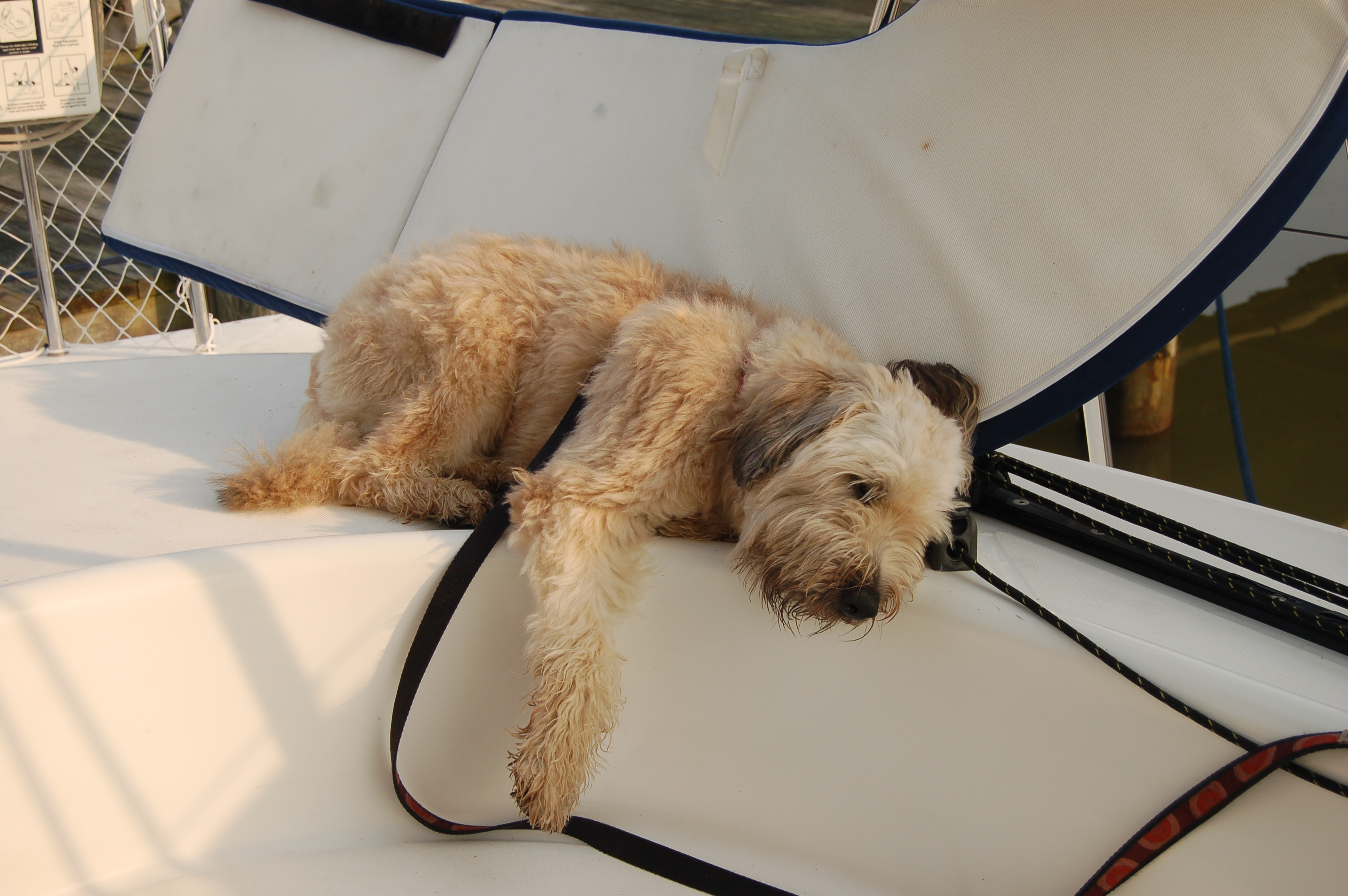
Farley looks how I feel after trying to shop for six months. #sailing The hard part comes after getting back to the boat. After loading the provisions into our dingy, we to lift it onto Mattina.
Then the fun begins. We open all cabinets and storage areas and play the game for figuring out where to store everything.
Farley is left with a corner to sleep in the cockpit. Behind him you can see our cockpit cushions, shoved out of the way, so we can access spots for oil, cleaners, etc.
The question. Why is the dog exhausted when we did all the work?
Share this:

Should Punctuation Show Emotion?
Is it better to use punctuation or dialogue tags? #writetip Here is a very simple example.
“Stop nagging at me!” Jane loomed over her husband and glared.
or
“Stop nagging at me,” Jane yelled. She loomed over her husband and glared.
or
“Stop nagging at me.” Jane loomed over her husband and glared.
I thought the goal was to eliminate exclamation marks. Now, I’ve been given other advice and I’m not so sure.
Any views on this one?
Related articles
- What sense do you use to punctuate? (kristinastanley.net)
- Punctuation (illathrael.wordpress.com)
Share this:
The Mentorship Begins . . .
Yesterday I got my first feedback from Garry Ryan. #writetip Garry is an author from Calgary, Alberta. He writes the Detective Lane series. For those of you who have been reading my blog for a while, I wrote about the Crime Writer’s of Canada mentorship program. I didn’t end of partnering with David Cole, but all has worked out and the program is underway. Garry has volunteered his time to help my make my novel better.
I won’t bore you with the details, but I want to mention one highlight in his comments. There has been talk about series writing this week on some of the writing blogs. Well, my novels aren’t a series, but I do have characters that are in all three novels.
Garry pointed out to me that I don’t describe my characters in the opening scene. Seems obvious, but for me, I’ve lived with them through three novels, so I know what they look like. I just forgot to tell the reader.
Garry is the first person to read my third novel who hasn’t read the first two. I’m not sure my readers who read the first two would have picked up on this omission. I guess it’s good to find readers that haven’t read all your work. You never know what improvement you might be able to make. Thanks Garry.
Related articles
- Literary Mentors (kristinastanley.net)
Share this:
Does Every Character Deserve a Name?
How do you know if you should name your character? #writetip There are loads of writing books that tell you not to name a character unless that character has a significant part in your novel. Well, how to you know?
I name all characters in the first draft. I don’t always understand what role a character might play until I’ve finished the novel.
At the first draft stage, I review each scene for characters that appear only once. For example, I might need a lift attendant at a ski lift for a given scene to work. If that attendant only shows up once, I remove their name. I call them by their title at work, function in the scene, whatever works to identify them.
This is also the stage where I discover who I thought might be a minor character, a walk-on, is really someone significant to the story. Since I’ve already named them, I don’t have to change anything.
I’m sure there are many ways to accomplish this, but this method works for me.
