Does a routine help you write or . . .

Do you write anytime or anywhere?

I find I write best if I have a routine, but life doesn’t alway cooperate. I’m able to write during random times during the day or when I have a free half hour here or there, but what really gets me is too much external input.

I find can’t write while on a long distance drive, but I can write while on a plane. Could be because there is too much to see in the passing landscape along the highway, but really, on a plane? What’s to see.

I can write while I’m alone on a walk (digital recorder is much easier and safer than a pen while walking). But if someone is with me, it’s pretty rude to work on a novel instead of socializing with a walking partner, so no writing during social times.

I can write while we are sailing, assuming my husband is at the helm and the water is flat. Rough water = no writing.

I can write if a TV is on in another room. But I can’t write if music is on. TV – boring. Music – interesting.

I can write in very short periods of time but not if there are too many interesting things going on around me.

When do you write best? Do you get frustrated when you can’t get enough writing time?

Thanks for reading . . .

Novels: Point of a Scene – Is there one or should you cut it?

Is There One or Should You Cut It?

I’ve often read the advice that a novelist should be able to summarize their novel in one to two sentences. This made me start thinking about scenes and chapters.

I asked myself if I knew the point of a scene, and if I didn’t should I cut – yes the dreaded word cut – the scene from the novel? It’s easy to get attached to a scene for many reasons but if there is no point, then I ask you what is the point? J

I challenged myself to go through my latest novel and write one sentence describing the point of the scene.

Taking this one level deeper, and adding a new column to my spreadsheet, I tried to reduce the sentence to one word that described the scene.

This did a couple of things for me.

  1. It showed me what to cut. Ouch.
  2. I helped me organize my chapters into a theme.

The second item was a surprise and created a new way for me to look at organizing chapters.

How do you decide it a scene is needed or not?

Thanks for reading . . .


CWC First Novel Awards

The Crime Writers of Canada Crime Novel Awards

If you are looking for a new author to read, the short list for the 2013 Arthur Ellis Awards is out. Sometimes I find it hard to find a new author to read, so each year I check out the CWC list. There are other categories for Canadian crime writers if you are looking for an author you already are familiar with.

The five novels short listed for the BEST FIRST NOVEL  are:

Confined Spaces by Deryn Collier

The Dead of Winter by Peter Kirby

The Haunting of Maddy Clare by Simone St. James

A Private Man by Chris Lang

The Beggar’s Opera by Blair Peggy.

Enjoy.

Thanks for reading . . .

Proofreading: Choosing a Better Word

During the final proofreading of a novel, a writer can be tempted to change a word, deciding another word is better. I try not to cave to the temptation at this stage, but sometimes I just can’t help myself.

One thing I’ve learned while proofreading is that I need to be very careful during the final reading. It’s easy to introduce a typo, but worse, what if the new word doesn’t fit with the surrounding text?

How to I test this?

First, I replace the word. Then I read the entire scene to determine if it sounds right in the whole context. I often find that I’ve chosen a word already written in a paragraph before or after the one I’ve just altered.

The word change might sound better or it might not, but without testing the scene I wouldn’t know.  To make the process faster, I could search for the word, to find out if it’s anywhere near, but I still think it’s worth reading the scene to make sure the change makes the story better.

Are there things you look out for in the final proofing?

Thanks for reading . . .

Can a Ruler Help You Proofread?

I’m fascinated by how difficult it is to proofread my work. Why can’t my eye see if on the page instead of reading of – that’s not really there?

What does a ruler have to do with proofreading? Let’s call it the new tool in my toolbox.

When I think my work is ready to send to my agent, I print the final copy and read it, line by line, very slowly.

I place the ruler underneath each line as I read it. This forces my eye not to stray forward to the next line. The ruler stays in place until I’ve read every word.

Out of 80,000 words, I found five typos. They were:

–       a missing quote

–       a missing word (had)

–       a missing period at the end of a sentence

–       you’re instead of your

–       color instead of colour

I don’t think I would have found the mistakes without the ruler. This may seem like a lot of work for just 5 errors, but I believe in sending my best work out. If I don’t take is seriously, why would anyone else?

Do you have any proofreading tips you’d like to share?

Thanks for reading . . .

Swimming with Sharks

Living the cruising lifestyle presents some exciting opportunities. It only takes a little courage to take advantage.

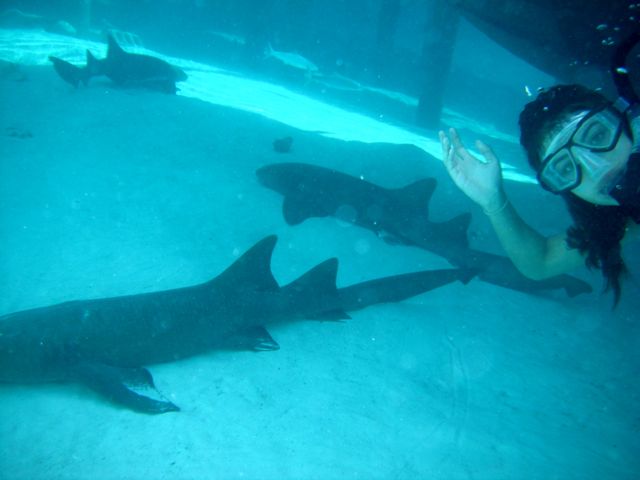
Compass Cay Marina in the Exuma island chain, Bahamas has a school of Nurse sharks that frequent the marina.

The sharks are used to human interaction, although the marina staff does recommend not putting your hand in a shark’s mouth – duh 🙂

My niece had the guts, I had the camera and off we went. She made me go in the water first. “Just in case,” she said. “It’s your duty as my aunt to sacrifice yourself.”

How could I argue? So I went first, nothing ate me and she came in after.

Here’s the proof we swam with sharks – okay I know they’re Nurse sharks and are harmless, but tell that to the adrenaline rushing through my body.

My brave niece and her new friends.

Point of View: Describing Characters

When you are writing in a character’s point of view, can you describe that character’s face or part of themselves that they can’t see?

For example, in a scene written in Ian’s point of view, can the following be written?

Ian blushed and his freckles turned orange.

My thoughts . . . Ian might know he’s blushing from the physical sensation, but how could he know his freckles turned orange?

So if you agree that this isn’t the right way to convey the image, then what?

Perhaps I could:

–       Have another a character make fun of the orange freckles.

–       Have another character say, “I know you’re lying. You’re freckles are turning orange.”

Do you have any ideas how to get around this?

Thanks for reading . . .

How Do You Deal With Thoughts in Your Novel?

Do you use one of the three choices listed below:

  1. Write the thought in italics.
  2. Write the thought followed by a comma and ‘she thought.’
  3. Write the thought and assume your POV is strong enough for the reader to know whose thought it is.

I’ve listed an example of each option below.

Let me set the scene: Two women are running from an encroaching forest fire and one of them (Nora) is nine months pregnant.

Here are the examples:

  1. Kalin slammed the Jeep into park at the end of the dirt road. She leaned over the centre console and checked out Nora’s footwear. Flip-flops. Not good. “Do you think you can hike to Silver Lake?”
  2. Kalin slammed the Jeep into park at the end of the dirt road. She leaned over the centre console and checked out Nora’s footwear. Flip-flops. Not good, she thought. “Do you think you can hike to Silver Lake?”
  3. Kalin slammed the Jeep into park at the end of the dirt road. She leaned over the centre console and checked out Nora’s footwear. Flip-flops. Not good. “Do you think you can hike to Silver Lake?”

Which one do you think is best?

And can an author use all three within a novel?

I’d love to hear your opinion on this one.

Thanks for reading . . .


Cruising and Blogging

As we travel through the Exuma islands, we get a lot of this . . .

Bubble Baths at Compass Cay

But not a lot of internet.

I can blog ahead of time and upload my posts — as long as I’m organized.

I can usually find a connection that’s strong enough to support an email connection, but not strong enough to post or reply to comments.

I love to get comments on my blog, and I try to respond to each one, so I have to say it can be frustrating when I receive a comment via email, know it’s on my blog and I can’t respond.

I guess like many, I’ve become accustomed to the immediacy of our lives and when I don’t have it, I feel disconnected.

Then I remember where I am and what I’m doing and laugh at myself. Life is pretty good in the Bahamas.

Thanks for reading . . .

Canadian spelling?

If you’re a Canadian writer and spell the Canadian, I’d love to know what you do about a forty-two inch flat screen television.

Canadian’s use the metric system, so should it be a 106.68 centimetres? Or maybe 1.0668 metres?

Both seem rather silly to me.

I think using inches is okay in this case.

Any opinions?

Thanks for reading . . .