How to Make the Most of a Writer’s Conference

Thinking of attending a writer’s conference?

You can learn a lot, make contacts and have fun, but how do you make the most of your time?

Here are a few tips:

  • Read the program before attending and decide who you want to meet. If there is a photo of the person/people you want to meet, it will help you pick them out of the crowd.
  • Ask yourself why you want to meet this person and prepare your questions ahead of time. You might only get a few minutes in a hallway, so make the most of it.
  • Often there are several presentations at the same time, so read the synopsis and choose what’s best for you.
  • Bring business cards. If you have any publications or writing awards, print these on the back of your card. You may get the chance to hand your card to and agent or a publisher and this will help them remember who you are. Maybe your card will stand out from the crowd.
  • Don’t be shy. Everyone is there to make contacts, so walk up to  groups of people you don’t know, introduce yourself. Ask what they write as an icebreaker. Who doesn’t like talking about their work?
  • If there is a way to volunteer, do so. It’s an easy way to meet people if you are shy. Sitting at a booth means other people come and talk to you. Working with other people gives you the chance to get to know them.

I hope this helps.

Thanks for reading . . .

Spelling: Canadian Vs. American

I’m confused.

I’m a Canadian and spell Canadian. I’ve spent many hours proofreading my novels to make sure my spelling is consistently Canadian.

I read novels written by Americans and am used to reading American spelling. This can make writing in one or the other difficult. as both ways of spelling look correct. I have my spell checker set to Canadian spelling, but sometimes there is an option and so the spell checker won’t highlight if I’ve slipped into American spelling when both versions may be acceptable.

What I’m saying is I’ve worked hard to keep my spelling consistently Canadian.

Then – and I feel like I should play music here – I attended the Bloody Words Conference in Toronto and a Canadian editor said, “It drives me crazy when the first thing I have to do is change all the Canadian spelling to American. Taking out the ‘u’ gets annoying.”

I didn’t get a chance to talk with her about the comment, but it’s been bothering me ever since.

Do any other Canadian writers out there prefer one way of spelling to another?

Is there a standard in the Canadian publishing industry?

Have I done this the wrong way?

If you’re opinionated on the subject, I’d love to hear about it.

Thanks for reading . . .

Farley’s Friday: A Wheaten Can Listen Well (Audrey Jessup Crime Writing Award)

Farley here,

I’ve had a weird week.

Kristina talked for days on end and it took me a while to figure out what she was doing. First I thought she was talking to me, and I felt pretty flattered to get so much attention.

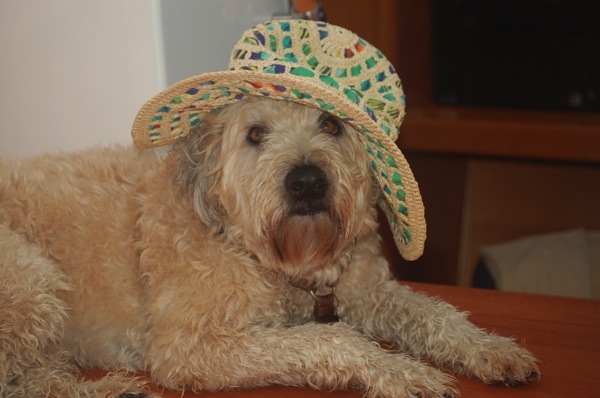
Then I realized she was focussed on something else entirely. And look what she made me wear.

Farley in Hat

“Take this hat off my head,” I bark.

“You’re my audience,” Kristina says.

“Audience for what?” I bark.

“I have to read aloud at the Audrey Jessup awards, and I need to practice.”

“Yeah, but why do have to wear a hat?”

“Because I’m pretending you’re sitting in a bar listing to me read my story.”

Okay, I get it. She’s nervous and wants to practice. She keeps mumbling something about the 10,000 hour theory and the more you do something to better you get at it.

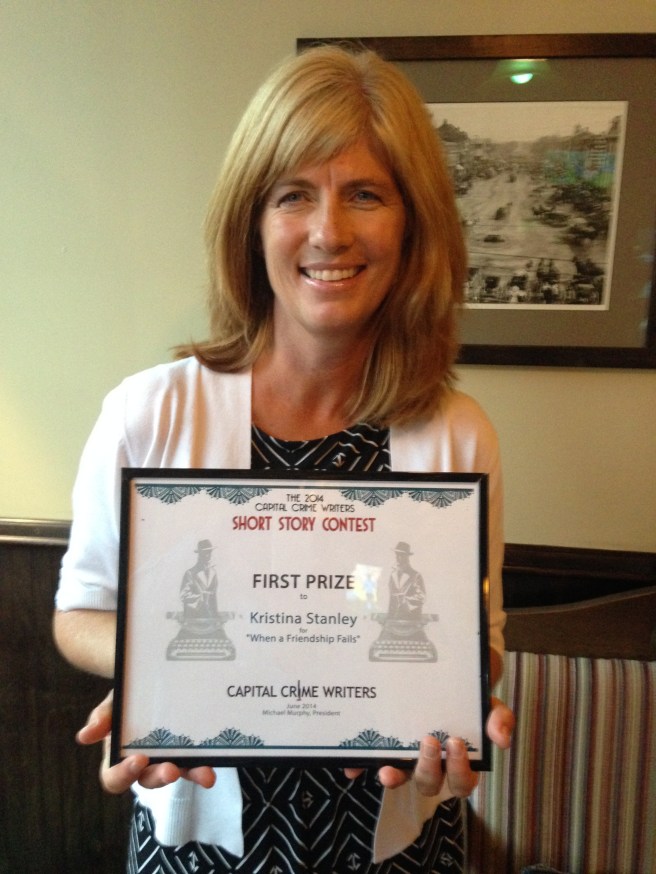
So the night of the awards, she comes home all happy and dances around the living room. She won 🙂

Kristina Stanley Audrey Jessup

Now I just wag my tail. I’ll let her read to me anytime if it helps.

Woof Woof.

Capital Crime Writers


Bloody Words Conference

Danse Macabre: The Historical Dance of Death was the theme of the Bloody Words conference held in Toronto over the June 6th weekend.

The action packed conference started on Friday night and ended Sunday afternoon.

My favourite part: Meeting other authors. What a treat it was to meet with people who have been my “internet friends” for the last several years. I was pleased to see so many of the Crime Writers of Canada authors in attendance.

Learning in the sessions is a given, but learning in the hallway is fun too. Everyone spent time networking  – translate: experienced authors sharing trade secrets with the newbies. There was an opportunity to meet with agents and publishers.

Many thanks to the gang who ran the conference. The hard work put into the conference showed in the professional delivery. On a sad note, rumour has it this is the last Bloody Words conference. The year was my first and I’m glad I got to the event.

Thanks for reading  . . .

Prepping for a Reading

Have you ever read your writing aloud in public? I haven’t and am about to.

My short story “When a Friendship Fails” has been nominated for the Capital Crime Writer’s Audrey Jessup. As part of the nomination, the 5 nominated authors are asked to read part of the story aloud. The event is taking place in a pub in down town Ottawa.

The complete story takes 20 minutes to read, and I’ve been given 7 minutes.

I’ve been using Audacity to practice, and to deliver a strong emotional impact, I need to choose if I should read:

  • from the beginning
  • middle
  • or the last three scenes

Audacity makes me listen and practice. After I decide which section to read, I can work on the timing.

Here’s my question.

When reading a scene on a page, the reader can see paragraph breaks and knows a new character is speaking. But when listening to a story, the listening doesn’t have the advantage of seeing the paragraph breaks. I’m not an actor who can change the sound of my voice for each character (although I’m trying),  so when reading from a finished work, is it okay to add a few he said/she said tags to make it clear who is speaking?

What comes next and is the most nerve-wracking of all: I have to read aloud in front of people.

Yikes.

Thanks for reading . . .

Thanks to HSW Literary Agency

Life as a writer is often spent behind closed doors working hard, but there are moments when a writer catches a glimpse of hope that her work may actually entered the world of the published.

Margaret Hart and Natalie St. Pierre at the HSW Literary Agency have been working hard behind the scene to help me get my novels published.

Their last post at HSW Literary Agency:News certainly made me smile, so here’s a shout out to say thanks.

Sometimes a girl just has to share her happiness.

Thanks for reading . . .

Here is what HSW wrote about me:

Persons Unknown? Crime Writer Kristina Stanley Makes Her Name

Author Kristina StanleyThe life of an author, quietly perfecting her craft, is often anonymous. But the efforts of crime writer Kristina Stanley are at last getting the attention they deserve: Stanley has three works up for separate crime writing awards!

Descent, the first book in Stanley’s Kalin Thompson series, is nominated for the Unhanged Arthur, the Arthur Ellis Award recognizing the year’s most promising piece of unpublished crime fiction. Over in the UK, the Crime Writers’ Association honours book two in the series, Burnt, with a nomination for their Debut Dagger. Finally, just in time for Short Story Month, Stanley’s “When a Friendship Fails” is nominated for the Capital Crime Writers‘ Audrey Jessup Short Story Award.

Congratulations, Kristina! We anxiously await the results!

Scapple and Writing

If you haven’t used Scapple, it’s a neat tool for organizing thoughts when editing or writing a novel.

I made bubble diagrams of each suspect in my novel, Avalanche.

Things I found that helped:

  • Connections between characters that could strengthen the readers belief that one of the characters was guilty.
  • Inconsistencies with clues.
  • Ideas for more clues.
  • At what point in the plot did the protagonist learn important details. Then I made sure I didn’t reference the information earlier.
  • Were the clues evenly balanced amongst the suspects?
The software is free flowing in the sense that you can draw what you like. Bubble diagrams, flow of information etc. It has a free 30 day trial so if you’re interested, you have nothing to lose.

It’s a fun and easy tool to work with, and I think has tightened my plot. See Literature and Latte for a better product description.

Here’s a shout out to Kirsten for pointing out Scapple to me. She always blogs about something interesting and useful.

Do you have any tools to help you write?

Thanks for reading . . .

Farley’s Friday: My Human Is Doing The Happy Dance

Farley here.

My human is singing “Debut Dagger Shortlist” and doing the happy dance. Sometimes Kristina looks really silly, but she’s so happy I won’t mention that to her.

I give her my confused look to ask her what’s going on. Seriously, she’s freaking me out.

Farley looking interested

She makes we wait until I settle down. Then she says, “My novel BURNT has been shortlisted for the Debut Dagger Award.”

“Huh,” I bark.

“It’s from the Crime Writers’ Association in the UK for unpublished authors.”

I decide I better do the happy dance too.

Farley Happy Dance

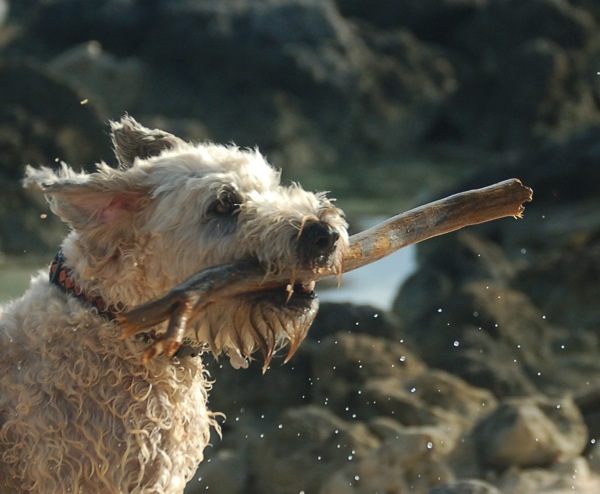
Then I bring her a present. Who doesn’t like an already chewed stick?

Farley With Stick


Well apparently Kristina. She won’t chew it, but she’s still dancing.


Woof Woof


See Mystery Fanfare: CWA Nominations

Reading Before E-Books

Life before E-books? Try sailing before E-books.

On our Niagara 42, Allura, we sailed from Toronto to Aruba and back. Every summer I would scour the second-hand books stores looking for a year’s worth of reading material. Trying to figure out in August what I’ll want to read in January is difficult. So many things influence what I feel like reading.

You can imagine the storage space all the books took up, not to mention the weight. Throughout our first sailing adventure, I searched for book trades if I needed to add to my library. I left books in many marinas and libraries along the way.

Enter E-books. I bought my first Kindle after one year on Mattina. Imagine the happiness my husband felt when I cleared out the cabinets and storage spaces under the bed. He thought he could have the space for storing important things like tools and spare parts. So the negotiations began, and we shared the space. I used to stuff the built-in bookshelf on my side of the bed with books, now I don’t know what to put there. My Kindle only takes up a tiny space.

With the Kindle, I have an endless supply of books at my fingertips. I thought of this today because I’m reading all of the books nominated for the Arthur Ellis writing awards for excellence in crime writing. Before an E-book, I never would have had access to these books while I was sailing. Isn’t it nice how technology makes our lives more fun.

Thanks for reading . . .

Reading to Write Well

I believe to write well, you have to read. Read everything in the genre you write in, read everything close to the genre you write in, read books you would never write but love to read, but find the time to read.

This is a lovely excuse to spend time reading. I pretend I’m working. Yup – working. Then I don’t feel as if I’m slacking off and not doing other things I should be doing.

So how do I find books to read?

Every year when the Crime Writers Of Canada announces the Arthur Ellis Short lists, I read all the books on the list.

I read by category. The Best Novel, Best First Novel, Best Novella.

Then I play a game with myself and pick the winners. After the winners are announced I compare my list to the winning list. If I’ve chosen a different book, I go back and look at the two books and try to figure out why a certain book one over the one I chose. It makes me look at the book in  a different way and helps me learn new writing techniques.

I hope you find time to read too.

Thanks for reading . . .