#Read about Guest #Author Kristina Stanley | Chris The Story Reading Ape’s Blog

Taught by my dad to ski at Camp Fortune near Ottawa, Canada, I’ve spent a good part of my life on the slopes. Winter is my favorite season. I know that sounds crazy since I’ve spent 9 years living …

Source: #Read about Guest #Author Kristina Stanley | Chris The Story Reading Ape’s Blog

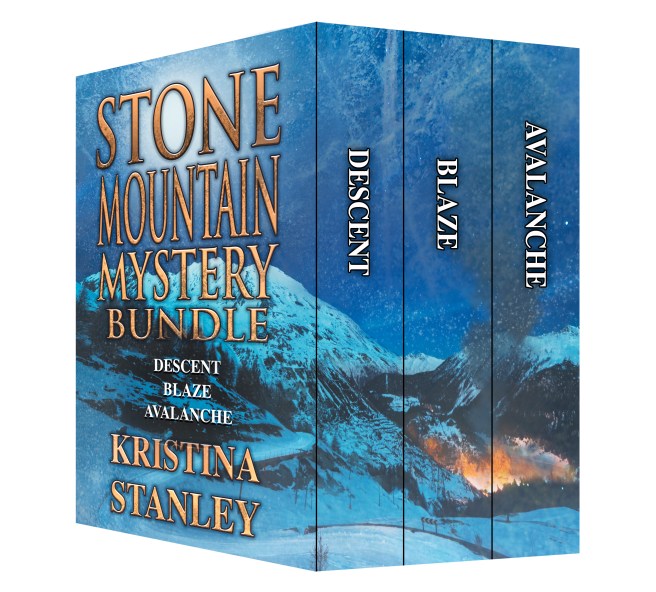
Stone Mountain Mysteries: All 3 Together!

Thank you Cheryl Kaye Tardif and Imajin Books for yet again surpassing my expectations!

Imajin Books is releasing the Stone Mountain Mystery series in a bundle. Now available for pre-order. To be released October 7, 2017.

Stone Mountain Mystery 3D.jpg

If you only want to read one, click the book cover below…

Descent 3D coverBlaze 3d Cover transAvalanche 3D Cover trans

Thanks for reading…

Mystery Mondays: Lyn Horner on Formatting & Publishing on Amazon

Today on Mystery Mondays we have Lyn Horner here to give us an in-depth lesson on how to format and publish your book on Amazon. This is a great resource if you’re about to embark on a self-publishing journey.  Thanks Lyn!

Over to Lyn…

Formatting & Publishing Your Book on Amazon

by Lyn Horner

Many thanks to Kristina for having me on her awesome site. I’m a self-published author with 15 books on Amazon. Some authors hire a service to format and upload their books to Kindle Direct Publishing (KDP), Amazon’s self-publishing platform, but I do it myself. Today I’ll share what I’ve learned about the process.

**First, make sure your book meets Amazon’s content and quality guidelines.

 Then prepare your manuscript:

  1. Back-up your book file onto an external drive or one of the cloud backup sites (or both.) Copies can be a life saver if anything goes wrong during formatting.
  2. Combine your chapters. If you normally save chapters separately, you need to combine them into one document. Insert a page break at the end of each chapter to prevent them from running together in the uploaded book.
  3. Remove page numbers. Kindle books are reflowable (viewable in different font sizes). Page numbers would cause problems. Also remove any headers with the book title, your name, etc.
  4. Your font style must change sizes easily on a variety of devices. Times New Roman 12 pt. works well. Enlarge font for chapter headings.
  5. Remove paragraph indent tabs to avoid uneven indents in your ebook. To remove, type one tab at the top of your document, select and copy it. Open Find in the Edit menu. Paste the tab you copied into the Find box. (Word won’t let you type in the tab.) Open Replace in the Edit menu but leave the box empty; click Replace All. This will remove all tabs from your document.

To replace indents, select one whole chapter at a time, except the chapter title. Go to Indents and Spacing in your Paragraph drop-down. Set your first line indent at 0.5″ (default width) or smaller if preferred. Click okay. WORD will indent each paragraph for you. This does not cause problems with the Kindle conversion.

  1. Do not double space, no double line spacing and no double spaces after each sentence.
  2. Do not underline to indicate italics. Just italicize the word. Be sure to italicize foreign word. They will be underlined in red by the Word spell checker, but those lines will not show in your uploaded file.
  3. Indicate scene breaks within a chapter by centering three or four asterisks, pound signs or other symbol on a line between scenes. For point of view changes in a chapter, I simply insert a blank line. I want readers to know which character’s POV they’re in.
  4. Front and Back matter: Create a title page at the start of your book. See published books for style ideas. Add a copyright page after the title page. Again, see examples in published books. Next, add a dedication page and/or preface if you wish.

End your book by thanking your reader for purchasing it and include live links to your Amazon author page, website, social sites, etc. Then add a brief author bio and review snippets if you have them. Place a page break at the end of each page in your front and back matter.

  1. Amazon wants a table of contents (TOC) even in fiction ebooks, allowing readers to navigate easily. Some authors don’t include one, but I do. Each chapter title in the TOC must link to that chapter in your book. I also include links to my front and back matter pages. Find instructions for creating a TOC in your Word program.
  2. Create an HTML copy. You can upload your book as a doc or docx file, or in html format. To do that, first save your formatted book as a Word document first, in case you need it later. Then hit “Save As” and choose “Web Page, Filtered” as the file type. This converts it to an HTML file.


Another option is to have your book converted to mobi, the Kindle format, by a professional service, but it’s not necessary in most cases.

Okay, your book is ready to upload. Now what?

–Use your Amazon account to sign in to KDP or create a new one.

–Make sure your browser is updated.

–Go to your KDP Bookshelf. In the “Create a New Title” section, click +Kindle eBook and

enter your information for each section:

Kindle eBook Details: Enter title, description, keywords, categories, etc.

Kindel eBook Content: Upload manuscript and create your cover. (That’s a whole different post.) Preview your eBook to make sure everything looks good.

Kindle eBook Pricing: Select the territories where you hold distribution rights. (In most cases you should select Worldwide.) Select a royalty plan and set your list price.

  1. Click Publish Your eBook. Wait ’til your book is live on Amazon, then celebrate!

WHO IS LYN HORNER?

Lyn in cat shirt cropped.2Lyn Horner resides in Fort Worth, Texas, with her husband and several very spoiled cats. Trained in the visual arts, Lyn worked as a fashion illustrator and art instructor before she took up writing. She loves crafting passionate, action packed love stories, both historical and contemporary. Her Texas Devlins series blends Old West settings, steamy romance and a glimmer of the mysterious. This series has won multiple awards and nominations.


Lyn is now writing book 7 in her Romancing the Guardians series. These books combine her trademark psychic phenomena with chilling apocalyptic prophesies and sizzling romance. All feature suspense and adventure in settings ranging from Ireland to Texas, the Navajo Nation and other exotic sites.

Profiling Nathan

Pageflex Persona [document: PRS0000038_00074]Nathan Maguire just wants to make a living inking tattoos in steamy Tampa, Florida, but a serial killer is murdering young women near his shop. Latino gangbangers are giving him trouble. On top of all that, he’s a covert Guardian of Danu sworn to protect one of seven ancient scrolls containing apocalyptic prophesies.
When sexy FBI profiler Talia Werner delivers a message from one of the other Guardians, Nate instantly distrusts her. No one outside the top-secret group is supposed to know they exist, but despite his suspicions, a fiery attraction ensnares the pair. Then, to save Talia’s pretty neck, Nate must help catch the murderer. His psychic gift may come in handy.


Five Star Review from mystery author Craig A. Hart

Lyn Horner doesn’t waste any time getting into the meat of the story with this book. One thing that bothers me about a lot of writers is that they take forever to get to the actual story–not an issue here!

I also enjoyed the characters. Nathan Maguire, a psychic tattoo artist, and Talia Werner, a sexy FBI profiler are both larger than life and help move the story along.

The story itself is a good mix of romance and murder mystery, so there’s something for everyone! Horner also does a good job of creating some great Florida atmosphere, although early on in the book, I got hungry for a Cuban sandwich and had to stop reading to eat something!

A great read!

Profiling Nathan buy links:

US Amazon     UK Amazon     CA: Amazon     AU Amazon

Amazon Author Page: http://amzn.to/Y3aotC

Lyn’s Romance Gazette: (http://eepurl.com/bMYkeX

Lyn Horner’s Corner: (http://lynhorner.com)

Twitter   Facebook   Goodreads   Google Plus

Celebrating LOOK THE OTHER WAY with Imajin Books

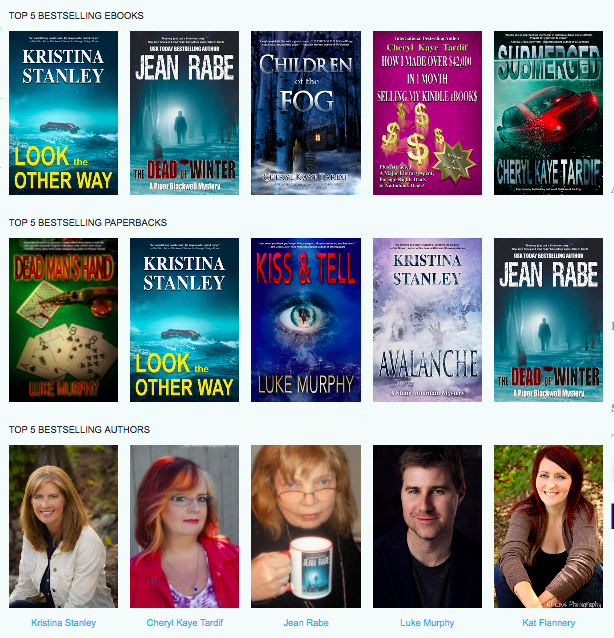
Every month my publisher showcases the top selling books from Imajin Books.

August was an awesome month for Look the Other Way and Avalanche. Top Bestselling eBook, 2nd bestselling paperback, and top selling author overall. I feel like I won the lottery.

Can I just say the smile on my face is huge? I feel so lucky that Imajin Books took on Descent in 2015 and has kept me on as an author.


Imajin Books Aug 2017

Thank you, Imajin Books, for your continued belief  in me.

That’s all for today’s happy dance. Thanks for indulging my little bit of happiness.

Mystery Mondays: Amy Reade on Setting

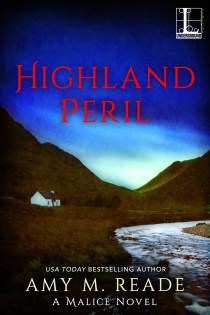
HighlandPerilToday, we are celebrating tomorrow’s release of Highland Peril by author Amy Reade.   Congratulations, Amy!
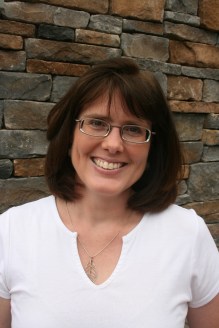
Amy hosts a fabulous blog called Reade and Write. Today she’s talking to us about one of my favorite subjects: SETTING.

Setting the Scene

by Amy Reade

Whether I’m on a panel or at a book signing or visiting a book club, one of the questions I’m frequently asked is whether I consider setting to be a character in my books. I get the question so often that I’ve started putting it in the back of each book as one of the discussion topics.

Here’s my short answer (and yes, I’m answering a question with another question): would the book be the same if it were set someplace else? If no, then I would consider the setting a character. If yes, then setting is probably not one of the characters, however important it may be.

Novels with a strong setting tend to be my favorite books. The main reasons I read are to learn and to be entertained. When a book has a strong atmosphere and sense of place combined with a strong plot, not only do I lose myself in the story, but I also get the opportunity to learn about a new place (or learn more about a place I already know). This is even true for places that don’t actually exist, such as a fantasy world or a fictional town. Two examples that immediately spring to mind are Hogwarts (from J.K. Rowling’s Harry Potter series), and Loch Dubh (from M.C. Beaton’s Hamish Macbeth series).

So how can a setting be a character? Let’s break down some of the qualities of well-drawn characters. Such characters generally have at least three components: personality, emotion or lack thereof, and the ability to change or move the plot along.

In some books, setting has those same three characteristics. Personality, emotion, and ability to move the plot forward can be indefinable when applied to a place rather than a person, but they are easily understood through examples.

Just as with a human character, a setting’s “personality” is its essence. Personality includes a place’s heritage, its culture, its climate; in other words, its specialness. Take, for example, a book set in New Orleans. New Orleans is a place of music, of storied cuisine, and of sultry heat. In any book I’ve ever read that takes place in New Orleans, at least one of those three components are essential to the plot. Such a book could never be set in Chicago without losing its essence.

And how about emotion? In much the same way a human character expresses emotion, a setting can be cheerful, spooky, stormy, listless, or almost any other adjective you can think of. This notion can be applied equally to any setting: towns and cities, houses, islands, boats, schools, hospitals, mountain tops, etc. You get the point.

When I think of a setting’s emotion, often what comes to mind is weather. Weather can play a huge role in a story—think of how wintry weather and blizzard conditions can affect the outcome of a particular plot. That same plot isn’t going to work as well if it’s set in a place where there are no blizzards; in other words, the frigid, blizzard-prone setting is essential to the story.

And when it comes to moving the plot forward, setting has the ability to do that as well as any character. In my first novel, Secrets of Hallstead House, the main character, Macy, can’t swim. The setting of the story is the Thousand Islands region of northern New York, on an island. When a person who can’t swim is put on an island, you can imagine the dread that can develop. And that story couldn’t have taken place, say, on a busy barrier island along the eastern seaboard—it had to take place on a small, isolated island in a region where the weather can be harsh and unpredictable. Just like a human character. There are several instances in Secrets of Hallstead House in which the direction of the plot is determined by the very nature of the island setting.

Now for my favorite part of this post. I’ve made a short list of some of my favorite books which feature setting as one of the characters. Though you may not be familiar with all of them, you are no doubt familiar with most of the titles. I am confident you’ll agree that setting is one of the main characters in each of these books. Remember, ask yourself this question: could this story have taken place anywhere else without losing its very essence?

To Kill a Mockingbird by Harper Lee and Gone with the Wind by Margaret Mitchell: the setting is an absolutely essential part of each of these books, both of which take place in the American south. I would go so far as to say these books wouldn’t even exist if it weren’t for the American south.

Rebecca by Daphne du Maurier: the setting of this book, the Cornish coast of England, is reflected in every action the characters take. Just like the characters, the cliffs and moors, the mansion, and the grounds in Rebecca are stormy, moody, and dark. The book would be fundamentally different if it took place anywhere else.

Heidi by Johanna Spyri: everyone knows the story of the little girl who went up the mountain to live with her gruff grandfather. The mountain is as important to the book as the main characters: Heidi loves the mountain just as she loves her grandfather and her friend Peter; the mountain provides a stark and necessary contrast to the bleak city where she lives temporarily. The story just wouldn’t be the same if Heidi lived in an area that was simply rural without being mountainous.

From the Mixed-Up Files of Mrs. Basil E. Frankweiler by E.L. Konigsburg: if you’re not familiar with this book, the majority of the action takes place in the Metropolitan Museum of Art in New York City. The main characters, a brother and sister, run away from home and live in the museum for a time, trying to solve a mystery they find there. Whenever I think of this book, it’s the museum that comes to mind, not the human characters, not the mansion in the suburbs where they find someone who helps them in their quest, not the streets of New York City. It’s the museum—a setting-character if ever there was one.

Black Amber by Phyllis A. Whitney: this book, probably my favorite of Whitney’s works, is set in Turkey. The plot and setting are inextricably linked—you can’t have one without the other. The story wouldn’t be the same if it were set in, say, Michigan (not that there’s anything wrong with Michigan).

Finally, to my new book, Highland Peril, which comes out tomorrow. As in all my novels, the setting in Highland Peril is one of the book’s most important elements. The main characters live in a little village called Cauld Loch, and though I had to send them to London and Edinburgh for short stints, they always return home to the Highlands. The beauty, the majesty, and the rugged landscape are as important to the story as any character. If you get a chance to read the book, I hope you’ll agree.

Please share your thoughts about books with setting-characters. What are your favorites? Which ones stick in your mind?

Kristina, thank you so much for having me here today. I love the Mystery Monday posts because they make me think, and I hope I’ve done that for your readers.

Who Is Amy Reade?

Amy M. ReadeAmy M. Reade is a cook, chauffeur, household CEO, doctor, laundress, maid, psychiatrist, warden, seer, teacher, and pet whisperer. In other words, a wife, mother, and recovering attorney. But she also writes (how could she not write with that last name?) and is the author of The Malice Series (The House on Candlewick Lane, Highland Peril, and Murder in Thistlecross) and three standalone books, Secrets of Hallstead House, The Ghosts of Peppernell Manor, and House of the Hanging Jade. She lives in southern New Jersey, but loves to travel. Her favorite places to visit are Scotland and Hawaii and when she can’t travel she loves to read books set in far-flung locations.
Where Can You Find Amy?

Website: www.amymreade.com

Blog: www.amreade.wordpress.com

Facebook: www.facebook.com/amreadeauthor

Facebook: www.facebook.com/groups/AmyMReadesGothicFictionFans

Twitter: www.twitter.com/readeandwrite

Pinterest: www.pinterest.com/amreade

Instagram: www.instagram.com/amymreade

Amazon Author Page: https://www.amazon.com/Amy-M.-Reade/e/B00LX6ASF2/ref=ntt_dp_epwbk_0

Goodreads Page: https://www.goodreads.com/author/show/8189243.Amy_M_Reade

And Finally, Where Can You Buy Highland Peril?

Amazon: http://amzn.to/2uaP5dq

Barnes & Noble: http://bit.ly/2uzgzcD

Kobo: http://bit.ly/2v9ooHB

Google Play: http://bit.ly/2vKh6Hh

iTunes: http://apple.co/2ePwnTf

Independent Bookstore: http://www.indiebound.org/book/978151610018

Thanks for reading…

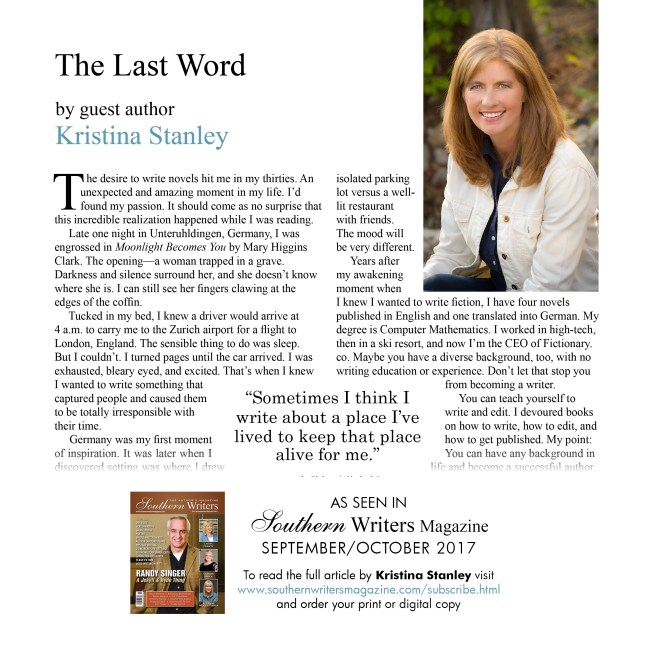
Kristina Stanley has the “Last Word” in Southern Writers Magazine


Talk about thrilled!

Gary Fearon, Creative Director at Southern Writers Magazine, reached out to me and asked if I would write a column in this magazine for authors. So of course, I said yes. Who wouldn’t?

Here’s a little teaser…

Kristina Stanley LW promo SW Sept 2017

Farley’s Friday: Dogs and Sticks

Farley here,

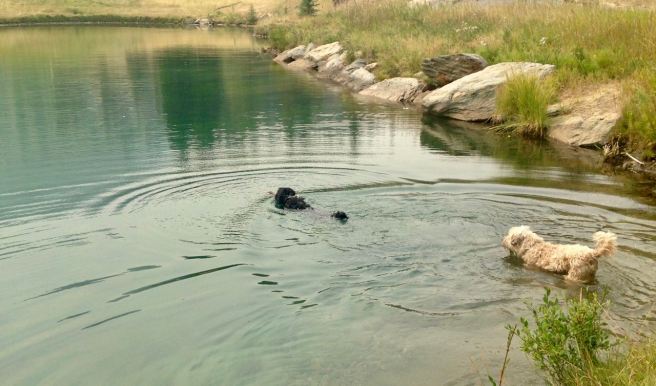
Playing at the pond with my pal Flint.

My human throws a stick. I’m don’t like to swim, so I wait for Flint to get the stick. I’ve a plan to get the stick…and I’m sneaky…

Farley Flint Pond

Flint has no idea I’m making him do the work. But here he comes, and I’ll get the stick without having to swim.

IMG_4116

As it turns out, my plan didn’t work. The trickster gets the stick and takes off. I give Kristina my best stare, but she doesn’t understand she’s supposed to get the stick from Flint and hand it to me!

Farley Flint Stick 2

Grrr….

Woof Woof

Improve Your Novel’s Setting With Structural Editing – Fictionary

Focus on the settings in your novel and write a better story. Structural editing using Ficionary will help you get this done faster.

I highlighted every sentence that described the setting. What I realized was the author only described things or places that were relevant to the plot.

Most writers know the setting creates the story world. But in the context of novel structure, it can do so much more for you.

Consider the following for each scene when working on setting:…

Source: Improve Your Novel’s Setting With Structural Editing – Fictionary

Meet The Best Selling Thriller / Mystery Author- Kristina Stanley!! #amreading #thriller #mystery | Author, Kim Knight

    It’s the 25th of the month, taking centre stage we have another great author, a best selling one at that all the way from Canada! I’m thrilled to have her here let’s not waste anytime. L

et’s get into it and learn Kristina’s style….

Source: Meet The Best Selling Thriller / Mystery Author- Kristina Stanley!! #amreading #thriller #mystery | Author, Kim Knight

Mystery Mondays: L.J.M. Owen on Self-Publishing v. Traditional Publishing

Today on Mystery Monday is another first. We have author L.J.M Owen here and she’s going to share her experience with self and traditional published novels. She’s done both!  It’s all very interesting and insightful.

Mystery Mondays: L.J.M. Owen on Self-Publishing v. Traditional Publishing

In 2015 I accidentally performed the ultimate newbie experiment: self-publishing and traditionally publishing the same book in one year. I’m often asked which option I’d recommend to aspiring authors. Here are my thoughts.

 How did it happen?

The day I finished drafting Olmec Obituary, the first instalment in my Dr Pimms, Intermillennial Sleuth archaeological mystery series, I faced The Question: how do I publish it?

After calculating the odds of my Midsomer Murders-meets-Temperance Brennan tale rising from the collective slush pile, I decided on self-publishing. After all, there had to be other Amelia Peabody devotees out there who would love my awkward archaeologist-librarian protagonist as much as I did, right? All I had to do was find them. Enter crowdfunding.

On 12 December 2014 I launched a Kickstarter campaign to raise sufficient funds to print a 300 copy run. Just five days later I was contacted by a commissioning editor from Bonnier Australia asking to see the manuscript. The ensuing celebratory dance was, I’m told, a sight to behold!

Several nail-biting weeks later and not only did I reach the Kickstarter goal, Bonnier also offered me a book deal.

So, in 2015 I found myself publishing my first novel twice—once as a limited edition self-produced run, and then with a traditional publisher.

 How did the processes differ?

The differences between the two experiences were stark.

To set up a Kickstarter proposal I had to sell the book to potential readers, which involved developing a project outline, financial spreadsheets, and a promotional a video and blurb. Then I stumbled through crash courses in Twitter and Facebook in an effort to reach my prospective audience. It was a month of incessantly promoting my work to others, not a comfortable undertaking for any introvert.

In order to complete the self-published run I had to develop brand new skills in editing, design, typesetting in multiple formats, printing, distribution, shipping, finances, social media strategy, marketing and events.

The exhaustion was overwhelming. I failed basic hair shampooing. Twice. (Despite the limited options in the confines of a shower cubicle I have no idea what I put in my hair. Can body wash and face scrub combine to form builder’s putty?)

Ultimately, I found self-publishing as a first-time novelist arduous but gratifying. The fatigue was the most difficult aspect to manage; if I had continued with self-publishing I honestly don’t know how many instalments I could have produced in the Dr Pimms series before collapse. Yet there was a special joy in sending books I had personally created to readers that, to this day, remains unmatched.

Publishing with Bonnier, by comparison, meant a team of experts handled cover design, typesetting, printing and finances. I was involved in editing, marketing and events, but not responsible for organising them. Oh, and the distribution! My traditionally published Olmec Obituary was on the shelves of every major book chain in Australia, something I could only dream of as a self-publisher.

The one difficulty I faced with traditional publishing was having to let other people in to largely control the process. If you’re used to (in life) being responsible for all aspects of delivery, as I am, it’s a touch unnerving to share the process. The benefits, however, far outweighed any considerations of personal comfort.

I’m three books into my planned series of nine now, and I honestly don’t know if I would have made it this far as a self-publisher. Apart from the innumerable practical aspects of publishing taken care of by Bonnier, having the support and encouragement of a commissioning editor who believes in my work is invaluable.

 Which would I recommend?

Is self-publishing suitable for you? If you’re passionate about getting your work out there and confident you can handle the editing, typesetting, cover design, publishing, marketing and events on your own–or hire people directly to do those things for you–then yes. You’ll have the certainty of knowing your novel will be published, as long as you can shoulder the burden of managing the entire project.

If you want the machinery of a publishing house behind you, and are prepared to wait until you connect with the right publisher (I’m aware of and grateful for my ridiculously good fortune in having been plucked from obscurity via the internet), then the long-term benefits to an emerging author of signing on with a good publisher are incalculable.

Of course, you can always go for a combination by self-publishing some work while pitching other pieces to traditional publishers. If you’re successful as a self-publisher–that is, you build a significant social media following and demonstrate that your work sells–you’ll be an attractive proposition when the right publisher comes along.

WHO IS L.J.M OWEN?

2015-07-03 20.36.06 (3)DR L.J.M. OWEN escapes dark and shadowy days as a public servant by exploring the comparatively lighter side of life: murder, mystery and forgotten women’s history. An author, archaeologist and librarian with a PhD in palaeogenetics, L.J.’s focus is on transforming science and history into accessible fiction with a broad appeal.

A passionate advocate for reclaiming women’s history, L.J. incorporates human genetics, forensic science and ancient cultures in her Australian-set mystery series: Dr Pimms, Intermillennial Sleuth. The first book in the series, Olmec Obituary (2015) was awarded a Highly Commended in the 2016 ACT Writing and Publishing Awards. The second in the series, Mayan Mendacity (2016), will be followed by Egyptian Enigma in 2018.

In addition to writing, L.J. is a panellist, interviewer, workshop provider and public speaker. Rare moments of free time are spent experimenting with ancient recipes–under strict feline supervision, of course.


Mayan Mendacity

Mayan Mendacity_COVERDr Elizabeth Pimms has a new puzzle.

What is the story behind the tiny skeletons discovered on a Guatemalan island? And how do they relate to an ancient Mayan queen?

The bones, along with other remains, are a gift for Elizabeth. But soon the giver reveals his true nature. An enraged colleague then questions Elizabeth’s family history. Elizabeth seeks DNA evidence to put all skeletons to rest.

A pregnant enemy, a crystal skull, a New York foodie, and an intruder in Elizabeth’s phrenic library variously aid or interrupt Elizabeth’s attempts to solve mysteries both ancient and personal.

With archaeological intrigue, forensic insight and cosy comfort, Mayan Mendacity takes readers back into the world of Dr Pimms, Intermillennial Sleuth.

Really cold cases.

You Can Find Her…

Website:  ljmowen.com

Facebook Author Page: @DrLJMOwen

Facebook Book Series Page: @dr.pimms.intermillennial.sleuth

Twitter: @Bleuddyn_Coll

Instagram: Librocubicularist (@ljmowen)