Mystery Mondays M.H. Callway on NaNoWriMo

Mystery Mondays welcomes M.H. Callway to talk about riding NaNoWriMo Tiger.

If you don’t know what NaNoWriMo is: read on!

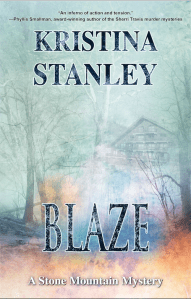
I know M.H. Callway as Madeleine. We met online through other authors. Madeline has a special place here as she provided an endorsement for my second novel, BLAZE. It’s difficult to ask another author for an endorsement and Madeleine said yes right away. Her generosity with her time and thoughtfulness in writing an endorsement has pushed my writing career along.

So please help me welcome M.H Callway.

RIDING THE NANOWRIMO TIGER by M.H. Callway

Many thanks to Kristina for inviting me to her blog! I’m delighted to be here.  Today I want to share with you my experiences doing last November’s National Novel Writing Month or NaNoWriMo.

Print

My friend and fellow author, TO Poet, encouraged me to join him and his friends for this 50,000 word marathon adventure. He has ridden the NaNoWriMo tiger no less than six years running.

So I jumped in feet first with little – well, let’s be honest – no preparation!


What is National Novel Writing Month?

November is pretty dull so every year hundreds of thousands of authors around the globe try to write 50,000 words to fill up the 30 days. Chris Baty and 21 of his writer friends came up with the idea in San Francisco more than 15 years ago. Thanks to the internet, participation has since gone viral. In 2015, writers located as far away as central Russia and Micronesia took part. No restrictions, no writing experience necessary.

How did y’all keep going? 

TO Poet set up a Facebook page for our team, the NaNoWriMo Misfits.  He kept us inspired with daily posts and we logged on to report our progress. Peer pressure proved to be a compelling motivator for me.

And coffee. Lots and lots of coffee.  TO Poet’s coffee mugs rival goldfish bowls.

Why embark on this marathon?

Like most newly published authors, I’d spent the past 12 months promoting my debut novel, Windigo Fire,  through conferences, meet-ups, bookstores and libraries. On my own or with our group, The Mesdames of Mayhem, I literally did hundreds of events. I needed to do get back to work on the second novel in my Danny Bluestone series, Windigo Ice.

Not that my keyboard was idle. I managed to write a suspense novelette, “Glow Grass”, for the Mesdames of Mayhem’s second anthology, 13 O’clock.

What plan / approach to use? 

As a scientist and MBA-type, I knew that an overwhelmingly large project can be broken down into incremental steps. That meant 1700 words over 30 days to reach the required 50,000 word count. I did a couple of test runs to prove to myself that I could pull it off. November 1st dawned and I was off and writing!

How did NaNoWriMo go? Did you make 50,000 words?

I did indeed make the grade: 50,048 words to be exact.  Here are the stats from my trusty Excel spreadsheet: my daily output ranged between 1600 and 2200 words. On my last day, I wrote 3300 words just to get done – my record for the month! It’s “the barn door syndrome” familiar to runners: we get a charge of life-saving energy when we spot the finish line.

What worked with NaNoWriMo?

For me, NaNoWriMo was a lifesaver. I refocused on writing and pushed aside life’s nagging demands to make it a priority.

Meeting my daily word count meant turning off the editor in my head. I tend to be a deliberate, measured writer so NaNo felt immensely freeing. I got to know my characters again, resolved tricky plot problems, churned out fun action sequences and created an encounter between Danny and Santa, the escaped villain from Windigo Fire that was a joy to write.  I now have several ideas for the core theme(s) and a goodly chunk of words to draw on – or to store for Books 3 and 4.

What challenges remain? 

After the freedom of NaNo, the hard work really begins, the tough thinking especially. I had to put my “plotter” hard hat back on while surrendering my “pantser” plumage with a sigh. I reviewed the 50,000 words I wrote and organized everything into a plot-logical order.

Right now I’m developing the details of the crime at the heart of Windigo Ice. And fleshing out the villain who made his first ghostly appearance to me during NaNo.

A thriller runs 80,000 to 100,000 words so even if all my 50,000 words were useable, I’d only be halfway there. That’s the keyword: useable. Editing is the next big step so in February, we NaNo Misfits are will be supporting each other during our Edit Month.

Would you recommend NaNoWriMo to other authors?

Most definitely! I’m pumped about Windigo Ice and can’t wait to finish writing Danny’s winter adventures. It’s a great way to get refocused on writing and to bond with fellow authors.

In an ideal world, I’d recommend having one’s plot meticulously laid out so that one’s first draft would be done by the end of November. But no matter, anyone who participates will be infinitely farther ahead than sitting around worrying about finding time to write.


Madeleine’s BIO:

madeleineM. H. Callway’s critically acclaimed debut novel, Windigo Fire (Seraphim Editions) was short-listed for the 2015 Arthur Ellis Award for Best First Novel. Under different titles, it was nominated for both the Unhanged Arthur and the Debut Dagger Awards. Margaret Cannon of The Globe and Mail called her “a writer to watch”.

Madeleine’s crime fiction stories, many of which have won or been short-listed for major awards, have appeared in anthologies and magazines. Most recently, her speculative fiction story, “The Ultimate Mystery” in World Enough and Crime (Carrick Publishing), was a 2015 Derringer finalist.

Madeleine blogs regularly about the weird things she encounters and about the wonderful people in her life. Visit her at www.mhcallway.com.

In 2013, she founded the Mesdames of Mayhem, a group of 15 established Canadian women crime writers. Two anthologies showcase their work: Thirteen and 13 O’clock. Stories in Thirteen were finalists for the Arthur Ellis and Derringer awards. Learn more about the Mesdames at www.mesdamesofmayhem.com

Madeleine is a longstanding member of Crime Writers of Canada and Sisters in Crime. An avid cyclist, runner and downhill skier, she has participated in the Toronto Ride to Conquer Cancer every year since 2008.  She and her husband share their Victorian home with a spoiled cat.

***

Thanks for reading…

Next week we welcome Lisa De Nikolits
 

Farley’s Friday: A Wheaten’s Dancing Shoes

Farley here,

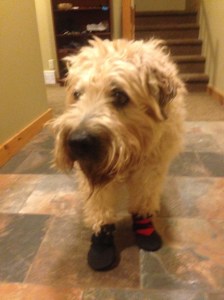
I lost a boot and look what my humans made me wear. One red shoe. All the others are black. Farley with Red BookI’m calling it my dancing shoe.

I’ll make the best of it if and try impress the other dogs with my skills on the slopes and maybe they won’t notice my mismatching shoes…

Maybe I can persuade Kristina to go shopping.


Woof Woof.

Book Deal with Luzifer-Verlag in Germany

How to announce something so exciting…I’ve signed a deal with Luzifer-Verlag for the the print and ebook rights for the German translation of DESCENT.

Screen Shot 2016-01-26 at 6.25.11 AM

How did this happen?

Liliana Conn translated the English version of DESCENT in to German. My publisher, Imajin Books and Cheryl Kaye Tardiff, brokered the deal. Essentially, my publisher acted as my agent. I can’t thank Liliana, Cheryl and Luzifer-Verlag enough for supporting me.

What happens next?

A new book cover for DESCENT to fit the German market.

Final translation and editing of the German version.

Off to print DESCENT goes.

I’ll let you know how this goes and what I learn in the process.

What is DESCENT about?

When Kalin Thompson is promoted to Director of Security at Stone Mountain Resort, she soon becomes entangled in the high-profile murder investigation of an up-and-coming Olympic-caliber skier. There are more suspects with motives than there are gates on the super-G course, and danger mounts with every turn.

Kalin’s boss orders her to investigate. Her boyfriend wants her to stay safe and let the cops do their job. Torn between loyalty to friends and professional duty, Kalin must look within her isolated community to unearth the killer’s identity. 

If you’d like to try DESCENT in English, you can find it at: myBook.to/Descent

Has anyone else had their book translated to another language? I’d love to know what your learned in the process.

Thanks for reading…


Mystery Monday: R.J Harlick on When Dreams Become a Reality

This week I have the honor of hosting R.J. Harlick on Mystery Mondays. I was lucky enough to have R.J. provide an endorsement of BLAZE which I proudly display on the cover, so it is a true pleasure to have her on Mystery Mondays.

R.J is here to talk to us about When the dream becomes a reality.

By R.J. Harlick

Hi Everyone.

I’m thrilled to be speaking to you today on Kristina’s blog . Thanks, Kristina for inviting me.

Today I thought I would address a question I am often asked by readers. At what point did I know I wanted to be a writer?

Though some of my confrères knew at a very young age, for me it was a more gradual transformation. There was no lightening bolt moment when I shouted, “Yes, I want to be a writer.” I more or less slid into it, starting where most writers start, as a reader.

As a child, I devoured books, in particular mysteries beginning with Nancy Drew and the Hardy Boys, eventually graduating to Agatha Christie, Sherlock Holmes, Dorothy Sayers, Raymond Chandler, Nero Wolf and the like. Sometimes I thought it would be fun to write one of these myself.

I even tried writing a mystery for a grade seven English class. But I blush at the memory. I’m afraid this first attempt was far too long and, I hate to say it, far too boring. Nonetheless I kept this idea of writing a mystery buried in the far reaches of my mind.

Though I loved reading, English was never my favourite subject in high school. I found the piecemeal taking apart of a story would destroy the magical hold it had over me. But I loved the creative writing part of English classes. I’d spend many an hour on class assignments making the stories swirling around my head come alive with words. Needless to say many had a mystery angle to them.

In university, I continued to enjoy playing with words. I excelled at making essays sound as if I knew something about the topics about which I was writing, when I didn’t. Studying wasn’t one of my strengths. Perhaps this is where my penchant for creative writing started.

I also continued to read voraciously branching out into the world of the greats. Though I thought it might be fun to become a writer, like Ernest Hemingway or Somerset Maugham, I didn’t treat it seriously. I didn’t really think I had it in me.

This enjoyment for words continued on into my work life as an information technology consultant. I invariable preferred the writing part of my job to other aspects. But it was business writing; letters, proposals and reports. Nonetheless I continued to harbour the dream of being ensconced somewhere bucolic penning the next great Canadian novel, or should I say mystery.

To satisfy my need to write, I started recording my time spent at my log cabin in a journal. Finally, one day after reaching a significant birthday, I decided it was time to find out if I could become the fiction writer in the bucolic setting of my dreams. The setting was easy. I was already sitting in it; the screened-in porch of my log cabin overlooking the surrounding forests. And so I set out to write what would eventually be published as my first Meg Harris mystery, Death’s Golden Whisper.

My first goal was to see if I could write a novel. Up till then, none of my business writing had approached the one hundred thousand word length of a typical novel. The next goal was to determine if I could write fiction, for I quickly discovered fiction writing was a totally different animal from business writing. As I marched along this new adventure, scene after scene, chapter after chapter, toward the climactic end, I realized I really, really enjoyed it. I decided writing was what I wanted to do for the rest of my life. The third goal, of course, was to see if I could get it published. But this is a story best left for another day. Let’s just say it was a long haul with many disheartening rejections.

Seven books and the odd short story later I am still having fun. I’m in the midst of continuing my adventure with Meg. I’m midway through the writing of the eighth Meg Harris mystery. Though I do have a title, I’m not quite ready to share it, in case I change my mind. But I will tell you that the colour for this book is purple and it will be set in the Northwest Territories.

What about you? Was it a slow gradual slide into becoming a writer or did you know from the get-go that you wanted to be one?

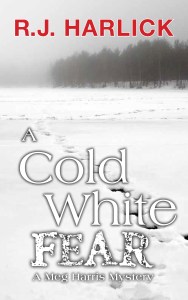
Cold White Fear final coverNow for some BSP – If you happened to live in the Toronto area, I will be reading from and signing my latest book A Cold White Fear on Thursday, January 28 from 6:00 pm to 7:30 at Sleuth of Baker Street on Millwood Ave. It would be fabulous to see you there.


OLYMPUS DIGITAL CAMERA

RJ Harlick is an escapee from the high tech jungle. After working for over twenty-five years in the computer industry, first for major computer corporations such as IBM and DMR Group, then with her own management consultancy practice, she decided that pursuing killers by pen would be more fun than chasing the elusive computer bug.

Originally from Toronto, R.J., along with her husband, Jim, and their standard poodles, Sterling and Miss Molly, now bides her time between her home in Ottawa and log cabin in West Quebec. A lover of the outdoors, she spends much of her time roaming the forests of the Outaouais. Because of this love for the untamed wilds, she decided that she would bring its seductive allure alive in her writings. This she has done in her Meg Harris mystery series, where the wilderness setting plays almost as large a role as the main character, Meg Harris.

Write Better Fiction: Point of View Character Goal

Feedback iconToday on Write Better Fiction we’ll cover the Goal of your Point of View Character. Write Better Fiction is a process to help you critique your own manuscript and give yourself feedback. This will help you improve your novel, so you’re ready to submit it to an editor. Check the bottom of this post for links to previous Write Better Fiction articles.

Last week I wrote about naming a scene. This week I’ll cover the goal of the point of view character. Each scene will have a point of view character, and we discussed this in #1 question to ask yourself about plot. ADD LINK

The point of view (POV) character must have a goal. Without a goal, what’s the point?

There are two types of goals:

Internal: The reader isn’t told what the POV goal is.

External: The reader clearly understands what the POV goal is.

Each POV character should have an overall novel goal. The most important goals should belong to your protagonist and antagonist. Of course, these goals should oppose each other.

Screen Shot 2015-12-17 at 1.28.11 PMThe overall goal drives the character throughout the novel. In DESCENT, Kalin Thompson’s external goal is to find out who killed an Olympic-caliber skier. She has an internal goal that drives her through the first three novels in The Stone Mountain Mystery series, which I can’t share or it would ruin the mystery, but it’s there and influences how I write.

Finding a murderer is Kalin’s main goal throughout DESCENT. She also has goals within each scene where she holds the point of view. In the opening scene her external goal is to go skiing. Her internal goal is to be good at her job. Both goals will be tested very early in the story.

The reader doesn’t know about the internal goal, but it helped me create a focus and drive for Kalin in the next few chapters.

Other characters might have a goal in the scene. In fact, they should and it should be in conflict with the POV goal. This is a different column in the spreadsheet that we’ll talk about later.

Your challenge this week is to review each scene in your novel and determine what are the internal and external goals of each POV character. This will also focus you on the who has POV and give you another opportunity to check you’re consistent with the POV and that you’re not head hopping (unless it’s intentional). Please let me know in the comments if this helped you write better fiction.

I critiqued DESCENT and BLAZE using the techniques I’m sharing in Write Better Fiction, and I believe this helped me sign with a publisher.

Previous blog posts on Write Better Fiction:

Please me know in the comments below how you deal with the goal of your POV characters? Did you have difficulty defining a clear scene goal?

Thanks for reading…

Farley’s Friday: A Wheaten Nordic Skis

Farley here,

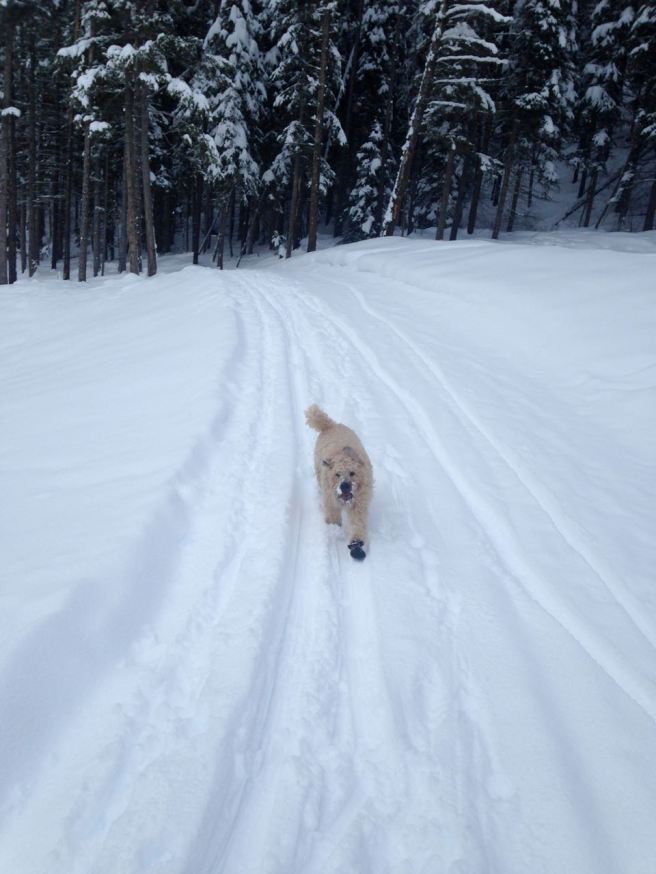
January is here, and Kristina and I are hitting the nordic trails. The first problem…the crowds. Wag, Wag, Wag.

Farley Nordic Skiing

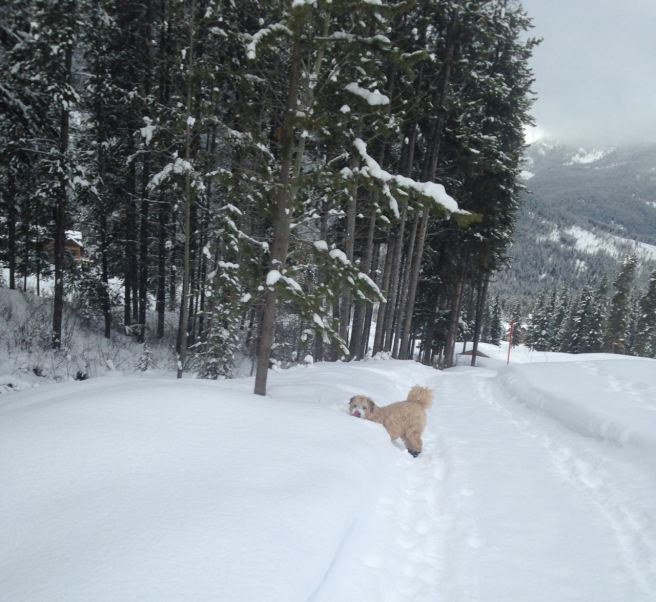
The second problem. Going up hill, Kristina is so slow I have to bury my head in the snow while I wait for her.  Can’t say I like the ice chunks in my eyes, but it’s worth cooling my head.

Farley Nordic skiing 2

Downhill is a rush, but Kristina says she’s not coordinated enough to take a photo when where going that fast. Maybe she should get a go pro 🙂

Woof Woof

P.S. if you haven’t read DESCENT or BLAZE yet, she’s getting some awesome reviews. Here’s her latest review for DESCENT by Author Judy Penz Sheluk:

A great debut mystery novel! The location of Stone Mountain Ski Resort in British Columbia is so well drawn, I could almost see my breath puff out in the cold, and the protagonist, Kalin Thompson, a rookie head of security, is entirely believable. Add to the mix a sexy boyfriend and an interesting cast of characters and you’ve got yourself a winning combination. Thoroughly enjoyable!

All dogs love to be read out loud to, so if you want to do some reading for your dog, you can get the books at:

myBook.to/Descent

myBook.to/BLAZEbyKristinaStanley


Write Better Fiction: Scene Naming

Feedback iconToday on Write Better Fiction we’ll cover NAMING A SCENE. Write Better Fiction is a process to help you critique your own manuscript and give yourself feedback. This will help you improve your novel so you’re ready to submit it to an editor. Check the bottom of this post for links to previous Write Better Fiction articles.

Last week I wrote about the action in a scene. Maybe it seems odd I chose to fill out the action before naming the scene, but I have a strategy for this.

Did you find it hard to describe a scene in three sentences or less? Well, naming a scene is harder, but it help you hone the scene.

Scene NamesNow I’m going to ask you to use one word to name the scene. If you must, you can use two. I confess this sometimes happens to me.

Some writers list scenes with numbers only and that’s fine. For me, the exercise of naming the scene makes me narrow down what the scene is about. Since I already have the scene action defined in one to three sentences, the scene name might already exist somewhere in those words.

The Scene Name column is connected to the Purpose of a Scene column, and will help you discover what the scene is really about. The purpose of the scene is another place to look for hints on what to name your scene. At this point you may want to re-evaluate the purpose of the scene in case you’ve changed your mind based on the scene action and naming the scene.

The names of the scenes might give you insight into the theme of your novel.

Your challenge this week is to name each scene in your novel. Then let me know if this helped you focus your scenes.

I critiqued DESCENT and BLAZE using the techniques I’m sharing in Write Better Fiction, and I believe this helped me sign with a publisher.

Previous blog posts on Write Better Fiction:

Please me know in the comments below how you name your scene? Is it important for you to have a scene name?

Thanks for reading…

Mystery Mondays: Elinor Florence on the Mystery Genre

This week on Mystery Mondays we welcome Elinor Florence. I met Elinor about a year ago, and since then we’ve been sharing our writing and publishing experiences over lunches.

Here’s what Elinor has to say about genres and her debut novel, BIRD’S EYE VIEW.
Bird's Eye ViewMy wartime novel Bird’s Eye View isn’t a classic murder mystery – although I have seen it shelved in the Mystery section of one bookstore – but rather, a whole series of mysteries.

You see, in my novel the serial killers are the Nazis, and my detective is an aerial photographic interpreter. Rose Jolliffe is an officer in the Royal Canadian Air Force. Like Sherlock Holmes, she uses her magnifying glass to study aerial photographs for clues, trying to outwit the enemy.

Along the way, she tackles a number of baffling mysteries:

  1. When the Allies bomb an important railyard behind enemy lines, why don’t the aerial photographs taken the next day show any damage?
  2. Is that charming French village real, or is it an elaborate camouflage created by the Germans to disguise an aircraft factory?
  3. Most importantly, what is the secret revenge weapon that Hitler says will win the war — and where on earth is it?

Rose examines aerial photos to the point of exhaustion (since there was no colour film, she is literally studying fifty shades of gray), striving to solve these and other mysteries – painfully aware that her failure will cost thousands of lives.

She is suffering from personal strain as well. Her brother Jack is flying a Spitfire, and she fears for him every day. She is in love with her commanding officer, who unfortunately already has a wife. And she is desperately homesick for her farm on the Canadian prairies. She keeps in touch with the home front through a constant flow of letters from her parents and her best friend, June.

Bird’s Eye View is the only novel ever written in which the main character is a Canadian woman in uniform. I find that very sad, considering that there were fifty thousand of them in World War Two alone. They were just as patriotic and dedicated as the men, but we know little about them. I wanted to shine a light on women’s contribution to the war effort.

To create my characters, I drew heavily on my own family. My mother lived through the war as a teenager in Canada, and her home town of North Battleford, Saskatchewan was an air training base. Her beloved elder brother was killed in the war. My father served in the Royal Canadian Air Force, as did my uncles. So I had access to a gold mine of personal anecdotes.

I was also intrigued by that fascinating but little-known branch of Allied Intelligence called photo interpretation. During the war hundreds of trained interpreters studied the aerial photos brought back from Europe – literally spying on the enemy from the sky. I read as much as I could about the subject, and travelled to both England and Germany for my research. Every incident in the book is based on fact.

Since the book was published a year ago, I’ve received hundreds of positive comments. People often tell me that my book enlightened them about our own Canadian history, especially the role of women. One former bomber navigator told me that he combed my book looking for errors and couldn’t find any – that was music to my ears! Others tell me that my book moved them to tears. Touching people’s hearts is always a good thing.

By far the most typical comment, however, is this: “I couldn’t put it down!” That’s the best compliment of all.

Elinor Florence PhotoElinor Florence is a career journalist who grew up on a farm in Saskatchewan, a former wartime airport. She wrote and edited daily newspapers and magazines across Western Canada, including Reader’s Digest. Married with three grown children, she now lives in the mountain resort of Invermere, British Columbia. Bird’s Eye View is her first novel. It’s available through bookstores or online from Amazon, and as an ebook. Order it here: http://www.amazon.ca/Birds-Eye-View-Elinor-Florence/dp/1459721438/ref=sr_1_1_twi_1_pap?ie=UTF8&qid=1429642038&sr=8-1&keywords=Birds+eye+view

Thanks for reading…


Farley’s Friday: A Wheaten Holiday

Farley here,

It’s January now, and I’m dreaming about all the fun I had over the holiday.

I made a new friend but forgot to ask his name.

Farley and pal


I played with an old friend, Finn.

Farley and Finn with Stick

And I opened every present under the tree. Talk about ripping good fun!

Farley opening gits

Woof Woof

Write Better Fiction: Scene ACTION

Welcome the 2016 kickoff of Write Better Fiction. It’s the start of a new year, maybe you wrote your manuscript during November, took a break for the holidays and are ready to get to work.

But what to do? How about self-critiquing your manuscript?

If you missed the first three blogs in this series, you might want to check them out before reading this one.

Feedback icon

I need a systematic method for critiquing my novels, and I’ve used this method for all my novels. To prove to you it works, here is what Todd Barselow, senior editor at Imajin Books, said about DESCENT.

“My life would be so much easier if all the manuscripts that crossed my desk were as clean as yours.”

Now that I have your attention, today I’ll explain how to use the ACTION column.

Screen Shot 2015-11-30 at 5.06.20 PM

I keep this entry short. Use only one to three sentences to describe what happens in the scene. If you can’t describe the action in three sentences, maybe too much is happening in the scene, and it could be broken into two or three scenes. A scene with too much happening might confuse or exhaust the reader.

Once you’ve written the action for every scene in your novel, review the entire column and look for repetitions. Repetitions, unless written for a purpose, can be boring to the reader.

For example, your protagonist is hit by a car. In three different scenes you fill in the action, having your protagonist tell another character about the incident. Do you really need to have this happen three times? Could you summarize if the other character needs to know this information?

The action column helps me write a synopsis. After I’ve completed this for the manuscript I cut the column, save it to a word document and start writing a synopsis. It’s only a beginning, but it gives me a framework. And we all know how hard it is to write a synopsis.

Your challenge this week is to articulate the action for each scene in your novel. Please me know in the comments below how you evaluate the action? Do you have a question you ask yourself about action?

I critiqued DESCENT and BLAZE using the techniques I’m sharing in Write Better Fiction, and I believe this helped me sign with a publisher.

Thanks for reading…