Before You Submit: Hyphenated Adjectives

Do you have a draft of your novel or short story and are thinking of submitting to an agent, publisher or writing contest? My series called Before You Submit might help. This series contains hints and tips I’ve received from professionals in the publishing industry. Each week I’ll share a new tip.

This week I’ll write about Hyphenated Adjectives.

If you’ve been reading Before You Submit, you’ll know I love getting feedback from an editor. Some of the tips I’m presenting are from the  early days of my writing career, and I’m almost embarrassed to admit I made these mistakes. I say almost, because we all have to learn, and not all of us remember everything we learned in grade school.

The editor corrected the following sentence:

Young people living in a dorm type facility . . .

to:

Young people living in a dorm-type facility . . .

Instead of trying to describe the nuances around hyphenated adjectives, I’m going to refer you to Grammar Girl for an explanation. If you don’t know about Grammar Girl, it’s an excellent site to look up grammar rules. The hyphen is a tiny mark on the page, but one that will show an acquiring editor you are serious about your trade if you get it right, or you have homework to do if you get it wrong. The lack of a hyphen when you need one could throw your novel back into the slush pile, especially if it’s on the first page.

I hope this helps improve your writing.

See Before You Submit:Likeable Characters for the first blog in this series and an introduction the benefits of submitting even if you get a rejection letter.

Thanks for reading . . .

Farley’s Friday: A Shoulder Injury

Farley here,

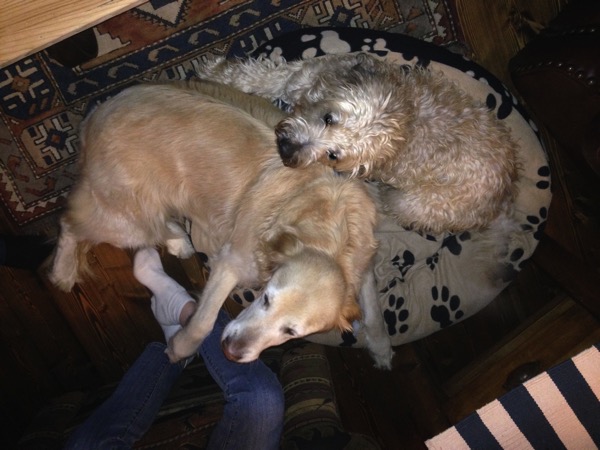
I don’t want you to feel sorry for me, but I hurt my shoulder this week, and I used  gestures to let Kristina know I had a boo boo. The only problem with my gestures is I made her sad instead of making myself feel better. Sometimes I wish I could talk.

Kristina loves to interpret my gestures, and she always errs on the soft side. Sometimes I’ll be bad, and she’ll read something positive into it. I chewed Matt’s sock this week, and Kristina said it was because I was hurt and wasn’t getting enough exercise. How cute.

What she doesn’t  know is Matt waits until she’s not around,  his eyes twinkle – that’s his gesture for we’re about to be mischievous but don’t tell Kristina – and he runs to the sock drawer. Yup you heard me. There’s a magic place called the sock drawer. Matt rolls his sock into a ball and throws it at me, repeatedly. He thinks it’s  funny when I play with his sock. I chewed the sock because ripping material with my teeth is satisfying. My behaviour has nothing to do with lack of exercise, but just in case you’re worried, I know not to chew Kristina’s socks.

So back to my injury. I was playing with my friend Beans, and I don’t know what happened. One minute all was fine. We were rolling around in the mud at the base of the ski lift station, and the next minute, sharp pain drove through my shoulder.

At first I pretended nothing happened, but half way home, I had to admit to the pain and I started to limp.

Kristina and Matt slowed down for me. We were almost to the house when I remembered a gesture that gets her every time. I sat and raised my paw. This is my universal signal for something is wrong with me.

My softie of a human turned around, came back for me and then . . . She picked me up and carried me home. I weigh 42 pounds and am a bit awkward to carry, but she didn’t care. I could feel her heart pumping against me. She was worried. I didn’t mean to make her worry, I just wanted a ride home.

When we got home, I curled up on her lap and cuddled her. Her heart rate lowered, and she began to relax. I was trying to tell her I was okay and she shouldn’t worry. But she’s a human. Worry seems to come naturally to them.

Farley sad

Later, just to make sure she’s okay, I’ll sleep in bed with her.

Woof Woof

Before You Submit: Point of View Goal

Do you have a draft of your novel or short story and are thinking of submitting to an agent, publisher or writing contest? My series called Before You Submit might help. The series contains hints and tips I’ve learned from professionals in the publishing industry that I’d like to share.

See Before You Submit:Likeable Characters for the first blog in this series and an introduction the benefits of submitting even if you get a rejection letter.

This week I’ll give you questions to ask yourself for each scene in your novel when you are thinking about your Point of View (POV) character. The POV may be the same throughout the novel, change per scene, or change within a scene. However you structure your novel, the following questions can help ensure you POV character is active and interesting.

  1. What is the goal of the scene POV?
  2. What hinders the goal?
  3. How is the goal important to the overall story?
  4. How does the goal move the story forward?
  5. What happens if the POV character doesn’t succeed?
By answering the questions you might surprise yourself and come up with new ideas for your plot. You may find areas where you can deepen the character, intensify the action, or dare I say it, cut a scene.
 
Thanks for reading . . .

Farley’s Friday: A Wheaten Meets Snow

Farley here,

The snow’s a-comin! British Columbia is turning into a Wheaten Terrier paradise.


BC Snow

Running in the snow is awesome. I never overheat and I can eat the stuff if I get thirsty.

Farley and Snow

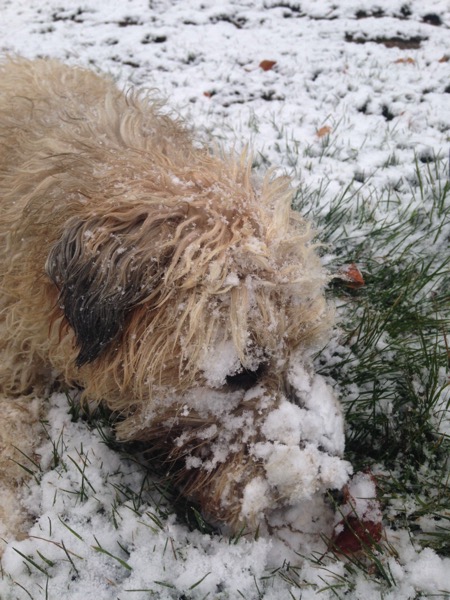
Snowballs stick to my fur is not so awesome. What’s a dog to do?

Farley Snowball


I mean literally what’s a dog to do?

Anyone have any idea how to get this stuff off my nose?  I’d really like some advice, and please don’t say stop rubbing my nose in the snow. I’m having too  much fun, and there is now way I can control the urge. I keep telling Kristina is an instinct. She’ll believe anything I woof at her, but it’s really about playing.


Woof Woof

Before You Submit: Scene Opening and Closing

Do you have a draft of your novel or short story and are thinking of submitting to an agent, publisher or writing contest? My series called Before You Submit might help. The series contains hints and tips I’ve learned from professionals in the publishing industry that I’d like to share.

See Before You Submit:Likeable Characters for the first blog in this series and an introduction the benefits of submitting even if you get a rejection letter.

This week I’ll write about how to start and end scenes throughout a novel without being monotonous.

Sometimes it’s easy to get into a habit and open or close scenes in the same manner.

A dramatic line of dialogue is a great way to hook the reader and keep them reading. But what if you do this every scene? The dramatic tension will decrease. The same goes for other ways to start a scene.

Here are your options for opening and closing a scene.

  1. Dialogue
  2. Narrative
  3. Action
  4. Thought

When you are reviewing your manuscript prior to submitting, make a list of how you enter and exit scenes. I do this in excel so I can graph how many scenes start or finish in each way. The result gives me an idea of whether I’ve used one technique to often or not.

Entering and exiting scenes in a balanced and thought out approach will make your writing more interesting and keep the dramatic tension flowing.

If you have any tips on entering and exiting scenes, please share.

Thanks for reading . . .

Farley’s Friday: A Wheaten Loves Leaves and Cold Weather

Farley here,

I’m a dog who has lived on a boat in the Bahamas since I was 9 month old. All of a sudden, my humans decide enough of the sea life, it’s off to the mountains we go. British Columbia to be exact.

At first, I thought they were crazy. But now, I’m rethinking this situation.

Did you know leaves fall off trees in the fall? No one told me that.

Did you know a dog has more energy in cold temperatures? I didn’t either.

Did you know sticks are free in the forest? I’m kinda figuring this one out on my own.

Farley in Leaves

Rolling in leaves while chewing on a stick is the best. I miss boat life, but wilderness living is cool too.

Woof Woof.

Before You Submit: Likeable Characters

Do you have a draft of your novel or short story and are thinking of submitting to an agent, publisher or writing contest?

This is a scary prospect, right? Ignore the night demon who tells you to hide your work in a drawer and prepare your story for submission. Besides signing an agent, getting your work published, or winning a contest, there are other benefits to submitting.

Submitting your work is a great way to get feedback from a professional in the industry. We all know this is hard to get, but if you’re lucky, valuable pieces of advice will end up in your inbox.

There are contests, the Debut Dagger hosted by The Crime Writers’ Association is one of them, that will provide feedback on your entry if you are short listed. There are also agents, who when queried, will give you feedback. You might even get comments back from a publisher or editor.

I thought I’d share a bit of what I’ve learned this last year from people in the industry.

The week I’ll talk about liking the main protagonist.

Many writing books declare the reader must like your main character. This doesn’t mean everything about your character should be likeable. No one likes a perfect person. On the flip side, even if your character is nasty, is there at least one characteristic your reader can relate to, like or admire? If not, you might create something.

In a novel, giving your reader someone to cheer for and follow for 300 or so pages might make the difference between the reader dropping your book on the coffee table after chapter one to staying awake late into the night reading until the climax satisfies their need to know what happened to the character.

When I started writing, I struggled with how to make a character likeable. Thinking about what made me like people in real life was difficult to translate into the pages of a novel. How was I to get a reader to like my character?

The Crime Writers’ Association honoured me by shortlisting my novel, Burnt. The comment I received from one Debut Dagger judge on the topic of likeable characters was:

“The thread with the dog is a clever way of engaging interest and building suspense right from the start, while telling the reader something appealing about Kalin.”

Kalin is the main protagonist in Burnt.  In the opening scene, on the run and separated from her dog in a forest fire, Kalin fights for her life. The suspense part: Will she be able to save herself and her dog?  The likeable part: Her concern for her dog.

What I learned from this comment: The actions of your characters can show the reader a likeable trait. There is no need to describe the trait by telling the reader Kalin cares about animals.

I hope this helps you review your draft and get it ready for submission. In the coming months, I’ll post a series on what I’ve learned from the mysterious publishing industry.

Thanks for reading . . .

Click here for a look at my proofreading and copyediting series.

Farley’s Friday: Drink from a Creek and Get Happy

Farley here,

Have you have tasted fresh water, right out of a creek? It’s awesome. I’m on my hike, making sure my human get some exercise, and look what I find. The water is cold and rushing across my feet. I think the supply is endless. Sometimes life is confusing. I have no idea where the water is coming from. At home, Kristina fills my bowl, so who is filling this creek? I think about this great life question and realize I don’t care. Just bring it on.

Hike 1


Everyone should drink from a creek every day. It’s the secret to life happiness 🙂

Woof Woof

Farley’s Friday: A Wheaten Goes Hiking

Farley here,

I’ve been in British Columbia for over a month, and let me tell you, this province is doggie paradise. I’ve covered over 90 kilometres of trails through the forests, up hills, down hills, through streams, and yes, sometimes on the golf course. Although I’m not allowed on the fairways or greens, whatever that means. I have to stay on the cart path or on the rough. I’ve gotta watch some golf today and figure out what my new commands are. Can’t be looking unintelligent to my humans.

How did I manage to get my humans to take me on two hikes a day – everyday? I should have been an actor. Who could resist this face?

Walk please

When I’m out running free and get tired I take a break and search the wilderness for deer. I think of myself as the protector of humans. I’m on the rough here, I but who can be sure? I notice a pit full of sand. Who put that there? And why does someone rake it every morning? My humans get very excited if I roll in it and dig for golf balls.

I didn’t find any deer today, but I know they’re out there. I am a diligent dog.

Farley checking for deer

So when I get home, I don’t go off duty. I see no reason the deer have amble close to our house. Most of the day, I relax on deck, but then one of the forest creatures gets too close, I let them have it. Well, I bark like crazy until it clears my space and my humans are safe.  You can’t see the deer in the photo, but she’s crossing the driveway just below me.

Farley on deck

Once she’s out of sight,  I’m exhausted. It’s time to watch golf and learn some new words. Oh, and for Kristina to make me dinner. She loves to pamper me 🙂

Woof Woof

The Golden Leaves of British Columbia

Spending a large part of my youth in Ontario, I’m used the reds, oranges and yellows of fall. The forest of British Columbia have a different look and feel to them. Just as beautiful, but not the same.

BC Yelloe

The mountains are an inspiration to me when I think about writing. As I stopped and took in the scenery, I thought of the importance of getting details correct when writing a novel. Before living in BC, I might have assumed all forests transformed into a multitude of colours in the fall. There is nothing like seeing your imagined setting in real life.

Now, I’m not saying you have to visit every place you write about, although, if you’re lucky, maybe you get to, because with today’s technology, you can see the places without ever going there. Google Earth is a wonderful way to explore a setting, getting familiar with an area before putting words to a page.

Online videos, photos and travel blogs are also a good source to travel from the comfort of your back porch.

Every day the forest of the Purcell  Mountains inspire me to be a better writer. And now that I’m used to seeing only yellow leaves, I find them just as beautiful as the multicoloured trees of the east.

Thanks for reading. . .