Inciting Incident In The Context Of The Story Arc

You’ve written a first draft. And with that major milestone completed, I’ll guess you want others to read your story and love it.

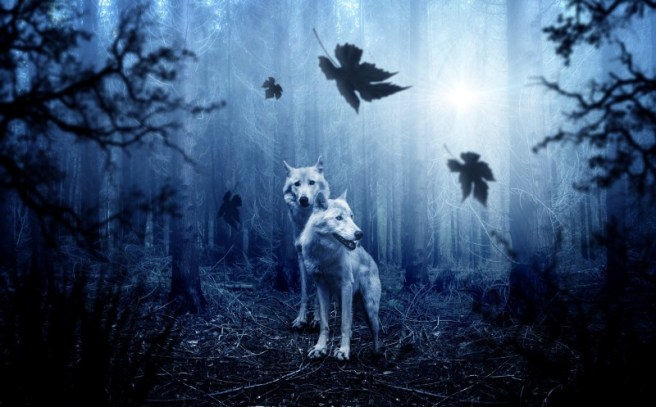
fantasy-3281795_1920

That means you need to take your first draft and tell a better story. One way to to tell a better story is to evaluate the story arc while you’re performing a story edit.

Today, we’ll cover the the first key event in the story arc. The inciting incident.

What is an inciting incident?

The inciting incident is the moment the protagonist’s world changes in a dramatic way.

It’s a major turning point that occurs before the midpoint of the first act. Note it doesn’t have to be the first event in your story.

The dramatic change can be positive or negative and should give the protagonist a goal she can’t turn away from.

To make your inciting incident shine, make it cause both a conscious and unconscious desire in your protagonist.

I recommend that you write your inciting incident as a dramatic scene and not as backstory or narrative summary. This enables the reader to experience the event at the same time as the protagonist and increases your chances of getting the reader emotionally involved.

The inciting incident can happen to the protagonist or can be caused by the protagonist. It’s up to you as the artist to decide what’s best for your story.

Famous Inciting Incidents

Gone Girl: Nick comes home to find his wife missing. (External goal — find wife. Internal goal — get wife out of his life.)

The Martian: Mark Watney goes missing during a storm on Mars. His teammates can’t find him, think he’s dead, and evacuate the planet.

The Philosopher’s Stone: Harry Potter receives a letter from Hogwarts and his uncle won’t let him have it.

Twilight: Bella faces the hunter as he moves forward to kill her.

Placement of the Inciting Incident

The story arc has been around for over 2000 years. It’s a proven form to keep readers engaged and is not about formula. The story, the imagination is unique to you.

The story arc is the structure of your story and the timing of the events in that story.

The arc takes the reader from one state at the beginning to a changed state at the end.

Using the tools at your disposal, like the story arc, and knowing how to write and when to place key events in your story for maximum reader satisfaction is key to a good story. So what’s a good story? It’s story others want to read.

The first of the key events is the inciting incident.

The inciting incident exists in the context of the complete story arc. If you don’t have an inciting incident in the first 15% of your novel, you need a strong reason for delaying it. Readers expect something to trigger the protagonist to act. If you delay the inciting incident, add in subplots that keep the reader engaged.

Here’s an example of a story arc from Fictionary. The brown line shows the recommended story arc, and the green line shows the actual story arc for the novel.

Story Arc Bad

You can see above, the inciting incident occurs too late in the story. The writer will lose readers who get bored.

After that, plot point 1 is reached too quickly, denying the reader story depth.

And on it goes until the climax is too late, and there isn’t enough time for a satisfactory resolution. Meaning the reader won’t read the writer’s next book.

I’ll cover other key events such as plot point 1, midpoint, plot point 2 and the climax in future blogs.

I’ve love to know what you think and if you have any questions 🙂


99428-0zktgjmg_nbxoiy49

Fictionary is online software that simplifies story editing. Why not check out Fictionary’s free 14-day trial and tell better stories?

Post written by Kristina Stanley, author of Look The Other Way (Imajin Books, Aug 2017).

d9e70-1utkhhu-sp5fjiahqxtl8xwKristina Stanley is the best-selling author of the Stone Mountain Mystery Series and Look The Other Way.

Kristina is the CEO of Fictionary, and all of her books were edited using Fictionary.


5 Ways to Hook Your Reader In Every Scene

Many writing books talk about the importance of the first line, first paragraph and first page of a novel.

If you don’t grab the reader early in your novel, you might lose them for good. Taking that thought and applying it to each scene means evaluating the entry hook for each scene.

There’s a lot of pressure on a writer to produce an extraordinary first line for a novel.

But as with most things, practice will make you better. So start practicing now with the first line of every scene in your novel. By the time you’ve evaluated every scene looking for the entry hook, and maybe rewriting the scene opening for a few, you’ll be ready to go back and rework the first line of your novel.


What Is A Scene Entry Hook?

How many times have you read a book, were a little tired, and not sure if you wanted to start the next scene or chapter? You might read the first few lines of the next scene and then decide to keep reading.

Whatever you read at the beginning of the scene that kept you reading was the scene entry hook.


5 Ways To Hook Your Reader

When creating an entry hook, consider:

  1. Starting in media res
  2. Foreshadowing trouble
  3. Using a strong line of dialogue
  4. Raising a question
  5. Not wasting words on extraneous description.

Alternate Your Technique

Alternate your technique so the reader doesn’t get bored. If you don’t know what the hook is or why the reader would keep reading the scene, think about rewriting the scene opening.

Sometimes you might find you’ve started the scene too early. Look at cuttingthe beginning of the scene until something exciting happens.

If there is description you need, move it to later in the scene if you can. You might just need a little reorganizing of the scene to make the opening sizzle.


How Fictionary Can Help You

Fictionary is a new interactive web app for self-editing fiction that helps writers turn a first draft into a story readers love.

Below is the opening scene from Look The Other Way (by Kristina Stanley).

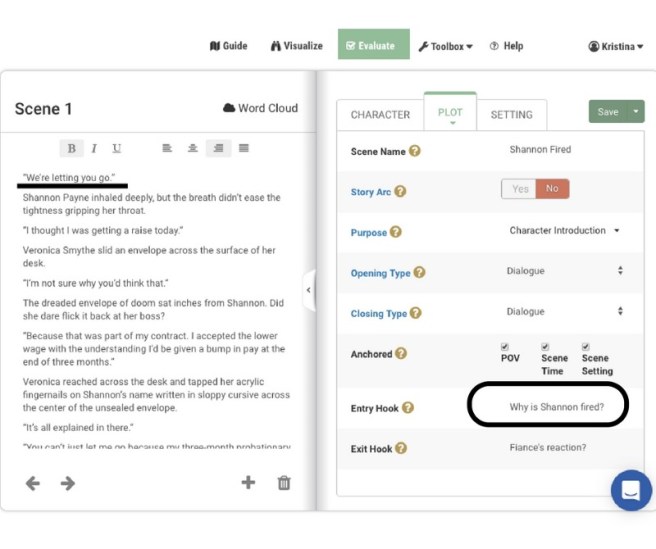
The “Entry Hook” key element makes me evaluate each scene and think about whether I’ve used a good entry hook. If I haven’t, then I need to rewrite the opening.

The entry hook is the first line of dialogue. “We’re letting you go.” leaves the reading wondering who is being fired and why.

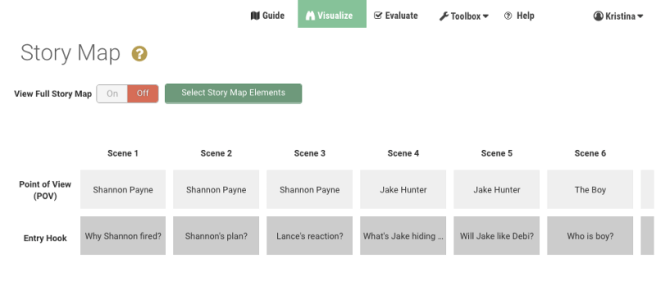
In Fictionary, you can use the Story Map so evaluate key elements of fiction throughout your story.

Here, I’ve chosen just the point of view character and the entry hook to be shown in the Story Map. This way I can evaluate how I’m drawing a reader into each scene.

Your challenge is to ask yourself if every scene in your novel is has an entry hook.


Post written by Kristina Stanley, author of Look The Other Way (Imajin Books, Aug 2017).

Kristina Stanley is the best-selling author of the Stone Mountain Mystery Series and Look The Other Way.

Crime Writers of Canada nominated DESCENT (Imajin Books, July 2015) for the Unhanged Arthur award. The Crime Writers’ Association nominated BLAZE (Imajin Books, Oct 2015) for the Debut Dagger. Imajin Books published her third novel in the series, AVALANCHE, in June 2016.

Luzifer-Verlag published Abwaerts (Descent) in Germany in the fall of 2017.

Her short stories have been published in the Ellery Queen Mystery Magazine and The Voices From the Valleys anthology. She is the author of THE AUTHOR’S GUIDE TO SELLING BOOKS TO NON-BOOKSTORES.

Her short story, WHEN A FRIENDSHIP FAILS, won the 2014 Audrey Jessup with Capital Crime Writers.

Kristina is the CEO of Fictionary, and all of her books were edited using Fictionary.


Why not check out Fictionary’s free 14-day trial and turn your draft into a story readers love?

Two Types Of Character Goals

A character goal is what a character wants. She should want it so badly that your readers feel her need in their guts.

The Point of View (POV) goal is what the POV character of a scene wants.

Whether you write from a single POV for the entire novel or from multiple points of view, it’s important to know what the POV character is trying to achieve in each scene.


Internal and External Goals

An external goal is the goal a character shows the world.

In a fantasy novel, that might be to find a magic object. The reader and other characters in the novel are aware of the goal. The antagonist(s) will try to make the character fail.

An internal goal is a character goal that the other characters in the scene are not aware of.

For example, a character may have a goal of stealing a jewel from a desk drawer. The other characters in the scene may think the character’s goal is to sit at the desk and calculate the latest revenue figures for their business.

The reader may or may not know about the internal goal, but as a writer, you must keep track of this.

To give a scene depth, have an internal and external goal for the POV character for each scene.

Failing To Reach A Goal

Once you know the POV goal for a scene, you can start thinking about all the ways the character will fail at achieving the goal, what obstacles you put in the way, and how the character will feel about failing or achieving the goal.

This will add tension and conflict to your scenes.

Scene Goal Versus Novel Goal

Your protagonist must have an overall goal for the novel, but she will also have a goal for each scene where she is the POV character.

You may find the POV goal for a scene is the same as the character’s goal for the novel, or you may find the character has a different goal for a scene. In the second case, make sure the scene goal is related to the plot.

For example, in a murder mystery, the protagonist’s goal for the novel is to solve the murder. In a specific scene, her goal may be to uncover a clue, hide something from the antagonist, or something a simple as trying to get a few hours of desperately needed sleep.

Driving the story forward

By giving your POV character a goal in every scene, you’re also giving your readers something to cheer for or cheer against. This will keep your readers engaged in your story and turning the pages.


Fictionary

Fictionary helps you keep track of internal and external goals. You can list the goals right beside a scene, or you can see the goals listed together in the Story map report.

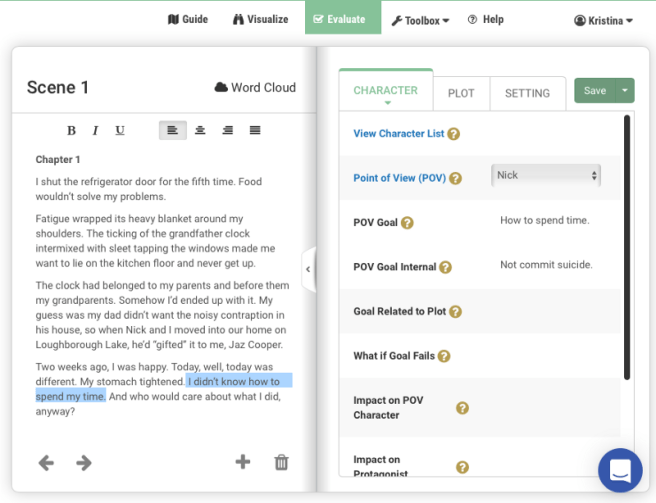
Here is an example of my work in progress, Evolution, from within Fictionary. The protagonist, Jaz Cooper has two goals in the first scene.

She’s struggling with how to spend her time. This external goal is shown to the reader early in the scene (highlighted in blue).

Her internal goal, which the reader doesn’t know about, is her struggle against suicide. As the writer, I know this is her goal, and it influences what I write.

Why not try the free 10-day trial of Fictionary and see if can help you turn your first draft into a story readers love?

Story Editing. Copyediting. Proofreading. What in the world are they?

Nano Blog and Social Media Hop2Thank you, Raimey Gallant for organizing the #AuthorToolboxBlogHop.

This is a monthly blog hop on the theme of resources/learning for authors: posts related to the craft of writing, editing, querying, marketing, publishing, blogging tips for authors, reviews of author-related products, anything that an author would find helpful.

To continue hopping through other great blogs in the monthly #AuthorToolboxBlogHop or to join, just hop on over to Ramey Gallant!

In today’s publishing environment, it’s up to an author to ensure all the major steps of revision/self-editing have been completed.

After you’ve written your first draft, you’ll need to work your way through the revision process. So what are the different steps in self-editing fiction?

Here is our take on it. After you write your story, the first step is a story edit,followed by your rewrites. Then you’ll do a copyedit and finally a proofreadStory editing, copyediting, and proofreading combined make up the revision process.

Following this order will save you time on editing. If you copyedit or proofread too early, you may have to repeat this work. Of course, you can fix obvious errors when you see them, but don’t spend time on copyediting until you’ve finished a comprehensive rewrite.


Write

Image Source Fictionary

Create your story and complete your first draft. Easier said than done 🙂

That’s why there has been so much written about how-to-write fiction! Whether you’re a plotter or a panster, it’s up to you to decide how to best write your story.


Story Edit & Rewrite

You’ve completed a draft and may have been told to put your work in a drawer for a few weeks and then come back and reread it with fresh eyes. This never worked for me. Even if I ignored my draft for weeks, I needed a structured process to evaluate and rewrite my manuscript. I realized I was doing my own story edit.

A story edit focuses on the big-picture of the novel. You’ll evaluate:

You’ll check for consistency and clarity, and you’ll end up rewriting scenes in your manuscript to improve content and structure. This is the most time-consuming step of self-editing, however, your effort spent on evaluating and rewriting your draft will ensure your story makes sense and is ready to polish and share.

So no surprise…this is where Fictionary will come to the rescue!


Copyedit

Now you’re getting into the details of each sentence with a focus on style. It’s time to check for:

  • Language errors including punctuation, grammar, and spelling
  • Run-on sentences (you may want these in dialogue or thought — just make sure you do this on purpose)
  • Repeated information or words
  • Clichés
  • Too much description
  • Unclear or confusing passages
  • Boring or passive language
  • Showing versus telling
  • Too many adverbs
  • Sentence length variation
  • Consistent spelling (For example: US versus Canadian)
  • Consistent hyphenation, fonts, and capitalization

Both ProWritingAid and Grammarly are great online tools for copyediting and proofreading. I use both, ‘cause I like them both.


Proofread

At this phase, you shouldn’t be finding too many errors. This is the final check before publishing your manuscript. You’ll notice you’re not changing your story or your style. Here you’ll check for final spelling or grammar mistakes, then ask yourself:

  • Are all chapter headings formatted the same?
  • Are any pages or headings omitted?
  • Is the page numbering consistent?
  • Are the headers and footers formatted the same?
  • Are italics consistently used?
  • Are paragraph indents formatted the same?
  • Are there any double or triple spaces between words?
  • Are there any double spaces after a period?
  • Are times formatted the same — am, a.m. AM?
  • Is the spacing between ellipses consistent (… and not . . . )?

How Will Fictionary Help You Story Edit

Fictionary is a new interactive web app for self-editing fiction that helps writers turn a first draft into a story readers love.

Developed by writers to help fellow writers, Fictionary is the first online tool for editing the story, not just the words. Writers are guided through a scene-by-scene evaluation of their manuscript by analyzing key story elements for characters, plot, and settings.

With interactive reports and writing advice for each element, writers can visualize their story and see where and how to improve their writing. With automated progress tracking, writers save time on self-editing and can be confident that their work is ready to share.

How Fictionary Works: A writer imports a manuscript. Within seconds, Fictionary automatically creates a character list, links characters to scenes, plots word count per scene, and draws a story arc.

The writer then inputs key story elements for each scene, evaluates and edits the manuscript based on output from Fictionary, and then exports the updated manuscript. The output from Fictionary is dependent on the writer’s input and is specific to each manuscript.

Why not check out our free 10-day trial?

95146-17nieqznvern2ojqp-djvow

Ensure The Purpose of A Scene Is Engaging Your Readers

A great scene makes your reader feel an emotion.

What Is A Scene?

A scene is a section of your novel where a character or characters engage in action or dialogue. You can think of a scene as a story with a beginning, middle, and an end.

Usually, you’ll start a new scene when you change the point of view character, the setting, or the time. You may start a new scene if the scene your working on is too long to fit the structure of your manuscript.

Fictionary will take you through the process of evaluating each scene in your novel.

The Purpose of a Scene

The first question in my post Top 3 Story Editing Questions For Fiction Writers was “What is the purpose of a scene?”

I’d like to share my thoughts in more detail.

The purpose of the scene must relate to the overall story. If it’s not driving the story forward, then ask yourself what is the point of including the scene in your novel.

Here are some examples of the way the purpose of a scene can drive the story forward. You can choose one of these to define your purpose or come up with your own definitions.

  • Build suspense
  • Character development
  • Character Introduction
  • Climax
  • Establish mood
  • Establish setting
  • Inciting Incident
  • Intensify Conflict
  • Move the story forward
  • Plot point 1
  • Plot point 2
  • Resolution (after climax)

How Purpose Of A Scene Helps With Other Elements Of Fiction

I articulate the purpose of the scene early in my story editing, so I can address other elements of the scene and test if they are in line with the purpose.

Let’s say you fill out the list of objects in a scene. You can weigh the objects against the purpose of the scene and see if there is a way to use them to further the purpose. This goes for revelations, tension, conflict, weather, etc. Basically, every scene element can be tested against the scene purpose.

After you whittle down the purpose of a scene to a few words, one of three things will happen.

  1. You’ve got the purpose nailed, and you understand why this scene is included in your novel.
  2. You have a weak purpose, but there is still some value in the scene.
  3. You have no idea what the purpose is.

So you’ve got the purpose nailed. Yay! Move on to the next scene.

If the point of the scene is weak, see if you can take what is important in a scene and move it to another scene, then delete the weak scene. You can also enhance the scene to give it a stronger purpose.

If you can’t articulate the purpose of a scene, think about removing the scene.


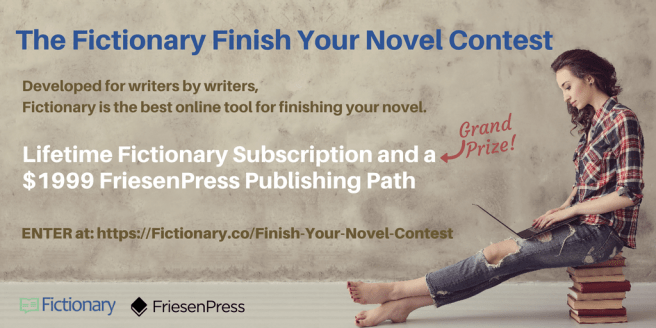
The Fictionary Finish Your Novel Contest.

Fictionary FYNC

Fictionary is designed for the serious author who wants to produce a high-quality manuscript.

To encourage you to finish your novel and get published, we’ve partnered with FriesenPress and are hosting a contest together.

Grand Prize

One lifetime Fictionary subscription and a $1999 FriesenPress Publishing Package.

Additional Prizes

$200 annual Fictionary subscription for 3 lucky writers!

Check out the details and enter the contest.

Winners are chosen at random. No purchase necessary. Entrants accepted until February 18th, 2018.

Fictionary is a proud sponsor of the National Novel Writing Month Now What Months.

Ensure The Purpose of A Scene Is Engaging Your Readers

Conquer Your Story Edit and Finish Your Novel (NaNoWriMo Guest Blog)

Conquer Your Story Edit and Finish Your Novel

Every year, we’re lucky to have great sponsors for our nonprofit events. Fictionary, a 2018 “Now What?” sponsor, is a breakthrough tool for editing fiction. Today, author and Fictionary co-founder Kristina Stanley shares her editing expertise, as well as the details of the Fictionary Finish Your Novel Contest:

Tell me a story!” your reader demands. “I want to feel happy, sad, frightened. Take me to a new world and make me care about what happens.

That’s a big ask of a writer. How do you go from the first draft of your novel to a story that works and captures readers? Think about some of the best novels you’ve read. What do you remember?

Read More…

Top 3 Structural Editing Questions For Fiction Writers

After completing my first two novels, I knew to become a better writer, I needed to learn to edit my own story.

Write a Story Readers Love

What about you? Before sending your story to beta readers, writers’ critique groups, or to an editor, don’t you want your story to be the best you can make it?

I put all my energy in learning how to perform a structural edit. A structural edit, also known as a developmental edit or a story edit, will turn your draft into a story readers love. You’ll notice I like to use the term story edit. It sounds much more fun than the formal terms!


A Great Story Readers Love

Once you have a draft written, it’s time to focus on characters, plot, and setting.

Characters

During a story edit, you also take a hard look at your characters. How often do they appear? What are their goals? What gets in the way of their goals? Characters will drive the tension in your story, and tension is what keeps a reader engaged in your story.

Plot

Performing a story edit on your first draft means analyzing your story from a high-level perspective and fixing any weak areas. You want to make sure the story structure makes sense, the scenes are tense, there are no plot holes, and your key scenes appear in the best place along your story arc.

Setting

Finally, the story edit should examine your settings. Do you make the most of your settings? How often do you use the same setting, and is it too often? Do your settings help with the tone of your scenes? Settings are key to keeping your reader engaged, so don’t ignore them.


Where To Start Your Story Edit

Here are three questions to ask yourself when you review a scene and look for ways to improve it.

1. What is the purpose of this scene?

Defining the purpose of the scene first allows you to address other elements of the scene and test if they are in line with the purpose. A scene may have more than one purpose, but see if you can choose the most important one and then ask yourself does this help drive the story forward.

2. Who has the point of view?

Multiple points of view means the character who controls the POV for a scene changes from scene to scene. As a writer, you must be in control of this aspect. The generally accepted method is to have one POV character per scene. Switching mid-scene can be known as head-hopping and can jar the reader from the story.

3. Is the setting the best place for emotional impact?

When answering the question, think about who has the point of view for the scene and what makes them feel strong or vulnerable.

Do you have a character who is afraid of the dark? Imagine the character is about to have a confrontation with an employee. If the character feels confident being in his/her own office and you want the character to be in a position of strength, then use the office as a setting.

If you want the character to feel vulnerable during the confrontation, try locating him/her outside, at night, in an isolated parking lot. And make it very dark. The streetlight is broken. There is no moon. Maybe it’s windy, so a cry for help won’t be heard.

Tackle each question and edit each scene accordingly.

Fictionary is the first online tool for editing your story, not just your words. Think characters, plot, and settings. Find out more at Fictionary.co.

Download our free eBook, Story Editing: 15 Key Elements of Fiction To Ensure Your Story Works and learn how story editing is all about evaluating the major components of your story.

Turn Your First Draft Into A Great Story

Try Fictionary for free. The first 10 days are on us. No credit card required.

What Writers Are Saying About Fictionary!

D.S. Kane, Amazon Bestselling Author

“I have used Fictionary to revise my current work in progress, entitled MindField, an espionage technothriller due out in early December 2017. My feeling is that Fictionary helped me to improve the manuscript significantly, and I will use it on all my subsequent novels. I am trained as both a novelist and screenwriter, but I focus exclusively on producing novels. And, that is where Fictionary is most useful. The toolbox within Fictionary helps a novelist see exactly where their work is weakest and strongest, and pushes me to work on fixing my problems.”

Helping Authors Create Stories That Work

You know I love to write, but I also love to edit. I’m thrilled to announce Fictionary’s Story Editing Course. Try it, and maybe you’ll love to edit too!

once-upon-a-time-719174_1920

At Fictionary, We believe to become a successful author, your novel needs to tell a great story.

Think about some of the best novels you’ve read. What do you remember?

Like me, you probably recall a compelling character like Jason Bourne, the intriguing plot told in Gone Girl, or the fantastic settings depicted in The Game of ThronesYou remember the story.

Combining Fictionary (a self-editing tool for fiction writers) with an online course seems like a great way to give authors the knowledge and process needed to complete their own story edit.

If you’ve finished that first draft and aren’t sure what to do next, we’ve got a solution.

Announcing the Fictionary Story Editing Course

This course will guide you through your manuscript with a scene-by-scene approach to editing. Fictionary focuses on the story, not the words.

To receive the first two lessons, all you have to do is sign up for a free trial of Fictionary. No credit card required. No obligations.

The full 14-lesson course is included with a Fictionary subscription.

Lesson Plan

  • Lesson 1: How To Use Fictionary To Make Your Story Work
  • Lesson 2: Characters And Novel Structure
  • Lesson 3: How To Improve Your Plot
  • Lesson 4: How To Improve Your Settings
  • Lesson 5: How To Use Word Count To Evaluate Your Scenes
  • Lesson 6: Connect Your Readers To Your Characters
  • Lesson 7: Make The Most Of Your POV Characters
  • Lesson 8: Story Arc And Engaging Your Readers
  • Lesson 9: Finding Plot Holes
  • Lesson 10: Draw Your Readers Into and Out of Each Scene
  • Lesson 11: Maximize Your Use of Tension And Conflict
  • Lesson 12: Check For An Empty Stage
  • Lesson 13: Keep Your Timeline Clear
  • Lesson 14: Bringing It All Together

Lesson 1: How To Use Fictionary To Make Your Story Work

Fictionary can identify and help you fix problems within your manuscript by focusing on the structure of your story, not on the words. In lesson one, we’ll tackle these critical structural areas:

  1. Pacing
  2. Character names and appearances
  3. Point of view characters and goals
  4. Story arc
  5. Plot holes (scenes without a clear purpose)
  6. Flow from scene to scene
  7. Absence of tension or conflict
  8. Empty stage syndrome
  9. Confusing timelines or missing objects

 
Where Can You Get More Information?

Check out Fictionary.co for a full description of what Fictionary is and how it can help you.

Download our free Story Editing eBook.

Learn how story editing is all about evaluating the major components of your story. We call these components the Key Elements Of Fiction.  Our eBook shows you how to use the key elements of fiction to evaluate your story and become your own big-picture editor.


Turn Your First Draft Into A Great Story

Take Your Story up Several Levels by Editor Jodie Renner – Fictionary

Today it is our pleasure to welcome editor & author Jodie Renner to share expert editing advice. Jodie is generously sharing her wisdom on how to improve your story before you share it with others. Jodie is an editor and award-winning author of three Editor’s Guides to Writing Compelling Fiction: Writing a Killer Thriller Fire up Your Fiction Captivate Your Readers Jodie’s […]

Source: Take Your Story up Several Levels by Editor Jodie Renner – Fictionary

Fictionary: Online Story Editing Tool + Online Course

I’ve found a lot of joy over the years helping authors promote their books online. Now, I’ve expanded that to help authors learn how to do their own story edit. Some of you know I not only write books, but I’m also the CEO of Fictionary.co.

Fictionary is the first online tool for editing your story, not your words. Think characters, plot, and settings.

Fictionary is developed by writers for writers. That’s me 🙂 and indie author Michael Conn. Our third co-founder is Mathew Stanley – yup – my husband. He’s been my first reader and eagle-eye-editor for years.

Today, I’m thrilled to announce the Fictionary Story Editing Course.

Helping Authors Create Stories That Work

We believe to become a successful author, your novel needs to tell a great story.
Combining Fictionary with an online course seems like a great way to give authors the knowledge and process they need to complete their own story edit and ensure their story works.
Twitter Fictionary Course

Fictionary Story Editing Course

This course will guide you through your manuscript with a scene-by-scene approach to editing. Fictionary focuses on the story, not the words.

We’ll send you the first two lessons when you sign up for a free 10-day trial.
The full 14-lesson course will also now be included with a Fictionary subscription.
  • Lesson 1: How To Use Fictionary To Make Your Story Work
  • Lesson 2: Characters And Novel Structure
  • Lesson 3: How To Improve Your Plot
  • Lesson 4: How To Improve Your Settings
  • Lesson 5: How To Use Word Count To Evaluate Your Scenes
  • Lesson 6: Connect Your Readers To Your Characters
  • Lesson 7: Make The Most Of Your POV Characters
  • Lesson 8: Story Arc And Engaging Your Readers
  • Lesson 9: Finding Plot Holes
  • Lesson 10: Draw Your Readers Into and Out of Each Scene
  • Lesson 11: Maximize Your Use of Tension And Conflict
  • Lesson 12: Check For An Empty Stage
  • Lesson 13: Keep Your Timeline Clear
  • Lesson 14: Bringing It All Together
We hope you get a chance to experience Fictionary and the Story Editing Course.
Screen Shot 2017-10-26 at 8.43.37 AM