Mystery Mondays: James M. Jackson On Is Your Manuscript Ready

Welcome to Mystery Mondays. I’m a huge fan of the Seamus McCree novels, so it’s a great honor to have James M. Jackson share his writing advice today. I first met James when he agree to have me guest blog on his site in August 2015. James was helping me spread the word about my first novel, Descent. Over the last year, I’ve learned what generous people authors are, and here he is again being generous with his time and sharing some advice.

Is it Soup Yet? by James M. Jackson

Well, no. When I agreed with Kristina to write this blog, (thank you so much for the invitation), I was confident I would have published the next book in the Seamus McCree series. It hasn’t happened, and I’m quite happy with that because the decision was mine.

By today’s standards, I am a slow writer. There are several reasons for this. Probably the most important is that writing is only one of the things I enjoy doing. I spend considerable time each year teaching the game of bridge at my local bridge club. [In fact my first published book was One Trick at a Time: How to start winning at bridge.] I also teach an online class on self-editing/revision, and I am the president of the 600-member Guppy Chapter of Sisters in Crime.

But none of those other interests or commitments are why you can’t buy Doubtful Relations today. You can’t buy it because I don’t think it’s ready.

Readers clamor for authors they enjoy to write more books more quickly. Publishers echo the demand, even writing faster deadlines into contracts. The once-a-year-release timetable has been replaced by a nine-month regimen. Many authors now produce two books a year, and many independent authors produce three or more books a year.

This pressure for more words, more quickly, comes at a time when publishers have pulled back on the amount of sales and marketing support they provide most of their authors. Now, most published authors spend a significant amount of time performing tasks that do not directly relate to writing their next book.

Some authors have always been prolific, producing great quality writing with everything (or nearly everything) they publish. For these authors, nothing has changed. I read eighty to a hundred books a year, mostly fiction, and over the past few years, I have discovered many authors who I once loved cannot produce high-quality manuscripts with these shorter timeframes.

Storylines become flat, characters become caricatures, plot holes appear. Editors in the past would have jumped all over these problems, but shortened production schedules don’t leave enough time for major fixes. Problems are papered over. For big names, this isn’t really much of a problem: a number one bestseller will obtain huge sales with a mediocre book, or two, or three. For a less-known author, it could be a death knell.

I teach my students that in revising a manuscript, it is important to give space between the writing and the rewriting. As a first step, they should try to read their manuscript as if they were a discerning reader. When I did that with Doubtful Relations, I realized the manuscript contained two major problems: new readers to the series required a deeper understanding of prior relationships than I had provided, and I had not given the reader sufficient understanding of the motivation of the primary antagonist.

Each problem had a straightforward solution, and had I been forced to turn in a manuscript to meet an approaching deadline, I could have applied those bandages to an otherwise decent manuscript. But in thinking about those issues, I realized I could significantly improve the novel if I tore it apart and addressed certain aspects using a different approach.

I attended a week-long workshop in 2015 run by Donald Maas, and one of the takeaways I have treasured is that sometimes the best way to fix something is to tear it down to its foundation and build it back up again. That’s what I am doing with Doubtful Relations. That’s also the approach I took with my most recent publication, Ant Farm. It started life as my first written novel. It attracted an agent’s attention and went nowhere. Frankly, it had good bones, but my writing was not yet mature. The flawed writing should not have earned an agent’s contract, and I am glad it was not published back in 2010. [I would now be very embarrassed if it had.] After being consigned to a drawer, I reread it in 2014, tore it down and built it up through a series of rewrites. When I was done, it won a contract through the Kindle Scout program.

I’m now in the process of building Doubtful Relations back up. I expect it will be available later this year. You can follow its progress (and the next two in the series that are also in the works) on my website, http://jamesmjackson.com or follow me on Facebook https://www.facebook.com/James-M-Jackson-388804844542707/ or on my Amazon page http://www.amazon.com/James-Montgomery-Jackson/e/B004U7FRP2 .

Ant Farm
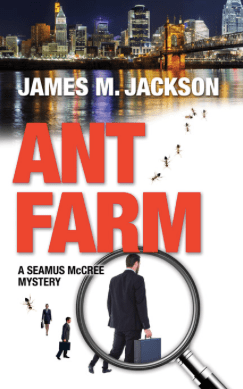
Screen Shot 2016-04-03 at 7.24.14 AMIn this thrilling prequel to Bad Policy and Cabin Fever, when thirty-eight retirees meet a gruesome end at a picnic meant to celebrate their achievements, financial crimes consultant Seamus McCree comes in to uncover the evil behind the botulism murders.

But the deadly picnic outside Chillicothe, Ohio, isn’t the only treacherous investigation facing Seamus; he also worms his way into a Cincinnati murder investigation when the victim turns out to be a church friend’s fiancé.

While police speculate this killing may have been the mistake of a dyslexic hit man, Seamus uncovers disturbing information of financial chicanery, and by doing so, puts his son in danger and places a target on his own back. Can Seamus bring the truth to light, or will those who have already killed to keep their secrets succeed in silencing a threat once more?

author-photoJames M. Jackson authors the Seamus McCree mystery series. ANT FARM, BAD POLICY, CABIN FEVER, and DOUBTFUL RELATIONS (2016). Jim also published an acclaimed book on contract bridge, ONE TRICK AT A TIME: How to start winning at bridge, as well as numerous short stories and essays. He splits his time between the deep woods of Michigan’s Upper Peninsula and the open spaces of Georgia’s Lowcountry.

Write Better Fiction: When A POV Doesn’t Reach A Goal

Today on Write Better Fiction we’ll cover What happens if the POV doesn’t achieve her scene goal. Write Better Fiction is a process to help you critique your own manuscript and give yourself feedback. This will help you improve your novel, so you’re ready to submit it to an editor. 

If you’ve been reading this series, you know I’m describing a spreadsheet I created to evaluate each scene of a novel. I use this spreadsheet after a solid draft to evaluate each scene and revise it as needed.

This week I’ll over POV goal failure.

To shorten the heading in the spreadsheet, I’ve called the column “Outcome if POV Fails.” I know this means what happens if POV doesn’t achieve his goal.

This question is sometimes hard to answer. If the question is hard to answer, the goal may not relate to the overall plot. If nothing happens because the character fails to achieve the goal, then what’s the point of the goal.

The answer doesn’t have to be earth shattering.

In DESCENT, Kalin’s internal goal is to be good at her job. If she fails, she might get fired, be reprimanded or lose her confidence at work.

In the opening scene, her external goal is to go skiing. This has a more subtle relationship to the plot. The goal is there to show Kalin is adventurous and athletic. When Ben tells he she can’t go skiing because the conditions are too dangerous, her trait of not listening to others is revealed. This goal is about character development.

For an obvious example, say a character’s scene goal is to reveal to the police she’s discovered fraud at work. She fails to reach the police in time, and she becomes a suspect in the fraud. You can easily tell what happens when she fails to reach her goal.

The answer strength should vary throughout the novel. The will help with pacing and keep the reader engaged.

If every scene has an obvious goal and and obvious failure, the reader will get bored with the repetition.

Sometime the character will achieve their goal. This is okay too. The idea is to create tension in the scene with the possibility the character might fail. They don’t have to fail, for the tension to be effective.

Your challenge this week is to use the columns for internal and external character goal that you set in POV GOAL AND PLOT and ask yourself what happens if the character doesn’t achieve that goal.

I critiqued DESCENT and BLAZE using the techniques I’m sharing in Write Better Fiction, and I believe this helped me sign with a publisher.

Please me know in the comments below if you found this exercise challenging. Did it help you write a tenser scene?

Thanks for reading…

Descent & Blaze

Mystery Mondays: Carol Balawyder on Subplots

Welcome once again to Mystery Mondays.

I first connected with Carol Balawyder when she graciously agreed to have me guest blog on her series HOW I GOT PUBLISHED.  DESCENT had been published less than a month previously, and I was nervous about guest blogging. Carol’s generous nature made it easy for me, and now I feel very lucky to have her guest blogging on my series.

Carol writes the The Getting To Mr. Right series.

Screen Shot 2016-03-20 at 8.14.27 AM

THE PURPOSE OF SUBPLOTS by Carol Balawyder

Thank you so much Kristina for inviting me as a guest on your Mystery Monday series. It’s a true honor for me to be in the midst of so many flourishing writers.

In my writing, whether it is women’s contemporary fiction or crime genre they both have in common a subplot which deals with the complexity of domestic relationships – specifically, relationships between an adult and his/her parent and the dysfunctional behaviors they can get tied up in.

For example, Getting To Mr. Right looks at how a daughter’s relationship as an adult is influenced by an emotionally or physically absent father. While researching this subplot I found a number of clinical studies to be of a valuable resource on the consequences of an absent daddy which I have used as foundation for the subplot.

Adding a subplot to the main plot gives depth to the character; the reader gets to know him/her more intimately.

This, I found to be especially true for a series. How many of us have wanted to read book 2, 3 or 8 of a series not only for the thrill of the story or mystery but also for wanting to know more about the protagonist’s personal life? Through the intricacies of the subplot readers become hooked on a series.

Subplots can enrich a novel and add tension. They give insight into a character’s personality and value system. They propose ground upon which a reader begins to build trust and sympathy for the character because s/he has a deeper understanding of him/her.

Subplots create a link from one series to the next and, as readers learn more about the characters’ personal life they begin to care more about them. To treat them as literary friends and sometimes even become their fans.

In some cases subplots help speed up the pace while in other cases they might serve to provide a breather to the action of the main plot.

Perhaps most importantly, subplots add to the suspension of disbelief.

I’ll give you an example drawn from my crime novel in progress. The protagonist, a nineteen year old girl, develops an intense and obsessive relationship with a man she meets on a train; she is ready to do anything to keep him even if it means leaving her distressed mother, turning her back on a career opportunity and murder.

Not such a nice girl, you might think, and rightfully so. But the subplot of addiction and its effects on the entourage supplies a different outlook.

Our nineteen year old protagonist, since very young, has been forced into the role of being caretaker to her heroin addicted mother. Research has shown that children who are flung into this kind of role grow up with a warped sense of self, lack of confidence and mounting frustration. Thus, the subplot adds credibility to the protagonist’s actions and irrational behavior. Although we might not condone some of her behavior we can understand. We believe that the protagonist is capable of doing what she does because of the world she lives in. We willingly suspend our disbelief.

Finally, as writers we need to make our characters come alive on the pages of our novels. Subplots are perfect opportunities to do just that.

My Getting To Mr. Right Series:

Carol Books

Carol’s BIO
CarolCarol Balawyder has taught criminology in both Police Technology and Corrections Programs for 18 years. Her area of expertise is in drug addiction and she worked in a methadone clinic with heroin addicts. She is very much interested in the link between drugs and crime and the devastating effects addiction has on the addict’s entourage. She has published short stories in The Anthology of Canadian Authors Association, Room Magazine, Entre Les Lignes, Mindful.org. and Carte Blanche. She regularly writes book reviews on Amazon and Goodreads.

LINKS:

Amazon – http://www.amazon.com/Carol-Balawyder/e/B00HVETKWM

Goodreads – http://www.goodreads.com/author/show/7704883.Carol_Balawyder

Smashwords – https://www.smashwords.com/profile/view/cbala

Website – http://carolbalawyder.com/

Blog- http://carolbalawyder.com/blog/


Write Better Fiction: Characters Mentioned In A Scene

Feedback iconToday on Write Better Fiction we’ll cover the Characters Mentioned in a Scene. Write Better Fiction is a process to help you critique your own manuscript and give yourself feedback. This will help you improve your novel, so you’re ready to submit it to an editor. Check the bottom of this post for links to previous Write Better Fiction articles.

Sometimes a character does not have a role in a scene but is referred to by another character. This could be in dialogue, thought, dream, an eMail or phone conversation.

Why would you do this?

  • To remind the reader of a character if you haven’t written about them for a few scenes or chapters
  • To show the character through the eyes of an other character
  • To foreshadow an event that will affect the character
  • To give the reader a clue or red herring
  • To show the POV character’s goal, personality trait, or attitude
  • To keep the antagonist in the readers mind if the antagonist doesn’t have any POV scenes.

This is a column that I fill out when I review each scene. Once the spreadsheet is complete review the column and plot how often characters are referred to. This is similar to a first character appearance diagram.

Once I’ve finished, I review the column for each character. I’m looking for:

  • Big blocks of time where a character disappears
  • Sections where a character is mentioned repeatedly but then not for a while
  • Mentioning an unimportant character too often

Your challenge this week is fill out this column with the characters mentioned.  Then review you major characters and see how often they are mentioned. Too often? Too Little? Too much time passed between being in a scene or being mentioned?

I critiqued DESCENT and BLAZE using the techniques I’m sharing in Write Better Fiction, and I believe this helped me sign with a publisher.

Please me know in the comments below if you found this exercise challenging. Did it help you improve your character arcs?

Thanks for reading…

Other blogs on the topic…

Write Better Fiction: A Character Enters A Scene

Write Better Fiction: Characters in a Scene – too few/too many?

Write Better Fiction: #1 Question To Ask About Characters In A Scene.

Write Better Fiction: Characters in a Scene – too few/too many?

Today on Write Better Fiction we’ll cover the Characters In A Scene. Write Better Fiction is a process to help you critique your own manuscript and give yourself feedback. This will help you improve your novel, so you’re ready to submit it to an editor. Check the bottom of this post for links to previous Write Better Fiction articles.

We’ve discussed using our spreadsheet to balance the number of scenes the protagonist and antagonist are in. But what about other characters? There is a columns for that too.

In the column called characters, list all characters in the scene. This includes characters that don’t have a name. The bartender, the skier, the person on the street, etc. I include animals as characters. The animal may or may not have a name. If you’ve read DESCENT, you know Chica is a character that is a yellow labrador. In BLAZE, a grizzly bear has a scene, but it’s not named. They both get listed in this column.

The character column helps

  • keep track of characters from one scene to another. If a character is in one scene, and the next scene is in the same location, then either the character has to still be there or you must write his/her exit. This column will keep you from having randomly disappearing characters.
  • you assess whether you have too many characters or too few in a scene.
  • you count how many times the protagonist and antagonist appear together.

If you get feedback from beta readers that you have too many characters, this column will help look for places you could cut characters or combine two characters into one.

Your challenge this week is to list all the characters in each scene.  Have you given your protagonist and antagonist a fair amount of time in your novel?

Please me know in the comments below if keeping track of characters in a scene helped you tighten your writing. Did you edit out any characters?

Thanks for reading…


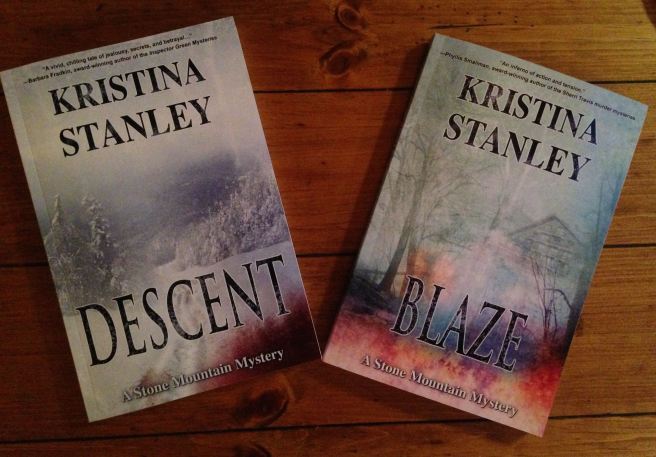
If you’d like to check out DESCENT or BLAZE the links are below:

myBook.to/Descent

When Kalin Thompson is promoted to Director of Security at Stone Mountain Resort, she soon becomes entangled in the high-profile murder investigation of an up-and-coming Olympic-caliber skier. There are more suspects with motives than there are gates on the super-G course, and danger mounts with every turn.

myBook.to/BLAZEbyKristinaStanley

Instead of exchanging vows, Kalin Thompson spends her wedding day running from a forest fire near Stone Mountain Resort, and the pregnant friend trapped with her has just gone into labor. Meanwhile, Kalin’s fiancé, Ben Timlin, hangs from the rafters of a burning building, fighting for his life. Can the situation get any hotter?

Mystery Mondays: Lisa de Nikolits on The Writer’s Seeing Eye

BTCSF_FrontCoverLisa de Nikolits sat in front of me at The Bloody Words conference, and what I remember is her great bit smile. This week, I’d like to welcome this very friendly and talented author to Mystery Mondays. Lisa’s going to tell you about the Writer’s Seeing Eye.

THE WRITER’S SEEING EYE by Lisa de Nikolits

 Ideas for crime novels. Where do they come from? 

“We need to watch another episode of Forensic Files,” I said to my husband. 

“It’s 2 a.m. on Christmas Day,” he replied, “We need to get some sleep so we can enjoy Christmas.”

“Ah, just one more,” I encouraged him. “It’s all research for me and I’ll make you a fresh cup of tea. Just one more!”

Research? 

That’s what I tell myself anyway. 

And it’s true that I have learned a lot about ethylene glycol and ketotic hyperglycinemia, blood spatter, fingerprint analysis, handwriting analysis, the ever-famous DNA, toolmarkings and ballistic analysis.

While the things those guys can do is just mind-blowingly amazing, two things struck me with this program. The first is how stupid some people are, when it comes to committing a crime. Most of the time they leave behind a trail of evidence that is nearly a paint-by-numbers for the detectives to solve. 

And the second thing is the impulsivity of the crimes, which occur on the spur of the moment. 

While I am full of admiration for Forensic Files, when it comes to novels, things are very different. Readers have very little patience with stupid protagonists and they are very quick to spot any story inconsistencies or things that might not ring true in the flow of a crime committed. 

In real life, how many times you have found yourself staying “real life really is stranger than fiction” and it is stranger because it’s not reasoned out in the same way that we plot books, real life crime just happens and then people try to mop up the mess and sometimes they succeed and sometimes they don’t. 

My ideas for the crime in my novels comes from flights of my imagination. The big ‘what if?’

For example, my husband and I got confused while taking a ferry back from Sydney to Cremorne Point – he got off while I didn’t and in that nano-second, I was convinced that he had fallen into the black water of the Sydney harbor and drowned. 

He was fine, of course he was, he had got off while I had been photographing something and there was nothing to it. 

But my writer’s seeing eye saw him being ushered off the boat, with a gun tucked under his armpit, and a gothic anarchist girl leading him away. I saw that a human trafficking gang had confused him with his doppelganger, and that an innocuous picture that he had posted on Instagram had caused all the confusion. I saw that my husband’s niece was involved in the kidnapping, and that she was being haunted by the ghost of a woman who had been locked up in an insane asylum. 

None of which could have come from Forensic Files or crime stories from real life, but that said, nothing is going to stop me from watching my favourite program – all for ‘research’ of course!

Bio

WhiteShirtBioPicLisa de Nikolits is the author of five novels: The Hungry MirrorWest of Wawa, A Glittering ChaosThe Witchdoctor’s Bones and Between The Cracks She FellBetween The Cracks She Fell was reviewed by the Quill & Quire and on recommended reading lists for Open Book Toronto and 49th Shelf. Canadian Living magazine called it ‘a must-read book of 2015’. 

Lisa has also been published in various anthologies and journals including Postscripts To Darkness, Volume 6, 2015, Thirteen O’ClockMaud.Lin House, the Canada Woman Studies Journal, Hood and the Jellyfish Review.


Links:

www.lisadenikolitswriter.com 

twitter: @lisadenikolits

www.facebook.com/lisa.denikolits

https://www.facebook.com/lisadenikolitsauthor

http://www.goodreads.com

http://pinterest.com/lisadenikolits/

LinkedIn: http://linkd.in/1r8H9Df

Instagram: http://www.instagram.com @lisadenikolits

Wattpad: https://www.wattpad.com/user/LisadeNikolits

The Mesdames of Mayhem: http://mesdamesofmayhem.com/about/

Write Better Fiction: The Antagonist

Feedback icon
Self Critique Your Novel


Today on Write Better Fiction we’ll cover the Antagonist. Write Better Fiction is a process to help you critique your own manuscript and give yourself feedback. This will help you improve your novel, so you’re ready to submit it to an editor. Check the bottom of this post for links to previous Write Better Fiction articles.

This is similar to last week’s post except you are looking at when your antagonist shows up in your novel instead of the protagonist.

The antagonist should show up early and be visible throughout the novel. This doesn’t mean they can’t disappear for a while, but controlling the appearances will give you power to create the most tension.

The antagonist may or may not have the point of view in any scene. That’s a choice for you to make. In the thriller genre you may be pitting your protagonist against the antagonist, so you’ll want to give both point of view scenes.

In a mystery, you may choose NOT to write any scenes from your antagonist’s point of view so you don’t have to give away inner thoughts.

The goal of this column is to have you look at how early the antagonist arrives in your novel, how many scenes he/she appear in, and most importantly, is he/she in the climax scene.

Same as last week, sort the spreadsheet by the antagonist column. Are you giving your antagonist enough time for the reader to be surprised but not blindsided that he/she is the villain?

Your challenge this week is to count the number of scenes your antagonist is in. Does this seem balanced compared to the number of scenes your protagonist is in?

Previous blog posts on Write Better Fiction:

  • Number 1 Question to ask yourself about PLOT
  • Number 1 Question to ask yourself about CHARACTER
  • Number 1 Questions to ask yourself about SETTING.
  • ACTION in a scene
  • NAME of a scene
  • GOAL of point of view character
  • The PROTAGONIST

I critiqued DESCENT and BLAZE using the techniques I’m sharing in Write Better Fiction, and I believe this helped me sign with a publisher.

Please me know in the comments below if you agree with the advice on counting scenes for your antagonist? Does the genre impact if the antagonist has a point of view scene?

Thanks for reading…

Write Better Fiction: Point of View Character Goal

Feedback iconToday on Write Better Fiction we’ll cover the Goal of your Point of View Character. Write Better Fiction is a process to help you critique your own manuscript and give yourself feedback. This will help you improve your novel, so you’re ready to submit it to an editor. Check the bottom of this post for links to previous Write Better Fiction articles.

Last week I wrote about naming a scene. This week I’ll cover the goal of the point of view character. Each scene will have a point of view character, and we discussed this in #1 question to ask yourself about plot. ADD LINK

The point of view (POV) character must have a goal. Without a goal, what’s the point?

There are two types of goals:

Internal: The reader isn’t told what the POV goal is.

External: The reader clearly understands what the POV goal is.

Each POV character should have an overall novel goal. The most important goals should belong to your protagonist and antagonist. Of course, these goals should oppose each other.

Screen Shot 2015-12-17 at 1.28.11 PMThe overall goal drives the character throughout the novel. In DESCENT, Kalin Thompson’s external goal is to find out who killed an Olympic-caliber skier. She has an internal goal that drives her through the first three novels in The Stone Mountain Mystery series, which I can’t share or it would ruin the mystery, but it’s there and influences how I write.

Finding a murderer is Kalin’s main goal throughout DESCENT. She also has goals within each scene where she holds the point of view. In the opening scene her external goal is to go skiing. Her internal goal is to be good at her job. Both goals will be tested very early in the story.

The reader doesn’t know about the internal goal, but it helped me create a focus and drive for Kalin in the next few chapters.

Other characters might have a goal in the scene. In fact, they should and it should be in conflict with the POV goal. This is a different column in the spreadsheet that we’ll talk about later.

Your challenge this week is to review each scene in your novel and determine what are the internal and external goals of each POV character. This will also focus you on the who has POV and give you another opportunity to check you’re consistent with the POV and that you’re not head hopping (unless it’s intentional). Please let me know in the comments if this helped you write better fiction.

I critiqued DESCENT and BLAZE using the techniques I’m sharing in Write Better Fiction, and I believe this helped me sign with a publisher.

Previous blog posts on Write Better Fiction:

Please me know in the comments below how you deal with the goal of your POV characters? Did you have difficulty defining a clear scene goal?

Thanks for reading…

Write Better Fiction: Scene Naming

Feedback iconToday on Write Better Fiction we’ll cover NAMING A SCENE. Write Better Fiction is a process to help you critique your own manuscript and give yourself feedback. This will help you improve your novel so you’re ready to submit it to an editor. Check the bottom of this post for links to previous Write Better Fiction articles.

Last week I wrote about the action in a scene. Maybe it seems odd I chose to fill out the action before naming the scene, but I have a strategy for this.

Did you find it hard to describe a scene in three sentences or less? Well, naming a scene is harder, but it help you hone the scene.

Scene NamesNow I’m going to ask you to use one word to name the scene. If you must, you can use two. I confess this sometimes happens to me.


Some writers list scenes with numbers only and that’s fine. For me, the exercise of naming the scene makes me narrow down what the scene is about. Since I already have the scene action defined in one to three sentences, the scene name might already exist somewhere in those words.

The Scene Name column is connected to the Purpose of a Scene column, and will help you discover what the scene is really about. The purpose of the scene is another place to look for hints on what to name your scene. At this point you may want to re-evaluate the purpose of the scene in case you’ve changed your mind based on the scene action and naming the scene.

The names of the scenes might give you insight into the theme of your novel.

Your challenge this week is to name each scene in your novel. Then let me know if this helped you focus your scenes.

I critiqued DESCENT and BLAZE using the techniques I’m sharing in Write Better Fiction, and I believe this helped me sign with a publisher.

Previous blog posts on Write Better Fiction:

Please me know in the comments below how you name your scene? Is it important for you to have a scene name?

Thanks for reading…

Write Better Fiction: Scene ACTION

Welcome the 2016 kickoff of Write Better Fiction. It’s the start of a new year, maybe you wrote your manuscript during November, took a break for the holidays and are ready to get to work.

But what to do? How about self-critiquing your manuscript?

If you missed the first three blogs in this series, you might want to check them out before reading this one.

Feedback icon

I need a systematic method for critiquing my novels, and I’ve used this method for all my novels. To prove to you it works, here is what Todd Barselow, senior editor at Imajin Books, said about DESCENT.

“My life would be so much easier if all the manuscripts that crossed my desk were as clean as yours.”

Now that I have your attention, today I’ll explain how to use the ACTION column.

Screen Shot 2015-11-30 at 5.06.20 PM

I keep this entry short. Use only one to three sentences to describe what happens in the scene. If you can’t describe the action in three sentences, maybe too much is happening in the scene, and it could be broken into two or three scenes. A scene with too much happening might confuse or exhaust the reader.

Once you’ve written the action for every scene in your novel, review the entire column and look for repetitions. Repetitions, unless written for a purpose, can be boring to the reader.

For example, your protagonist is hit by a car. In three different scenes you fill in the action, having your protagonist tell another character about the incident. Do you really need to have this happen three times? Could you summarize if the other character needs to know this information?

The action column helps me write a synopsis. After I’ve completed this for the manuscript I cut the column, save it to a word document and start writing a synopsis. It’s only a beginning, but it gives me a framework. And we all know how hard it is to write a synopsis.

Your challenge this week is to articulate the action for each scene in your novel. Please me know in the comments below how you evaluate the action? Do you have a question you ask yourself about action?

I critiqued DESCENT and BLAZE using the techniques I’m sharing in Write Better Fiction, and I believe this helped me sign with a publisher.

Thanks for reading…