Thrilling Review of BLAZE On Writers Who Kill

REBLOGGED FROM WRITERS WHO KILL

An Interview with Kristina Stanley by E. B. Davis 

Instead of exchanging wedding vows in front of friends and family,

Kalin Thompson prepared her home for evacuation.

–Kristina Stanley, Blaze (Kindle loc. 35)

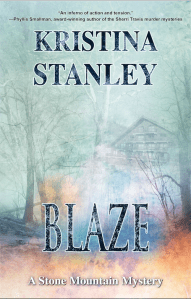
BLAZE CoverAfter the first six months of interviewing authors here on WWK, I realized that an interview, in and of itself, was an endorsement. So, when I agree to read and interview authors, I now do so with the condition that I like what I read unless I’m already a fan. It was a condition that I gave to Kristina Stanley because I was unfamiliar with her writing. What I found, after being hooked by the first sentence, which I’ve quoted above, was a primer on how to write a novel. I turned the page to the second chapter and realized she’d hooked me right from the start…


For the full review and interview checkout Writers Who Kill

A little about E.B. Davis who wrote the review and asked the interview questions:

 A writer and beach bum of note, E. B. Davis writes short stories and novels in the mystery and paranormal mystery genres. Ms. Davis graduated from George Washington University with a Masters Degree from the Elliot School of International Service, and continued degrading her writing skills working as a government contractor. 

Write Better Fiction: The Antagonist

Feedback icon
Self Critique Your Novel


Today on Write Better Fiction we’ll cover the Antagonist. Write Better Fiction is a process to help you critique your own manuscript and give yourself feedback. This will help you improve your novel, so you’re ready to submit it to an editor. Check the bottom of this post for links to previous Write Better Fiction articles.

This is similar to last week’s post except you are looking at when your antagonist shows up in your novel instead of the protagonist.

The antagonist should show up early and be visible throughout the novel. This doesn’t mean they can’t disappear for a while, but controlling the appearances will give you power to create the most tension.

The antagonist may or may not have the point of view in any scene. That’s a choice for you to make. In the thriller genre you may be pitting your protagonist against the antagonist, so you’ll want to give both point of view scenes.

In a mystery, you may choose NOT to write any scenes from your antagonist’s point of view so you don’t have to give away inner thoughts.

The goal of this column is to have you look at how early the antagonist arrives in your novel, how many scenes he/she appear in, and most importantly, is he/she in the climax scene.

Same as last week, sort the spreadsheet by the antagonist column. Are you giving your antagonist enough time for the reader to be surprised but not blindsided that he/she is the villain?

Your challenge this week is to count the number of scenes your antagonist is in. Does this seem balanced compared to the number of scenes your protagonist is in?

Previous blog posts on Write Better Fiction:

  • Number 1 Question to ask yourself about PLOT
  • Number 1 Question to ask yourself about CHARACTER
  • Number 1 Questions to ask yourself about SETTING.
  • ACTION in a scene
  • NAME of a scene
  • GOAL of point of view character
  • The PROTAGONIST

I critiqued DESCENT and BLAZE using the techniques I’m sharing in Write Better Fiction, and I believe this helped me sign with a publisher.

Please me know in the comments below if you agree with the advice on counting scenes for your antagonist? Does the genre impact if the antagonist has a point of view scene?

Thanks for reading…

Mystery Mondays M.H. Callway on NaNoWriMo

Mystery Mondays welcomes M.H. Callway to talk about riding NaNoWriMo Tiger.

If you don’t know what NaNoWriMo is: read on!

I know M.H. Callway as Madeleine. We met online through other authors. Madeline has a special place here as she provided an endorsement for my second novel, BLAZE. It’s difficult to ask another author for an endorsement and Madeleine said yes right away. Her generosity with her time and thoughtfulness in writing an endorsement has pushed my writing career along.

So please help me welcome M.H Callway.

RIDING THE NANOWRIMO TIGER by M.H. Callway

Many thanks to Kristina for inviting me to her blog! I’m delighted to be here.  Today I want to share with you my experiences doing last November’s National Novel Writing Month or NaNoWriMo.

Print

My friend and fellow author, TO Poet, encouraged me to join him and his friends for this 50,000 word marathon adventure. He has ridden the NaNoWriMo tiger no less than six years running.

So I jumped in feet first with little – well, let’s be honest – no preparation!


What is National Novel Writing Month?

November is pretty dull so every year hundreds of thousands of authors around the globe try to write 50,000 words to fill up the 30 days. Chris Baty and 21 of his writer friends came up with the idea in San Francisco more than 15 years ago. Thanks to the internet, participation has since gone viral. In 2015, writers located as far away as central Russia and Micronesia took part. No restrictions, no writing experience necessary.

How did y’all keep going? 

TO Poet set up a Facebook page for our team, the NaNoWriMo Misfits.  He kept us inspired with daily posts and we logged on to report our progress. Peer pressure proved to be a compelling motivator for me.

And coffee. Lots and lots of coffee.  TO Poet’s coffee mugs rival goldfish bowls.

Why embark on this marathon?

Like most newly published authors, I’d spent the past 12 months promoting my debut novel, Windigo Fire,  through conferences, meet-ups, bookstores and libraries. On my own or with our group, The Mesdames of Mayhem, I literally did hundreds of events. I needed to do get back to work on the second novel in my Danny Bluestone series, Windigo Ice.

Not that my keyboard was idle. I managed to write a suspense novelette, “Glow Grass”, for the Mesdames of Mayhem’s second anthology, 13 O’clock.

What plan / approach to use? 

As a scientist and MBA-type, I knew that an overwhelmingly large project can be broken down into incremental steps. That meant 1700 words over 30 days to reach the required 50,000 word count. I did a couple of test runs to prove to myself that I could pull it off. November 1st dawned and I was off and writing!

How did NaNoWriMo go? Did you make 50,000 words?

I did indeed make the grade: 50,048 words to be exact.  Here are the stats from my trusty Excel spreadsheet: my daily output ranged between 1600 and 2200 words. On my last day, I wrote 3300 words just to get done – my record for the month! It’s “the barn door syndrome” familiar to runners: we get a charge of life-saving energy when we spot the finish line.

What worked with NaNoWriMo?

For me, NaNoWriMo was a lifesaver. I refocused on writing and pushed aside life’s nagging demands to make it a priority.

Meeting my daily word count meant turning off the editor in my head. I tend to be a deliberate, measured writer so NaNo felt immensely freeing. I got to know my characters again, resolved tricky plot problems, churned out fun action sequences and created an encounter between Danny and Santa, the escaped villain from Windigo Fire that was a joy to write.  I now have several ideas for the core theme(s) and a goodly chunk of words to draw on – or to store for Books 3 and 4.

What challenges remain? 

After the freedom of NaNo, the hard work really begins, the tough thinking especially. I had to put my “plotter” hard hat back on while surrendering my “pantser” plumage with a sigh. I reviewed the 50,000 words I wrote and organized everything into a plot-logical order.

Right now I’m developing the details of the crime at the heart of Windigo Ice. And fleshing out the villain who made his first ghostly appearance to me during NaNo.

A thriller runs 80,000 to 100,000 words so even if all my 50,000 words were useable, I’d only be halfway there. That’s the keyword: useable. Editing is the next big step so in February, we NaNo Misfits are will be supporting each other during our Edit Month.

Would you recommend NaNoWriMo to other authors?

Most definitely! I’m pumped about Windigo Ice and can’t wait to finish writing Danny’s winter adventures. It’s a great way to get refocused on writing and to bond with fellow authors.

In an ideal world, I’d recommend having one’s plot meticulously laid out so that one’s first draft would be done by the end of November. But no matter, anyone who participates will be infinitely farther ahead than sitting around worrying about finding time to write.


Madeleine’s BIO:

madeleineM. H. Callway’s critically acclaimed debut novel, Windigo Fire (Seraphim Editions) was short-listed for the 2015 Arthur Ellis Award for Best First Novel. Under different titles, it was nominated for both the Unhanged Arthur and the Debut Dagger Awards. Margaret Cannon of The Globe and Mail called her “a writer to watch”.

Madeleine’s crime fiction stories, many of which have won or been short-listed for major awards, have appeared in anthologies and magazines. Most recently, her speculative fiction story, “The Ultimate Mystery” in World Enough and Crime (Carrick Publishing), was a 2015 Derringer finalist.

Madeleine blogs regularly about the weird things she encounters and about the wonderful people in her life. Visit her at www.mhcallway.com.

In 2013, she founded the Mesdames of Mayhem, a group of 15 established Canadian women crime writers. Two anthologies showcase their work: Thirteen and 13 O’clock. Stories in Thirteen were finalists for the Arthur Ellis and Derringer awards. Learn more about the Mesdames at www.mesdamesofmayhem.com

Madeleine is a longstanding member of Crime Writers of Canada and Sisters in Crime. An avid cyclist, runner and downhill skier, she has participated in the Toronto Ride to Conquer Cancer every year since 2008.  She and her husband share their Victorian home with a spoiled cat.

***

Thanks for reading…

Next week we welcome Lisa De Nikolits


Farley’s Friday: A Wheaten’s Dancing Shoes

Farley here,

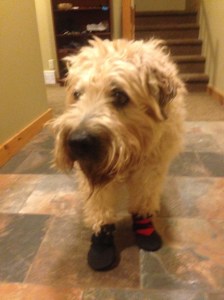
I lost a boot and look what my humans made me wear. One red shoe. All the others are black. Farley with Red BookI’m calling it my dancing shoe.

I’ll make the best of it if and try impress the other dogs with my skills on the slopes and maybe they won’t notice my mismatching shoes…

Maybe I can persuade Kristina to go shopping.


Woof Woof.

Book Deal with Luzifer-Verlag in Germany

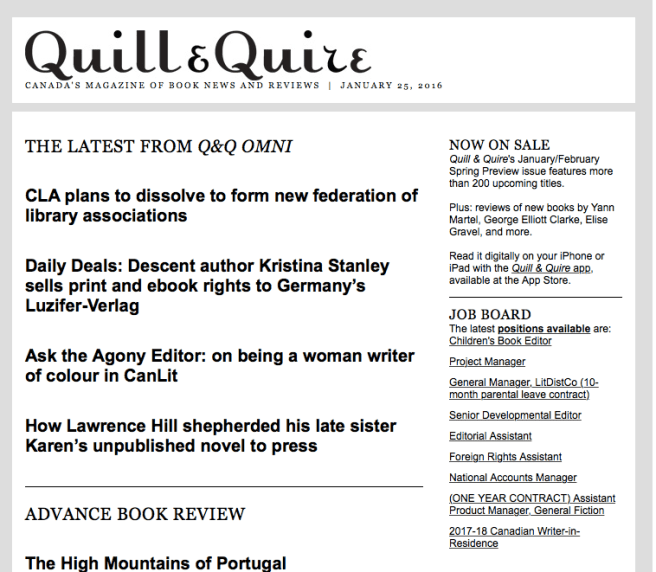
How to announce something so exciting…I’ve signed a deal with Luzifer-Verlag for the the print and ebook rights for the German translation of DESCENT.

Screen Shot 2016-01-26 at 6.25.11 AM

How did this happen?

Liliana Conn translated the English version of DESCENT in to German. My publisher, Imajin Books and Cheryl Kaye Tardiff, brokered the deal. Essentially, my publisher acted as my agent. I can’t thank Liliana, Cheryl and Luzifer-Verlag enough for supporting me.

What happens next?

A new book cover for DESCENT to fit the German market.

Final translation and editing of the German version.

Off to print DESCENT goes.

I’ll let you know how this goes and what I learn in the process.

What is DESCENT about?

When Kalin Thompson is promoted to Director of Security at Stone Mountain Resort, she soon becomes entangled in the high-profile murder investigation of an up-and-coming Olympic-caliber skier. There are more suspects with motives than there are gates on the super-G course, and danger mounts with every turn.

Kalin’s boss orders her to investigate. Her boyfriend wants her to stay safe and let the cops do their job. Torn between loyalty to friends and professional duty, Kalin must look within her isolated community to unearth the killer’s identity. 

If you’d like to try DESCENT in English, you can find it at: myBook.to/Descent

Has anyone else had their book translated to another language? I’d love to know what your learned in the process.

Thanks for reading…


Write Better Fiction: Protagonist Point Of View Scenes

Feedback iconToday on Write Better Fiction we’ll cover the Protagonist. Write Better Fiction is a process to help you critique your own manuscript and give yourself feedback. This will help you improve your novel, so you’re ready to submit it to an editor. Check the bottom of this post for links to previous Write Better Fiction articles.

Last week I wrote about Point Of View Goal. This week we’ll keep track of which scenes your protagonist is in.

The spreadsheet has a column for who is the point of view character in a scene, but we also need a column for your protagonist if you write from multiple points of view. If you write from a single point of view, your protagonists POV, throughout the novel, then you don’t need this column.

Screen Shot 2015-11-30 at 5.06.20 PM

This column is easy. All you have to do is put the protagonists name in the row where your protagonist is in the scene. The protagonist doesn’t have to be the point of view character for the scene.

The protagonist should show up early in your novel. Some argue the protagonist must appear in the first scene. That’s up to your creative instincts. Whichever way you choose, do so with thought. By keeping track of the first scene the character appears in will part of the process in deciding if you’ve chosen the right protagonist.

Use this column to see if there are long gaps in your scene progression where the protagonist isn’t in a scene. This may jar the reader from the story. The reader may lose track of who they are supposed to be cheering for.

You can sort the spreadsheet by this column and count how many scenes your protagonist plays a part in your novel. If the protagonist isn’t in more than three quarters of the scenes, maybe you’ve chosen the wrong protagonist. You should ask yourself whose story is this.

If you’re writing a romance novel you may follow the pattern where you alternate scenes between the romantic partners. This column can tell you if you’re giving both partners equal time in the novel. You can also sort the point of view column to check the balance of POVs given to each main character.

Your challenge this week is to count the number of scenes your protagonist is in and balance that with how many scenes the protagonist has the point of view.

Previous blog posts on Write Better Fiction:

  • Number 1 Question to ask yourself about PLOT
  • Number 1 Question to ask yourself about CHARACTER
  • Number 1 Questions to ask yourself about SETTING.
  • ACTION in a scene
  • NAME of a scene
  • GOAL of point of view character

I critiqued DESCENT and BLAZE using the techniques I’m sharing in Write Better Fiction, and I believe this helped me sign with a publisher.

Please me know in the comments below if you agree with the advice on counting scenes for your protagonist? Do you write in a genre where it doesn’t matter?

Thanks for reading…

Mystery Monday: R.J Harlick on When Dreams Become a Reality

This week I have the honor of hosting R.J. Harlick on Mystery Mondays. I was lucky enough to have R.J. provide an endorsement of BLAZE which I proudly display on the cover, so it is a true pleasure to have her on Mystery Mondays.

R.J is here to talk to us about When the dream becomes a reality.

By R.J. Harlick

Hi Everyone.

I’m thrilled to be speaking to you today on Kristina’s blog . Thanks, Kristina for inviting me.

Today I thought I would address a question I am often asked by readers. At what point did I know I wanted to be a writer?

Though some of my confrères knew at a very young age, for me it was a more gradual transformation. There was no lightening bolt moment when I shouted, “Yes, I want to be a writer.” I more or less slid into it, starting where most writers start, as a reader.

As a child, I devoured books, in particular mysteries beginning with Nancy Drew and the Hardy Boys, eventually graduating to Agatha Christie, Sherlock Holmes, Dorothy Sayers, Raymond Chandler, Nero Wolf and the like. Sometimes I thought it would be fun to write one of these myself.

I even tried writing a mystery for a grade seven English class. But I blush at the memory. I’m afraid this first attempt was far too long and, I hate to say it, far too boring. Nonetheless I kept this idea of writing a mystery buried in the far reaches of my mind.

Though I loved reading, English was never my favourite subject in high school. I found the piecemeal taking apart of a story would destroy the magical hold it had over me. But I loved the creative writing part of English classes. I’d spend many an hour on class assignments making the stories swirling around my head come alive with words. Needless to say many had a mystery angle to them.

In university, I continued to enjoy playing with words. I excelled at making essays sound as if I knew something about the topics about which I was writing, when I didn’t. Studying wasn’t one of my strengths. Perhaps this is where my penchant for creative writing started.

I also continued to read voraciously branching out into the world of the greats. Though I thought it might be fun to become a writer, like Ernest Hemingway or Somerset Maugham, I didn’t treat it seriously. I didn’t really think I had it in me.

This enjoyment for words continued on into my work life as an information technology consultant. I invariable preferred the writing part of my job to other aspects. But it was business writing; letters, proposals and reports. Nonetheless I continued to harbour the dream of being ensconced somewhere bucolic penning the next great Canadian novel, or should I say mystery.

To satisfy my need to write, I started recording my time spent at my log cabin in a journal. Finally, one day after reaching a significant birthday, I decided it was time to find out if I could become the fiction writer in the bucolic setting of my dreams. The setting was easy. I was already sitting in it; the screened-in porch of my log cabin overlooking the surrounding forests. And so I set out to write what would eventually be published as my first Meg Harris mystery, Death’s Golden Whisper.

My first goal was to see if I could write a novel. Up till then, none of my business writing had approached the one hundred thousand word length of a typical novel. The next goal was to determine if I could write fiction, for I quickly discovered fiction writing was a totally different animal from business writing. As I marched along this new adventure, scene after scene, chapter after chapter, toward the climactic end, I realized I really, really enjoyed it. I decided writing was what I wanted to do for the rest of my life. The third goal, of course, was to see if I could get it published. But this is a story best left for another day. Let’s just say it was a long haul with many disheartening rejections.

Seven books and the odd short story later I am still having fun. I’m in the midst of continuing my adventure with Meg. I’m midway through the writing of the eighth Meg Harris mystery. Though I do have a title, I’m not quite ready to share it, in case I change my mind. But I will tell you that the colour for this book is purple and it will be set in the Northwest Territories.

What about you? Was it a slow gradual slide into becoming a writer or did you know from the get-go that you wanted to be one?

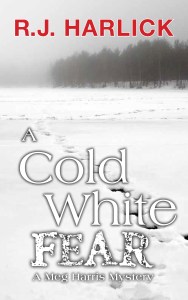
Cold White Fear final coverNow for some BSP – If you happened to live in the Toronto area, I will be reading from and signing my latest book A Cold White Fear on Thursday, January 28 from 6:00 pm to 7:30 at Sleuth of Baker Street on Millwood Ave. It would be fabulous to see you there.


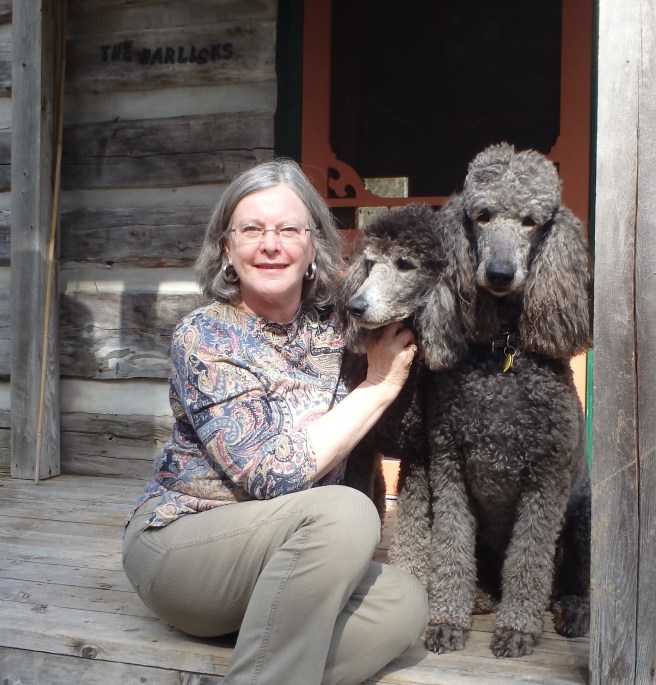
OLYMPUS DIGITAL CAMERA

RJ Harlick is an escapee from the high tech jungle. After working for over twenty-five years in the computer industry, first for major computer corporations such as IBM and DMR Group, then with her own management consultancy practice, she decided that pursuing killers by pen would be more fun than chasing the elusive computer bug.

Originally from Toronto, R.J., along with her husband, Jim, and their standard poodles, Sterling and Miss Molly, now bides her time between her home in Ottawa and log cabin in West Quebec. A lover of the outdoors, she spends much of her time roaming the forests of the Outaouais. Because of this love for the untamed wilds, she decided that she would bring its seductive allure alive in her writings. This she has done in her Meg Harris mystery series, where the wilderness setting plays almost as large a role as the main character, Meg Harris.

Write Better Fiction: Point of View Character Goal

Feedback iconToday on Write Better Fiction we’ll cover the Goal of your Point of View Character. Write Better Fiction is a process to help you critique your own manuscript and give yourself feedback. This will help you improve your novel, so you’re ready to submit it to an editor. Check the bottom of this post for links to previous Write Better Fiction articles.

Last week I wrote about naming a scene. This week I’ll cover the goal of the point of view character. Each scene will have a point of view character, and we discussed this in #1 question to ask yourself about plot. ADD LINK

The point of view (POV) character must have a goal. Without a goal, what’s the point?

There are two types of goals:

Internal: The reader isn’t told what the POV goal is.

External: The reader clearly understands what the POV goal is.

Each POV character should have an overall novel goal. The most important goals should belong to your protagonist and antagonist. Of course, these goals should oppose each other.

Screen Shot 2015-12-17 at 1.28.11 PMThe overall goal drives the character throughout the novel. In DESCENT, Kalin Thompson’s external goal is to find out who killed an Olympic-caliber skier. She has an internal goal that drives her through the first three novels in The Stone Mountain Mystery series, which I can’t share or it would ruin the mystery, but it’s there and influences how I write.

Finding a murderer is Kalin’s main goal throughout DESCENT. She also has goals within each scene where she holds the point of view. In the opening scene her external goal is to go skiing. Her internal goal is to be good at her job. Both goals will be tested very early in the story.

The reader doesn’t know about the internal goal, but it helped me create a focus and drive for Kalin in the next few chapters.

Other characters might have a goal in the scene. In fact, they should and it should be in conflict with the POV goal. This is a different column in the spreadsheet that we’ll talk about later.

Your challenge this week is to review each scene in your novel and determine what are the internal and external goals of each POV character. This will also focus you on the who has POV and give you another opportunity to check you’re consistent with the POV and that you’re not head hopping (unless it’s intentional). Please let me know in the comments if this helped you write better fiction.

I critiqued DESCENT and BLAZE using the techniques I’m sharing in Write Better Fiction, and I believe this helped me sign with a publisher.

Previous blog posts on Write Better Fiction:

Please me know in the comments below how you deal with the goal of your POV characters? Did you have difficulty defining a clear scene goal?

Thanks for reading…

Mystery Mondays: Viv Drewa on Mystery, Thriller or Suspense

This week on Mystery Mondays we have Viv Drewa, also known as the Owl Lady. I met Viv online via blogging. She’s hosted me on her site, and we comment back and forth on writing. Viv generously shares Mystery Mondays on a regular basis, so if you’re inclined to share, now’s your chance.

Maybe in the comments below, Viv will let us know why she’s called the Owl Lady.

So on to Viv…

Mystery, Thriller or Suspense by Viv Drew

These three genres can be used alone in any combination depending on the book you are writing. But what’s the difference? Let’s look at each one.

Mystery: a detective or other law enforcement person, or really anyone will be in a position to solve a murder or some type of puzzle, and finally exposes, or captures, the villain. Throughout the novel the reader has no idea who the villain is until the end of the book.

Thriller: The victim is in danger throughout the book and is generally someone with a bit of a sordid history them self. In order to clear his/her name the victim pursues the villain and ends up with sometimes harrowing escapes. In the end the victim brings evidence to the proper authorities clearing his/her name. The victim, and the reader, learn who the villain is as the story progresses.

Suspense: These books let the reader in on who the villain is from the get go. The victim or victims realize there is a deadly problem but have no way of knowing the who or why. The reader will be on edge until the villain is caught before he/she kills or kills again. Some of these books in a series may end as a cliff hanger.

 Midnight Owl: A Joe Leverette Mystery, Book 1

midnight owl coverCHAPTER ONE

Heather North had felt as if someone were following her for a while now, weeks to be exact. The sensation was driving her crazy. She lived in a relatively safe area with a short walk from her parking spot to her apartment, but the feeling was much stronger tonight and it made the walk look a lot farther.

Behind the large SUV to the left of her car, a figure waited. He watched Heather get her purse and sweater out of her car and lock the door. He watched her look around nervously, checking her surroundings before heading to her apartment.

The one thing that Heather really didn’t like was that there was no fence between the parking lot and the small wooded area next to it. Her insecurity tonight made it feel even more ominous. A great horned owl gave off three quick hoots making Heather jump and almost drop what she was carrying.

Before she had a chance to step away from her car, a strong arm wrapped around her waist and a damp cloth was clamped tightly over her mouth. She dropped her purse, keys and sweater and everything went dark.

When Heather awoke she felt groggy and very cold. She found she was bound to the top of a cold steel table. Her arms and legs were stretched apart, and she was naked. She was horribly cold but even more terrified. Her heart beat hard against her chest like it was going to explode. The room had a nasty, pungent smell, like animals. There was a door off to her right.

Frantically, she looked around and saw that she was in a small dimly-lit room with nothing in it except for the table she was lying on and another small table, which was about six feet from where she lay bound. On it she saw a small chain saw and some other things she couldn’t make out. Her stomach became a ball of fear, knotting tighter and tighter. Except for the two tables, the room looked filthy. There was a bright light hanging on the ceiling just above her. It was the only light in the entire room.

From under the door she saw a stream of light and some movement behind it.

The room was so quiet. Even the movement behind the door was quiet, except for the zipper sound she just heard.

“Who’s there?” she called out in a trembling voice that didn’t sound like her own.

The light behind the door went out and the squeaking door opened slowly. A man stood there and looked at her. He was wearing a total-body rain suit, surgical cap and mask. Only his eyes were visible.

“Hello, Heather,” he said in a calm voice.

“What do you want? Why are you doing this? Who are you?” she blurted out.

“Now, now. I’m here to take you on an adventure. One that will allow you to pay for all the misery you’ve caused to a lot of people,” he said with his calm voice. “I’m going to make sure you’ll never hurt anyone again.”

He turned and reached for a pile of what looked like fabric straps from the table. They were four strips. He began applying one of them to each of her limbs, tightly, like a tourniquet, a few inches below her torso.

She became more terrified; the tourniquets hurt as he tightened them around her legs and arms. This made her more frantic, not knowing what he was going to do. She tried to think of something to say but all that came out was, “Please, please don’t hurt me.”

“Now, now. This will be nothing compared to the grief and misery you’ve caused six people, and two were even family,” he said in his calm voice with just a slight inflection when he said family. She looked into his eyes and that frightened her even more. His lifeless eyes were so dark she felt as if she was falling into them.

Once he finished with the tourniquets he turned back to the table and picked up a small electrical chain saw.

“This is going to hurt. I won’t lie to you,” he said with a smile showing through the mask. He started the saw and Heather felt as if she were going to vomit.

“Now just lie still. I’ll be done in a second.”

He began to cut her left leg a couple of inches below the tourniquet.

Heather screamed and thrashed trying to get out of her restraints but to no avail. The pain was excruciating! She started hyperventilating. He quickly finished cutting off her left leg and stopped. He saw her breathing hard.

“Now just relax. We have four more to go.” His calm demeanor terrorized her even more. “We don’t want you passing out just yet.”

He stopped and waited for her to slow her breathing a little, even though he knew it wouldn’t get anywhere close to normal.

“If you breathe too hard you’ll lose blood a lot quicker.”

She couldn’t talk, she was in shock. All she could do was to stare at him. He said he had four more to go. Four more? What four? He had only tied on four tourniquets.

He saw her looking at him with wide-eyed terror. Her mouth moved but nothing came out.

He walked around the foot of the table to her right leg.

“Remember what I said. This is going to hurt.” His voice was still calm. With that said, he started the saw and proceeded to cut off the right leg.

Again she started screaming, wishing she could pass out from the pain. Her bladder and bowels emptied. His cut was quick but the pain was still agonizing!

“I see we had a little accident,” he said, moving the leg away from the excrement on the table. “I’ll get to that in a little while.”

Heather tried desperately to think. What could she have done so wrong that she deserved this? She wasn’t that bad of a person. Sure, she knew she pissed off some people but she only wanted what was best for her and her kids. Was this monster hired by her ex-husband? Was it her ex-husband? He was a bastard but he wouldn’t do anything like this, would he? She wondered if she was even thinking clearly.

He checked his work on her right leg, and being satisfied, walked to her right arm.

“I’ll let you rest for a while. Then we can get back to work,” he said and took the severed leg to the other side of the table. She saw him put it in a black trash bag and fasten the top. Then he took the other leg and did the same. He looked at Heather and she could see the smile behind the surgical mask.

“Now, I’ll let you pick. Right arm or left arm?”

“F you!” was all she could say in a weak, raspy voice. “Why don’t you just cut my head off and be done with it?”

“Oh, that’s the encore my dear. We must get the limbs off first. Since you have no preference, I’ll start with this one,” he said as he walked to her right arm. He turned on the saw and proceeded to cut off her right arm.

Heather couldn’t take the pain anymore. She was sure she was going to pass out this time.

He stopped and shut off the saw. “Maybe I’ll let you rest for a minute. You’re not looking well.”

“F you,” she tried to say. She was getting weaker and colder. Even with the tourniquets, she was losing some blood from where he had cut.

He took her detached right arm and walked over to the table, carefully, almost reverently, placing it in the bag and tying it shut.

He looked over at Heather and saw that she was still awake and that made him happy.

She felt as if she were losing her mind. Is this a dream? A f-ing dream? The pain was so real. Then Heather saw him coming back to her left side and he had the saw.

“Two to go,” his calm demeanor made her more furious but she was too weak to even speak anymore.

She closed her eyes when she heard the saw and the little energy she had left allowed her one weak scream.

“Now I will put this in its bag and we can get on with the rest,” he said and put the arm in the bag.

He picked up the saw and walked over to her again.

“The fun is just beginning. Aren’t you excited?” he said sounding genuinely enthusiastic. “Don’t think you’ll feel much. Maybe get really, really cold. Ready?”

Heather shook violently from fear and loss of blood. What the hell could be worse?

“Now, my favorite part,” he looked into her eyes and smiled. “Are you ready?”

He picked up the saw and turned it on. “I hope you enjoy it as much as I do,” he said and brought it toward her head.

“No, no, no, please, no, no,” she could barely speak. She prayed she’d pass out before he started to cut her neck. The terror worked against this and she laid there, eyes opened wide and mouth trying to scream.

He smiled sweetly and brought down the saw.

“Now, wasn’t that the … what’s the saying? ‘The cat’s meow?’” he laughed hysterically and shut off the saw.

“All done.”

He walked to her side and released both tourniquets on her legs at the same time, then her arms.

Blood flowed quickly and Heather’s body began to convulse as the remaining blood quickly poured onto the table and squirted the wall. Some dripped down to the floor. He put the saw down on the small table, then stroked her hair and closed her eyes.

He picked up her head and turned it around in his hands.

“So pretty, but such a bitch,” he said and put her head into its trash bag.


***

Next week on Mystery Mondays, we welcome Mystery Author R.J Harlick.

Thanks for reading…