Helping Authors Create Stories That Work

You know I love to write, but I also love to edit. I’m thrilled to announce Fictionary’s Story Editing Course. Try it, and maybe you’ll love to edit too!

once-upon-a-time-719174_1920

At Fictionary, We believe to become a successful author, your novel needs to tell a great story.

Think about some of the best novels you’ve read. What do you remember?

Like me, you probably recall a compelling character like Jason Bourne, the intriguing plot told in Gone Girl, or the fantastic settings depicted in The Game of ThronesYou remember the story.

Combining Fictionary (a self-editing tool for fiction writers) with an online course seems like a great way to give authors the knowledge and process needed to complete their own story edit.

If you’ve finished that first draft and aren’t sure what to do next, we’ve got a solution.

Announcing the Fictionary Story Editing Course

This course will guide you through your manuscript with a scene-by-scene approach to editing. Fictionary focuses on the story, not the words.

To receive the first two lessons, all you have to do is sign up for a free trial of Fictionary. No credit card required. No obligations.

The full 14-lesson course is included with a Fictionary subscription.

Lesson Plan

  • Lesson 1: How To Use Fictionary To Make Your Story Work
  • Lesson 2: Characters And Novel Structure
  • Lesson 3: How To Improve Your Plot
  • Lesson 4: How To Improve Your Settings
  • Lesson 5: How To Use Word Count To Evaluate Your Scenes
  • Lesson 6: Connect Your Readers To Your Characters
  • Lesson 7: Make The Most Of Your POV Characters
  • Lesson 8: Story Arc And Engaging Your Readers
  • Lesson 9: Finding Plot Holes
  • Lesson 10: Draw Your Readers Into and Out of Each Scene
  • Lesson 11: Maximize Your Use of Tension And Conflict
  • Lesson 12: Check For An Empty Stage
  • Lesson 13: Keep Your Timeline Clear
  • Lesson 14: Bringing It All Together

Lesson 1: How To Use Fictionary To Make Your Story Work

Fictionary can identify and help you fix problems within your manuscript by focusing on the structure of your story, not on the words. In lesson one, we’ll tackle these critical structural areas:

  1. Pacing
  2. Character names and appearances
  3. Point of view characters and goals
  4. Story arc
  5. Plot holes (scenes without a clear purpose)
  6. Flow from scene to scene
  7. Absence of tension or conflict
  8. Empty stage syndrome
  9. Confusing timelines or missing objects

 
Where Can You Get More Information?

Check out Fictionary.co for a full description of what Fictionary is and how it can help you.

Download our free Story Editing eBook.

Learn how story editing is all about evaluating the major components of your story. We call these components the Key Elements Of Fiction.  Our eBook shows you how to use the key elements of fiction to evaluate your story and become your own big-picture editor.


Turn Your First Draft Into A Great Story

Take Your Story up Several Levels by Editor Jodie Renner – Fictionary

Today it is our pleasure to welcome editor & author Jodie Renner to share expert editing advice. Jodie is generously sharing her wisdom on how to improve your story before you share it with others. Jodie is an editor and award-winning author of three Editor’s Guides to Writing Compelling Fiction: Writing a Killer Thriller Fire up Your Fiction Captivate Your Readers Jodie’s […]

Source: Take Your Story up Several Levels by Editor Jodie Renner – Fictionary

Fictionary: Online Story Editing Tool + Online Course

I’ve found a lot of joy over the years helping authors promote their books online. Now, I’ve expanded that to help authors learn how to do their own story edit. Some of you know I not only write books, but I’m also the CEO of Fictionary.co.

Fictionary is the first online tool for editing your story, not your words. Think characters, plot, and settings.

Fictionary is developed by writers for writers. That’s me 🙂 and indie author Michael Conn. Our third co-founder is Mathew Stanley – yup – my husband. He’s been my first reader and eagle-eye-editor for years.

Today, I’m thrilled to announce the Fictionary Story Editing Course.

Helping Authors Create Stories That Work

We believe to become a successful author, your novel needs to tell a great story.
Combining Fictionary with an online course seems like a great way to give authors the knowledge and process they need to complete their own story edit and ensure their story works.
Twitter Fictionary Course

Fictionary Story Editing Course

This course will guide you through your manuscript with a scene-by-scene approach to editing. Fictionary focuses on the story, not the words.

We’ll send you the first two lessons when you sign up for a free 10-day trial.
The full 14-lesson course will also now be included with a Fictionary subscription.
  • Lesson 1: How To Use Fictionary To Make Your Story Work
  • Lesson 2: Characters And Novel Structure
  • Lesson 3: How To Improve Your Plot
  • Lesson 4: How To Improve Your Settings
  • Lesson 5: How To Use Word Count To Evaluate Your Scenes
  • Lesson 6: Connect Your Readers To Your Characters
  • Lesson 7: Make The Most Of Your POV Characters
  • Lesson 8: Story Arc And Engaging Your Readers
  • Lesson 9: Finding Plot Holes
  • Lesson 10: Draw Your Readers Into and Out of Each Scene
  • Lesson 11: Maximize Your Use of Tension And Conflict
  • Lesson 12: Check For An Empty Stage
  • Lesson 13: Keep Your Timeline Clear
  • Lesson 14: Bringing It All Together
We hope you get a chance to experience Fictionary and the Story Editing Course.
Screen Shot 2017-10-26 at 8.43.37 AM

Seven Drafts by Editor Allison K Williams – Fictionary

At Fictionary our mission is: To help writers become successful authors.

We think one way to do this is to bring in experts in the field of editing to share their knowledge. Today we host our first editor!

It is our pleasure to welcome editor Allison K Williams. Allison is a writer, editor, speaker, and coach. Allison has edited books published by Big Five publishers including Penguin Random House, and independent presses including Spencer Hill, as well as working with self-published authors.

[…]

Source: Seven Drafts by Editor Allison K Williams – Fictionary

Visual Structural Editing Of Your First Draft

fictionary twitter

If you’ve been reading my blog for a while, you know I’m a panster until I edit and then I love a process.

I’ve finished my first draft of Evolution and am now embarking on a structural edit.

After spending months and months writing the draft, I owe it myself to spend the time performing a story edit before I share the work with anyone.

Of course, I’m going use Fictionary to do this.

And I’m starting today because we’ve updated Fictionary based on input from our writing community.
  • New Guide and videos to lead you through your story edit.
  • Text Editing for updating your manuscript within Fictionary.
  • Manuscript Export to Word when your edit is complete.
  • Faster (I mean a lot faster!) and easier to use.

You can start your edit, too. We’re launching Fictionary at a special price of $10 US/month. There is no long-term contract commitment, and you can try it for free first.

Try free for 10 days (no cc required) and see if Fictionary is helpful to you. It just might become your new favorite writing tool!

If you’d like more information, check out https://Fictionary.co

And of course, send me a message if you have any questions.

Happy Editing.

Learn How To Self-Edit #AuthorToolboxBlogHop Purpose Of A Scene

Nano Blog and Social Media Hop2Thank you, Raimey Gallant for organizing the #AuthorToolboxBlogHop. Today is the 5th post of this new series!

This is a monthly blog hop on the theme of resources/learning for authors: posts related to the craft of writing, editing, querying, marketing, publishing, blogging tips for authors, reviews of author-related products, anything that an author would find helpful.

To continue hopping through other great blogs in the monthly #AuthorToolboxBlogHop or to join, just hop on over to Ramey Gallant!

I’ll focus my entire series on self-editing. Here is what I’ve covered so far in the series:

Today’s topic is PURPOSE OF A SCENE.

The first plot element I evaluate is the purpose of the scene. The purpose of the scene must relate to the overall story. If it’s not driving the story forward, then ask yourself what is the point of including the scene in your novel.

Here are some examples of the way the purpose of a scene can drive the story forward. You can choose one of these to define your purpose or come up with your own definitions.

  • Build suspense
  • Character development
  • Character Introduction
  • Climax
  • Establish mood
  • Establish setting
  • Inciting Incident
  • Intensify Conflict
  • Move the story forward
  • Plot point 1
  • Plot point 2
  • Resolution (after climax)

HOW PURPOSE OF A SCENE HELPS WITH THE OTHER ELEMENTS

I articulate the purpose of the scene first, so I can address other elements of the scene and test if they are in line with the purpose.

Let’s say you fill out the list of objects in a scene. You can weigh the objects against the purpose of the scene and see if there is a way to use them to further the purpose. This goes for revelations, tension, conflict, weather, etc. Basically, every scene element can be tested against the scene purpose.

After you whittle down the purpose of a scene to a few words, one of three things will happen.

  1. You’ve got the purpose nailed, and you understand why this scene is included in your novel.
  2. You have a weak purpose, but there is still some value in the scene.
  3. You have no idea what the purpose is.

So you’ve got the purpose nailed. Yay! Move on to the next scene.

If the point of the scene is weak, see if you can take what is important in a scene and move it to another scene, then delete the weak scene. You can also enhance the scene to give it a stronger purpose.

If you can’t articulate the purpose of a scene, think about removing the scene.

More Self-Editing Advice

BIG-PICTURE Editing
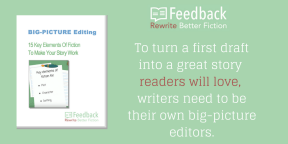
If you’re looking for more help on self-editing download the free eBook, BIG-PICTURE Editing 15 Key Elements of Fiction To Make Your Story Work and learn how big-picture editing is all about evaluating the major components of your story. We call these components the Key Elements Of Fiction.

Our eBook shows you how to use the key elements of fiction to evaluate your story and become your own big-picture editor.


Interested In An Automated Approach To Big-Picture Self-Editing?

Why not try Fictionary?

A new online tool for serious fiction writers. Turn your first draft into a story reader love by becoming your own structural editor. Fictionary is the first web app to help fiction writers evaluate their own work with a focus on story, not words.

AVAILABLE FOR FREE TRIAL NOW!

With Fictionary, you can focus on plot, character, and setting. You can evaluate on a scene-by-scene basis or on the overall novel structure. Fictionary will show you the most important structural elements to work on first.

Fictionally will guide you through the rewriting process by asking you questions specific to your manuscript, enabling you to evaluate your own story.

Fictionally helps you visualize your manuscript. Forget about yellow stickies or white boards. Fictionary will draw character arcs, provide reports on scene evaluation, and show your rewriting progress.

Happy editing and thanks for reading…

Structural Editing for Characters and Point of View – Fictionary

Top 3 Character Elements To Make The Most Of A Structural Edit. How to revise and edit a novel focussing on characters and structure.


Why Do People Read Fiction?

Structural Edit and CharactersOne reason people read fiction is to escape and experience the world through the thoughts and actions of the characters in the story.

We believe characters are your story. They act and react. They create emotion. They show motivation. Without any of this, you don’t have a story. That’s a tall order for your characters.

So how do you make sure you’re putting the most into your characters? You edit and rewrite until your characters are performing at their best. A little bit of organization will help you quickly complete these revisions…

Source: Structural Editing for Characters and Point of View – Fictionary

Camp NanoWriMo: 75% Done! Fictionary Launched!

It’s been a big week for me. I finished 75% of my Camp Nanowrimo word count goal, launched Fictionary, and created a Fictionary explainer video. Exhausting but truly fun.

Great DaneThe novel I’m writing in the camp is called Evolution and is a challenge for me. The Stone Mountain Series and Look The Other Way are all written in third person point of view. Evolution is written in first person point of view. It’s quite different to write an entire novel from on character’s point of view.

Daisy, a Great Dane, has a key part in Evolution. The story is written from Jaz Cooper’s point of view, but Daisy has a “big” role. I’m having lots of fun with her character. Can you see the slobber?

I’d love to know if any of you have written from both first and third person point of view and what challenges you faced. Any tips are most appreciated.

Fictionary - Logo - 400What does Fictionary have to do with Camp Nanowrimo?
I’m going to use Fictionary to do a big-picture edit on Evolution. I created the online tool for writers because I wanted a tool to help me edit the structure, not the words. Now I’m happy to share that with other writers who want to create a great story readers love. You can try Fictionary for free!

Screen Shot 2017-07-17 at 7.02.30 PMNow back to Nanwrimo.

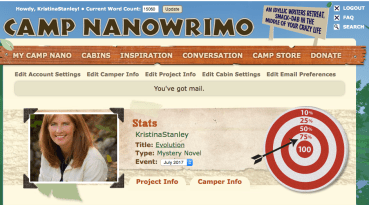
I reached 75% of my word goal. That’s 15,000 words. 5,000 more and I have my first draft of Evolution done. Anyone else doing Camp Nanowrimo? Let me know in the comments how it’s going.


Screen Shot 2017-07-17 at 7.10.57 PM

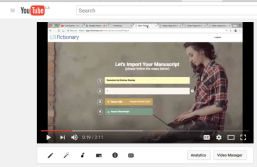
My first ever video is now on Youtube. It explains what Fictionary does. Creating this was a learning experience for me. I made the video on Youtube, then edited it using iMovie, then uploaded it back to Youtube.

There always seems to be a new challenge, but wouldn’t life be boring without it? 🙂

Thanks for reading.