Mystery Mondays: Kathleen Duhamel with An Unconventional Approach to Romance

Pageflex Persona [document: PRS0000040_00070]Kathleen Duhamel and I have a special connection. We both signed with Imajin Books for the publication of our first novels last summer.

Kathleen’s second book, DEEPER, is set to be released this spring. Her first book, DEEP BLUE, explores the theme Love Is the Most Addictive Drug of All. 

Read to the end and you’ll find a surprise for Kathleen’s launch party.

So let’s hear what Kathleen has to say about romance…

Going Deeper: Kathleen Duhamel’s Unconventional Approach to Romance (by Kathleen Duhamel)

I’m a contemporary romance writer, author of Deep Blue and Deeper (Books One and Two in the Deep Blue Trilogy) so what am I doing on Monday Mystery? The truth is my books aren’t conventional romances. When I began developing Deep Blue, I deliberately set out to write a love story that wasn’t typical in any way (except my characters do have mind-blowing sex). I wanted to weave a tale that combined romance with suspenseful elements, a book that read more like a thriller than a Harlequin novel. You’ll have to judge for yourself whether I’ve succeeded.

No shrinking violets

When we’re first introduced to Claire Martin, she’s a 58-year-old struggling landscape painter and cancer-survivor who’s all but given up on finding love again at her age. She’s also fiercely independent. After she meets Robert Silver and gets swept up into his overblown celebrity life, she refuses his gifts of a new car and money to pay off her debt to a loathesome ex-husband, because she doesn’t want to be pegged as a gold-digger. It was crucial to the book’s plot and her character that Claire find a solution to her problems without having to be rescued by a man. (Although Rob was more than willing to be her rescuer.)

Similarly, her BFF and single mother Denise Hrivnak searches for a way to plan her financial future, with or without a boyfriend in the picture. In her mind, having a man in her life is a luxury, not a necessity. She will find a way to make her dream a reality, maybe at the expense of having a personal life.

Men who truly love women

In many of the romance novels I’ve read, the alpha male is an arrogant, sometimes cruel jerk who is ultimately redeemed by the love of a good woman. I’m not saying this could never happen, but it’s highly unlikely in reality. In Deep Blue, Rob is a rock star idolized by millions of fans, but he’s also a 62-year-old lonely soul, still grieving the death of his wife three years earlier. He has issues (panic attacks, stage fright and a history of substance abuse), yet he never bullies or disrespects Claire because he genuinely loves her, and he’s a lot more needy than he lets on. By the end of Book One, Claire has rescued him.

Interesting flaws make memorable characters

No one gets to be 50 or 60 years old without accumulating some emotional baggage that affects every aspect of life, and my characters all reflect this idea. I’ve already mentioned Rob’s various problems, including his ongoing struggle with sobriety. His musical partner, Artie Hoffman, has his own set of issues. He’s an impoverished foster child turned millionaire rock guitarist, lauded as a genius, with a train wreck relationship history. Artie hides his softer side under a cloak of sarcasm so he never has to let anyone get too close. Fame has made him distrustful of almost everyone.

Even though they’re older, these characters retain their youthful personalities. Claire says she’s still surprised to look in her mirror and see someone old enough to be a grandmother, when she feels so young.

Inside, we all remain the best younger version of ourselves, despite our outward appearance. And our desire for love, sex and companionship does not diminish. As Rob tells Claire, “We can’t help getting older, but we don’t have to get old.”

Deeper (Book Two of the Deep Blue Trilogy) picks up where Deep Blue left off, but it also works a stand-alone novel. The band Deep Blue plans its future, while Claire and Rob’s relationship is rocked by an unexpected development that threatens to rip his family apart. Meanwhile, Denise and Artie embark on a somewhat humorous, prickly relationship of their own. Deeper probes into the psychology of these characters while combining elements of suspense, drama and hot romance.

Pre-orders are available now on Amazon, and the book comes out March 20. I’m having a book launch party on Facebook, March 20, 7 p.m. to 9 p.m. Eastern Time. You can find me on Facebook. Message me or email me at kathleenduhamel@gmail.com if you’d like to attend. My friend Kristina will be giving away a copy of Blaze! (Surprise 🙂 )

Kathleen’s Bio:

kathleen-duhamel  croppedKathleen Duhamel wrote and illustrated her first short story at the age of eight, and has never stopped writing. Her love of the written word continued throughout her varied career as a newspaper journalist and editor, public relations executive, freelance travel writer and owner/operator of two small businesses. A native of Texas, she spent most of her adult life in Colorado before relocating to Virginia in 2014, where she lives with her husband, a standard poodle and a geriatric cat. She is a lifelong devotee of rock and soul music, contemporary art and pop culture. https://kathleenduhamel.wordpress.com/

Thanks for reading…


Mystery Mondays M.H. Callway on NaNoWriMo

Mystery Mondays welcomes M.H. Callway to talk about riding NaNoWriMo Tiger.

If you don’t know what NaNoWriMo is: read on!

I know M.H. Callway as Madeleine. We met online through other authors. Madeline has a special place here as she provided an endorsement for my second novel, BLAZE. It’s difficult to ask another author for an endorsement and Madeleine said yes right away. Her generosity with her time and thoughtfulness in writing an endorsement has pushed my writing career along.

So please help me welcome M.H Callway.

RIDING THE NANOWRIMO TIGER by M.H. Callway

Many thanks to Kristina for inviting me to her blog! I’m delighted to be here.  Today I want to share with you my experiences doing last November’s National Novel Writing Month or NaNoWriMo.

Print

My friend and fellow author, TO Poet, encouraged me to join him and his friends for this 50,000 word marathon adventure. He has ridden the NaNoWriMo tiger no less than six years running.

So I jumped in feet first with little – well, let’s be honest – no preparation!


What is National Novel Writing Month?

November is pretty dull so every year hundreds of thousands of authors around the globe try to write 50,000 words to fill up the 30 days. Chris Baty and 21 of his writer friends came up with the idea in San Francisco more than 15 years ago. Thanks to the internet, participation has since gone viral. In 2015, writers located as far away as central Russia and Micronesia took part. No restrictions, no writing experience necessary.

How did y’all keep going? 

TO Poet set up a Facebook page for our team, the NaNoWriMo Misfits.  He kept us inspired with daily posts and we logged on to report our progress. Peer pressure proved to be a compelling motivator for me.

And coffee. Lots and lots of coffee.  TO Poet’s coffee mugs rival goldfish bowls.

Why embark on this marathon?

Like most newly published authors, I’d spent the past 12 months promoting my debut novel, Windigo Fire,  through conferences, meet-ups, bookstores and libraries. On my own or with our group, The Mesdames of Mayhem, I literally did hundreds of events. I needed to do get back to work on the second novel in my Danny Bluestone series, Windigo Ice.

Not that my keyboard was idle. I managed to write a suspense novelette, “Glow Grass”, for the Mesdames of Mayhem’s second anthology, 13 O’clock.

What plan / approach to use? 

As a scientist and MBA-type, I knew that an overwhelmingly large project can be broken down into incremental steps. That meant 1700 words over 30 days to reach the required 50,000 word count. I did a couple of test runs to prove to myself that I could pull it off. November 1st dawned and I was off and writing!

How did NaNoWriMo go? Did you make 50,000 words?

I did indeed make the grade: 50,048 words to be exact.  Here are the stats from my trusty Excel spreadsheet: my daily output ranged between 1600 and 2200 words. On my last day, I wrote 3300 words just to get done – my record for the month! It’s “the barn door syndrome” familiar to runners: we get a charge of life-saving energy when we spot the finish line.

What worked with NaNoWriMo?

For me, NaNoWriMo was a lifesaver. I refocused on writing and pushed aside life’s nagging demands to make it a priority.

Meeting my daily word count meant turning off the editor in my head. I tend to be a deliberate, measured writer so NaNo felt immensely freeing. I got to know my characters again, resolved tricky plot problems, churned out fun action sequences and created an encounter between Danny and Santa, the escaped villain from Windigo Fire that was a joy to write.  I now have several ideas for the core theme(s) and a goodly chunk of words to draw on – or to store for Books 3 and 4.

What challenges remain? 

After the freedom of NaNo, the hard work really begins, the tough thinking especially. I had to put my “plotter” hard hat back on while surrendering my “pantser” plumage with a sigh. I reviewed the 50,000 words I wrote and organized everything into a plot-logical order.

Right now I’m developing the details of the crime at the heart of Windigo Ice. And fleshing out the villain who made his first ghostly appearance to me during NaNo.

A thriller runs 80,000 to 100,000 words so even if all my 50,000 words were useable, I’d only be halfway there. That’s the keyword: useable. Editing is the next big step so in February, we NaNo Misfits are will be supporting each other during our Edit Month.

Would you recommend NaNoWriMo to other authors?

Most definitely! I’m pumped about Windigo Ice and can’t wait to finish writing Danny’s winter adventures. It’s a great way to get refocused on writing and to bond with fellow authors.

In an ideal world, I’d recommend having one’s plot meticulously laid out so that one’s first draft would be done by the end of November. But no matter, anyone who participates will be infinitely farther ahead than sitting around worrying about finding time to write.


Madeleine’s BIO:

madeleineM. H. Callway’s critically acclaimed debut novel, Windigo Fire (Seraphim Editions) was short-listed for the 2015 Arthur Ellis Award for Best First Novel. Under different titles, it was nominated for both the Unhanged Arthur and the Debut Dagger Awards. Margaret Cannon of The Globe and Mail called her “a writer to watch”.

Madeleine’s crime fiction stories, many of which have won or been short-listed for major awards, have appeared in anthologies and magazines. Most recently, her speculative fiction story, “The Ultimate Mystery” in World Enough and Crime (Carrick Publishing), was a 2015 Derringer finalist.

Madeleine blogs regularly about the weird things she encounters and about the wonderful people in her life. Visit her at www.mhcallway.com.

In 2013, she founded the Mesdames of Mayhem, a group of 15 established Canadian women crime writers. Two anthologies showcase their work: Thirteen and 13 O’clock. Stories in Thirteen were finalists for the Arthur Ellis and Derringer awards. Learn more about the Mesdames at www.mesdamesofmayhem.com

Madeleine is a longstanding member of Crime Writers of Canada and Sisters in Crime. An avid cyclist, runner and downhill skier, she has participated in the Toronto Ride to Conquer Cancer every year since 2008.  She and her husband share their Victorian home with a spoiled cat.

***

Thanks for reading…

Next week we welcome Lisa De Nikolits


Mystery Mondays: Elinor Florence on the Mystery Genre

This week on Mystery Mondays we welcome Elinor Florence. I met Elinor about a year ago, and since then we’ve been sharing our writing and publishing experiences over lunches.

Here’s what Elinor has to say about genres and her debut novel, BIRD’S EYE VIEW.
Bird's Eye ViewMy wartime novel Bird’s Eye View isn’t a classic murder mystery – although I have seen it shelved in the Mystery section of one bookstore – but rather, a whole series of mysteries.

You see, in my novel the serial killers are the Nazis, and my detective is an aerial photographic interpreter. Rose Jolliffe is an officer in the Royal Canadian Air Force. Like Sherlock Holmes, she uses her magnifying glass to study aerial photographs for clues, trying to outwit the enemy.

Along the way, she tackles a number of baffling mysteries:

  1. When the Allies bomb an important railyard behind enemy lines, why don’t the aerial photographs taken the next day show any damage?
  2. Is that charming French village real, or is it an elaborate camouflage created by the Germans to disguise an aircraft factory?
  3. Most importantly, what is the secret revenge weapon that Hitler says will win the war — and where on earth is it?

Rose examines aerial photos to the point of exhaustion (since there was no colour film, she is literally studying fifty shades of gray), striving to solve these and other mysteries – painfully aware that her failure will cost thousands of lives.

She is suffering from personal strain as well. Her brother Jack is flying a Spitfire, and she fears for him every day. She is in love with her commanding officer, who unfortunately already has a wife. And she is desperately homesick for her farm on the Canadian prairies. She keeps in touch with the home front through a constant flow of letters from her parents and her best friend, June.

Bird’s Eye View is the only novel ever written in which the main character is a Canadian woman in uniform. I find that very sad, considering that there were fifty thousand of them in World War Two alone. They were just as patriotic and dedicated as the men, but we know little about them. I wanted to shine a light on women’s contribution to the war effort.

To create my characters, I drew heavily on my own family. My mother lived through the war as a teenager in Canada, and her home town of North Battleford, Saskatchewan was an air training base. Her beloved elder brother was killed in the war. My father served in the Royal Canadian Air Force, as did my uncles. So I had access to a gold mine of personal anecdotes.

I was also intrigued by that fascinating but little-known branch of Allied Intelligence called photo interpretation. During the war hundreds of trained interpreters studied the aerial photos brought back from Europe – literally spying on the enemy from the sky. I read as much as I could about the subject, and travelled to both England and Germany for my research. Every incident in the book is based on fact.

Since the book was published a year ago, I’ve received hundreds of positive comments. People often tell me that my book enlightened them about our own Canadian history, especially the role of women. One former bomber navigator told me that he combed my book looking for errors and couldn’t find any – that was music to my ears! Others tell me that my book moved them to tears. Touching people’s hearts is always a good thing.

By far the most typical comment, however, is this: “I couldn’t put it down!” That’s the best compliment of all.

Elinor Florence PhotoElinor Florence is a career journalist who grew up on a farm in Saskatchewan, a former wartime airport. She wrote and edited daily newspapers and magazines across Western Canada, including Reader’s Digest. Married with three grown children, she now lives in the mountain resort of Invermere, British Columbia. Bird’s Eye View is her first novel. It’s available through bookstores or online from Amazon, and as an ebook. Order it here: http://www.amazon.ca/Birds-Eye-View-Elinor-Florence/dp/1459721438/ref=sr_1_1_twi_1_pap?ie=UTF8&qid=1429642038&sr=8-1&keywords=Birds+eye+view

Thanks for reading…


Mystery Mondays: Laurence St. John on Writer’s Block

It’s time to celebrate the first 6 months of Mystery Mondays. Leading us to the end of the year is Laurence St. John with the final Mystery Monday of 2015. He has some excellent advice on dealing with writer’s block.

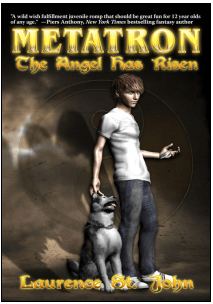
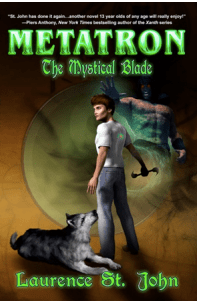
But first, Laurence is the author of the young adult fantasy/sci-fi novel series Metatron. Click on the book covers to find the novels on Amazon. Just remember, Christmas is coming soon, and these books would make awesome gifts…

The Angel Has Risen
The Angel Has Risen
The Mystical Blade
The Mystical Blade

My Secret Remedy for Writer’s Block by Laurence St. John:

For writers or even kids in school working on an essay or any other writing assignment – I’m sure at least one point in time while writing or in school you have had writers block. I did – several times when I began by writing career. When I was in school, teachers told me to keep writing/typing stuff no matter if it made sense or not. The purpose behind it was to keep my mind active. After a few minutes or even longer for some, something I wrote would spark an idea to get me back on track on what I was originally writing. Early in my writing career it was recommended to me that I should walk away from my work and take a break. However, I didn’t do what I was told – sshh, don’t tell.  

My secret…

First of all, I don’t have time to walk away from my work when I know I have a personal deadline to attain. Therefore what I do for writers block is to metaphorically kill two birds with one stone. I will run on my treadmill for a few minutes to get my heart rate up. Or instead of running I will perform sit-ups and push-ups. This gets my blood flowing as well as my mind. From what I  have read, exercise triggers a kind of chain reaction beginning with the release of chemicals that stimulate increased blood flow, which in turn causes the brain to perform more efficiently in numerous ways.

Exercise is my remedy for writers block.  


Laurence St. JohnBio: Laurence A. St. John was born on January 11, 1965 in Toledo Ohio. Laurence has one older brother and two younger sisters. Laurence along with his parents, brother and sisters moved once while growing up to Genoa Ohio, just south of Toledo. While attending Genoa Area schools, he was active in track, football and baseball. Later, after he graduated from Genoa High School (Comets) in 1983, he worked for a few manufacturing companies.  

At the age of 23 and after three years of dedication, hard work and sweat, in 1988, Laurence received his first-degree black belt (Shodan) in Tae Kwon Do. This gave him the self-confidence and perseverance needed to surmount anything that came his way.  

When Laurence was 25 years old he fell in love then married the love of his life, Julie in 1990. He then adopted her two young wonderful children Joe and Jan shortly after.  

Out of high school for nearly fifteen years and after persuaded by his former manager, Laurence attended Owens State Community College where he obtained an Associates Degree in Microcomputer Business Systems while working full-time. In addition to computer classes, he enjoyed composition classes where he could free his mind and write what he wanted.  

While working in the steel processing business for almost fifteen years, Laurence’s place of employment changed hands, for the third time in 2006; fighting for his job, again. In the same year his first granddaughter, Kendall, “Papa’s Angel” was born. He described this as one of the most uplifting moments of his life. In addition, it was during this time when his emotions were running wild; he became inspired as well as determined to write his penned-up thoughts on paper.  

Nearly four years later, he had completed his first middle grade/teen fantasy/sci-fi novel, Metatron: The Angel Has Risen. In addition his second novel, Metatron: The Mystical Blade was published in August 2014. The next Metatron novels in the series are projected to be published in 2016 and 2018.  

Laurence currently lives in Northwood Ohio with his wife of 26 years, Julie. His son Joe is married to Cari and they have three daughters, Kendall, Sadie and Harper. His daughter Jan is married to Andrew and they have a son Eli and a daughter Evelyn. Laurence currently holds the position of Administrations Manager at Precision Strip, Inc. in Perrysburg Ohio, where he works full time. He continually writes in his spare time; weekends and after work, and is endlessly inspired by his five grandkids Kendall, Elijah, Sadie, Evelyn and Harper.    

You can find Laurence at:

Website: http://www.laurencestjohn.com  

Blog: http://laurencestjohn.blogspot.com/

Twitter: http://twitter.com/laurencestjohn

Facebook: http://www.facebook.com/laurenceastjohn  

    ***

I know the suspense is killing you…when will the next Mystery Monday be? Who will kick off 2016? Well…

The international best-selling author and CEO of Imajin Books, Cheryl Kaye Tardif, will guest blog on Monday, January 4th!

Mystery Monday: Howard Shrier on 10 Rules of Writing

Today we welcome TorontBuffalo Jumpo Author Howard Shrier. I had the pleasure listening to Howard speak about Buffalo Jump at The Scene Of The Crime on Wolf Island, Kingston, Ontario and never dreamed I’d be hosting him on my blog. Howard writes the Jonah Geller series.

Howard is sharing some of his insight today, but if you’re interested in more…Howard teaches a Mystery Writing Workshop at the University of Toronto.Boston Cream

TOP TEN RULES OF WRITING BY HOWARD SHRIER

1.Create characters with strong needs and send them on a journey worth documenting and telling

2. Place significant obstacles in their path and allow them to reveal their characters through the actions they take to get around them.

3. Do enough research to be authoritative and plausible, but keep it to a minimum in the text.

4. Read voraciously, epsecially but not exclusively in your chosen field.

5. Tell your story in the most compelling voice you can muster. Have a sense of urgency, even if it’s buried. And develop an ear for dialogue if you don’t already have one.

High Chicago6. As Hemingway and so many others have noted, the best writing day ends when you know how you’re starting tomorrow.

7. Outlining, even if it’s in your head, can save you months of grief. The process of building a story in notebooks, all the aha moments, can be every bit as creative as writing itself.

8. Throw everything you can at the first draft. You can always cut it later.

9. Cut it later. And often.

10. Do not, under any circumstances, make the mistake I did and quit your day job before your first book comes out.

11. Bonus: A first draft is just that. Once you finish it, get people to read it. Take their comments graciously, even if you don’t agree with them. Sleep on them. See if they make sense in the morning. For me, revisions are where the best writing happens. Cutting what’s not needed, tightening the springs that provide tension, sharpening dialogue. As much as you revise your completed text, polish your first few chapters to a fine point. Bring them to a note of suspense, perhaps the incendiary incident we’ve talked about. Create a worthy sample of 5,000-10,000 words to show an agent if you get the chance.

Howard Shrier Bio

Howard Shrier PhotoHoward Shrier is the author of four acclaimed novels featuring Toronto investigator Jonah Geller: Buffalo Jump (2008), High Chicago (2009), Boston Cream (2012) and Miss Montreal (2013). A two-time winner of the Arthur Ellis Award for excellence in crime fiction, he has also written the standalone thriller Lostport, and is now working on a crime novel set in Montreal, 1950, when it was Canada’s Sin City.

Howard was born and raised in Montreal, where he earned an Honours Degree in Journalism and Creative Writing at Concordia University in 1979. He started out as a crime reporter at The Montreal Star and has since worked in print journalism, theatre and television, sketch comedy and improv, and corporate and government communications. Howard now lives in Toronto with his wife and two sons and teaches writing at University of Toronto’s School of Continuing Studies. He also works with mystery writers on their manuscripts to bring them up to professional standards. You can find out more about his work at howardshrier.com.

Mystery Mondays: Jayne Barnard on Spicing Up Secondary Characters

This week we welcome multi award winning author Jayne Barnard . First, let me tell you about Jayne’s latest release is Maddie Hatter and the Deadly Diamond, and then we’ll move on to Spicing Up Your Secondary Characters.

Maddie DD frontMiss Maddie Hatter, renegade daughter of a powerful Steamlord, is scraping a precarious living as a fashion reporter when the story of a lifetime falls into her lace-gloved hands.

Baron Bodmin, an adventurer with more failed quests than fingernails, has vanished in circumstances that are odd even for him.

While he is supposedly hunting the fabled Eye of Africa diamond in the Nubian desert, his expeditionary airship is found adrift off the coast of England. Maddie was the last reporter to see the potty peer alive. If she can locate the baron or the Eye of Africa, her career will be made.

Outraged investors and false friends complicate her quest, and a fiendish figure lurks in the shadows, ready to snatch the prize . . . at any price.

Spicing Up Secondary Characters by Jayne Barnard

A good character, we’re often told, is loyal, patient, loving… oh, wait! That’s a good dog. Our characters must be more interesting than our dogs, or readers – at least, those who don’t love dogs deeply – wouldn’t stay with them page after page. Received wisdom is that mystery characters (except the villain) should be likeable, relatable, engaging, dynamic, memorable, competent, fully fleshed-out, well-motivated, and a little unhappy.

Is it always true? How many fictional crime-solvers have been depressed loners who drink too much? Are they likeable? Not hardly. We forgive them, and keep reading, because they’re competent, well-motivated, and, on some level, relatable. Maybe they treat dogs well.

Then there are Inspectors Clouseau and Gadget, both likeable and memorable but failing the competence test. They succeed by the competence of secondary characters.

Good secondary characters are a challenge. They have at least some traits of a good lead character, and have to some degree an individualized appearance, personality, and skills. They fulfill vital plot functions. They never, ever become so interesting that they steal the sleuth’s limelight.

They also don’t burn up a lot of word count. A neophyte’s first chapter I once critiqued hit the right marks: a handful of characters individual in appearance, personality-rich, explicated in just a few sentences each. I was panting to see how they would all interact through the coming 250 pages. Tragically, all those well-drawn characters never appeared again. They were so many wasted words from a plot perspective and, worse, they made a promise to the reader that was never to be fulfilled.

Because Maddie Hatter and the Deadly Diamond is a humorous adventure rather a serious mystery, my answers won’t work for everyone. While some of my secondary characters are written as engaging humans, other characters’ appeal relies not on them seeming realistic but on the outright caricature of well-known characters or types.

Caricature is not to be confused with cliché. The latter, by definition, is a trope or trait so often copied that it has lost all meaning. Caricature, on the other hand, starts with a copy but exaggerates or twists familiar characteristics to create a desired effect.

Here’s Maddie’s first sight of one memorable secondary character:

Before the steam grate stood a rotund man in a camel-hair topcoat finished with both a shoulder cape and a wide astrakhan collar of some chocolate-hued fur. In the mirror above the mantle, he was admiring his extravagant moustaches, carefully waxed and shaped on either side of a small, pink mouth. Did he notice her beyond the doorway? No. He merely stroked a finger along one hairy arabesque with a satisfied smile.

Did you think of a certain Belgian detective made famous by Agatha Christie?

Hercule Hornblower has the recognizable features of waistline and facial hair, and also claims to be Britain’s greatest living detective. However, he’s also bombastic, endlessly self-promoting, cannot pass a mirror without grooming his handlebars, and he has a flaw that gives him more kinship to Inspector Clouseau than to Agatha Christie’s famously dapper sleuth. Hornblower is narcoleptic. He frequently falls asleep just when he might learn some fact that could crack the case.

As with any sound secondary character, Hornblower serves the main character and the story. His erroneous suspicions and conclusions help Maddie find correct ones. His incompetence highlights her competence. His bombast and lapses into slumber inject incongruities into otherwise serious scenes. In a novella featuring stolen idols, invisible airships, and eccentric adventurers, an intense conversation or introspection – which must sometimes occur in order for the real sleuth to solve the mystery – might mar the zany atmosphere. A caricatured secondary character like Hornblower is worth his considerable weight in light relief.

In a more serious mystery, a Hornblower would throw off the tone. A less intrusive secondary character might be the dog, who finds the victim’s bandanna just where it shouldn’t be, and then digs up the flowerbed of the one old man who might have answered the sleuth’s questions willingly if he hadn’t had to chase the dog.

Before you ask, there are no dogs in Maddie Hatter and the Deadly Diamond. Maddie’s pet is more suited to airship travel. He doesn’t dig up flowerbeds, either.

Bio:

Jayne launch headshotJayne is the author of author of the Steampunk Stories:
Maddie Hatter and the Deadly Diamond (Tyche Books, 2015)

The Evil Eye of Africa – a guess-the-murderer game in two acts

Parasol Dueling: An Epistle on the Infamous Hungarian Imperial Rules

Dueling Figures in Daily Life, in A Guidebook to Parasol Dueling – the Brandenburg Variation(Written by Kevin Jepson, with original artwork by Audra Balion)

***

Next week on Mystery Mondays we welcome Eileen Schuh, Canadian author of SciFi novellas and the young adult Backtracker series.

Thanks for reading…

MYSTERY MONDAYS: Author Gloria Ferris with 5 Tips For Writing A Mystery Series

My honour this week is to host author Gloria Ferris. As an award winning author, Gloria has valued advice that she’s sharing with us today. But first, a bit about her books.

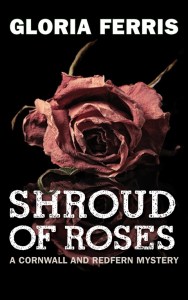
Shroud of Roses SHROUD OF ROSES: The Class of 2000 left behind a skeleton in its closet, and fifteen years later someone is coming for the rest of the graduates, including none other than Bliss Moonbeam Cornwall. Against their better judgment, Cornwall and Redfern team up to expose the killer before time — or Cornwall’s talent for stumbling into danger — gets the best of them.

HOT OFF THE PRESS (I’ve always wanted to say that):

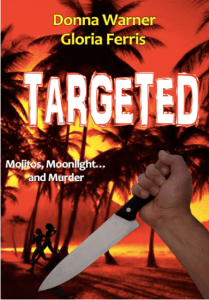
TARGETEDTargeted is available for pre-order now.

What could be better than a week of sipping mojitos, basking in the sun, and listening to waves lap against a Caribbean beach? Nothing, according to Jordan Blair and her friend, Ellie Cassidy. Until their vacation takes a sinister turn…

***

5 Tips for Writing a Mystery Series by Gloria Ferris

Every author who writes a series will have found her own truths and tips on what works for her storylines and characters (right, Kristina?). I don’t pretend that my list is comprehensive or will apply to everyone. But, they work for me and might help another writer just getting started on a series.

  1. Don’t info dump everything you know about your protagonist into the first book.

If you’ve planned a series, little secrets and heretofore unmentioned family members can be introduced when you need them. I plan to bring a badass gramma into book 4 of the Cornwall & Redfern series. So far, Gram hasn’t been mentioned and doesn’t need to be.

  1. Yes, your protagonist can be involved in more than one crime in his/her life.

Even murder. What are chances that a young woman in a small town will run across a homicide or other serious crime more than once? Slim to fat, but this is fiction. Readers suspend reality to enjoy the story. When they pick up a sequel, they expect mayhem to rampage through the pages, just like book 1. How many of us think when we pick up the latest episode of our favourite series, Oh no! Another murder? More crime and mystery! Not again!

Me neither. So, throw in another homicide or bank robbery and let ‘er rip.

  1. The love life of your protagonist doesn’t have to be all doom and gloom, or consume her every waking moment. (Be careful of rhyming prose as well, but that’s for another set of tips.)

Watching the mating dance of your favourite cop or sleuth is exciting. It should be incidental to the plotline, a slow blossoming of character development that can be nurtured over the course of several books. But, come on! After book 23 in the series, if our heroine is grappling with relationship issues with the same boyfriend she’s had for 15 years, or still can’t decide between Carlos and Brad, I’m losing interest and even an intriguing mystery won’t pull me back. Move on and show conflict with another character.

  1. You can and should rotate your secondary characters.

Some authors kill off their supporting cast with nary a smidge of regret. How bloodthirsty! And, unnecessary. I love my characters, even the mean, snotty ones with no obvious redeeming qualities. To keep readers from tiring of one of these individuals, I can send him out of town, demote him temporarily to spear bearer, or just mention him in passing. Or not at all. But, he can return for a future episode. When I need suspects or doomed victims, I create them just for that purpose. I don’t mess with my regulars.

  1. Each book in a series should be a separate entity.

A reader should be able to pick up Book 2, or Book 12, in a series and not be lost in time and space. It’s okay for the reader to realize she isn’t reading the first book in a series, but play fair. The ending of each book should resolve the mystery before the next one begins. If you’re writing a serial, state this on the front or back cover.

On a related note, repeat readers will not be offended by brief reminders of the setting and descriptions of the returning characters. This information will firmly anchor new readers in the world you have created for them.

Thanks for having me as your guest, Kristina. I’m honoured to take part in Mystery Monday!

BIO – Gloria Ferris

Gloria Ferris
Gloria Ferris

Gloria Ferris is the author of the darkly humorous Cornwall & Redfern Mysteries. The first in the series, Corpse Flower, won the Crime Writers of Canada Unhanged Arthur Award. The second, Shroud of Roses, was released in July, 2015. Her first paranormal mystery novel, Cheat the Hangman, won the 2012 Bony Blithe Award. Gloria’s mystery suspense novella, Targeted, co-authored with Donna Warner, will be released on November 21st. Targeted takes place in Roatan, Honduras and was planned as the first in a series. The next episode will follow cop/PI duo, Blair and Piermont, as they solve a murder in Old Quebec City.

Gloria began her writing career as a technical procedure writer at a nuclear power plant on Lake Huron’s rocky shores. It was an exciting job, but opportunities for plot and character development were limited. So she turned to crime fiction and found it to be a lot more fun. Now, she has returned to her roots in southwestern Ontario to work on both series, and to dream of finishing the sequel to Cheat the Hangman.

***

Next week on Mystery Mondays: Jayne Baynard.

Thanks for reading…

MYSTERY MONDAYS: Are you interested in Guest Blogging

What is Mystery Mondays about?

Mystery Mondays began in July 2015 and every week a different author posts about their favourite writing or publishing topic. It’s a chance to showcase your latest novel, engage with new readers and share your knowledge.

Mystery Monday Authors

Are you interested in guest blogging?

January spots are already full, but I’m taking requests from February 8th onward.

If you’d like to participate, here’s what you need to qualify:

  • your novels contain a hint of mystery (I’m very lose on what mystery means),
  • you are a published author – traditional or Indie or any other way that I don’t know about,
  • you are about to publish and have a launch date within a week of blog post,
  • you want to promote other authors and spread success,
  • you write novels with a hint of mystery,
  • you are willing to engage in the comments section when readers comment on your post.

All I ask from you is that you follow my blog, comment on author’s posts and help share via Twitter and Facebook.  If you’re interested send me a message via my contact page.

The guidelines:

You’ll have to send me your bio, back text of your novel, author photo and book cover. I’d like you to write something about yourself, your novel, your research, a writing tip or a publishing tip. Please keep in mind I am a family friendly blog. I do reserve the right to edit anything I think might be inappropriate for my audience, which I will discuss with you first. I think anything under 700 words is great, but it’s your book so up to you.

I’m looking forward to hearing from you and sharing your novel with the Internet world.

Thanks for reading…

Mystery Mondays: C.S. Lakin on Showing Through Your Characters’ Senses

This week I have the pleasure of hosting C.S. Lakin.

C. S. Lakin is a novelist and writing coach who spends her time divided between developing new book ideas and helping writers polish theirs. She is the author of fourteen novels – six contemporary novels, seven in the fantasy/sci-fi genre, and one in historical Western romance. Whether she is exploring the depths of the human psyche and pushing her characters to the edge of desperation, or embellishing an imaginary world replete with talking pigs and ancient magical curses, she is doing what she loves best – using her creativity and skills to inspire and affect her readers.

I was first introduced to C.S. Lakin through her novel Time Sniffers and have been a fan ever since.

Today’s she’s sharing an excerpt from her latest non-fiction book. Just another indication of her willingness to help other authors.

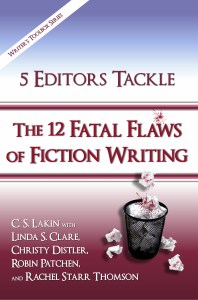
Excerpt from the newest release in the Writer’s Toolbox Series: 5 Editors Tackle the 12 Fatal Flaws of Fiction Writing.

 Fatal Flaws FINAL ebook coverShowing through Your Characters’ Senses

 One of the reasons readers willingly immerse themselves in a story is to be transported. Whether it’s to another planet, another era—past or future—or just into a character’s daily life, readers want to be swept away from their world and into another—the world of the writer’s imagination.

It’s challenging for writers to know how much detail to put in scenes to effectively transport a reader. Too much can dump info, drag the pacing of the story, and bore or overwhelm. Conversely, too little detail can create confusion or fail to evoke a place enough to rivet the reader.

In addition to knowing how much detail to show, writers have to decide what kind of details to use. I often read scenes in the manuscripts I critique, for example, that have characters engaging in lots of gestures, such as rubbing a neck, bringing a hand to a cheek, pushing fingertips together, turning or moving toward something—all for no clear reason.

Showing body movement, gestures, and expressions can be an effective way to indicate a character’s emotional state, but this needs thoughtful consideration so that the gesture or expression packs the punch desired.

It also important to show setting—and not just show it any old way. What is key to creating a powerful setting is to show it through your character’s POV and in a way that feels significant.

Showing Significant Settings

 When is setting significant to the reader? When it’s significant to the character.

That’s not to say every place you put your character has to evoke some strong emotion. A character who goes around gushing, crying, or jumping in excitement over every locale will appear to be missing some marbles.

But just as in real life, places affect us—some more than others. Each of us can think of numerous places in our past that bring a flood of emotionally charged memories. Showing setting colored by a character’s emotions is not only effective and powerful, it also captures real life.

But let’s talk about those other settings. The ones that aren’t emotionally charged. The many places in which you set your characters to play out your scenes. Some of those places are merely backdrops, places your character traverses daily or on occasion. They’re not important, right?

Let me just pose this possibility: even though you’ve thought a bit about the locales for your scenes, it may be that you aren’t truly tapping into the power of setting. In the rest of this chapter, we’ll look at ways to fix that.

Bring the Setting to Life

 You may need to write a scene that shows a tense discussion between two characters. So you stick them in the coffee shop, since it doesn’t matter where you put them. And, hey, a coffee shop makes sense. Everyone goes to them. It shows the characters doing ordinary things.

Sure, put your characters there (but please not twenty times in a novel). Or do something more interesting. I encourage writers to try to think up original, unique settings that bring a character’s bigger world—town, city, region—alive. But even if a writer thinks up fresh and creative locales in which to place her characters, those settings might still come across in a boring, ineffectual way.

But it’s the conversation that matters, the writer argues. That’s what I want readers to pay attention to. The setting is just a backdrop.

In many scenes, that may be true. But if a writer wants to transport her reader, she’ll think about bringing the setting to life via sensory details—which are observed by the POV character.

 Go through your scenes and look for these indications of flawed” telling” instead of showing:

  • Summarizing important moments instead of playing them out in real time
  • Lack of sensory details to bring the scene alive: sights, smells, sounds, and textures, brought out through the POV character’s senses
  • Detailing insignificant actions that aren’t important to the plot or don’t reveal anything helpful about the characters (showing too much)
  • Not starting in the middle of something happening in real time; instead, setting up a scene by explaining and filling in with information
  • Showing characters moving (driving, walking, etc.) from one location to another when those actions are not useful to the story
  • Numerous paragraphs of narrative that summarize interaction between characters and lack actual dialogue, gestures, and/or body language
  • Excessive use of gestures, body language, and “body feelings” to show emotion instead of alternating or replacing with internal thoughts that imply the emotion
  • Showing setting not presented through the POV character and void of sensory detail

Setting is so often overlooked, but it can be a powerful element in your story, so don’t neglect it.

Author C.S. Latin
Author C.S. Latin

S. Lakin is a multipublished novelist and writing coach. She works full-time as a copyeditor and critiques about two hundred manuscripts a year. She teaches writing workshops and gives instruction on her award-winning blog Live Write Thrive.

The latest book in The Writer’s Toolbox Series is now available for sale on Amazon: 5 Editors Tackle the 12 Fatal Flaws of Fiction Writing. Get yours here.

***

Next week on Mystery Mondays we welcome Gloria FerrisWinner of the 2012 Bony Blithe Award forCheat the Hangman” and Winner of the 2010 Unhanged Arthur for “Corpse Flower

Mystery Mondays: Kat Flannery

This week I have the pleasure of hosting Kat Flannery. Now I’m going admit I haven’t read much romance, but when I read CHASING CLOVERS by Kat Flannery, I was hooked. I was just going to read a couple of pages and get on with my day, but then I couldn’t get off the couch. So it’s with great excitement today that I get to share Kat’s writing tips.

By Kat Flannery and Alison BruceBefore getting to the tips, I have some breaking news. HAZARDOUS UNIONS  by Kat Flannery and Alison Bruce is on sale from Nov. 8-12 for $1.99

Now let’s get find out what Kat has to say.

5 Tips to Help You Write a Novel by Kat Flannery

Start with a Bang!

The beginning of a book is where you will set the stakes for your story. How do you do this? Start your story with tension, action, or a problem. I always begin with a conflict. This enables me to introduce the reader to the plot in a way that will grip them and hopefully keep them turning the pages.

In freelance, journalism, short stories, novellas etc. the key ingredient is to hook your reader, just as you’d hook a publisher when querying them; writing a novel is no different. Bring the reader into your story by setting up the action. Keep your reader engaged by giving droplets of information about your character and the plot, or sub plots while building toward the climax of the story.

Backstory and Exposition

As authors we are always told to keep the story moving forward. When telling backstory writers often get confused with how to continue forward when it is a contradiction to the rule. Tell, not show the reader in a paragraph, or page important facts relevant to the character or setting.

Exposition is breaking away from the action to give information. You will need to decide when it is appropriate to place necessary background facts within your novel. This can be tricky, but always remember the story comes first.

Do not bog down the plot with flashbacks of exposition. What I like to always remember for exposition is…telling it when the story allows.

* Three ways to present your exposition is to place it into the scene, put it between scenes, or let a character explain.

Characters

Write them to be tangible. If your character is the antagonist, who is a serial killer, explain how they became this way by foreshadowing, inner dialogue, and actions of other characters. Do not assume your reader doesn’t care who the antagonist is because he is the bad guy. Make it believable, and always ask yourself why, when flushing out character biographies.

Do not change the rules. Characters that don’t follow his/her actions will pull the reader from the story. When you’ve written a character that is shy and timid then all of a sudden she is argumentative and abrasive you will piss your reader off. There is nothing like being stopped dead in a book from poor characterization. If your character starts out meek and mild but you want her to become stronger, build toward it. Do not change her in a few pages. People don’t behave this way. Keep it real.

Sub plots

Well handled, subplots can deepen the story’s background, and be used as pacing to turn the action from a break in the plot. If you’re going to have one or two subplots pertaining to the main characters, start the first one right in the beginning of the story. If you’re choosing to have your subplot around someone other than your protagonist, allow the reader to get to know them first before starting the subplot.

Subplots should be woven throughout the novel, each taking a turn at being the central point of the story. This can be complicated and I’d advise taking notes on subplots so you don’t get confused.

Tie up loose ends. Like plots, subplots need development, crisis, and resolution. Even if the subplot is minimal, treat it the same way you would your plot. Mention to it once in a while throughout the story. Try to write the subplots predicament to be directly involved with the main plot.

Resolution

This is the end of your story. Similar to the beginning, the end will solve the problem you’ve built the reader up to throughout the whole story. Endings can come in three ways, happy, unhappy or both together. It is up to you, and the story you’ve written as to which way you will end things.

The resolution is the winding down of the rocky middle. Here you will resolve the central conflict. The main plot will end, and if you choose to write a series, you can keep a sub plot open, but do not leave the reader guessing on your central plot. Wrap it up!

Happy Writing!

Bio:

IMG_0484
Kat Flannery

Kat Flannery’s love of history shows in her novels. She is an avid reader of historical, suspense, paranormal, and romance.

A member of many writing groups, Kat enjoys promoting other authors on her blog. She’s been published in numerous periodicals throughout her career.

Her debut novel CHASING CLOVERS has been an Amazon bestseller many times. LAKOTA HONOR and BLOOD CURSE (Branded Trilogy) are Kat’s two award-winning novels and HAZARDOUS UNIONS is Kat’s first novella. Kat is currently hard at work on her next book.

 You can find Kat here:

Facebook

Twitter

Author Website

***

Next week on Mystery Mondays come on by and find out what C.S. Lakin (novelist and writing coach) has to say.

Thanks for reading…