Positive and Negative Feedback on Your Novel

#writetip

How do you know if your reader is any good?

Does your reader only give you negative feedback? That might be okay, but it won’t tell you what you’re good at.

Does your reader only give you positive feedback? That might feel great, but it’s not going to help you improve your writing.

To me the best reader gives me both positive and negative feedback. The positive keeps me motivated and tells me what I can relax about. The negative tells me what I need to work on.

What type of feedback do you like to receive and how does it help you?

Step Away From Your Novel

#writetip

How many times have you heard or read that when you finish your first draft, and I mean a serious draft, that you should put your novel in a drawer for a couple of weeks?

I never understood this until recently. I had three readers commenting on my updated version of The Final Gate.  While they were commenting, I decided to start work on my fourth novel, and leave The Final Gate alone.

Now that I am reviewing their comments and doing the final proofread, I finally get the importance of the advice.

I can see things I hadn’t seen before. Maybe it’s a passage of text that is too earnest, or maybe it’s narrative describing something I’ve already described. Without taking a break, I couldn’t see these things.

Even thought it’s hard to leave something alone that you are passionate about, I am now a believer in “Step Away From Your Novel.”

Dialogue Tags

#writetip

Who is talking? Do you always need a tag? Advice from how-to-write books say it should be clear from the dialogue, who is speaking. For the longest time, I interpreted this to mean that the character should have some unique way of speaking.

I don’t like to read dialogue where I get distracted with unique speech patterns, so I don’t like to write that way.

I finally understood what the advice means. The context and what the character has to say should give the reader enough information to know who is talking. If it doesn’t then a tag is needed.

If you need a tag, you could try using character movements or thoughts instead of a tag.

So back to my original thought. I now get the advice. So here’s an example.

A brother and sister are talking.

“What?” – can’t tell who’s speaking. Consider a dialogue tag or other method of indicating who is speaking.

“Mom loved you more because you’re a girl. She liked to dress you up and do your hair. I had nothing but scrapes and bruises to offer.”  – easy to tell the brother is speaking, so no dialogue tag needed.

Setting For A Novel

#writetip

How to choose a setting for your novel?  That depends on what your story is. But can your story depend on your setting? I think so.

I chose mine because I wanted to write a thriller. I wanted the novel to be tense, and I wanted the setting to have a lot to do with it.

For a mystery novel, choosing a location that isolates your characters, pummels them with bad weather, scares them with wildlife, and gives them nowhere to run, opens up the imagination.

I spent 6 years living in an isolated mountain ski resort, and that had a lot to do with my choice of setting, Even though I write about a fictitious resort, I know what it’s like to live in the depths of BC. Experience lends authenticity; my imagination can do the rest.

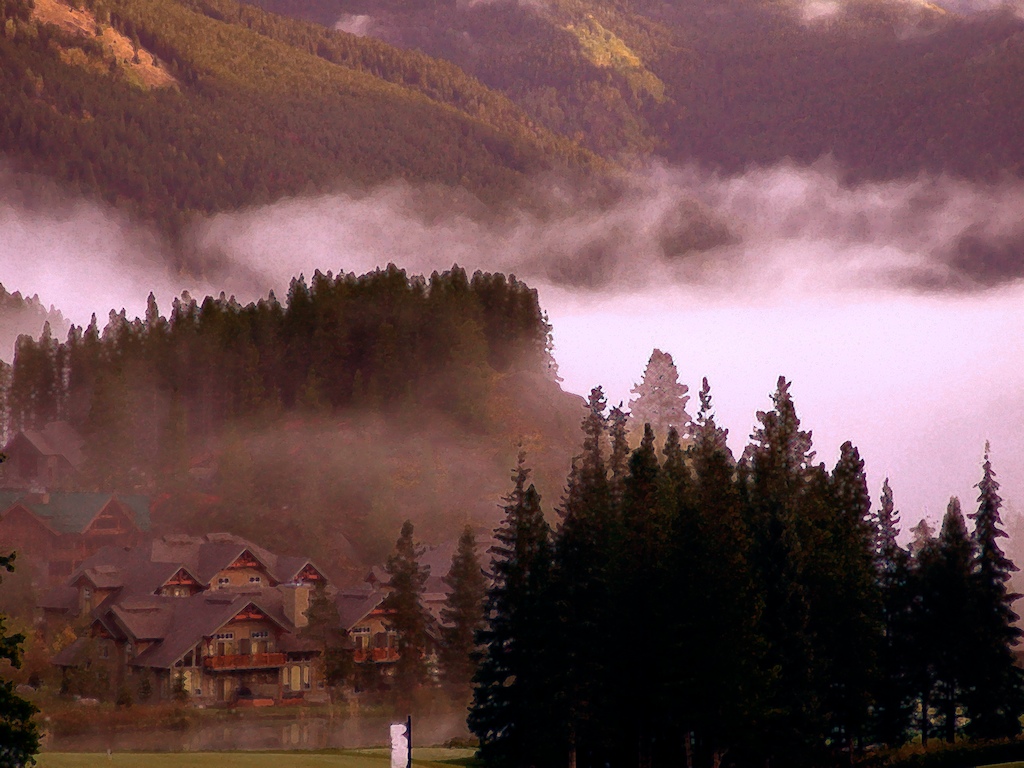
Tell me the photo doesn’t give you any ideas for choosing a scary setting.

Write From Experience

#writetip

Do you have scenes in your novel that are beyond your experience?

If you do, why not try the things your characters are doing? Everywhere you look, someone writes about writing being lonely. Well, it doesn’t have to be. Writing can be your excuse to be adventurous.

In The Final Gate I have a scene where my main protagonist is in danger while snowshoeing in the mountains. Having spent many hours snowshoeing in steep, rugged terrain, I found it easier to describe than if I’d just read about it.

My husband gets to do all these things in the name of writing a good novel and is happy to pose for a photo.

Starting My Fourth Novel

#writing

Novel One, Novel Two, Novel Three . . . Now what?

I’ve eighteen pages of notes on my fourth novel, and it’s time to move location.  Three novels are set in the Purcell Mountains, BC, Canada.

The fourth novel (and I feel like I should play music here) is set in the Bahamas. It’s time for a sailing adventure.

It’s been quite the experience writing about the Purcell’s. A place I lived and loved. An isolated mountain resort provides a great setting for a romantic thriller.

But the winds are changing and pushing me in a new direction. This is not to say I won’t continue to write about BC, only that it’s time to try something new.

New characters, new location, new mystery. It’s all a bit overwhelming, but also fun.

Now to go back and read what I wrote about the writing process and make sure I remember it all.

Blurb Translated to German

Fracture Line in German

As my translator works hard on Fracture Line, I asked her if she would translate my blurb into German. So here it is . . .

Stone Mountain, Britisch Kolumbien, Canada, Montag 31. Dezember, 7.29Uhr.

An einem kalten Wintermorgen, hoch auf den Purcell Bergen verschwindet Roy McCann in einer Lawine. Unfall oder Verbrechen ist die Frage.

Kalin Thompson kündigt ihren Job mit der Kanadischen Regierung  in Ottawa und nimmt den Job als Personalchefin im Stone Mountain Resort im Inneren von Britisch Kolumbien an,  um mit ihren entfremten Bruder Roy, wieder zusammen zu treffen.

Nach ihrer Ankunft enteckt Kalin, daß Roy im Verdacht steht einen großen  Diebstahl im Resort durchgeführt zu haben.

Kalin muß sich in die Sub-kultur des Ortes reinversetzen und zugleich eine heimliche Untersuchung leiten , die Roys Unschuld beweisen soll.

Kalins Leben wird bedroht als ihre Forschung nach der Wahrheit Erfolge zeigt.

Kalins Dillema ist, wem kann sie vertrauen, und ist ihr Glaube an die Unschuld ihres Bruders gerechfertigt

The next question: What is the title in German? After many hours of deciding on a title for Fraction Line, it’s time to start the process for the German Version.

This writing business is very time consuming.

Yeah, But . . .

#writetip

How do you overcome the ‘Yeah, but . . .” syndrome? It’s oh so tempting to respond to critique with the dreaded ‘Yeah, but . . .’ –  the temptation to explain why you wrote something the way you wrote it.

My advice is delay a rebuttal. You might be surprised what your brain does with the critique if you let it mull over what’s been said. If the answer comes to you in the middle of the night, be sure to write it down.

My reader, Sue is particularly good at pointing out where I need more emotion in a scene.

My reader, Janice points out where I need one level of emotion for the main characters and another for the secondary characters.

They are usually right. They don’t tell me how to fix a problem, only that the scene has one. Invaluable, but only if I’m willing to hear them.

My trick – I don’t respond to critique right away. I listen to it, go away and think about it, and then I have a non-emotional response and can decide logically if I want to make the requested changes or not.

Romantic Thriller

#writetip

How you see your work and how someone else sees your work can be quite a surprise.

Romantic Thriller? I thought I was writing a Suspense novel. Then, my agent commented that my second novel, The Final Gate, could be positioned as a Romantic Thriller if I added a little more romance.

Oh, Oh, I think. I like to read novels that are full of action, so that’s what I like to write. But Romance? Who knew?

Over the last couple of months, I’ve been reading Romantic Thrillers to get a feel for the genre and discovered my novel is not that far off. But . . .

I spent three months on rewrites, that’s the fun part, and now I’m back to proofreading. I’ve just sent The Final Gate to my favourite readers for comments, so I’ll see how they like the new romantic version.

This is a change for me, and I’m nervous about the feedback.  I guess I’ll have to wait and see . .

Maybe my husband will send me flowers for all the hard work I’ve done – that’s kinda romantic.


Capitalize your parents?

#writetip Should you capitalize parents? Proofreading is an endless task and here’s a mistake that’s easy to make.

Should you capitalize mom? (or dad, mother, father, aunt, uncle, you get the gist)

This short example shows you when you do and when you don’t.

“I don’t want to go, Mom. Really I don’t,” Ian said.

“You must,” Ian’s mom said.

Ian hesitated but obeyed his mom.

If you’re using mom as the name, then capitalize. If not, then don’t. Pretty easy, except when proofreading, one tiny letter is hard to see. I do a search for each mom, mother, dad, etc. and check to see if I’ve used them right.