Small Caps

#writetip Tricks of the trade are hard to come by, and it’s one more reason to have a mentor. If you’re a Canadian crime writer you might want to check out CWC. My mentor, Garry Ryan, President of Crime Writers of Canada, pointed out that I should use small caps when using acronyms such as RCMP, SUV, or DIN. Here is the same sentence. The first is 12 point for all words. The second has RCMP written in small caps.

RCMP Constable Wagner prepared herself for a fight. She squared her body . . .

or

RCMP Constable Wagner prepared herself for a fight. She squared her body . . .

The second sentence is the correct way. It even looks better on the page. You can see for yourself how RCMP blends better in small caps and doesn’t pull the eye away from the rest of the words.

Character Names

#writetip Do you refer to your character the same way throughout your novel or short story? Does this change depending on who has the POV in a particular scene?

I’m wondering if this matters.

I have a character, let’s call him Mike Chambers.

When Mike has the POV or his girlfriend has the POV, I refer to him as Mike.

When a cop who is interviewing him has the POV, I refer to him as Chambers.

I think it’s more personal to use Mike in his POV scene or his girlfriends POV scene.

When it’s the cops POV, I think the cop should be more distant from Mike and I refer to him as Chambers.

The question is: is this okay or does it confuse the reader?

My solution to answering this question. I ask my readers what they think after they’ve read the scenes. If the reader is not confused as to who the character is, I think using first and last names allows me to indicate closeness of a relationship. If the reader is confused, maybe it’s better to use either the first or the last name, but not both.

When writing tips drive you crazy . . .

#writetip Don’t panic!

At first I wondered how I would remember everything I was learning about writing. I kept notes. I recorded tips in spreadsheets. It was overwhelming.

Now that I’m working on my third novel, I find it easier to retain tips.

I think, once an author has a substantial amount (you can insert what you think is substantial) under their proverbial writing belt, it becomes easier to relate a tip to the actual writing.

Ask yourself if you follow the tip?

Ask yourself is the tip relevant to your writing?

Ask yourself does the tip come from a trustworthy source?

But don’t drive yourself crazy. Just write as best you can.

Humour and Writing

#writetip What do you do when the advice is to add more humour to your writing?

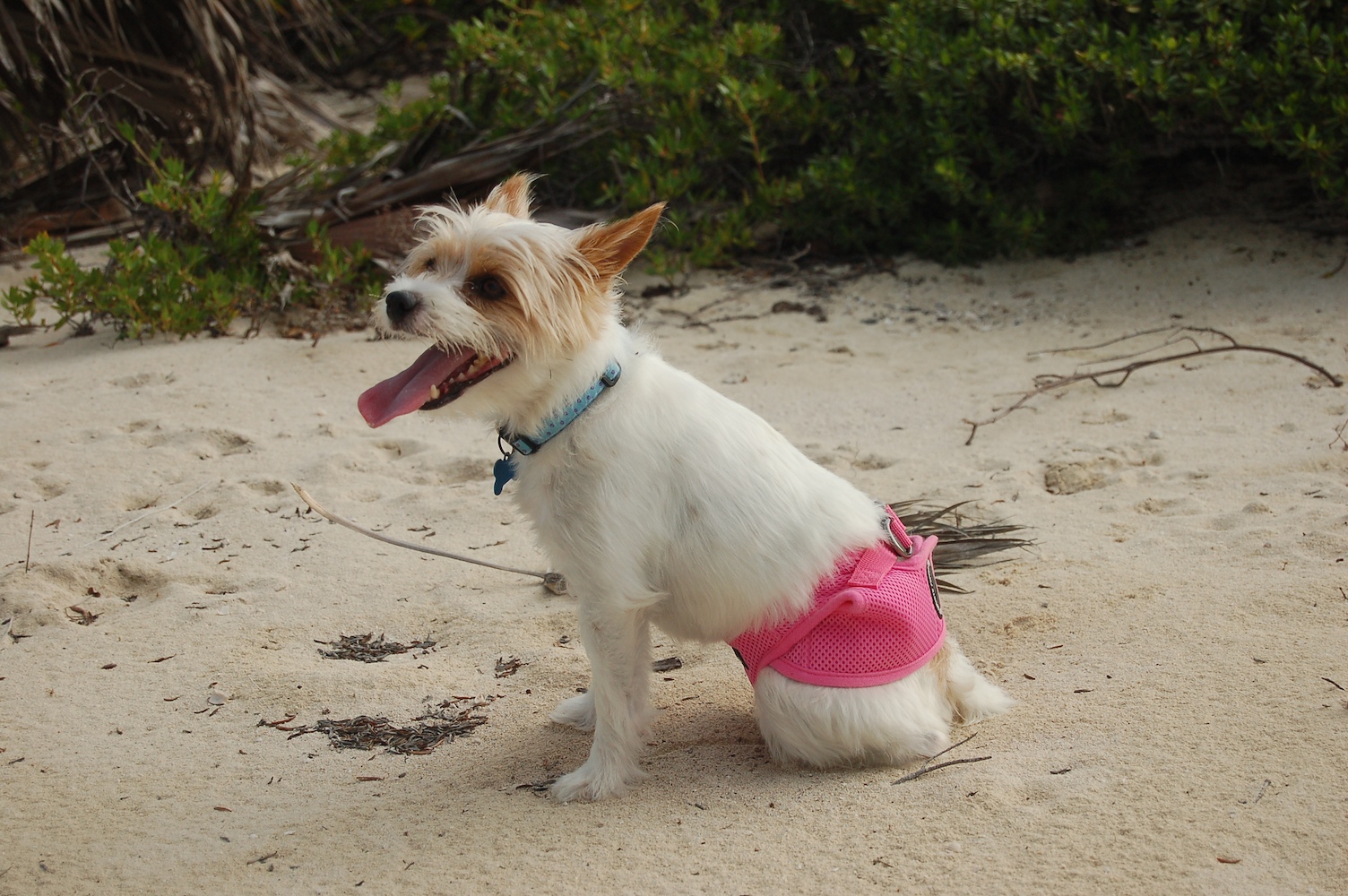
Is Calli (Jack Russell) wearing diapers or did her harness slip?

In a tense novel, humour can give the reader the breather they need. Garry Ryan suggested I watch my dog and see what antics he gets up to. This is only useful for writing if you have a dog in your story.

It’s so true that dogs are funny. It might not feel funny when your dog is thirsty in the middle of the night, and to wake you he swats his steel bowl against the wall until you get up and then he greets you with a wagging tail like nothing is wrong.

It might not seem funny when your dog takes a banana right out of a strangers hand and eats it. Especially after you warned the stranger that your dog likes bananas. Well, it depends on the stranger, but it did happen to be funny.

And let’s face it, when your dog lets off a ripper at an inappropriate time, that’s pretty funny too.

So now, I’m collecting stories from my dog. Hopefully, I’ll find the right one to add to my novel. My dog’s name is Farley Mowat, so I think he should write part of my novel.

Italics for Thoughts?

#writetip Garry Ryan, author of the Detective Lane Mysteries is kindly donating his time to be my mentor. This is part of the CWC mentorship program. We’re working through my third novel, Burnt, and in my humble opinion, the novel getting better.

One thing we’ve discussed is using italics for a characters thoughts. This is something I hadn’t done before. Garry’s advice is that it makes it easier for the reader to jump from narrative to thought.

I’ve been trying this technique, and I have to say it’s rather fun. It’s putting me more into the character’s head. I guess it reduces the distance between author and character, and then hopefully, between reader and character.

Now, we’ll see what kind of feedback I get on this new style (new for me, I mean).

Ordinary Life of a Writer

#writetip. Who wants to read about ordinary life? We all live one. It’s ours to live, but that doesn’t mean reading about it is anything but boring.

I’m trying to edit out the ordinary life stuff. You know, the lines where the character walks across the room, opens the door, and discovers who is there.

I think the readers get the “skip to the next scene scenario.” We see it all the time on television shows and in movies. Why not just have your character react to whomever is on the other side. We know if their reacting, they’ve walked across the room and opened the door.

Once I started looking for ordinary life, I was surprised to find how many times I used it. It’s an easy place to cut words if you need to.

Finding Time To Write

#writetip Every season I have the dream that I’ll have endless hours to write. We live on a sailboat. What could we possibly have to do to keep us busy?

When the wind changes direction, and we have to move the boat, it’s not like I have an option. I can’t say, “This is my time to write, close a door and settle in.” Sometimes I’m even mid-sentence when an issue comes up and I have to move quickly. So much for completing a thought before leaving my Mac.

What I’ve learned is to write in short bursts. I still get my writing time in, just not in long sessions. I’ve also learned that if it’s impossible to write, I read about writing and how I can improve. Short time frames are useful if you read one good writing tip and think about how you can use it on your novel.

Meanwhile, I’m living on a Lagoon 380 S2 in the Bahamas, so who will feel sorry for me?

Show, Don’t Tell

#writetip How many times have you heard “Show, Don’t tell” ? So the advice is everywhere and it must be easy. Ha Ha. Here’s a technique I use when I’m trying to force myself to show and not tell.

For each scene, establish a point of view character and stick to it. If you find yourself throwing in other characters thoughts or feelings, see if you can get rid of them without hurting the scene. This narrows the POV to one character.

Once you’re that far, check the scene for anything the character can’t know, but you’ve described. There’s a good chance this is telling. It might be something that can be removed or put in as part of what the character is doing. This way you’re revealing the character’s experience and not what you as an author want the reader to know.

I’m not saying write your whole novel this way. I’m not even saying this works. What it does is give me a process to check if I’m telling and not showing. Then I can decide whether or not to make changes.

If you have other ways to check if for telling versus showing, I’d love to hear them.

Writing in a Small Space

#writetip #sailing Continuing with  my theme of writing and cruising, here are some tips on writing in a small space.

I don’t actually consider my Lagoon 380 S2 a small space. She is 38 feet long and with her two hulls, there is a lot of room. It’s just close together.

There are three sleeping cabins, a main salon and a cockpit. There is a built in desk in the starboard hull. But, and here’s the big but, It’s hard to be invisible and write. I can hear all that’s going on in the boat and around the area.

So I hear my friends launch their kayaks, heading out to explore and how to I resist? I allow myself one (okay maybe two) activities during work days (Mon – Fri). Saturday and Sunday are my weekends. I might write, but I don’t feel I have to.

That modern invention, the iPod, is a great way to tune out noise. If you can write to music, and don’t have a quite place, it might work for you.

Complicated Character Relationships

#writetip Should you drip out information on complicated relationships or get the info out early?

Here’s the advice I got from an acquiring editor: If the relationships are key to the  motivation of the crime, then it’s better to define them early. You can do this and still keep the reader intrigued.

Now to go do this…

I’m writing from Norman’s Cay in the Bahamas and the nearest cell tower is 7 miles away. I’m amazed I have a connection today.

I have to keep the posts short, and it may be slow, but at least it’s working.