#sailing As we sail through the Northern Exumas, we play the game of finding a WIFI connection or a cell tower.
We have a Bad Boy to connect to WIFI and a Kindle to connect to a cell tower. Other boats use other technology.
Connections are slow and that means no photos, no facebook or twitter, for a while, but these beautiful islands are worth it.
Lagoon

Trick of Provisioning
If you’ve never tasted a Florida orange or grapefruit freshly picked, you should. #sailing
The last items we provision for before we leave Florida and head for the Bahamas are oranges and grapefruit. We buy them fresh, and then here’s the trick if you want them to last..
Wrap each piece of fruit individually in foil. Then store them in a dark, dry spot on the boat. They’ll last up to 6 weeks.
When the fresh fruit and vegetables get thin on the boat, that last orange tastes amazing. After that, we know it’s time to head to civilization and find supplies.
Related articles
- Why is provisioning so tiring? (kristinastanley.net)
- Provisioning For Farley (kristinastanley.net)
Share this:
Cruising, Writing and Spreadsheets

Do we really need to eat this much? #sailing #writetip
I think I’ve turned into a spreadsheet junky.
I have just reached a first draft of my third novel. Now I study the spreadsheet I created as I was writing the novel, decide at the best order of scenes, where the chapter breaks should be, do I have enough scenes with the main characters, etc.
As if my head wasn’t exploding with details, but I was feeling so productive and decided it was time to do some provisioning. So out came spreadsheet number two. After two years of updating this spreadsheet, I know exactly how much food we eat.
Every season, I write down when we run out of food or if we have left overs at the end of the season. It’s getting pretty accurate. During the season I add lines if there is something we were missing. Last year, I didn’t bring enough honey. One little bottle. What was I thinking? I love honey.
Today it’s back to my writing spreadsheet and the hard work of editing that first draft.
Related links:
Share this:

Preparations for Cruising

The boats are starting to line up in the Vero Beach mooring field. #sailing
As I sit in my cockpit working on my novel, I can’t help but stop and enjoy the view. I should really be provisioning, as this is the time of year we get ready to cross the Gulf Stream and head for the Bahamas.
It’s an exciting time to be a cruiser in Florida. Many of our friends who cruise are arriving and each day we look forward to seeing who is in the mooring field. Some have passed us already and are farther south. Some are still farther north haven’t caught up to us.
Our catamaran, Mattina, is almost ready to go. Systems have been tested and maintained. spare parts ordered. Now the big task of provisioning begins.
Share this:

Dog Parks While Cruising
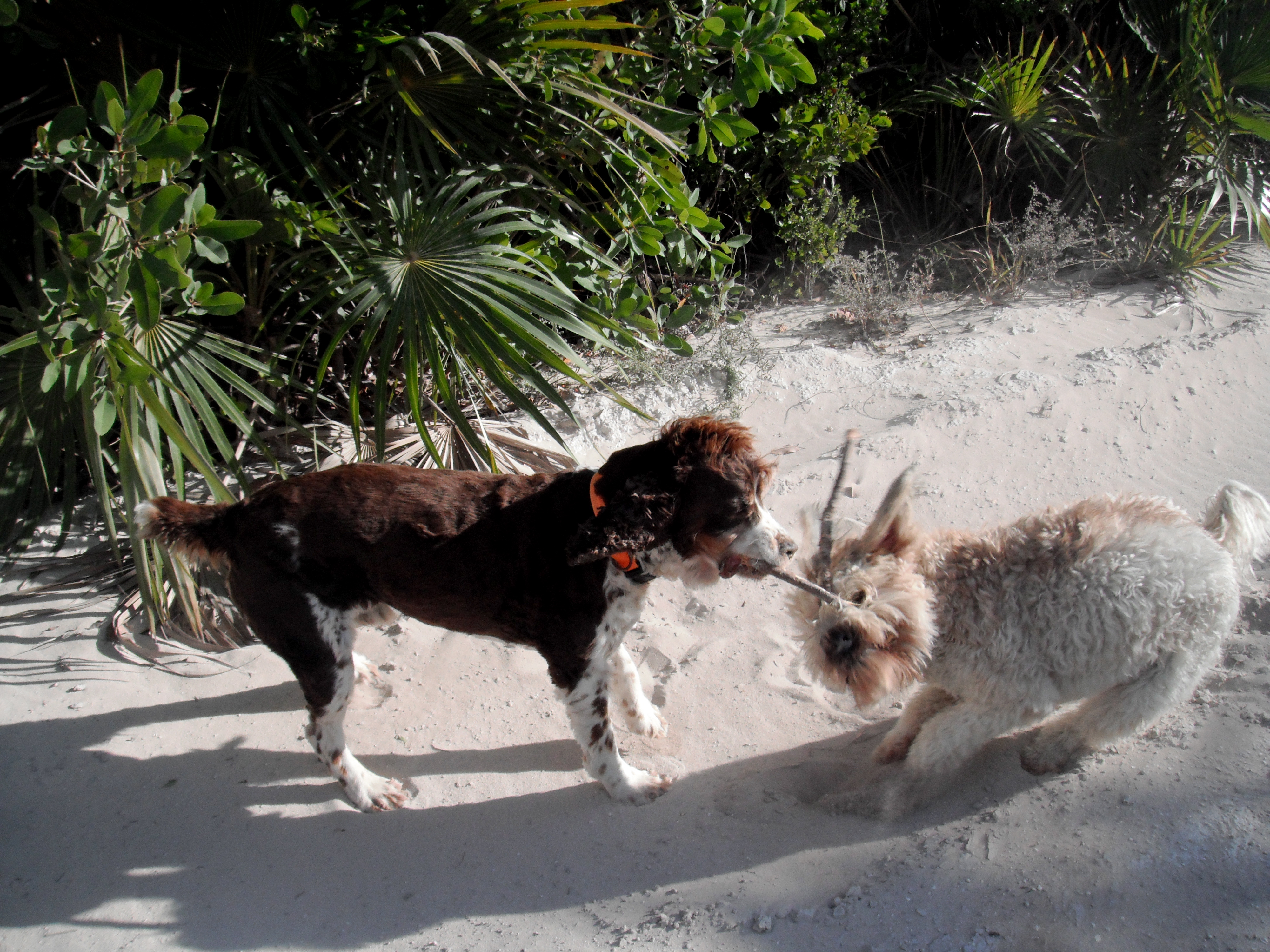 Dogs bring special needs with them onto a cruising boat. #sailing One of their needs is exercise. While in the U.S. or Canada is easy to find dog parks. When you pull into an anchorage, Google will find one for you if you don’t know where one is. Locals are always happy to point us in the direction of a good dog park.
Just north of the Titusville Municipal Marina in Florida is a fenced in dog park. It’s split in two. Half designated for small dogs, half for big dogs. It has a double gate for entry, ensuring our pup can’t run away. It even has water. It was a nice surprise for us and for Farley.
There is a dog park near Vero Beach Municipal Marina, but it’s not fenced.
Seaside beaches in the U.S have varying rules for dogs. Some allow them, some don’t. We always check first before taking Farley for a run.
If you’re cruising to the Bahamas, dogs can run free on the beach. Some places have organized “doggy beach parties” depending on how many dogs are in an anchorage. It’s easy to start one up. Just get on the VHF and announce one.
“Who let the dogs out?” Woof Woof
Share this:

Genoa Rigged
 When don’t you want wind for your Genoa? #cruising This morning we awoke to 3 knots of wind. Perfect for rigging the genoa. She went up without a hitch – literally (and pardon the cliché). Rigging the sail is easy on a catamaran. The wide bow with a trampoline gives us plenty of working space.
Now to rig the mainsail . . . The radar is telling us a rain storm is on they way, so the mainsail has to wait until tomorrow. Maybe we’ll get lucky and wake up to 3 knots of wind again.
Sometimes I love the rain. It gives me an excuse to stay inside and write.
Share this:

Milestones

It’s time to celebrate! #sailing Big moments in life shouldn’t go unrecognized. Mattina, our Lagoon 380, is in the water. We keep her on the hard for the summer and then, after a lot of hard work each fall, she goes back in the water for a winter of cruising.
Waking up this morning, I was too excited to write. The sun is up, coffee is ready and it’s time to put the sails up. Not literally. Before that can happen, we clean the sails, check and maintain the rigging, wait for a calm morning, and then up they go.
What does this have to do with writing? Well, aren’t all milestones important. Like the day you wrote your first page, finished your first draft, had your first reader, or sent your work to an agent. Every one of these moments should be acknowledged. Tomorrow, I’ll settle down and get some writing done.
Share this:

Preparation for Writing

Writing, like cruising, takes a lot of preparation. #writetip It took me many hours to install the netting behind Farley on my catamaran. First I had to research the product, then order it, figure out how to install it, and finally install the netting. Was it worth the effort? You bet. Farley is safe when we are underway.
To me writing a good novel is similar. It takes a lot of preparation too. I wanted to mention Mary Lou Dickinson’s blog about “So you want to write: Some questions to ask yourself.” Mary Lou gives you a good list of questions to ask yourself if you are thinking of writing a novel.
Writing my first novel was the hardest. I had to figure out what my story was, what genre I was writing in, figure out the rules of the genre, and then take the big leap and start writing. The first words on the page were the most intimidating. Hard work will get you a long way. Just keep at it.
Was it worth the effort? You bet. I have two completed manuscripts and a third one at the first draft stage. I have an agent willing to represent me. And best of all, I have the satisfaction of working hard at something and being proud of it.
Share this:

Checking for Errors

Getting a boat ready for a season of sailing is like proofreading a novel. #writetip Our catamaran is out of the water, and this gives us the opportunity to check under the water line for any issues. We go over every inch of the boat just like an author should go over every letter and punctuation mark on the page.
I don’t know if it’s just that I read in more detail since I’ve started writing, but I notice more and more errors in published novels. This goes for both those that go through the traditional publishing houses and those that are self-published.
I understand the occasional typo, but yesterday I found the same sentence written twice. I know the author has spent so much time with the book that is impossible to see it after a while. Here is where I believe an editor is in need.
Whether you hire a professional editor or ask a friend, make sure it’s someone with an eye for detail. It sounds obvious, but you need someone who is tough on you.
Share this:

Manuscript Feedback
How do you take high level comments and use them to improve work? #writetip Early on, I received feedback from my agent, Margaret Hart, telling me the pacing near the end of my first novel slowed down. I hadn’t been able to see it until she pointed it out. Afterward, it was obvious.
So how was I going to fix it?
I reviewed each scene and asked myself, did I really (and I mean REALLY) need the scene. Just because I liked it was not a good enough reason. If it didn’t move the plot forward, reveal something, develop a character, I deleted it. That was hard. By then end my novel went for 86,000 works to 80,000, but the story is tighter.
For the remaining scenes, I reviewed first and last lines. Get in late, leave early.
I studied the narrative. Did I need the description? Was the place I described important to the story. If yes, I kept the details. If no, I either removed them or shortened them.
If you have thoughts on how to ” pick up the pace”, I’d love to hear them.
