Dogs and Writing

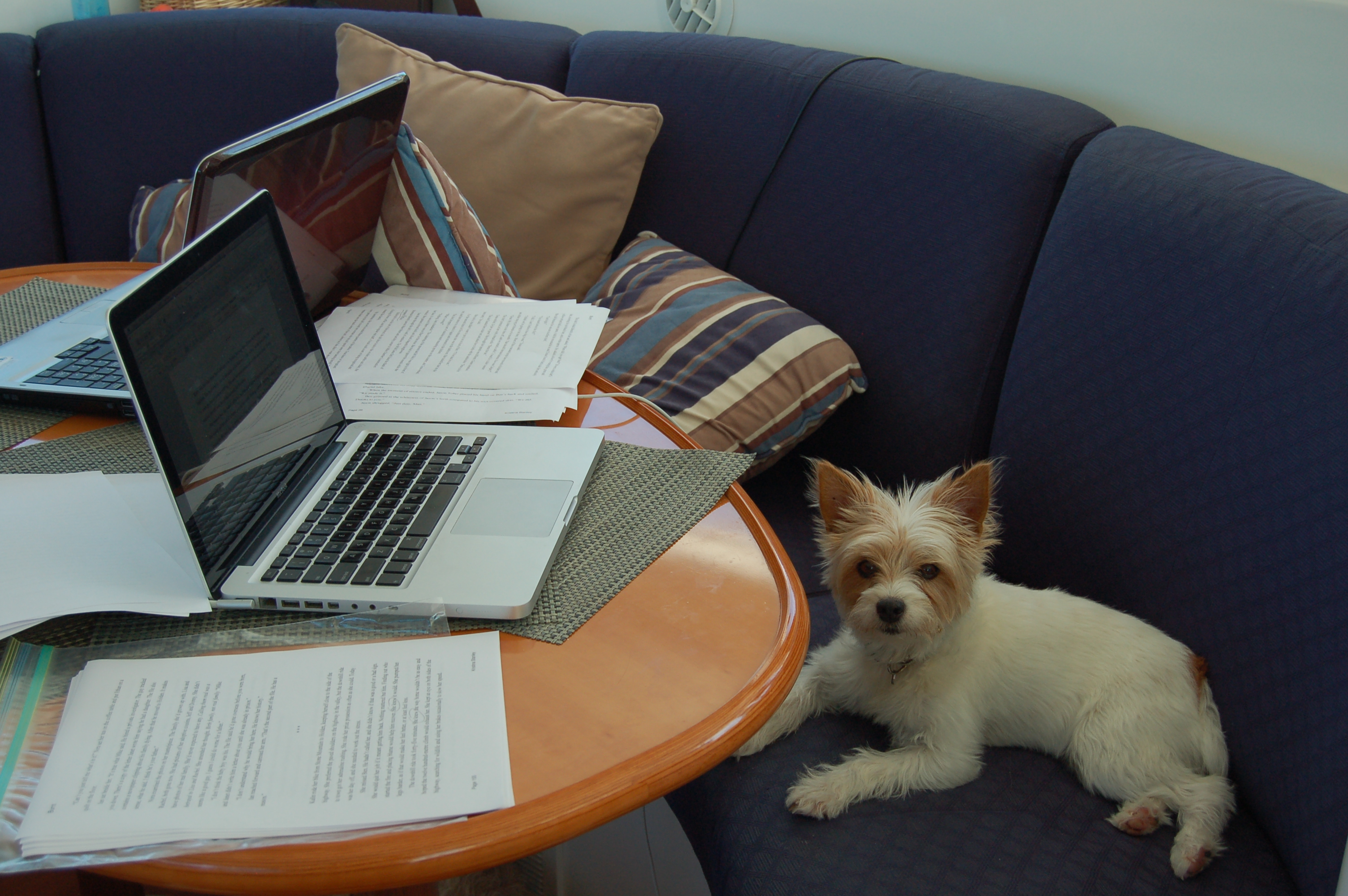
#writetip  Did someone say writing was lonely? My advice, get a dog. Cali is visiting our boat, Mattina, for the day while her owners are off kiting. Cali has decided that she’s the one writing my novel.  The only problem, she has trouble articulating story ideas.

I’ve made the main salon my writing platform and like to take over the entire table. Well the dogs had a different idea. So where am I supposed to sit?

Who's writing this novel?Are two dog ideas better than one?

How to use a spreadsheet for your synopsis

#writetip The dreaded synopsis has found its way to the top of my to-do list.

How do you take 82,000 words and summarize them in to 500 to 1000 words?

Sweat it out, of course.

As I’ve said before, I love my spreadsheets and don’t know how anyone can write a novel without one. Well, here is my next use.

One column of my spreadsheet has a name for each scene. The name represents what happens in this scene.

To create my synopsis, first I’m look for turning points in the novel. Luckily, I already have this in the spreadsheet. The turning points are events that take the story in a new direction.

Next, I write each scene name on a paper. I cross out anything that doesn’t need to be in the synopsis.  Once I do this four or five time, I write out a one line description of the scene. Now I know if I’m anywhere near the right word count. If not, I keep cutting.

I follow some simple guidelines:

–       Use protagonists POV

–       Don’t include questions

–       Use present tense

–       Write in the same voice as your novel

–       Don’t turn the synopsis into a list

–       Include the ending

If the first line of your novel is great, and I hope it is, why not use that as your opening line of your synopsis?

If you have any tips for writing a synopsis, I’d love to hear them.


Canadian versus American Spelling

#writetip There are too many ways to spell the same word and be correct. My goal is to spell consistently, thinking that should do the trick and I’ll end up with a professional manuscript.

Now I’m having my third novel, Burnt, proofread by two people. One is Canadian, the other American.  The American is circling words that are misspelled . . . but are they?

Let’s look at the word: travel

Say, one of my character takes a trip.

Canadian Spelling:    She TRAVELLED by car.

American Spelling:   She TRAVELED by car.

I’m Canadian and want to use Canadian spelling, but what happens if I get lucky and get published in both countries? Will one set of readers think I can’t spell?

Any opinions on this one?

Spread Sheets and Novels

#writetip I don’t know how anyone writes a novel without spread sheet. The more I write, the more columns my spread sheet contains.

What I’ve discovered writing my third novel, Burnt, is that I needed to add two new columns. These columns are helpful if you are writing a mystery novel.

One column is used for clues to solving the crime. This means the reader knows the clues, but the main protagonist might not. This is especially helpful if you write from multiple points of view. If not, you probably don’t need this one.

The second column keeps track of clues the main protagonist knows. This ensures the character doesn’t mysteriously know something at the wrong time.

For a more detailed description of my complete spread sheet and how I use it, please see:

Don’t Rush The Ending

#writetip This week has been a big week for me. I’ m still basking in the joy of completing my novel, Burnt.

If you’ve been reading my blog this week, you know I recently completed the CWC mentorship program, and I want to share one thing I learned from Garry Ryan.

Don’t Rush the Ending.

He told me the reader has been waiting for the final scene so let them savour it.

I think I shorted my ending to get the book finished and not let it drag. I missed the importance of satisfying the reader with a deep and thoughtful final scene.

I’ve now re-written it, and thanks the mentorship program, I think (as usual – in my biased opinion) that it’s much better.

It seems like there is always something to learn when it comes to writing a novel. I guess that’s why people spend a lifetime writing.

First Draft: Then What?

#writetip Do you get to relax and celebrate when you finish a manuscript and are getting ready to send it to your agent or publisher? You probably deserve it, but if you’re anything like me, it’s time to get to the next activity.

Yesterday, I finished updating my 3rd novel, Burnt, based on comments from Garry Ryan. I’ve sent it off to be proofread, and now, I’m not going to look at it for a couple of weeks.

What am I going to do with my time?  Well . . .

  • Write a blurb
  • Write a synopsis
  • Figure out if Burnt is the best title for the novel
  • Update my website
  • Update the CWC website
  • Update my agent’s website (Margaret Hart at HSW Literary Agency)

And on and on it goes . . .

There is so much more to writing a novel than actually writing the novel.

THANK YOU GARRY RYAN

#writetip As a member of the Crime Writers of Canada, I am entitled to participate in the mentorship program.  Garry Ryan, president of the Crime Writers of Canada and Author of the Detective Lane Mysteries, was my mentor.

Garry is the Winner of a 2007 LAMBDA Award and the Calgary Freedom of Expression Award 2009.

So how lucky was I feeling, when the CWC notified me that Garry would be working with me on my manuscript. Garry provided me with broad scoped and detailed feedback. He told me where I was doing things well and where I needed to work on things. He called it tweaking. I’ve saved all of his comments and will use them on future manuscripts.

If you write crime stories and are trying to get published, the CWC offers a way to get your manuscript ready.

Check out Garry’s website. He has a page that lists where you can buy his novels.

Thank you , Garry!

Opening Scenes: Action or Summary?

#writetip How do you start your novel? Are you a believer in action or summary? Me, I like to start with action, whether I’m reading or writing a novel.

In my humble opinion, the opening scene is where you get to “show” your stuff. An opening scene filled with action gives a writer the opportunity to show who their main character or villain is, what he/she is made of and how he/she behaves.

I find if I read a summary of a character in the first scene, I don’t tend to be that interested in the character or believe what the writer has to say about the character.

However, if the character is thrown into a situation, I get to learn through seeing and make my own decisions on what they are made of and then the writer has me, and I’m happy to go along for the ride.

Getting The Most Out Of Your Readers

#writetip Here are some of things to think about when having others read your drafts.

What you give your reader might depend on where you are in the process.

Early on, say after the first draft but well before you send it to an agent/publisher, you might want to give your reader smaller sections. This can be several scenes or a chapter.The value: Your reader can give you quick feedback on style, grammar, problems with story line, vacant scene, etc. You can then use this information to update the next section before sending it to them. Each section should be better than the last making you create a strong second draft.

When you think you have something you might send to an agent/publisher, this is the time to have a new reader (not the same person that read your early draft) to read your novel cover to cover.

The value: Your reader can comment on larger story issues, flow, pacing, believability, loose ends, etc.

Finally, don’t forget the phase of having someone other than yourself proofread. Here is where you need someone with attention to detail.

This works for me and I’m sure there are many ways to get the same result. I just can’t imagine sending out a manuscript without the help of others.

Kindle As A Learning Aid

#writetip If you’ve been following my blog for a while, you’ll know I use a Kindle to help me write my novel.

Here’s my latest use. I read “How to Write” books. Normally I’d highlight a hard copy and then later browse through the book looking for what I found interesting. I might even copy a tip into my journal. It was all so time consuming.

I’ve discovered the highlight function on my Kindle. Now when I’m reading at “How to Write” book, I do an electronic highlight. Then when I’ve read the book the highlighted notes are all stored in one place.

You can open the highlights and only read that.

In the end, you get the nitty gritty of the book, minus all the filler that goes around the tips. Way faster than my older method.