Writing: Speeding up a Scene

So you want to put your scene into overdrive? Here’s one way to work on it.

I recently read the opening scene in CJ LyonsNerves of Steel. It’s a fast paced scene that takes the reader along for a bumpy ride.

I wanted to know what made this scene speed along like a comet crossing sky.

I reread the scene, looking at each word very carefully. And it seems to me, the verb choice drives the speed.

CJ Lyons uses action verbs. She doesn’t use uncommon verbs that take a reader out of the story, but she does use specific verbs representing movement.

Here are some of them:

  • Thundered
  • Chopping
  • Gusting
  • Tugged
  • Tore
  • Shredding
  • Ricocheting

You get the idea, so if you think your scene is slow, why not check the verbs and see if they are fast?

What do you do to make your scene rip?

Thanks for reading . . .

Writing while Sailing: Retyping a novel

I love to read books and blogs on how to write and remember reading a tip I’ve never followed before.

The tip: When you’ve finished a good quality draft of your novel, put in a drawer for a least two weeks, longer if you have the patience. I’ve done this part. What I haven’t done is the next part of the tip. Retype your entire novel.

What? I thought, who has the time? And is it worth it?

Now that I’m back on Mattina, and we are in the Exumas, I’ve found the time.

I’ve typed in the first 8 chapters and am amazed at what I’m discovering.

First, typos appear fresh. I’ve seen some that I was sure I’d edited out.

Second, dropping clues too early jumped out at me. By letting time go by, I can see the novel with fresh eyes and have been able to hold back information. I think this will make the novel more tense.

Third, I had a few names that didn’t suit the character I’d assigned them to. Yup – changed those too.

Fourth, and the best result, when I read a sentence and it’s not the best it could be, I don’t want to type it back in. It’s easier to let go of writing and rewrite a sentence when it’s not on the page yet.

I’m amazed at how well this technique works. Yes, it’s a lot of work, but I think Look The Other Way will be a better novel because of it. Too bad my typing sucks.

If you have any editing techniques you’ve tried that worked for you, let me know.

Happy New Year!

Thanks for reading . . .

Copyediting – Proofreading Process (Part Five)

What a week! I can’t thank everyone enough for their contributions. I’m going to have to work hard at getting the comments and ideas summarized.

So you’ve finished copyediting – proofreading the manuscript, and it’s time to send it back to the author. This is usually when I think about the work I’ve done and have I done what the author asked of me. It’s a good time to pause and re-read ALL the comments. I ask myself:

  • Are the comments clear?
  • Are the comments consistent?
  • Have I introduced any errors?

If I am working on a computer copy of the document, I’ve asked the author not to touch their version until I’m done (I probably should have mentioned this in part one). With only one version active, the author can accept or reject changes without introducing new errors. Also, I figure if I’m going to spend the time editing, the author should wait for me and not create another version of the manuscript. It’s frustrating to have to repeat the editing process.

I usually summarize my detailed comments in an overview. I remember to tell the author what I liked about the story. This is important. Every writer needs to hear what he/she does well. It’s easy to focus on criticism, and my goal is to motivate the author to continue to write. I don’t want to de-motivate them because I made too many comments.

In the summary, I remind the author to do the following before shipping the manuscript to an agent, publisher or uploading it to an e-book site (if they are self-publishing):

  • accept or reject suggested changes
  • delete any remaining comments
  • turn off mark-up or track changes
  • remove bookmarks
  • check under properties that the title is correct

When you’re ready, ship the manuscript back to the author and see what he/she thinks. I’m usually nervous at this point. It’s an honour to read and work on another author’s manuscript, and I hope I’ve found a balance between being helpful and not being overly critical.

One final caution: I find it difficult to edit my own work. My eye reads what I think I wrote and not what I actually wrote. I do my best to correct my manuscript before I give it to someone else to edit, but I try to have a sense of humour and laugh at myself when errors are found. Nobody’s perfect ☺

Thanks again for reading . . .

Copyediting – Proofreading Process (Part Four)

First – thank you to everyone who has contributed thoughts on my blog and in LinkedIn. I’ve enjoyed putting my process out there and improving it based on the new ideas I’ve received.

We’ve made it through two readings of a manuscript. During the third reading, we get to propose changes that are subjective, and even though, as an editor, I want all my suggestions included in the next version of the manuscript, I have to accept that the author gets to decide how to handle each idea I put forward.

The first three blogs in this series are: Proofreading Process (Part One), Copyediting – Proofreading Process (Part Two) and Copyediting Proofreading Process (Part Three).

So here we go . . . Things to check during the third reading:

PASSIVE versus ACTIVE

Point out passive clauses but don’t change them. Passive or active is the author’s choice, but what if the author slipped into passive without noticing? I comment and then move on.

TENSE

Keep an ear out for tense and check for consistency. Tense can change during the course of a novel. Linwood Barclay uses past tense and present tense in his new novel Trust Your Eyes, but he keeps the tense consistent in each scene. The result is a fast paced, exciting novel. My point: It’s important to understand the author’s intent for tense and then edit accordingly.

FIRST, SECOND or THIRD PERSON      

This can change throughout a novel, but is it consistent per scene? If switching person takes away from the story, mention it to the author, but again, the author gets to decide whether to change it or not.

THAT

Check every use of that and decide if it’s needed. If that is not needed for clarity, suggest its removal. Here’s an example of when you don’t need that:

I used to think that it was easy to use a comma.

I used to think it was easy to use a comma.

The meaning of the second sentence without that is clear. Now compare the following two sentences, and I think you’ll agree that is needed.

Ignoring the shadows that vaguely reminded him of his long dead relatives, . . .

Ignoring the shadows vaguely reminded him of his long dead relatives, . . .

The meaning changes in the second sentence. That is needed  for clarity. The first sentence tells us the shadows remind him of dead relatives. The second sentence tells us ignoring the shadows reminds him of dead relatives.

ADJECTIVES

Are there cases where more than one adjective describes a noun? Yes? Then I ask if the author could pick the most important one and delete the others.

REPEATED WORDS

If a word jumps out at you as overused, it probably is. It’s okay to suggest alternatives, but it’s the author’s job to come up with a new word (if he/she agrees the word is overused).

WHAT’S NEXT?

I’ll post the final touches on Monday . . .

Thanks for reading 🙂

Copyediting – Proofreading Process (Part Three)

We are finally getting to the end of the second reading of a manuscript. Thank you to everyone who commented on the previous two blogs. It’s great to add new ideas to my process.

In Proofreading Process (Part One) and Copyediting – Proofreading Process (Part Two) I covered my process for the first and second reading of a manuscript. In the comments section of the blogs you can find lots of interesting ideas on the subject.

Today, I’m going to cover a few more technical areas and finish off the second reading. In the next blog, I’ll cover areas that involve making suggestions to an author but aren’t hard rules.

What about Mom and Dad?

Search for mom, dad, aunt, uncle, etc. and check if they are capitalized correctly. The capitalization of the first letter is easy to type wrong and difficult for the eye to see. A global search will force you to look at each case.

Mom is capitalized for direct address.

“Hey, Mom. I got a tattoo.”

Mom is not capitalized when referring to her.

“My mom doesn’t like my tattoo. Can you believe that?”

Acronyms

Acronyms should be added to your “list” as you read the manuscript. Then it’s easy to check if they are written in a consistent manner. For example:

PH.D or PhD or P.H.D.

AM or am or a.m.

It’s a good idea to check the style manual the author uses and pick the format from there.

Dialogue Format

When editing dialogue pay attention to punctuation and capitalization.

  • Is the punctuation inside the end quote correct?
  • Is the first word after the end quote capitalized when it shouldn’t be?

Correct: “I love my new car,” she said.

Incorrect: “I love my new car.” She said. (Did you notice the 2 errors?)

Correct: “Why did you steal my car?” he asked.

Incorrect: “Why did you steal my car?” He asked.

Possessive or Plural?

Look for words ending in ‘s’ and check if they were meant to be possessive or plural. Remember, it’s the dog’s tail, not the dogs tail – unless there are multiple dogs that share one tail, but then it would be the dogs’ tail. Now that I think about it, I guess that creature could exist in a fantasy or sci-fi novel.

The Dreaded Comma

I used to think I knew how to use a comma. Ha ha. The joke was on me. During my mentorship program with Joan Barfoot through the HSW Correspondence Program, Joan kindly pointed out I needed to learn how to use a comma.  I literally spent two months studying the comma. I guess the saying– you don’t know what you don’t know – is true. I can’t thank Joan enough for pointing this out to me.

I won’t go into the comma rules as there are enough books on the topic, but I wanted to mention how important the pesky little punctuation mark is. To create a professional looking manuscript, it’s worth the effort to learn how to use the comma.

What’s next?

Phew. I feel sweat dripping down my forehead. We are finally at the end of the second reading. The next blog, you guessed it, will start with the third reading.

I’m keeping track of suggestions and comments, and in the final blog in this series, I will post all the great ideas people have been generous enough to send me. I used some of the ideas to proofread this blog. I hope you don’t find a typo 🙂

Thanks for reading . . .
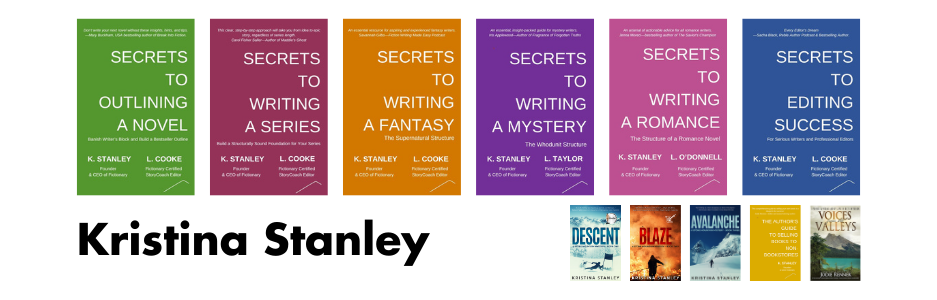
Novel Translation

The translation of my novel Fracture Line into German is done.

Kanadische Rockies: Verwehte Spuren Im Schnee

has been sent to my agent, Margaret Hart, at the HSW Literary Agency.

So what’s next? My translator has started on Descent.

And what did I learn? Proofreading in German is just has hard as in English. But more importantly, a translator looks at every word and decides what it should be in another language. If you want to have a novel scrutinized, getting it translated and working daily with a translator, is a great way to do it.

She caught things like repeated words or phrases, suggested better paragraph ordering, and highlighted character traits. It made me think of writing in a whole new light.

I’m proud to say she only found one typo. I was amazed by that.

For anyone interested: Here is the English Blurb followed by the German Blurb (where my spellchecker went crazy).

IN ENGLISH:

On a cold winter morning, deep in the Purcell Mountains, Roy McCann disappears in an avalanche. Was it an accident or did something more sinister happen?

Kalin Thompson accepts a job in the interior of British Columbia, thinking she is moving from Ottawa to be near her estranged brother, Roy. She leaves the comfort of her job with the Canadian government to become the human resources manager at Stone Mountain Resort.

On her arrival, she discovers Roy is the prime suspect in a major theft. She struggles to adapt to the subculture of resort life while covertly investigating Roy’s involvement. Threats against Kalin escalate as she gets closer to the truth and she doesn’t know who to trust.  Is her faith in her brother justified?

IN GERMAN 

Stone Mountain, Britisch Kolumbien, Canada, Montag 31. Dezember, 7.29 Uhr.

An diesem kalten Wintermorgen, hoch auf den Purcell Bergen verschwindet Roy McCann in einer Lawine.

Kalin Thompson kündigt in der selben Woche ihren Job mit der Kanadischen Regierung  in Ottawa und nimmt den Job als Personalchefin im Stone Mountain Skibetrieb an. Sie will ihren entfremten Bruder Roy, wieder treffen.

Nach ihrer Ankunft entdeckt Kalin, dass Roy im Verdacht steht, einen großen Betriebsdiebstahl  durchgeführt zu haben.

Kalin muss sich in die Subkultur des Ortes einleben. und zugleich eine heimliche Untersuchung leiten, um Roys Unschuld zu beweisen.

Ihre Liebe zu Ben Timlin kompliziert ihr Leben noch weiter. Ist ihr Vertrauen gerechtfertigt?

Kalins Leben wird bedroht als ihre Forschung nach der Wahrheit Erfolge zeigt.

Kalins Dilemma: Ist ihr Glaube an die Unschuld ihres Bruders richtig, und was verursachte die Lawine, Mann oder Natur?

Complicated Character Relationships

#writetip Should you drip out information on complicated relationships or get the info out early?

Here’s the advice I got from an acquiring editor: If the relationships are key to the  motivation of the crime, then it’s better to define them early. You can do this and still keep the reader intrigued.

Now to go do this…

I’m writing from Norman’s Cay in the Bahamas and the nearest cell tower is 7 miles away. I’m amazed I have a connection today.

I have to keep the posts short, and it may be slow, but at least it’s working.


Can you see every mark on the page?

It’s harder than I thought. #writetip. I like to use tools of the trade to help me perfect my work. I happen to use pages, but any good word processing program will help you check all marks on your page.

When you are checking details during a final proofread, turn on the “show invisibles” function of your software. I view the document at 200% or larger, set the colour of “invisibles” to a dark red (assuming your text is black), and then look at each character.

At this phase I’m looking for:

– one space only after each period.

– no spaces after an opening quote or before an end quote.

– no spaces after a paragraph or page break.

– no double spacing between words.

– etc.

This might seem like I’ve gone too far but I think it makes a manuscript a professional product. It takes time and makes your eyes tired, but in the end, it’s worth it.

Editing Online

Pages or Word have functions that allow you to edit a manuscript online. #writetip I’m working on a friend’s manuscript and am doing it over the internet. Since I’ll be traveling for the winter, it’s not practical for me to work on a hard copy. Yesterday I started reading the manuscript and decided to use two methods for editing online.

The “comments” functions allows me to  insert comments on the margin of the document. This is where I put things like, “Where did the garbage bags come from?” I made this comment on a scene where a group is on the run and they are about to jump off a train and into a lake. They packed their things in garbage bags before jumping. There had been no mention of garbage bags to this point. I use this function to mention anything that doesn’t make sense.

This is also where I mention what I like. It’s just as important to tell an author what you do like. They need to hear what’s working in their novel.

The “track changes” function allows me to correct typos, and punctuation or grammar mistakes. The author can then accept or reject the changes without too much effort.

On a side note, if you like my blog, you might also like to read Jennifer Eaton’s. She has some interesting things to say about what to look for in a manuscript.