Crime Writers of Canada

At every writer’s conference, I hear how important it is for writers to have a platform, but when you’re just starting out, how do you create a network of people? If you’re a Canadian Crime writer and looking for a way to build your platform and make connections in the writing world, the Crime Writers of Canada (CWC) might be for you.

This is my third year as an associate member, and all of a sudden I realized I belonged to a group that could help me expand my network and connect me with people who write in crime genre.

Now here’s the delightful surprise. I sent LinkedIn invitations to the other CWC members, and I’m getting messages back almost as fast as I can read them.

CWC has professional members (those who have published their work) and associate members (those who are unpublished), and I’ve connected with many authors in both groups.

This members’ list can be found at Bios on the CWC website  along with writer’s webpages and profiles. It’s a great way to explore Canadian crime novels.

I spent the weekend being amazed at how generous people are with their time and how willing they are to add me to their network.

Driving Across Canada

Ottawa to Winnipeg: 2000 Km of writing time – except when it’s my turn to drive.

The views are spectacular, the roads winding (until you hit the prairies), and there are ample passing lanes.  But what do you do with your time, hour after hour, in the car?

I find my mind wanders and with time to think, I get inundated with ideas. I keep a notebook handy to capture my thoughts. If I’m driving, my husband has to write them down. If only I could get him to write neatly.

Living is such a big country and having family in several provinces, along with the crazy notion that driving is the right way to get there, gives me lots of hours to write. I’ve written entire scenes without noticing what town we passed through, or that maybe we should stop for lunch, or that we are arriving.

As this is posted I am somewhere between Wawa, Ontario and Winnipeg, Manitoba hopefully coming up with some great ideas for my fourth novel.

Interruptions While Writing

#writetip

When you write at home do you get interrupted? I’ve heard it said that you wouldn’t get interrupted if you worked in an office. Well, I’ve worked in an office, and I did get interrupted, just not from my family. I think we all get interrupted.

They key for me is to not let it happen at critical moments. At work I could shut my office door. At home, maybe there isn’t an office door.

Here’s what did the trick for me. I explained why a 10 second interruption hurt my writing.

When I’m writing, I hold 2, 3 sometimes 4 ideas in my head at a time. If someone says “Do you know where the (blank – and you can fill in whatever blank is) is?,  the ideas in my head crash to the ground and shatter. I then spend the next idea picking them up and putting them back together again.

This description seemed to work and now I’m left alone unless there is a true emergency.

Now all you need to do is define a true emergency.

English to German: Translation Process

Translation Process

It’s been two days of translation work and we are at the end of Chapter one. Since this is the first time my translator and I have worked together on a project we are carefully working on each sentence.

Our process:

–       Read sentence out loud in English.

–       Read sentence out loud in German.

–       Discuss whether we have it right.

–       Investigate words in two printed dictionaries and three online ones.

–       Agree on changes.

–       Start on next sentence.

I think I might have to stay here all summer! 🙂

As we go along, the work should be faster. We understand each other better and are quicker at deciding what word we want.

A Novel: From English to German

The German translation of my novel Fracture Line  has arrived, and it feels like Christmas. It’s exciting to read my novel in another language, but now the hard part begins.

Working with a translator is an interesting process. We plan to spend the week discussing the nuances of each sentence and whether the voice sounds like my writing.

Dialogue is an area that we need to be careful with. I may want the character to sound sad, but in the translation they come off as angry.

And then there is proofreading. I thought proofreading in English was hard. Ha! The joke is on me.

I have a good relationship with my translator and know enough German to read, but I wonder how an author knows their novel has been translated in the manner they intended to write it if they don’t know the language. I guess it’s just one more mystery in the publishing industry.

Breaking The Rules

#writetip

As an author starting out, there is a ton of advice to consider. I’ve been reading blogs with different opinions on this one. Some say follow all the rules. Some say follow none of the rules – it’s your art, your creative process.

Here are my thoughts on “Do you have to follow the rules?”

Some of the rules (advice) include:

  • Don’t change point of view mid scene
  • Don’t open a scene with a character waking up
  • Eliminate/minimize adjectives
  • Don’t use names that are hard to pronounce
  • Etc.

My advice: learn the rules, use the rules, become an expert at the rules, and then break them to your heart’s content.

Being a master at something is tremendously satisfying and, I think, worth the effort.

Positive and Negative Feedback on Your Novel

#writetip

How do you know if your reader is any good?

Does your reader only give you negative feedback? That might be okay, but it won’t tell you what you’re good at.

Does your reader only give you positive feedback? That might feel great, but it’s not going to help you improve your writing.

To me the best reader gives me both positive and negative feedback. The positive keeps me motivated and tells me what I can relax about. The negative tells me what I need to work on.

What type of feedback do you like to receive and how does it help you?

Step Away From Your Novel

#writetip

How many times have you heard or read that when you finish your first draft, and I mean a serious draft, that you should put your novel in a drawer for a couple of weeks?

I never understood this until recently. I had three readers commenting on my updated version of The Final Gate.  While they were commenting, I decided to start work on my fourth novel, and leave The Final Gate alone.

Now that I am reviewing their comments and doing the final proofread, I finally get the importance of the advice.

I can see things I hadn’t seen before. Maybe it’s a passage of text that is too earnest, or maybe it’s narrative describing something I’ve already described. Without taking a break, I couldn’t see these things.

Even thought it’s hard to leave something alone that you are passionate about, I am now a believer in “Step Away From Your Novel.”

Dialogue Tags

#writetip

Who is talking? Do you always need a tag? Advice from how-to-write books say it should be clear from the dialogue, who is speaking. For the longest time, I interpreted this to mean that the character should have some unique way of speaking.

I don’t like to read dialogue where I get distracted with unique speech patterns, so I don’t like to write that way.

I finally understood what the advice means. The context and what the character has to say should give the reader enough information to know who is talking. If it doesn’t then a tag is needed.

If you need a tag, you could try using character movements or thoughts instead of a tag.

So back to my original thought. I now get the advice. So here’s an example.

A brother and sister are talking.

“What?” – can’t tell who’s speaking. Consider a dialogue tag or other method of indicating who is speaking.

“Mom loved you more because you’re a girl. She liked to dress you up and do your hair. I had nothing but scrapes and bruises to offer.”  – easy to tell the brother is speaking, so no dialogue tag needed.

Setting For A Novel

#writetip

How to choose a setting for your novel?  That depends on what your story is. But can your story depend on your setting? I think so.

I chose mine because I wanted to write a thriller. I wanted the novel to be tense, and I wanted the setting to have a lot to do with it.

For a mystery novel, choosing a location that isolates your characters, pummels them with bad weather, scares them with wildlife, and gives them nowhere to run, opens up the imagination.

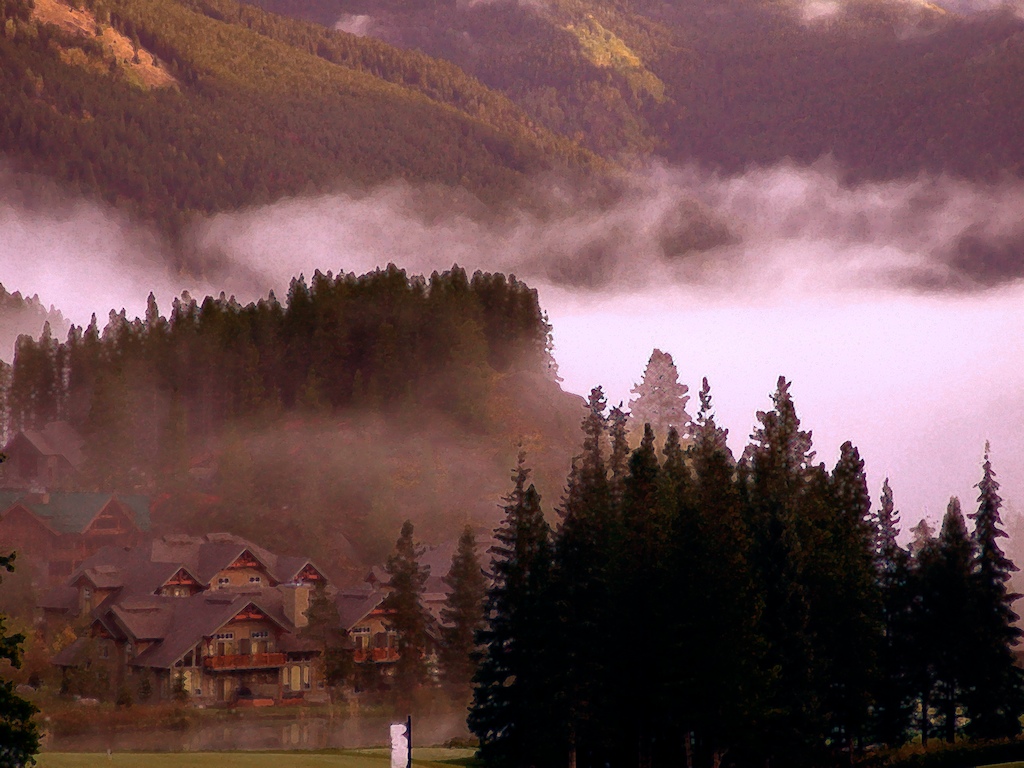
I spent 6 years living in an isolated mountain ski resort, and that had a lot to do with my choice of setting, Even though I write about a fictitious resort, I know what it’s like to live in the depths of BC. Experience lends authenticity; my imagination can do the rest.

Tell me the photo doesn’t give you any ideas for choosing a scary setting.