Converting from iWorks Pages to Microsoft Word

#writetip This is probably one of those things everyone knows except me. I recently switched from iWorks Pages to Microsoft Word. I’m a fan of both programs, but found most of the people I exchanged documents with use Word.

So for convenience, I changed over.

Already having completed the first draft of my novel, Burnt, I converted the document and at first glance everything appeared fine.

Until . . .

My proofreader sent the document to her kindle. The italics in the document didn’t transfer, but they appeared in the Word document on her computer copy.

What happened, you ask?

The italics showed on the Word copy, but when I clicked on italicized text, the little box at the top that shows a text is italicized wasn’t highlighted. The code to format the text didn’t copy from Pages to Word.

Hence the text didn’t appear italicized on the Kindle.

To fix this, I had to retype in any italicized text and hit the italics button. The next version appeared correct on the Kindle.

How does one know these things until they come up and bite you? And how do I know there aren’t other errors?

How to Create Chapter Breaks

#writetip  There a many different ways to write a novel, but one thing most have in common is the story is broken into chapters.

How do you do this?

Do write in chapters, plotting the entire novel ahead of time?

Do you write the novel in scenes and then group them into chapters?

Or, do you write one long scene and then break into scenes and group into chapters?

I tend to write in scenes. This gives me a small section to write. As the saying goes, Inch-by-Inch, Life’s a Cinch.  I find it less overwhelming to write a scene than attempting an entire novel.

Once I’ve completed a draft and have all my scenes printed, I try grouping them into themes. If I can give several scenes one name, then I make it a chapter. If I can’t, then I look for another way to group scenes. I don’t focus on the length of a chapter. I think it’s more important to have the grouping right than to have consistent chapter lengths.

Scene Locations

#writetip Where does your action happen?

Do you vary the locations of your scenes throughout your novel?

If you hadn’t guessed it, I’m going to mention my spreadsheet again. Yup, I have a column for scene locations. When I read, I enjoy a novel that takes place in different locations and has the characters moving around.

Sorting the spreadsheet by location tells me if I’ve used one location too many times. Maybe it’s important to the story, and that’s okay. But what if it’s not? When I see a location turn up many times, I assess it and see if I can come of with a more imaginative way of describing the scene.

Sometimes by creating new location, the characters surprise me and the story takes a new turn. Always an interesting process.

Synopsis and Blurb Review

#writetip So you’ve written your blurb and synopsis and think they’re great. That happens to me too. So . . . I need some outside feedback.

I treat my synopsis and blurb the same way I treat my novel. I have readers who read for content, and I have those who proofread.

If you’re lucky and have readers for your entire novel, why not ask them to read your synopsis and blurb too? You already know their skill set for reading. They already know your story and can keep you honest.

I try to tell my readers what I want from them.

For the blurb I ask:

–       Does it clearly represent the story?

–       Would you want to buy the book based on the blurb? Why or why not?

For the synopsis I ask:

–       Does it clearly represent the story?

–       Is it an engaging synopsis or does it feel too much like a list of events?

Please let me know if you have any tips for writing great blurbs or synopses.

Dogs and Writing

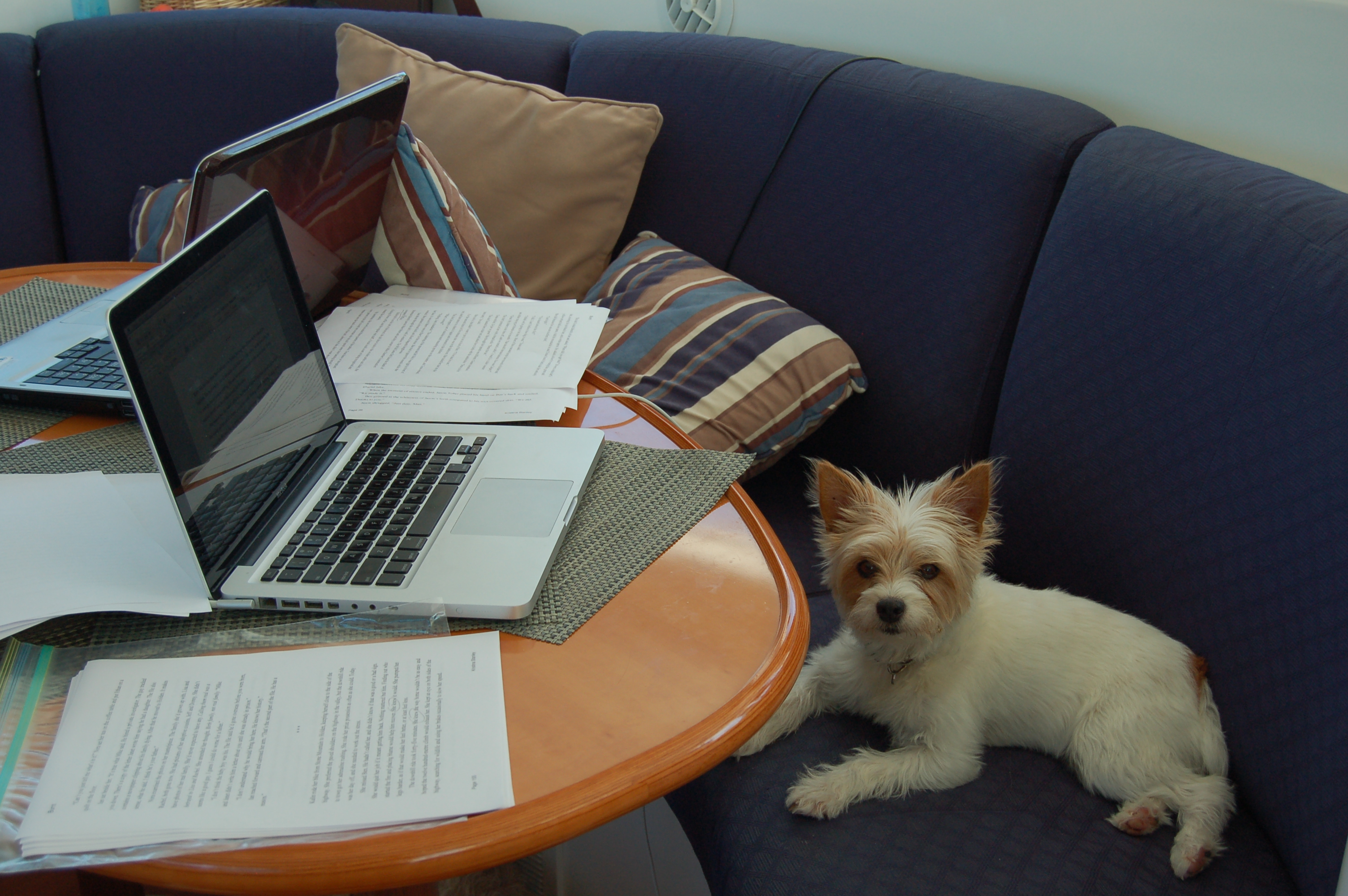
#writetip  Did someone say writing was lonely? My advice, get a dog. Cali is visiting our boat, Mattina, for the day while her owners are off kiting. Cali has decided that she’s the one writing my novel.  The only problem, she has trouble articulating story ideas.

I’ve made the main salon my writing platform and like to take over the entire table. Well the dogs had a different idea. So where am I supposed to sit?

Who's writing this novel?Are two dog ideas better than one?

How to use a spreadsheet for your synopsis

#writetip The dreaded synopsis has found its way to the top of my to-do list.

How do you take 82,000 words and summarize them in to 500 to 1000 words?

Sweat it out, of course.

As I’ve said before, I love my spreadsheets and don’t know how anyone can write a novel without one. Well, here is my next use.

One column of my spreadsheet has a name for each scene. The name represents what happens in this scene.

To create my synopsis, first I’m look for turning points in the novel. Luckily, I already have this in the spreadsheet. The turning points are events that take the story in a new direction.

Next, I write each scene name on a paper. I cross out anything that doesn’t need to be in the synopsis.  Once I do this four or five time, I write out a one line description of the scene. Now I know if I’m anywhere near the right word count. If not, I keep cutting.

I follow some simple guidelines:

–       Use protagonists POV

–       Don’t include questions

–       Use present tense

–       Write in the same voice as your novel

–       Don’t turn the synopsis into a list

–       Include the ending

If the first line of your novel is great, and I hope it is, why not use that as your opening line of your synopsis?

If you have any tips for writing a synopsis, I’d love to hear them.


Canadian versus American Spelling

#writetip There are too many ways to spell the same word and be correct. My goal is to spell consistently, thinking that should do the trick and I’ll end up with a professional manuscript.

Now I’m having my third novel, Burnt, proofread by two people. One is Canadian, the other American.  The American is circling words that are misspelled . . . but are they?

Let’s look at the word: travel

Say, one of my character takes a trip.

Canadian Spelling:    She TRAVELLED by car.

American Spelling:   She TRAVELED by car.

I’m Canadian and want to use Canadian spelling, but what happens if I get lucky and get published in both countries? Will one set of readers think I can’t spell?

Any opinions on this one?

Spread Sheets and Novels

#writetip I don’t know how anyone writes a novel without spread sheet. The more I write, the more columns my spread sheet contains.

What I’ve discovered writing my third novel, Burnt, is that I needed to add two new columns. These columns are helpful if you are writing a mystery novel.

One column is used for clues to solving the crime. This means the reader knows the clues, but the main protagonist might not. This is especially helpful if you write from multiple points of view. If not, you probably don’t need this one.

The second column keeps track of clues the main protagonist knows. This ensures the character doesn’t mysteriously know something at the wrong time.

For a more detailed description of my complete spread sheet and how I use it, please see:

Don’t Rush The Ending

#writetip This week has been a big week for me. I’ m still basking in the joy of completing my novel, Burnt.

If you’ve been reading my blog this week, you know I recently completed the CWC mentorship program, and I want to share one thing I learned from Garry Ryan.

Don’t Rush the Ending.

He told me the reader has been waiting for the final scene so let them savour it.

I think I shorted my ending to get the book finished and not let it drag. I missed the importance of satisfying the reader with a deep and thoughtful final scene.

I’ve now re-written it, and thanks the mentorship program, I think (as usual – in my biased opinion) that it’s much better.

It seems like there is always something to learn when it comes to writing a novel. I guess that’s why people spend a lifetime writing.

First Draft: Then What?

#writetip Do you get to relax and celebrate when you finish a manuscript and are getting ready to send it to your agent or publisher? You probably deserve it, but if you’re anything like me, it’s time to get to the next activity.

Yesterday, I finished updating my 3rd novel, Burnt, based on comments from Garry Ryan. I’ve sent it off to be proofread, and now, I’m not going to look at it for a couple of weeks.

What am I going to do with my time?  Well . . .

  • Write a blurb
  • Write a synopsis
  • Figure out if Burnt is the best title for the novel
  • Update my website
  • Update the CWC website
  • Update my agent’s website (Margaret Hart at HSW Literary Agency)

And on and on it goes . . .

There is so much more to writing a novel than actually writing the novel.